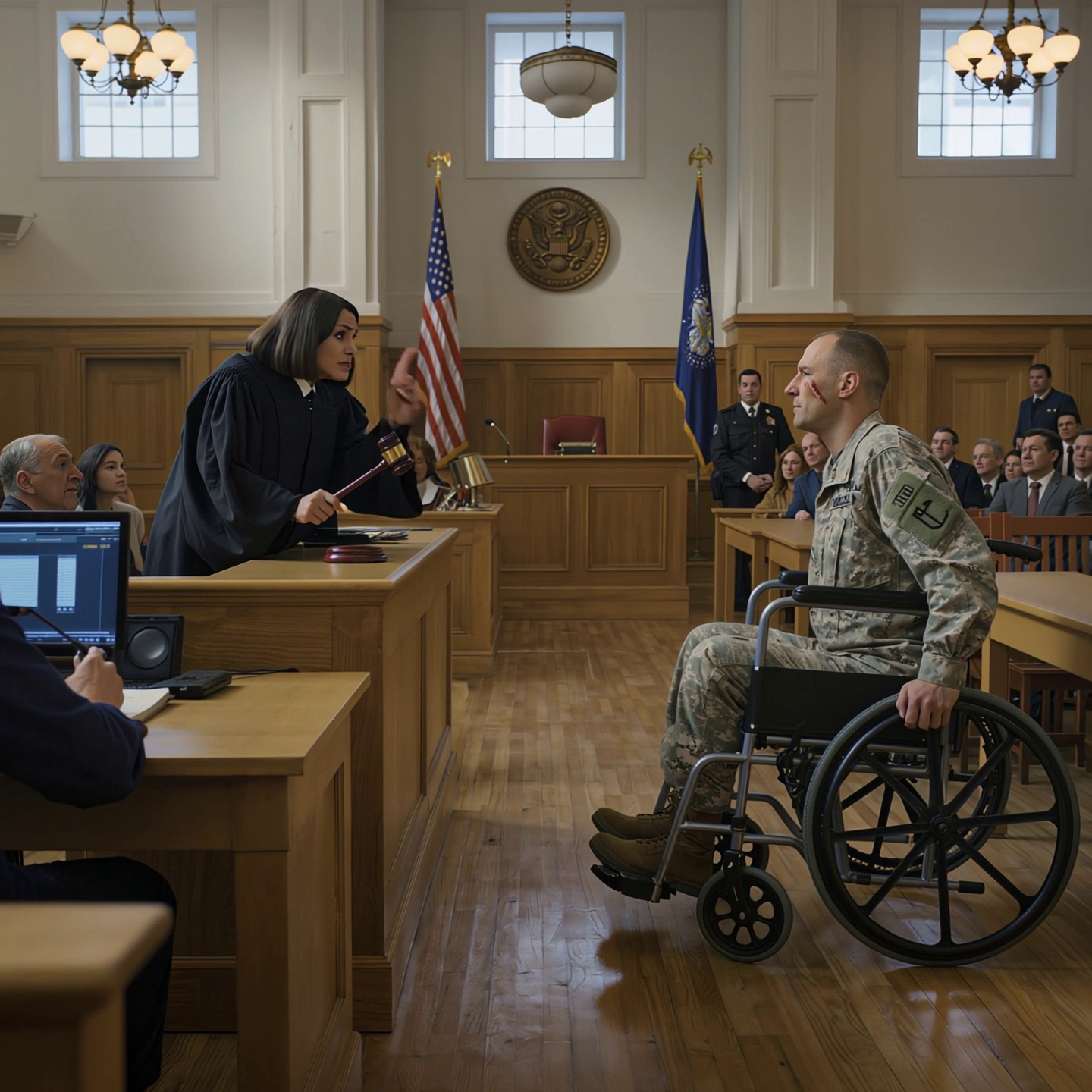
In the oldest courthouse in Brimford County, Virginia, the air smelled of lemon oil and old paper. Ceiling fans turned slow circles that did nothing to move the heat. On the defendant’s bench sat a veteran in a wheelchair, the burnished brass of his medals catching the winter light as if the past were still trying to be seen.
“Defendant, stand up,” the judge said.
Cole Bennett braced his palms on the chair rims. His shoulders rolled forward; the tendons at his neck stood out. A tremor moved through him like a fault line remembering. He tried. God knows he tried. Then his arms betrayed him, and he fell back hard—an ugly sound of metal on wood, breath knocked loose from his chest. The medals on his jacket knocked together with an embarrassed clatter.
A murmur rippled across the gallery. Somebody hissed. Somebody else muttered, “For God’s sake.” The bailiff, Renee Morales, took a step, then another, like a person approaching a cliff edge, not sure if the ground would still be there.
Cole’s lawyer, Mason Carter, was already kneeling, hands steady on the veteran’s shoulder. “Easy,” he said. “Just breathe.”
Cole couldn’t find the words. He dragged in air that felt like smoke. He had learned to smile at pity, to round its edges so it wouldn’t cut on the way down. Today the blade was sharp.
The judge’s gavel hovered. The set of her jaw broke for just a second—the smallest reveal of doubt, as if she’d caught her reflection in a mirror she hadn’t meant to look at. Then a voice broke from the rear of the courtroom, a clean wound in the hush.
“Your Honor, how dare you?”
Every head turned. A woman with white hair and a cane stood in the back row. Her coat was too thin for the cold; her hands shook, but her chin lifted like a flag in a stiff wind. She held a photograph. The edges were rounded from years in a wallet. She came down the center aisle, the tap of the cane measuring out a slow heartbeat.
“This man saved my son,” she said. “He cannot stand because he gave up his legs for this country. And you ask of him what can’t be given.”
Elena Whitaker’s fingers lost their grip on the gavel. It fell and knocked twice on the bench of its own accord, a toy hammer in a gigantic hand. A colorless silence swept the room.
The woman stopped at the counsel table and lifted the photograph so everyone could see. Two boys in desert camouflage leaned into each other, sun in their eyes, the world still intact behind them. “Corporal James Hale,” she said, touching the grinning face. “My Jimmy.” She tapped the other soldier with the long jaw and the watchful eyes. “And him.”
Cole looked and felt something give in his chest. He knew the shape of that day even in bad light. The smell of it came first—dust and heat and scorched rubber. “James,” he whispered, and the name left his mouth like a prayer spoken before any church could teach it.
The judge recognized the woman. The recognition hit like a fast-moving storm. Margaret Hale, mother of the boy the Department of Defense had folded neatly into the phrase missing in action, presumed dead. The same case that had once sent Elena to her knees in her kitchen with the phone cord wrapped around her wrist like a lifeline while someone from the other end read letters and numbers that meant nothing and everything.
Elena stood before she knew she was standing. Her body moved on a memory she did not control. The side door looked like a mercy, like air. She took it. The robe flashed and disappeared.
The room erupted. Shouts tangled with questions. Renee’s voice chased order like a shepherd does strays. Mason turned back to Cole, who sat clasping the photograph like a flotation device.
“What happened to my son?” Margaret asked. The cane knocked once against the tile as if insisting on an answer.
Cole swallowed. The floor came up to meet him and steadied him, a solid, indifferent friend. “He didn’t die the way they told you.” The words were hoarse and new. “He was alive when I carried him. We got separated in the blast. I searched until I couldn’t.” He looked up and found the mother’s eyes. “I never believed he was gone.”
A door opened hard enough to bite into the drywall. Elena was back, pale but lit from inside with something more dangerous than anger. Grief has a thousand faces. This one wore purpose. “Tell me the truth,” she said, voice thin and bright like wire. “What happened to Captain Daniel Harper?”
The name landed. It rang across the wood and dust, settling in the hollows people don’t show. Mason’s attention snapped to Cole. Margaret clutched the cane with both hands. Renee’s head tilted—small, human, curious.
Cole’s hands tightened on the chair arms. The room bent. He saw fire, not the kind that warms, but the kind that moves like an animal. “He was with us. The night of Firebreak.” The operation name fell out and no one wrote it down. “I had them both,” he said, voice thinning. “Harper and Hale. Then the second blast… I tried. He—Captain Harper—he pushed me clear. Ordered me to live.”
The judge took a step back as if the floor had shifted under her feet. The sound she made was the sound of a person finding the edge of a map and putting a hand into blank space beyond.
Renee passed Elena a tissue, not as a bailiff but as a woman, and maybe that was the most law-abiding act all morning. Elena pressed the square to her mouth, set her shoulders, and returned to the bench as if climbing back into a moving car.
“This matter is suspended,” she said. “Court will recess. I have a conflict that no robe can cure. Mr. Bennett, Mr. Carter—do not leave this building.” She looked at Margaret Hale. “Ma’am, you will please remain as well.”
The gavel struck once—the only clean sound left—and the room blew apart into noise.
Elena’s chambers were cooler. Law books lined the wall in solemn, rectangular oaths. On a credenza sat a photograph of a tall man in a khaki uniform, sleeve rolled to the elbow, fingers on a map like he could convince the world to be kinder with only his hands. Captain Daniel Harper had been gone fifteen years, but his absence had an afterimage.
She leaned on the windowsill and let her forehead touch the glass. Behind her, Renee shut the door and stood guard against the spill of voices. “Judge,” the bailiff said softly.
“I know.” Elena breathed in and counted. When the panic was new it took her breath like a thief; now it merely charged a toll. “I will recuse. Today.” She straightened. “But not before I do what I can.”
“What’s that?”
“Treat truth like evidence.” Elena turned. “Ask for it. Subpoena it if I have to.”
Mason’s conference room felt like a place where problems went to be turned into paper. He laid the photograph down like fragile evidence. Cole watched Margaret’s hands hover, then settle—one on the picture, one on the cane.
“Ms. Hale,” Mason said, “there are processes, some slow, some slower. But there are also people who can move things when they want to.” He glanced at Cole. “I am going to file a Freedom of Information Act request on Operation Firebreak and associated casualty reports. I am also going to call a man who owes me a favor.”
“Who?” Cole asked, wary of favors. Most of the ones he’d seen had been boomerangs with knives glued to them.
“A retired master sergeant named Troy Iverson who used to run the human side of logistics at Bragg.” Mason smiled thinly. “Fort Liberty,” he corrected himself, with the care of someone stepping around a new name.
Margaret’s eyes had the blue of a winter sky that still promised snow. “Tell me it’s not hope you’re handing me only to ask for it back later.”
“Hope’s not mine to hand,” Mason said. “But I can hand you work. We will put our backs into this.”
Elena made three phone calls that afternoon. One to the Chief Judge to say words that felt like unfastening a lifeboat and stepping into cold water: recusal, conflict, unbiased tribunal. One to the Office of the Inspector General, where she chose every syllable as if the wrong one might detonate. And one to a reporter who had once written about military hospitals with a tenderness that suggested she knew how to hold both a notepad and a hand.
“This happens only if you understand that I can’t give you everything,” Elena said. “Not because I don’t want to. Because I can’t.”
“I understand,” the reporter—Nora Penn—said. “Tell me what you can.”
Elena listened to her own voice telling the short, sharp version, the edges left raw. When she hung up, the room felt like a place where something had just broken and something else had just been made.
By the end of the week, a folder thicker than the book of Psalms sat on Mason’s desk. Some of it was public record that had simply been unloved by light. Some of it had been pried loose by FOIA and good manners turned relentless. Some of it had arrived by courier without a return address, the paper smelling faintly like smoke and cheap coffee.
Firebreak was a small, ugly word. On paper, it had been a reconnaissance mission in Khost Province that became an extraction that became a funeral. A convoy was ambushed on a dry riverbed. Communications went dirty after the first blast. The second blast came soft on its heels, as if grief had a twin.
Colonel Patrick Sloan’s signature appeared like a flag at the bottom of most of what mattered. Casualty reports, field notes, a disciplinary memorandum for a Staff Sergeant who had disagreed too loudly about a risk assessment that was never made public. The memorandum ended with a phrase that had a bureaucrat’s teeth: remedial counseling administered.
“Remedial counseling,” Cole said, and laughed once. The word sounded like a spoon tapping the lid of a pressure cooker. “That what we call locking a man in a room and telling him to shut up?”
“We don’t know what that means here,” Mason said. “We know only what they called it.” He slid across a black-and-white copy of an after-action photograph. Men blurred in the middle distance, a vehicle cracked open like an egg. “Iverson says there were radio logs missing before any of this was filed. That could mean chaos. Could mean hands.”
“Whose?”
“Colonel Sloan’s, if you’re asking for a man with a name.”
Margaret traced the photo without touching it. “Do any of these papers say where my boy went?”
“They say where he didn’t go,” Mason said. “There is no record of his remains moving through the pipeline. There is a record of a fragmentary human sample, unassigned. But that could be anyone. Or no one.” He met her gaze with the kind of honesty that doesn’t look like kindness. “Sometimes the absence is the clue, Ms. Hale.”
Elena joined them after hours, robe traded for a blue blazer that made her look less like a judge and more like a woman who had once known how to pack a duffel in five minutes flat. They sat around a table that had seen divorces and bankruptcies negotiated into paperwork. On it tonight lay a photograph of two boys and a letter Daniel Harper had written on brown MRE cardboard and mailed from a forward operating base, edges soft with her tears.
Dear E—, the letter said. If this gets to you, it means I kept my word to write something I couldn’t say out loud. We pass courage to each other like hands hauling a rope. If mine fails me, take the rope and keep pulling.
“I want to know if he died for the right reasons,” Elena said, and no one dared pretend to misunderstand. “I need that like I need oxygen.”
“We will likely not get right,” Mason said. “We might get true.”
“True will do.” She looked at Cole. “And if James Hale is alive…”
“If he’s alive, I’ll find him,” Cole said. He surprised himself with the certainty in his voice, like a muscle firing after atrophy. “I owe him more than a promise, but I can start there.”
The first lead came from a VA case worker in Boise, Idaho, named Lauren Kip who hated voicemail and believed in writing things down in pencil because you could press harder. She had handled a file in 2011 for a man they called Evan Holt, found wandering along U.S. Route 26 outside Shoshone with injuries that made the world a confusing place. The man had no identity that the system could love. He had a scar along his scalp like lightning. He flinched at diesel engines and slept folded up tight as a scorpion. She’d written “ask about military service?” in the margin and underlined it three times. No one asked. The file went cold.
Mason read the note out loud and the room leaned closer, as if bodies could make a story warmer. “Holt,” Margaret said, and touched the H like it might answer back. “How far is Boise?”
“Two time zones and a lifetime,” Mason said, and started booking flights.
The Dry Creek Ranch sat in the foothills north of Emmett, Idaho—sixty acres of fences that leaned, horses with winter coats, a white ranch house with a porch that faced west like it didn’t mind staring down the weather. The owner, Hank Duvall, met them in a hat that looked like it had earned every sweat stain.
“You folks the ones askin’ about Ames?” he said. “He’s a good hand. Quiet. Works like he’s trying to pay for something he lost.” Hank hooked a thumb toward the barn. “Came to me years back. Don’t know much of before. Doesn’t talk about it. Sometimes he wakes up mean at ghosts, but he’d rather scare himself than anyone else.”
“Ames,” Margaret repeated, tasting the shape. “Like James without the J.”
Hank squinted at Cole’s chair, at the ribbons like a code he did not read but respected. “You served,” he said.
“Yes,” Cole answered.
“Then you can understand how a man might have more than one name.”
They found Ames in the corral, a sorrel mare circling slow around him as if orbiting a small planet. He was lean and weathered, the kind of thin a man becomes when he forgets to argue with hard work. His hair was long under a wool cap; a ragged groove ran from temple to crown, an old wound that looked like it remembered.
He looked up. The world narrowed. Margaret’s cane dug into the dirt with a sound too quiet to be dramatic and too loud to be ordinary. “Jimmy?” she said, not crying the way movie mothers cried, but with something deeper, older; a sound like prayer that had outlasted words.
Ames—Jimmy—set his hand on the mare’s neck as if bracing himself against a wave. He blinked slow, like a man coming up from deep water. His eyes settled on Margaret’s face, then skittered away, then back, then away again, as if he were trying to convince himself of a magic trick.
“I don’t…” he started, then stalled. The voice had Virginia in it, sanded by years of wind. “Ma’am, I’m sorry.” His hand came up of its own accord, as if checking the shape of his own face. “I think I dreamed you.”
Margaret came to the fence and didn’t try to reach him. She took a photograph out of her purse and set it on the top rail. Two boys, sun and dust and the world intact. “You carried this once,” she said. “Maybe it’s time it can carry you.”
Ames looked and something changed, not the drama of a thunderclap, but the weather shifting. His posture eased, then tightened, then broke. He leaned into the rail like a man who has learned how to make wood take his weight when his own legs won’t. “I don’t know,” he whispered. “I don’t know.” His knees gave, and the mare nudged his shoulder as if trying to push him back up into himself.
Cole rolled forward until the crushed gravel complained. “James,” he said, feeling the name in his mouth like a piece of hard candy he could not bite. “It’s Cole. Firebreak.”
Ames turned toward the word like a compass does when a magnet walks in. The color drained from his face. His hands found each other and gripped so hard the knuckles went white. “Firebreak,” he repeated, and the syllables unlocked something. He swayed. The mare blew out a breath, patient as a nurse.
Hank moved fast, catching Ames under the elbow in a grip as old as work. “Easy,” he said. “You’re okay.”
Margaret didn’t climb the fence. She didn’t wail. She stood and handed her son a life the way mothers do—piece by piece, that he might choose what to hold. “You can say no,” she told him. “To names, to memories, to all of it. But there is a table waiting in my kitchen that has room for you. Whether you remember where the plates go or not.”
When he lifted his face again there were tears in it, not a flood but a fine rain. “I don’t know who I was,” he said. “But I know who I want to be. Can that be enough for a start?”
“It is always enough to begin,” Margaret said.
Cole swallowed a stone that had lodged behind his sternum fifteen years earlier. “We can help you remember,” he said, surprising himself with the gentleness in it. “Or we can help you not remember. Either way, you’re not alone.”
The science came later—cheek swabs, paperwork, polite men in lab coats with good hair and soft voices. The math of DNA wrote the sentence the heart had already read. But before the results, life had already started drafting its own.
They cooked. That was the whole of the plan. Margaret made fried chicken and green beans with bacon and onions the way James had liked them when he was eleven and ate like he was growing into a basketball hoop. Cole sat at the end of the table where his chair fit best and learned the ways a kitchen can be a church, the benediction made of butter. Elena came after court in a sweater that made her look like a person you’d tell a secret to. She brought a pecan pie in a dish too nice to be practical.
They talked around the hole, then across it, then right into it. When James caught a word that felt like a thread, he pulled gently. Sometimes the thread held; sometimes it broke and there was only fuzz and a headache that made him press the heel of his hand to his temple until the world settled. He learned to take smaller bites. He learned the napkin drawer. He asked if the old oak by Margaret’s back fence still had the tire swing.
“It does,” she said, even though it didn’t. In the morning, Cole and Hank and a neighbor boy put up a new one, the rope scratchy on their palms, the circle perfect as a promise.
The past did not take kindly to being uncovered. It has a way of pushing back with sharp elbows. Colonel Patrick Sloan, now retired and employed by a defense contractor with a lobbyist’s grin, heard whispers he did not like. He sent a man named Caleb Riker to ask around. Riker had bland hands and eyes a shade too curious. He found Elena in a parking garage and leaned on a sentence like it owed him money.
“Judge,” he said to her taillights. “Some stories don’t want telling.”
“Neither do some truths,” she said without turning. “That doesn’t make them less true.”
Riker smiled as if they were sharing a joke. “There are consequences for reopening old wounds.”
“There are consequences for pretending wounds aren’t there,” she replied. Her voice was steady, but he still made the skin between her shoulders itch.
He found Hank’s ranch and leaned on a fence rail with half an inch of respect. “I’m lookin’ for a hand goes by Ames,” he said.
Hank stared into the middle distance like the fields might give him answers or patience. “I only talk about my men if they ask me to,” he said.
Riker’s smile never reached his eyes. “That’s noble.” He left a card on a nail head, the logo on it too slick for a place where the best things earned their shine slow.
Hank used the card to wedge a table leg.
The next day, Riker tried Margaret’s street. Elena saw him first, a figure in a too-dark sedan with windows that made noon look like sunset. She called Renee, who called a detective she’d dated before he said he didn’t have time for anyone but the job and then realized it was the job that had no time for him. Patrol cars drifted by slow like sharks just to be seen.
Riker drove away, disappointed that the world had become a place where even old women had armies.
The DNA came back in a plain envelope as if it were a utility bill, not the end of a war. Positive. Ninety-nine point lineage and then some. James Hale was James Hale. Margaret sat at the kitchen table and read the numbers and then put her forehead on the cool wood and let herself feel tired for the first time in fifteen years.
James went outside and stood by the swing. He set it moving with his hand, a circle tracing air. Cole watched him through the window and saw a man trying on a childhood memory like a suit jacket from a closet found in a house you thought was demolished.
When James came back in he touched the photograph again and said, “Captain Harper?”
Elena folded her hands to keep them from shaking. “My husband,” she said. “He didn’t come home.”
James closed his eyes and the room waited. He inhaled and exhaled a slow count, five and five, like a boy blowing out a birthday cake he had forgotten was his. “Firebreak,” he said. “I remember a riverbed. I remember…the sky was too bright. Harper gave me water even though his canteen was low. He told jokes that should’ve been bad but weren’t.” His mouth twitched in a not-quite smile. “After the first blast, Cole had me. After the second—” He opened his eyes. “I lost him. Not Cole. The world.”
“What else?” Elena asked, voice as gentle as she knew how to make it.
James pressed the heel of his hand to his temple, winced, and backed away from the edge. “It’s like looking through a heat shimmer. The more I stare, the more the road moves.”
“That’s enough,” Margaret said, firm and kind, reminding everyone that sometimes mercy looks like closing a door.
A month later, Elena stood in a hearing room under lights that made everyone look the same percentage guilty. The Inspector General’s counsel asked questions as if truth could be ushered in with a polite cough. Elena answered. She gave them names and dates and the feel of the room. She gave them Sloan’s signature where it shouldn’t be and the line in Mason’s packet that read radio logs unavailable for review without explanation.
“Judge Whitaker,” the counsel said. “We appreciate your… thoroughness.”
“You’ll appreciate it more if you do something with it,” she said, and did not apologize for her tone.
Mason testified, sleeves rolled up, tie askew as always, the look of a man whose good suit had been asked to do heavy lifting and did not complain. So did Troy Iverson, who wore his old NCO calm like a dress uniform you put on once a year and still filled out. He said the word cover-up and let it sit on the table like a loaded weapon no one wanted to claim.
Riker tried to make trouble in the hallway. He found his way blocked by three men who had never served together but recognized in each other the look of people who had learned that standing can be a team sport. “You lost,” Troy said mildly. “Try again somewhere else.”
On a day with weather as crisp as an apple, they gathered at a small park beside the courthouse. Someone had decided that if you take furniture out of a room and let light in, you might as well let truth in, too. There was a simple granite bench with Daniel Harper’s name cut into it and words chosen with care.
He passed courage like a rope.
Elena touched the carved letters with two fingers as if introducing old friends. Her robe was gone; her blouse had a coffee stain because life had returned to ordinary, and ordinary includes coffee stains. She looked at Cole. “You didn’t owe me this,” she said. “But you gave it anyway.”
“You didn’t owe me an apology,” he said. “But you gave me that, too.” He shifted in his chair and found he could breathe without finding the edges. “We call it even?”
“We call it human,” she said.
The Commonwealth’s Attorney quietly dropped the charges against Cole and shook his hand, not because shaking hands erases wrongs, but because sometimes it’s the only tool you have for building something you can stand on while you try to do better. The statement mentioned mitigating circumstances, law enforcement de-escalation training, and a community commitment to supporting veterans. It did not mention shame, but everyone could read between the lines.
James stood beside his mother, taller than the boy in the photograph, older than the years they had missed, the scar like a road map to a town you hoped no one else would ever have to visit. He had a driver’s license now with a name that belonged to him; he had a VA appointment card with Tuesdays circled; he had a dog from the shelter that refused to sleep anywhere but across his feet.
Nora Penn wrote the story the way some people write love letters—plainly, precisely, with attention to the shape of the truth’s face. She did not inflate villains or crown heroes. She named the small mercies and the hard choices. The headline did not shout. It simply said: AFTER FIFTEEN YEARS, A MOTHER’S DOOR OPENS.
Sloan did not go to prison. That is not always how this works. He lost a contract and found his phone stopped ringing. He left town with a suitcase that looked expensive and a face that had to learn how to live without a particular kind of yes. It was not justice with a trumpet; it was consequences with a sigh. Sometimes that is the size justice comes in.
Elena went home to a house that had started feeling less like a museum and more like a place a woman lived. She took Daniel’s footlocker out of the closet where grief had put it and let it sit by the window. She opened it sometimes, not as a wound, but as a place where she could say thank you until the word felt large enough to carry what it should.
Cole learned his own version of standing again. It was not a medical miracle or a headline. It was quiet. It was making coffee in the morning and not dropping the cup when a truck backfired. It was letting Mason talk him into an adaptive sailing program on the river, the way the chair clipped into the deck so he could lean into the wind and find himself steady. It was letting himself laugh hard enough that the laugh had to catch its breath before he did.
Sometimes he went to Margaret’s house for Sunday dinner. He learned her kitchen by feel. He had one of those faces that looks solemn even when happy, so she learned to look at his hands. The way they relaxed without his permission told truths his face couldn’t. James would wash dishes with the care of a man who understands that not everything fragile is easy to replace. They did not talk about Khost unless it needed talking; then they talked about it like men who understood the difference between carrying a thing and letting it carry you.
On a spring afternoon, Cole and Elena found themselves alone on the bench with Daniel’s name. The park had a baseball game’s echo from the far end; somewhere a dog barked like a child telling a joke.
“I thought I hated you,” Elena said, not as confession so much as weather report. “I thought you were the shape my grief chose to take.”
Cole’s eyes stayed on the tree line. “I’ve been a lot of shapes,” he said. “Not all of them honorable.” He paused. “I thought if I punished myself well enough, it might count for something.”
“And?”
“It doesn’t,” he said. “It only builds a higher fence.” He turned to her. “What we did here today feels like a gate.”
She nodded. “My husband would have liked you.”
“I liked him,” Cole said, and they let what needed to be said sit there and do its work.
At the end of that first summer—the summer James came home—Margaret held a barbecue that stretched past dusk. The neighbors came with potato salad and lawn chairs. Fireflies rose from the grass like shaken stars. Someone’s radio found an old song and then another.
James stood on the porch with his mother and watched the street fill with the benign chaos of a town unafraid of itself. He held a paper plate he did not eat from. “I don’t know how to be the person they remember,” he said.
“You don’t have to be,” Margaret answered. “Memory is a quilt. We’ll just sew in your new squares.”
He smiled, the muscles remembering how. “I like that.”
Cole rolled up with a cooler balanced on his lap, a practice he had made into grace. “We forgot the ice,” he announced like a man telling the end of a mystery. “Which, as it turns out, is essential.”
Margaret laughed and took the cooler. “You remembered the important thing. You’re here.”
Elena arrived late, chambers running over for reasons that looked small on paper and large to the humans attached to them. She wore the day like a shirt she’d changed into twice and decided to keep anyway. Margaret pressed a mason jar of tea into her hand and nudged her toward the porch swing.
They sat there as the light went buttery and then thin. Cole told a story about adaptive sailing that made Elena laugh so hard she clapped her hands. James said he’d taken a job in Hank’s shop in town, sanding old chairs until the grain declared itself. “There’s something about bringing back a thing that looks lost,” he said. “Like proving the world wrong without ever raising your voice.”
An hour later, someone lit sparklers the kids ran with. The hiss and flare made both men tense, then breathe, then choose to stay. Margaret squeezed James’s hand twice—Are you okay?—and he squeezed back twice more—I’m okay. Cole set his jaw and watched Elena watch him, the careful attention of a person who has learned that care does not have to be loud to be real.
When the last spark burned out and the smoke went soft into the night, they sat in the kind of quiet that holds rather than empties. Crickets called their names like a chorus that accepted no applause.
James touched the scar on his head like a man checking his own weather. “There are days I don’t remember,” he said, voice easy with the truth. “But there are more days I do.” He looked at Cole. “Some memories are heavy. We can split the load.”
Cole nodded. “We already are.”
Elena set her empty glass on the porch rail and looked toward the park where Daniel’s bench would be waiting in the morning. “We pass courage like a rope,” she said, and let the words be more than a quote. She let them be instructions.
Margaret closed her eyes and heard a boy’s laughter braided with a man’s. She saw a kitchen table that had learned new names. She felt the weight that had lived in her chest for a decade and a half shift—not gone, but carried differently, like a backpack adjusted until it sits right on the hips and no longer tries to break a person in two.
When she opened her eyes again, the people she loved were still there, still themselves, altered and unbroken. Somewhere a dog barked twice. Somewhere a screen door slapped. Somewhere a tire swing creaked as if inventing a lullaby.
The night deepened, not as a threat but as a blanket. In the oldest courthouse in Brimford County the janitor turned out the lights and locked the doors. On a granite bench across the street, a name waited in the polite dark, ready to be touched in the morning by fingers that would not tremble as much as they once had. And in a small house three blocks over, a veteran who could not stand and a soldier who could not remember slept the kind of sleep that comes for those who have looked at the worst thing and decided to keep living anyway.
The world did not crack open into a miracle. It did, however, do something better. It held.
Leave a Reply