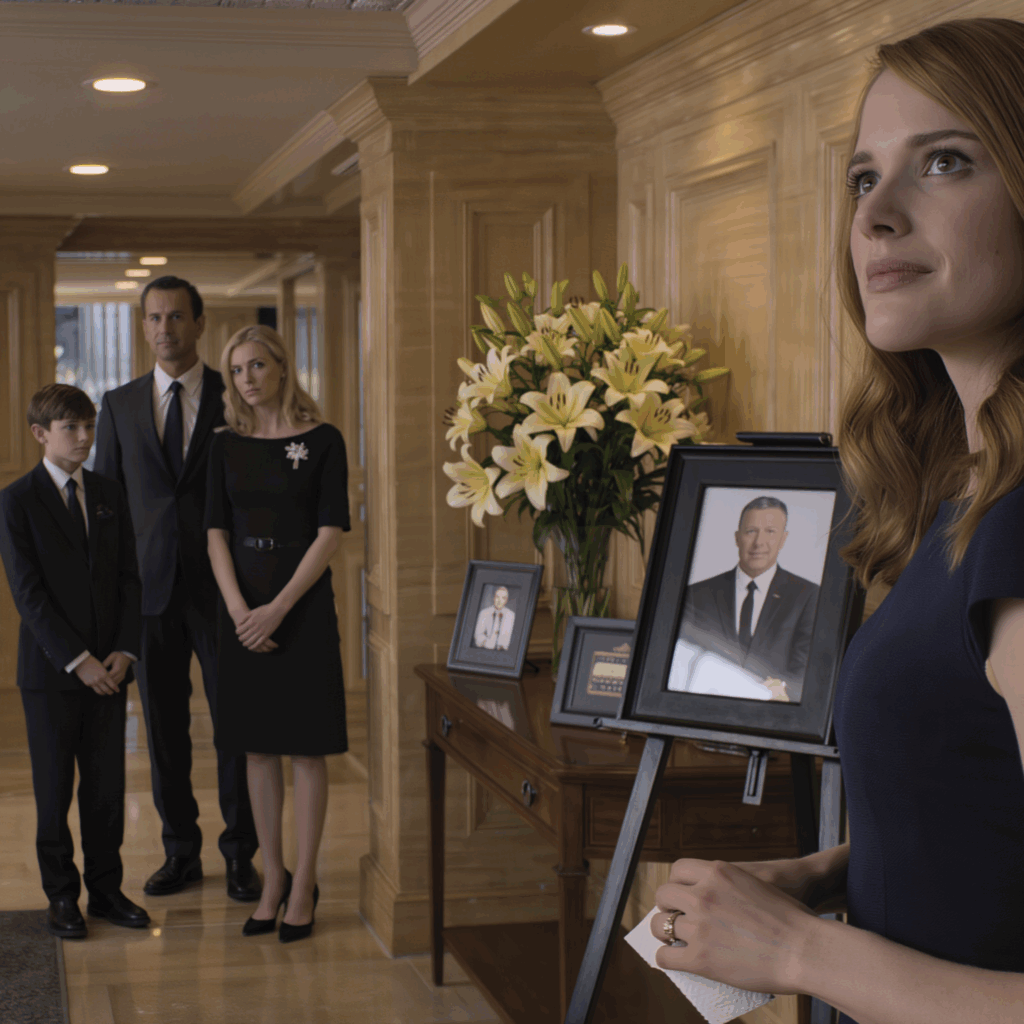
She had the posture of a person who believed she belonged: shoulders square, chin steady, the kind of composed that photographs well. Her black dress was tasteful, not new. She wore the widow’s pin my mother-in-law hands out to daughters-in-law because Marla likes to assign roles the same way she organizes Tupperware—labeled, stacked, airtight. The pin sat there on the stranger’s lapel like truth.
“Thank you for coming,” the woman told an old church friend of my father-in-law’s, and the friend folded her into a careful, sympathetic hug. “He was a good man,” the woman added. Her voice was polite and practiced. “Dad always said—”
“Claire?” Daniel’s hand brushed mine. His palm was dry. “You okay?”
I could hear the rustle of suits and murmured condolences, the slide of the funeral home doors opening to let in another gust of June heat. On the easel by the guest book, a blown-up photo of Robert Whitman smiled in the yellowed way of a man who never learned to relax for a camera. My father-in-law had died with his boots by the back door, leaf blower silent in the garage like a stopped watch. He was the kind of man who called me kiddo and taught me the right way to coil a hose.
The stranger hugged Marla, my mother-in-law, who swallowed hard and put her small hand against the woman’s forearm, tolerant and tired. Marla had a way of making room for everyone at the table. She would have made room for a wolf if it asked nicely.
“Who is she?” I whispered.
Daniel didn’t answer. He looked past me, his mouth a line I’d learned not to read because it changed with every excuse. For years, he’d been on the road three weeks out of four, hauling parts from Dallas to El Paso and down to Laredo, bringing back a cooler full of tamales and road stories. He smelled like diesel and convenience store coffee when he came home. I used to say his life was measured in mile markers; I didn’t know it was measured in alibis.
The stranger reached for Daniel next. She took his hands and held them a fraction too long. Not obscene. Not obvious. A second longer than a stranger would.
“Danny,” she said softly. “I’m so sorry.”
Danny.
No one called him that except his mother and old teammates. He flinched. I felt the flinch in my bones, and for a suspended moment the room thinned to a wire. I watched him hunt for a smile and come up with a grimace.
“Thank you for coming,” he said, the way you say it to the congregation, the way you say it when your voice has to hold everything steady.
The woman looked at me then. Her eyes were clear and unhurried. Green, or blue. The kind that change under different lights. She extended her hand, polite as a politician. “I’m Evelyn,” she said. “Evelyn Ward.”
I took her hand. It was warm. “Claire Whitman,” I said, although if she had stood in the family line long enough to earn that pin, she already knew my name.
“I know,” she said gently. “I know.”
Behind her, a boy of about fourteen stood in a suit that had maybe fit last fall. His tie was crooked. He had Daniel’s cautious eyebrows and the same crescent dimple that appears when Daniel concentrates on a stubborn jar lid. The boy kept looking at Daniel the way kids look at men they’re trying to impress—curious, hungry, careful.
The receiving line moved. The hymn ended. Marla dabbed her eyes with a cloth handkerchief embroidered with daisies. I went inside the chapel and sat on the aisle where I could leave if I needed air. Daniel slid in beside me, and I could feel the tremor in his leg as he bounced his knee—once, twice—then stopped, like he remembered himself and the eyes around us.
The pastor talked about Robert’s stubborn kindness and the way he fixed other people’s mowers for the price of a glass of iced tea. The slideshow clicked through decades: Robert’s wedding day; Daniel on a bike with training wheels; Thanksgiving turkey so glossy it looked lacquered. Once, briefly, the camera caught my arm around Robert’s shoulder at the lake house when the catfish wouldn’t bite and we laughed anyway. The photo passed. Another hymn. Another prayer. And then Daniel stood to speak and didn’t. He choked on a word he’s said a thousand times—“Dad”—and sat down hard, and I took his hand because I didn’t know what else to do.
The graveside service was smaller. Heat rose off the grass in those shimmering waves you can almost hear. Marla had on her wide straw hat with the black ribbon, and someone—maybe me, I can’t remember—made sure the water bottles were on ice. When everyone else drifted to the shade, Evelyn lingered by the casket like she was memorizing the exact angle of the light. The boy stood close enough to rest his knuckles against the polished wood, then pulled his hand back like he wasn’t allowed. Evelyn touched two fingers to the lid. It was the gesture of a daughter-in-law who had earned the right to say goodbye.
She shouldn’t have had it.
“Daniel,” I said when we were alone beside the hydrangeas that didn’t look right in the Texas sun, florist-blue against a hard blue sky. “Who is she?”
He slipped his sunglasses on. “A family friend.”
“From where?”
“Claire.” The warning was in the way he said my name. “Not now.”
But it was already now. It was a now that would live in my bones. I looked across the slope and saw Evelyn laughing softly with one of Robert’s neighbors, the hand-on-arm intimacy of people who have shared casseroles and crises. The boy stood with his back to the sun, his shadow long, and when Daniel drifted their way out of reflex—son to mother to person who says his childhood nickname like a secret—the boy’s face lifted involuntarily, bright as a porch light flicked on.
We hosted people back at Marla’s because that’s what you do, and Marla believed in doing things right. There were ham biscuits and a sheet cake with white roses and enough potato salad to feed a midsize church. Evelyn came. Of course she came. She moved through Marla’s kitchen like she knew where the broken drawer was, the one you had to jiggle just right. She set plates in the good cabinet without hesitating. She wiped the counter with the damp cloth Marla keeps by the sink, and when Marla said, “Honey, you don’t have to—” Evelyn smiled and said, “I want to.”
I stood by the back door, my hand on the brass knob Robert polished without thinking whenever he hung his cap, and I watched my life rearrange itself around a woman I had never met.
When I finally cornered Daniel in the garage between the pegboard and the unmoving leaf blower, the garage smelled like motor oil and old coffee. He kept looking past me as if the answer he needed had been tacked up somewhere for years.
“How long?” I asked.
He closed his eyes. “Claire.”
“How long.” It wasn’t a question anymore.
He swallowed. “Sixteen years.”
I felt nothing at first. Not rage. Not grief. Not even surprise. Just a clear, cold emptiness like the air after hail has stripped the leaves off the trees. Finally, steady, I asked, “Who is the boy?”
He opened his eyes. The brown in them was the brown of good dirt. “Noah,” he said. “He’s… he’s mine.”
Marla’s washer whirred in the next room; someone laughed too loudly in the kitchen; a cousin’s toddler cried in the hall because grief makes even the steady people forget to nap. I had the thought that I needed to take the deviled eggs out of the sun.
“You told me those nights you were gone you were in Laredo.”
“I was,” he said. “Sometimes. Claire, I—”
“How do you do it?” I asked, and my voice surprised me with its calm. “How do you split a life?”
He stared at the concrete floor. “I didn’t mean to. Evelyn was working at the warehouse back then, the parts distributor off Ben White. Her mom got sick. She needed help. It wasn’t—”
“Say it,” I said. “It wasn’t supposed to go this far.”
He nodded, grateful. He was always grateful when I finished his sentences for him.
“And you never told me because?”
“Because I was afraid.” He met my eyes then, and in his face I saw the boy he had been when he’d written my name in the dirt with a stick by the river and asked if I’d go to the county fair with him. “I didn’t want to lose you.”
“And Evelyn?” I asked. “What did you not want to lose there?”
He flinched. “Noah,” he said simply.
He said the boy’s name like a prayer and like a curse, the same way he sometimes said our daughter’s name when Maya came home late and scared us.
The garage swallowed the sound of my breath. “Sixteen years,” I said. “I have been married to you for nineteen, Daniel.”
“I know.” He touched the wooden workbench, the familiar, splinter-nicked edge where Robert had taught him how to sand and stain without leaving streaks. “Claire, I know.”
The second widow at the funeral. A son with Daniel’s eyebrows. Sixteen years.
The thing about betrayal is that it never has the decency to stay in one room. It seeps under doors. It finds the softwood under your paint. It shows up at your father-in-law’s funeral wearing your pin.
That night, after the last dish was washed and Maya fell asleep with her phone face-down on her chest, I sat at our kitchen table and made a list because lists had always saved me. Grocery list. Back-to-school list. How to fix the toilet list. Now: What I Know.
Her name: Evelyn Ward.
His name: Daniel Whitman. Married to me since May 13, nineteen years ago, at St. Bartholomew’s with lilies and a dress I still have in a bag in the closet.
The boy: Noah. Fourteen? Fifteen? Tie too small.
Timeframe: sixteen years. Noah’s age lines up.
Detail: She wore the pin. She knew the drawer. She called him Danny.
He said he didn’t “mean to.”
He said he didn’t want to lose anyone.
I added coffee to the grocery list.
In the morning, I drove to H‑E‑B for eggs because when the sky is falling you still need breakfast. The store hummed with the ordinary prayers of a Tuesday: a couple arguing sweetly over salsa heat; a toddler in a cart seat swinging his legs to the rhythm of his own song; a man in a UT cap reading labels like they had secrets. I walked the aisles like a ghost and wondered how many women were actively bleeding out next to the lemons.
At checkout, I texted my friend Lucia, who is not a morning person and is always a lawyer. Can you talk? Emergency but not the dying kind.
She called immediately. “Who died?” she asked, then winced. “Sorry. I know who died. Claire, I’m sorry about Robert. Are you okay?”
“I don’t think so.” I told her.
Silence on the line except for the gentle scrape of her spoon against a yogurt lid. Lucia has the kind of silence that leaves room for the whole story. When I finished, she said, practical and soft, “Where are you now?”
“In my car outside H‑E‑B.”
“Okay,” she said. “Here’s what I want you to do today. First, breathe. Then start a file. Screenshots, bank statements, phone logs, anything that shows where he is, where money goes, how long this has been happening. And Claire?”
“Yeah?”
“Texas calls it an informal marriage,” she said. “Most people say common law. Three prongs: agreement to be married, living together in Texas, and holding out to others as married. From what you told me—neighbors, hospital forms, the way she stood in that line—it sounds like he’s been holding out. That matters.”
“Are you telling me my husband of nineteen years might be legally married to someone else too?”
“I’m telling you,” she said carefully, “that if a prosecutor wanted to make an example of a case like this, there’s a statute about bigamy that includes living with someone ‘under the appearance of being married’ while you’re already married. It’s rare, but the facts…” She trailed off. “For now, we focus on your safety, your daughter, your finances. You don’t have to decide anything today.”
“I already did,” I said, surprising myself again. “I decided to know everything.”
“Good,” she said. “Knowledge is leverage. And leverage is oxygen.”
I have always been good at homework. I started with what I could see. Receipts in the truck console. A key on Daniel’s ring I didn’t recognize—a slim silver one with a triangular head. The way his phone vibrated three times at 11:12 p.m. and he put it face down. The toothpick in his pocket from a diner we’ve never been to.
Evelyn became a map. I drove the Ben White corridor where Daniel said the warehouse used to be before they consolidated distribution in Pflugerville. I drove the older neighborhoods south of Oltorf where the rent is lower and the oaks are patient. I drove past a small green house with a crooked mailbox and a basketball hoop that had seen better nets, and there he was: Daniel, stepping out with a grocery bag tucked against his hip like muscle memory. He looked tired in the way men look tired when they still believe they can balance on a wire forever. The boy—Noah—opened the door. Daniel kissed the top of his head. It was the kiss of a father who had never learned to do it casually.
I didn’t pull over. I didn’t honk. I drove past and let the picture develop in my mind the way old Polaroids do: overexposed, then sharp.
I parked two blocks down under a live oak that made a lace of the sun and watched women push strollers and old men pull weeds and a FedEx truck deliver other people’s lives. An elderly neighbor in a floppy garden hat paused by my window like a benevolent crossing guard. “You okay, honey?” she mouthed. I smiled the way you do when you’ve been caught in a private act and want to pretend it isn’t.
Her name, I would later learn, was Mrs. Diaz, and she had lived on that street for forty-four years and knew who belonged where by the sound of the screen doors. When I introduced myself days later, she would say, “Oh, you’re Danny’s wife,” not in accusation but in recognition, like a bell she had heard but never seen. “I always wondered.”
That afternoon, I opened a fresh document on my laptop and titled it: WARD. Beneath it I listed dates and times. I saved photos I didn’t remember daring to take. I created a folder for bank statements and found regular withdrawals—$400 here, $275 there—from a branch near the green house. There were Venmo payments to a user named “EveW” for “groceries” and “No school trip” and once simply “lights,” which I hoped meant electricity and not the way she lit him up.
At night, Daniel moved carefully through our house like a man in a museum where everything was precious and roped off. He took out the trash. He rubbed Marla’s shoulders. He asked Maya about her calculus quiz with a brightness that made me want to string those numbers around his neck like stones. When I asked where he was going, he told me. The kind of truth that clings to you because it has hooks in it.
The thing about secrets is that once you find one, the others come like mice.
Evelyn had a medical bracelet tucked in a ceramic dish by the door. I saw it when she opened the door to take a package from the UPS guy and I got brave enough to stand behind the big oak and pretend to adjust my laces. The bracelet was hospital-green and creased. My stomach flipped.
I called Lucia. “If I were going to find out who signed what on a hospital form,” I asked, “how would I do that without committing a felony?”
“You wouldn’t,” she said. “HIPAA is real.”
“But if a friend happened to work admissions at St. David’s,” I said, thinking of college friends who had scattered across Austin like dandelion seeds, “and that friend happened to tell me that a certain man had written ‘husband’ on two different intake forms for the same woman in the last five years—what would that be?”
“That would be a wedge.” Lucia’s voice went soft and fierce at once. “That would be ‘holding out.’ Keep notes. No photos of hospital forms. No illegal access to records. You didn’t hear it from me.”
We built a case the way you build a shed: measured, quiet, inevitable. I printed screen grabs. I logged dates. I talked to Mrs. Diaz when she waved to me from her flowerbed as I strolled by with a leash and no dog. “He’s a good one,” she said of Daniel—Danny—kind and matter-of-fact. “Always puts the trash out for Evelyn when Noah forgets. Went with her when her mama was in the hospital. Stood there like a husband.”
Like a husband.
I asked Daniel, finally, one night when the house was blue with TV light and the cicadas were scraping the dark. “Did you ever introduce yourself as Evelyn’s husband?”
He didn’t blink. “Sometimes,” he said. “It made things easier.” He looked at me then, eyes raw. “It made things make sense.”
“To who?” I asked.
He didn’t answer.
Maya found me on the porch the next morning, my coffee cold, my list out where a fifteen-year-old could see it because some part of me was too tired to hide anymore.
“Mom?” she asked. She chewed the inside of her cheek, a habit she’d picked up from me. “What’s wrong?”
I had promised myself I would keep Maya out of the blast radius as long as possible, but children are sensors. They feel a storm before it reaches the map. “Your father and I are dealing with something,” I said carefully. “Grown-up something. I will tell you the truth, but not all at once.”
She looked down at the list, at a photo of Daniel with a grocery bag on a porch that wasn’t ours. Her jaw tightened. “Is he sick?” she asked, and the innocence of the question split me like a seam.
“No,” I said. “He’s not sick.”
“Good,” she said, and then, more quietly, “Bad.” She swallowed. “I have a math test.”
“Do you want me to email your teacher?”
“No.” She balled up her cardigan sleeves. “I want to take it. I want something in my life to be exactly what it says on the board.”
When Daniel came home that night, I told him I was meeting with a lawyer. He sat at the edge of our bed and put his head in his hands. “Claire.” He said my name like a man calling for help in a dark field. “Please. Let me fix this.”
“You can’t fix sixteenth-birthdays you missed,” I said. “You can’t fix funeral lines with two daughters-in-law.”
“I didn’t marry her,” he said, desperate. “We never signed anything.”
“Daniel,” I said, and I felt the steadiness of my own voice as if it came from the house itself, from the studs and the quiet surety of the foundation, “you wrote ‘husband’ on hospital forms. You stood in a neighborhood in daylight and called a woman’s mother ‘Ma’am’ and paid the light bill and taught a boy how to tie a tie. You didn’t need a pen at the courthouse. You used your life.”
The hearing came fast because grief rearranges calendars. The petition I filed—the one Lucia drafted while I sat on her office sofa and crushed a box of tissues into origami—asked for a temporary orders hearing for support and possession and the right to live in the house while we sorted a marriage that had become a hydra. We filed the photos and the logs and the receipts and the affidavit from Mrs. Diaz that said “we believed them to be husband and wife on the street.” Lucia kept my hands from shaking by making me hold her coffee.
Daniel hired a lawyer who was either very expensive or very loyal. He filed a response that said words like “no lawful second marriage” and “no formal registration,” and what it meant was: you can’t call it bigamy if the second one isn’t official. He would have done better to call it what it was: a life I built alongside another and hoped the scaffolding would hold.
The courtroom was the color of waiting rooms. The judge’s nameplate looked heavy enough to stop a door. Lucia put a hand on my forearm and said, “We’re not arguing the criminal piece today. We’re here for orders. But what we say will matter if someone else decides to pick up the rest.”
Daniel didn’t look at me when he took the stand. He looked at his hands. He looked, briefly, at the door, like a man who forgets he is exactly where he walked himself.
Lucia was precise. “Mr. Whitman, did you represent yourself as Ms. Ward’s husband on hospital intake forms?”
Daniel’s lawyer objected and the judge let Daniel answer anyway. “Sometimes,” he said. “It was easier.”
“Mr. Whitman,” Lucia continued, “do you keep personal items at Ms. Ward’s residence?”
“Yes.”
“How many nights a week do you spend there?”
“It varies.”
“On average.”
“Two to three.” He rubbed his thumb against the base of his ring, a gesture I suddenly despised for its familiarity. “Sometimes four.”
“And the minor child Noah,” Lucia said, and Daniel’s head came up, eyes hot, “is he your son?”
He hesitated, the silence filling the room like smoke. “Yes.”
When my turn came, Lucia asked me only what she had warned she would: my name, my address, the date of my marriage, the years of Daniel’s absences. “Ms. Whitman, when did you first learn of Ms. Ward?”
“At my father-in-law’s funeral,” I said, and there was a ripple across the gallery, the kind people try to swallow. “She wore a pin meant for daughters-in-law.”
“And how did that make you feel?”
It was such a therapist question that I almost laughed. “Displaced,” I said. “Replaced.” I swallowed. “Duplicated.”
The judge granted me temporary exclusive use of the home and set child support and a schedule for Maya that gave her the grace to choose. He issued an order that Daniel not dissipate assets, which meant, in plain English, stop paying for two lives with one wallet. We walked out into the hot hallway and the stale scent of whatever the vending machine sold, and Daniel stood there with his hands in his pockets and his shoulders slumped in a way that made me want to fix him and never wanted to, both at the same time.
“Claire,” he said. “Please.”
“Don’t,” I said. “Don’t ask me to be the person who saved you from your own choices. I was that person for nineteen years.”
What happened next wasn’t mine to plan. Somewhere between Lucia’s file and a prosecutor’s morning coffee, the facts of our private catastrophe turned into a public interest. Maybe it was the affidavit. Maybe it was the hospital forms. Maybe it was the way a boy at a funeral had looked at a man like a lighthouse. Whatever it was, a week later, the county filed charges for bigamy under the subsection about living with a person “under the appearance of being married” while still married to someone else. The words looked absurd on paper. They looked like a misprint from a century I hadn’t lived in.
I didn’t want a perp walk. I didn’t want headlines. I didn’t want Marla to have to put on her good hat and walk into the sanctuary again. I wanted my life back. The problem with wanting things is that the world isn’t a menu; sometimes you get what you never ordered.
Reporters didn’t camp on our lawn because this was Travis County and the news had bigger things to do. But people at church looked up too quickly when I walked in, then down, and the woman in the pew behind me whispered, “That’s her,” like I couldn’t hear. I baked anyway for the youth fundraiser because the kids needed money for their mission trip, and when I put my lemon bars on the table, one of the dads said gently, “Those are the best in Texas,” and for three seconds I was only the person who made them.
Evelyn called me the day after the arraignment. I let it ring to the end and listened to the voicemail in my car with the windows up. Her voice was hushed and steady. “Claire,” she said. “I am so sorry for all of it. I want you to know—I didn’t know about you, not at first.” A careful breath. “He told me you were separated. Then he told me you needed him. And by then there was Noah.” Her voice shook. “I don’t know what I am allowed to say, but if you ever want to talk—if there is a version of this where we are not enemies—I would like that. For the kids.”
I deleted the message and then restored it from the trash immediately, like I had caught myself throwing away a photograph.
We met, finally, at a coffee shop that smelled like beans and rain. Evelyn wore a white blouse and no makeup, which made the bones of her face look honest. She was my age, which is to say that if we were plants we would have been repotted twice and still learning where the sun was. We sat at a small table and didn’t look like enemies because enemies have a crackling energy, and we both looked like women who had slept badly for a month.
“I want to hate you,” I said.
“I would let you,” she said.
We sat there, polite and broken, while other people took photos of their lattes. “Did you know about the funeral pin?” I asked.
She winced. “Marla pinned it on me. She said, ‘Family takes care of family.’ I tried to refuse. She said it would mean a lot to Robert to see me stand there with everyone.”
“Did it?” I asked, cruel without wanting to be.
Evelyn looked down. “I don’t know,” she said. “He called me ‘kiddo’ too.”
We talked about children the way mothers do when all else is land mines. Maya likes calculus; Noah hates it and loves history; both of them sleep with one foot out of the covers. We talked about the way Daniel made grilled cheese like a person building a ship, meticulous, buttered to the edges.
“He would have been a good man if he had been one man,” Evelyn said softly.
When the trial date came, we settled. Not because I wanted mercy. Mercy had nothing to do with it. We settled because the DA offered a plea to a lesser offense related to the false representations and the court would sentence him to a year in county with good time and conditions, and Marla didn’t have a second funeral’s worth of sorrow to spend. Daniel pled. He stood in a suit he had worn to happier days and said “guilty” like a person swallowing glass.
At sentencing, the judge was succinct and unexpectedly human. She tapped her pen once against the bench like a person thinking about groceries. “Mr. Whitman,” she said, “the law doesn’t recognize your intentions, only your actions. You built two lives and tried to convince them they weren’t the same house. That is not how houses work.” She looked at me, then at Evelyn, then at the two teenagers who sat two seats apart like magnets you could flip with a finger. “There are three ways the law understands a marriage existed where nothing was filed: you live together; you tie your lives financially; and you tell everyone you’re married. You did all three.” She set the pen down. “You also said, on more than one occasion, that you were ‘only trying to make things easier.’ For whom?” She didn’t wait for his answer. “The sentence is as agreed.”
When the bailiff took him by the elbow, Daniel turned to me. I don’t know what apology he intended. I looked at his face, the map of it I had learned like my own hand, and I shook my head once. He nodded. He always did understand me without words.
People will tell you that what comes after is healing, as if healing is a direction you can set your GPS to and arrive. What came after for me was paperwork. Copies of copies. Accounts closed and opened. The ugly math of division. It was returning the leaf blower to Marla’s garage and taking down the framed wedding photo and replacing it with a picture of me and Maya at the state fair pressed against a fence to watch the sheep. It was making chili because it was Tuesday.
It was also unexpected grace. Mrs. Diaz brought me a cutting from her rosebush that she said had survived worse storms than ours. At church, the woman who had whispered “That’s her” hugged me hard and said, “I saw your lemon bars sell out in six minutes,” and I laughed in a way that felt like a door opening. Lucia came over with takeout and wine and sat on the floor while we signed the last of the papers, and when I said, “I keep thinking I’m going to wake up and find out I hallucinated an entire second family,” she said, “You didn’t. But you can hallucinate a future where this is one chapter.”
Evelyn texted me on a Wednesday to say Noah had made the freshman soccer team and did I think Maya might want to go to his game. We are not a blended family, and we are not friends, but we are women who share a border and sometimes pass each other eggs over the fence.
Marla keeps the pin in a small dish now, unassigned. She says it’s not for daughters-in-law anymore; it’s for the person who shows up and does the work. Sometimes that is me. Sometimes it is Evelyn. Sometimes it is a neighbor with a casserole and no questions.
On the day before Daniel was due for release, I drove past the green house and saw Noah shooting hoops alone. The net was new. He missed and missed and then made three in a row, and each time he made it he did that teenage boy half-celebration like he didn’t want the air to know he was proud. I pulled over and rolled down my window.
“Noah?” I said. He turned, wary and polite. “I’m Claire.”
“I know,” he said. He had Daniel’s eyebrows and Evelyn’s steadiness. “Hi.”
“I just wanted to say…” I stopped, because there were a hundred ways to finish that sentence and most of them were wrong. “I wanted to say that none of this is your fault.”
He nodded like maybe he had been waiting for someone to say it out loud. “I know,” he said again, but the second time sounded more like hope than defense.
On my way home, I pulled into St. Bartholomew’s parking lot and sat in the shade of the bell tower. The air smelled like hot asphalt and the faintest trace of incense, the way the church keeps the ghosts of its own prayers. I closed my eyes and tried to imagine a version of my life that didn’t require me to be vigilant all the time. The thing I landed on wasn’t revenge or even justice. It was relief. It was the possibility that the next man I love—if there is a next one—will be only one man.
At night now, the house is quiet in a way that used to scare me. I sleep with the window cracked and listen to the city murmur. Sometimes I hear the train in the distance, the low, patient horn like a question asked carefully. Sometimes I hear nothing but the small noises a house makes when it remembers what it’s for.
I planted Mrs. Diaz’s rose cutting by the back fence. It sulked for a month and then, one morning, there it was: a red so red it was almost ridiculous. I took a photo and texted it to Evelyn because it felt like news you share with the people who live on the same street of your life, and she sent back a picture of Noah in his too-big uniform, hands on hips, grinning. I sent it to Lucia with a caption that said, We survive.
When people ask, I tell the story like this: At my father-in-law’s funeral, there were two daughters-in-law, and only one of them knew about the other. After that, the truth grew teeth and the law put a name to it, and then we all went on living, which is the strangest part of any story. I don’t leave out the part where I loved Daniel still, not the person he became, but the boy at the river and the man who taught our daughter to parallel park without swearing. Love doesn’t evaporate; it changes state.
The day Daniel came home, I let my phone buzz itself quiet. I made lemon bars. I ironed a shirt. I watered the rose. When the sun slid down and the heat lifted half an inch off the ground, I stepped onto the porch and looked at the sky and thought of all the ways a person can be honest if they decide to be. Then I went inside and turned off the lights and slept without dreaming, which felt like mercy.
A month later, I saw him in the produce aisle at H‑E‑B, looking at peaches like they might tell him how to start. He saw me and didn’t pretend he didn’t. He nodded. I nodded back. We stood there a few feet apart, past and future lined up on either side of the nectarines, and for once neither of us tried to say more than we could afford.
When I got home, I washed the fruit and set it on the counter and called Maya into the kitchen. “Taste,” I said, and she did, and she closed her eyes because it was perfect, and then she laughed because sometimes something is exactly what it says it is, and it is enough.
I don’t know if there is a moral. If there is, it is small: Learn the sound of your own life. If something new begins to hum under it, listen. If you find another widow in your pew, don’t hand her your pin. Ask her name. Ask your own. And when you stand in the line to receive condolences, know what you’re there to receive.
On Sunday after church, Marla made pot roast and we sat at her table the way we always had. The chair at the end was empty and would be for the rest of our lives. Maya set out the plates. I mashed the potatoes. Marla put the pin dish back on the shelf. When we bowed our heads, she said grace in her slow, steady voice: “Thank you for what we had. Help us to be honest about what we have.”
We ate. We did the dishes. We watched a little baseball. It was nothing and it was everything. And when I let myself imagine the next winter, then the next, I didn’t imagine courtrooms or signatures. I imagined a kitchen with warm light and a rose blooming out of season because no one told it it couldn’t.
That is the life I am making now. Not a life without sorrow. A life without counterfeit. A life that says what it is and then does it.
Leave a Reply