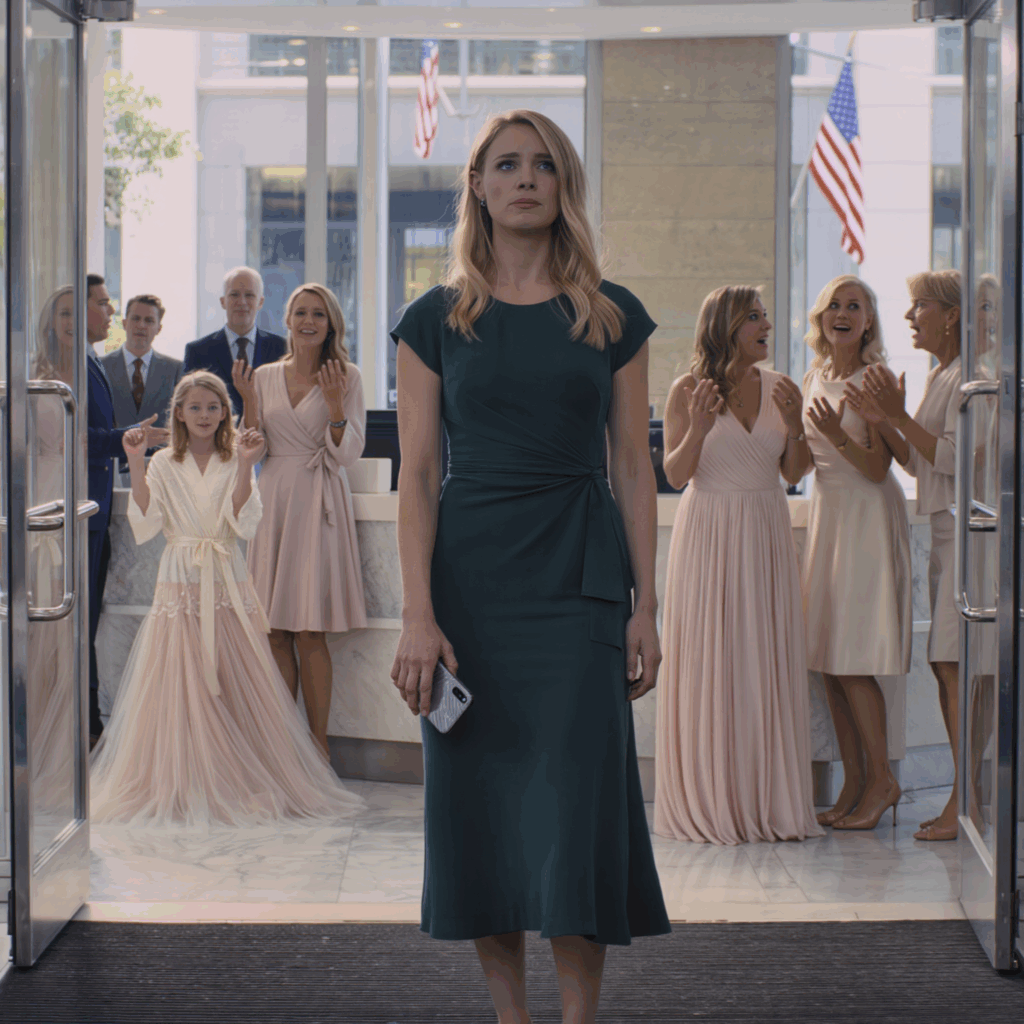
My sister texted me four words that punched the air out of my chest.
Don’t come to the wedding.
The notification sat on my phone beside a chipped navy coffee mug printed with a tiny American flag I’d bought at a gift shop near Pike Place Market the year I moved to Seattle. It used to make me smile in a cheesy, sentimental way, like a little reminder that in America, if you worked hard and stayed steady, things eventually made sense. That morning, the flag looked like a joke.
But that text wasn’t the part that broke me.
What came after my mother’s explanation, the planner’s silence, and the discovery buried inside the contracts was what changed everything. And the moment I used it, none of them saw it coming.
00:00
00:00
01:31
My name is Amanda Cole, and for most of my life, I’ve been the person everyone trusted to handle things.
I didn’t earn that title through affection or praise. It was assigned to me the way you assign chores to the kid who won’t talk back. Growing up in Spokane, Washington, I learned early that calmness wasn’t a personality trait in my family. It was a requirement.
My mother, Helen, used to say I was steady, the kind of daughter who didn’t need checking on. She’d tell people at church potlucks and Fourth of July barbecues, “Amanda? She’s fine. She’s my rock,” while I carried folding chairs and cleared paper plates with faded flag prints off the picnic tables.
My little sister, Lily, was the opposite—sensitive, fragile, easily overwhelmed. That was the word they used: fragile. As if she were made of thin glass and I was the towel used to wrap her.
When we were kids, if Lily’s eyes even shimmered with tears, the world stopped. Mom would abandon a simmering pot on the stove to sit with her on the porch swing, stroking her hair, whispering, “It’s okay, baby, you don’t have to do anything you don’t want to.” Meanwhile, I stirred the pot so it wouldn’t burn and set the table because someone had to.
While Lily was being comforted, soothed, protected from anything remotely uncomfortable, I was the one walking myself to elementary school, filling out my own field trip forms with a ballpoint pen at the kitchen table, cooking instant noodles in the microwave when Mom was driving Lily to another art lesson she’d quit two weeks later.
Once, in fifth grade, I had a piano recital the same Saturday Lily decided she didn’t want to go to her dance showcase because her leotard “felt funny.” Mom chose Lily. Dad drove Lily and Mom to return the leotard at the mall. I took the city bus alone to my recital with my sheet music tucked in a plastic grocery bag. My performance went fine. Nobody recorded it. Nobody remembered it happened.
That was the pattern. Lily’s feelings were a five-alarm fire. Mine were a flickering lightbulb you could ignore until it burned out on its own.
Dad—Rob—loved us both, but he stayed out of anything emotional. If Mom made a decision, he backed it by staying quiet. Silence was his way of saying, Don’t ask me to pick sides.
By the time I reached adulthood, the pattern was cemented. Lily didn’t just expect help. She existed inside a world where help would always arrive. And I existed in the world next door—the one where needing anything was an inconvenience.
Maybe that’s why I chose the jobs I did.
I went into operations at a healthcare tech firm in Seattle, the person who made sure schedules lined up and vendors delivered what they promised. If something broke, I fixed it. If something fell apart, I quietly put it back together before anyone higher up had to notice. I earned a decent salary, lived in a modest one-bedroom overlooking a sliver of Lake Union, and stashed money away instead of splurging on weekend trips or designer bags.
By thirty-two, I had emergency savings, a 401(k), and a brand-new blue binder labeled RETIREMENT on my bookshelf. It sat right next to my passport and a couple of old graduation photos where I stood off to the side while Lily posed front and center. That binder felt like my insurance policy, proof I could take care of myself even if no one else ever did.
So when Lily got engaged to Connor—tall, smooth-talking, good-on-paper Connor—I wasn’t surprised my mother called me the same night.
She didn’t ask how my day was or how work at the healthcare firm was going. She didn’t ask if I’d eaten dinner or how my last performance review had gone. She went straight to the point.
“Amanda, baby,” she said, breathless like she’d run up the stairs. “Lily’s dream wedding is finally happening. She wants something beautiful. And you’re so good at managing things.”
I could picture them clearly: Mom and Lily at Mom’s kitchen island back in Spokane, a bottle of California rosé open, Lily’s left hand extended again and again so the ring caught the light. Dad in his recliner in the living room, TV flashing muted baseball highlights. The same house with the same sighing air conditioner and the same framed photo of the American flag over the mantle, the one Dad had bought at a craft fair after 9/11 because “it felt right” to hang it somewhere important.
There was a pause, and I knew it was my line.
I glanced at the blue RETIREMENT binder on my shelf, then at the empty corner of my fridge where a magnet used to hold up my own travel wishlist. Somewhere along the way, I’d thrown the list out. What stayed taped up instead were other people’s needs—reminder notes for Mom’s medications, due dates for Lily’s student loan payments I’d once helped cover.
“Sure, Mom,” I heard myself say. “I’ll take care of it. I promise.”
That was the beginning of a six-month stretch filled with invoices, deposits, design calls, mood boards, emails from vendors, and endless drafts from the planner.
I paid the dress deposit. Then the dress balance when Lily changed her mind about the silhouette.
Lily cried tears of joy over the ballroom at the historic hotel downtown. She spun in a circle with her phone, filming the twinkling chandeliers and the glossy wood floors, whispering, “This is it,” like the room was a person she’d been waiting to meet. The imported flowers, she said, were exactly what she’d always imagined holding—a cascading bouquet of white peonies and pale pink garden roses that cost more than my first car.
Every bill and payment passed across my laptop under the warm kitchen lights of my Seattle apartment. I’d sit there after long days at work, the blue WEDDING binder open next to my laptop, highlighter uncapped, coffee growing cold in my flag mug.
I told myself it was worth it. That I was finally doing something that mattered to someone who never really saw me.
It wasn’t just about a party. It felt like a chance to rewrite history. To be part of something that, when Lily looked back, she’d remember as the time her big sister stepped up and made her dreams happen. I thought maybe, one day, she’d tell her kids, “Your Aunt Amanda made this possible.”
That hope was my hook. My private bet with the universe.
If I carried it all one more time, surely they’d finally see me.
But just when everything was in place, just when I thought I’d bought a seed of my own belonging in my sister’s happiness, something shifted in a way so small it almost felt accidental.
Almost.
It started with little things—small enough that if I mentioned them out loud, I’d sound paranoid.
A planner forgetting to CC me on a call recap.
A florist asking Lily for final approval even though I’d been the one paying the invoices.
A band coordinator who emailed her directly instead of me.
At first, I brushed it off. People get busy. Mistakes happen. I was used to being the shadow figure behind the scenes. But the shadow started getting longer.
Then there was Patricia—Connor’s mother.
We met once on a video call about the rehearsal dinner. She lived in a suburb outside Portland and had the polished look of someone who spent her afternoons at Pilates and charity luncheons. Her smile was polite, but her eyes sharpened whenever I spoke, like she was trying to figure out where I fit in the picture and kept not finding a place.
On the call, Lily sat between us on the screen, literally and metaphorically, her face glowing in the middle tile, my face in one square, Patricia’s in another. Lily talked about fairy lights and signature cocktails. Patricia talked about “elegance” and “taste” and “simple, classy choices.”
At one point, Patricia leaned closer to the camera and said, “We want the ceremony to feel peaceful, simple, no stress.” She lingered on the word peaceful, as if it were aimed at me and not the logistics.
I didn’t understand the meaning then.
Later, it became painfully clear.
About a week after that call, I noticed the planner wasn’t updating the shared folder anymore. The documents were there, but any new decisions were happening somewhere else. I refreshed the page over and over at midnight, watching the same old files sit there like abandoned homework.
I emailed the planner twice—short, neutral messages.
“Hi, just checking in on the latest draft of the timeline.”
“Hi again, wanted to confirm payment schedule for the final installments.”
She responded once, saying, “We’ll keep Lily closely looped in.”
Closely looped in. As if Lily had suddenly become the project manager, and I had been demoted to anonymous donor.
Then the questions stopped coming to me altogether.
Lily started acting strangely too. Short texts. Delayed replies. No more excited voice memos about tablecloth colors or dessert options. The constant stream of Pinterest links dried up overnight.
One afternoon, I called to ask if she wanted help reviewing seating charts, something she’d previously begged me to do.
She sighed into the phone. “Let me think about it,” she said, then hung up without waiting for my response.
For someone who used to call me crying about a chipped nail before a college date night, it felt like whiplash.
I told myself she was stressed. That weddings made people weird. That once the dust settled, we’d laugh about how dramatic everything had gotten.
But the real shift came the week before the wedding.
I was sitting at my kitchen table in Seattle, the blue WEDDING binder open, going through payments for the final installments when Lily’s name lit up my phone.
I smiled automatically, expecting a thank you, or a last-minute request about veil lengths or rehearsal dinner playlists. The kind of call where she’d say, “Mandy, you’re a lifesaver,” and I’d feel that warm little glow of being needed.
Instead, it was a text so blunt it didn’t feel real.
Don’t come to the wedding.
No emoji. No explanation. Just four words.
I reread it three times, waiting for context, an apology, a joke, a follow-up.
Nothing.
I called her. She didn’t answer.
I called again. Straight to voicemail.
Finally, I texted, What’s going on?
Three dots appeared. Then vanished.
Reappeared.
Vanished again.
Twenty minutes later, my phone lit up with a different name.
Mom.
“Amanda,” she said softly when I answered, using the same tone she always used when she needed something from me. “Don’t take it personally. Patricia wants to avoid tension. You know how you can be too direct. Lily wants everything to go smoothly.”
I felt heat rising up my neck.
“I paid for everything,” I said quietly.
“You’re the strong one,” Mom replied, as if that explained it. “You understand.”
There it was. That old sentence. The sentence that excused everything.
You’re the strong one.
The one who doesn’t need a place, or a seat, or basic respect. The one who is supposed to understand why she’s always the first one cut when someone else’s comfort is on the line.
I hung up before she finished talking.
For the rest of the night, I sat in my dim kitchen, the only light coming from the overhead pendants and the glow of my laptop screen. The WEDDING binder lay open in front of me, a messy fan of contracts and timelines.
I should have felt heartbroken or furious or humiliated.
Instead, I felt something sharper.
Clarity.
Because as I traced the lines of those documents, one detail stood out, pulsing like a beacon I’d never noticed before.
Every contract, every agreement, every payment—every single one—was under one name.
Mine.
I didn’t sleep that night.
I sat in my kitchen with only the glow of my laptop and the steady Seattle rain tapping the window. Outside, a neighbor’s balcony flag shifted in the wind, a quiet rustle of red, white, and blue against the gray.
The wedding contracts were spread across my screen. Payments, bills, emails, timelines. I’d seen them a hundred times before, but never like this. Never with the understanding that I had been erased from an event I had built.
My hands were steady. Too steady.
I clicked open the venue agreement first, scanned down the text I’d skimmed months ago, and there it was, bold, almost smug in its simplicity.
PRIMARY SIGNER: AMANDA COLE.
Cancellation rights reserved exclusively for the signer.
I leaned back in my chair. A cold calm settled in, thicker than anger, heavier than hurt. It wasn’t rage. It was recognition—of power I didn’t know I still had.
My phone buzzed on the counter. Mom again.
I let it ring.
I opened the catering agreement.
Same thing.
Signer: me.
The florist.
Me.
The band.
Me.
The décor team. The transportation service. The photo booth company.
Me. Me. Me.
Nine major contracts in total, each one with my name in the box that mattered.
In every document, every place Lily had dreamed of walking through in white, the only person with authority wasn’t her.
It was me.
My pulse finally picked up, not from fear, but from something close to awakening.
At 12:47 a.m., I opened a new email.
Hello, Kimberly, I typed to the venue coordinator. As the signer on this event, I’m formally requesting cancellation, effective immediately.
I paused for half a second, breathed, and hit send.
One email, then another, then another.
To every vendor, every coordinator, every contact who had ever called me such a responsible sister.
The replies came quicker than I expected.
Received.
Understood.
We’ll process the refund according to policy.
Thank you for the notice, Amanda.
No questions. No hesitation.
Because I wasn’t asking. I was exercising the authority they’d always assumed I’d never use.
Around 2:00 a.m., I made my first call to the Coastal Group, the catering team.
The manager, a man named Michael who had spent weeks shaping Lily’s perfect menu, answered, sounding half-asleep.
“Amanda? Everything all right?”
“I’m canceling,” I said simply. “I’m the signer. Please proceed under the contract terms.”
He exhaled slowly.
“I figured something like this might happen,” he said. “We’ll take care of it. You’re within your rights.”
Next was the florist, then the band, then the transport team.
Every call was the same—calm voices, quiet acknowledgements, the soft hum of professionals who had seen this kind of implosion before.
By 3:30 a.m., my inbox was full of confirmations.
The wedding, piece by piece, was collapsing silently and efficiently, exactly the way it had been built.
Around dawn, I closed my laptop. The sky outside was a pale silver, the kind Seattle shows only after a long night.
The blue WEDDING binder sat heavy on the table, its pockets stuffed with now-useless inspiration printouts. I folded the neon-yellow receipt from that last payment and slid it into the front sleeve, a final little flag planted in my own history.
I stood up, stretched, and poured myself a fresh cup of coffee.
For the first time in years, my chest didn’t feel tight.
They told me not to come to the wedding.
Fine.
I wasn’t coming.
I was taking the wedding with me.
The morning after I canceled everything, my phone looked like it was melting.
By 9:00 a.m., there were twenty-nine missed calls and seventeen voicemails stacked to the edge of the screen, numbers from Spokane and Portland and unknown area codes. The little red badge on my messages app blinked like an alarm.
I didn’t listen to a single one.
Instead, I made breakfast the same way I always did—eggs, toast, black coffee. I opened the kitchen window to let in the cool Pacific Northwest air and the distant sound of a neighbor’s radio playing Sinatra low in the background. The kind of quiet routine that steadied me more than any apology they could have delivered.
Around noon, the first real domino fell.
A message from the venue coordinator lit up my phone.
Lily and her family arrived asking to restore the booking. We informed them the signer must authorize changes.
I imagined it perfectly: my mother’s smile tightening, Lily’s eyes widening, Patricia stepping forward like she could out-negotiate policy.
Another email followed.
They’re upset. We’re following procedure.
I set the phone face down on the table, next to the blue WEDDING binder.
By 3:00 p.m., the texts shifted from confusion to panic.
Amanda, call me now.
Why would you sabotage the wedding?
This is humiliating.
You’re acting unstable.
Unstable.
The word they used when they didn’t want to face what they’d done. It was easier to call me dramatic than to admit they’d cut me out of something I’d built from the ground up.
I didn’t respond.
Instead, I opened my laptop and compiled everything—emails, receipts, payments, cancellations—into a single folder labeled RECORDS. I dragged copies onto an external hard drive and slid it into the WEDDING binder’s back pocket.
Evidence, not conversation.
At 5:00 p.m., Dad finally texted.
Call me when you can.
No accusation. No defense. Just that.
I stared at it for a full minute, my thumb hovering over the keyboard.
I thought about all the times his silence had been the deciding vote. The nights he’d watched Mom tear into me for not being more understanding of Lily and had just turned the volume up on the TV.
I put my phone down.
By 9:00 p.m., the doorbell rang.
No one visited me unannounced. Ever.
I walked to the door, my heart thudding once, then settling. I checked the peephole.
Lily.
She looked nothing like the curated version of herself she’d shown the world for years. Her hair was frizzy from travel, her mascara smudged, her sweater stretched at the sleeves like she’d been pulling on them all day. She clutched her phone in one hand and a crumpled tissue in the other.
She wasn’t crying yet, but the pressure was right there, collecting at the edges.
“Amanda,” she whispered when I opened the door. “Please let me in.”
I stepped aside.
She sat on the very edge of my couch, elbows on her knees, clutching her phone like it was the last thing tethering her to anything stable.
“Why did you do this?” she asked.
I kept my voice even.
“You told me not to come.”
She shook her head quickly.
“It wasn’t meant literally.”
“Texts are literal,” I said.
She looked down, twisting the tissue between her fingers.
“I was stressed,” she muttered. “Patricia said it might be calmer if you weren’t there. She thinks you’re… too intense.”
I couldn’t help the small laugh that escaped.
“Intense,” I repeated. “Patricia hasn’t seen intense.”
Lily’s eyes flashed.
“I didn’t think you’d react like this,” she said.
“How did you think I’d react?” I asked quietly. “After paying for everything?”
She didn’t answer.
Finally, she murmured, “Mom said you wouldn’t mind. She said you’re strong. You understand.”
There it was again.
That sentence. The one they’d weaponized against me my whole life.
I stood, needing the extra inches of height.
“I canceled because I was the signer,” I said. “Because I was removed. Because you expected my money without inviting me.”
Her chin trembled.
“We need the wedding back,” she said. “They said it can’t go forward without you. The venue actually told us to contact the signer. They made us wait in the lobby like we were… intruding.”
I nodded once.
“You were,” I said.
She blinked hard.
“Amanda, please just sign it again,” she pleaded. “Put it back. Connor’s family is furious. His mom said this is a bad look, that people are asking questions, that—”
“You wanted me gone,” I said, cutting her off. “Now you want me back because you need what I provided, not who I am.”
The doorbell rang again—three sharp presses in a row.
Lily flinched.
I walked to the door and opened it.
Mom stepped inside before I said a word, her face tight with a mix of anger and desperation. Behind her stood Patricia, perfectly composed, except for the stiff posture of someone scrambling to maintain authority.
Mom started first.
“Amanda Marie Cole, what is the meaning of this?” she demanded.
I folded my arms.
“The meaning of what?”
“Canceling the wedding,” she snapped. “You’re embarrassing us.”
“You erased me first,” I said.
Mom waved her hand like she could fan away my words.
“We did what we had to do to keep things peaceful,” she said. “You know how you get. You’re always so—”
“You broke the peace,” I replied, my voice still calm. “You removed me from the wedding I paid for.”
Patricia stepped forward, her voice clipped and cool.
“We needed a harmonious environment,” she said. “You complicate things.”
I stared at her.
“This is me calm,” I said. “Completely calm.”
She faltered, just for a second, before recovering.
“Your behavior proves our concern,” she replied.
“My behavior,” I repeated. “I sent polite cancellations. Meanwhile, you told people I was having a breakdown.”
Patricia looked away.
Mom didn’t.
Mom crossed her arms.
“Fix this, Amanda,” she said. “You can fix it with one signature. Stop being dramatic.”
“No,” I said simply.
Lily’s voice cracked.
“Please,” she begged. “The venue said you’re the only one who can authorize the reinstatement. They said we’d have to ask you.”
Her voice broke on the word ask.
She wasn’t used to asking me for anything besides money.
“Then ask,” I said quietly.
She swallowed hard.
“Amanda, please sign it,” she whispered.
“No,” I said again.
Her knees buckled, and she sank back onto the couch.
Mom gasped softly. Patricia stiffened.
“Why?” Lily whispered. “Why are you doing this to me?”
“I’m not doing anything to you,” I said. “I’m doing something for myself.”
Silence swelled in the room, thick and electric.
Then I delivered the final line I’d rehearsed only in my mind.
“You removed me from your wedding,” I said. “So I removed your wedding from my name.”
Mom’s breath hitched.
Patricia turned pale.
Lily covered her mouth, eyes wide, shattered.
“No more calls,” I added. “No more texts. No more using my strength as your excuse.”
Mom reached for me, but I stepped back.
“Please leave,” I said.
They stared at me, waiting for the familiar softening, the usual surrender.
It didn’t come.
Eventually, they filed out—stunned, defeated, already scrambling for a new version of the story to tell the world.
When the door clicked shut, I exhaled—not in triumph, just in release.
A life finally returned to its rightful owner.
In the days that followed, the chaos around the canceled wedding spun louder than anything I’d ever experienced.
Yet my own world grew strangely quiet.
My Seattle apartment felt different, almost lighter, as if removing myself from their expectations had finally opened a window I didn’t know was sealed shut. The flag mug on my counter was just a mug again. The WEDDING binder sat in the middle of the table like a relic from another life.
Vendors continued sending confirmation emails. Refunds processed. Accounts closed. Balances finalized.
Every line affirmed one thing.
I had acted within my rights. Contractually, legally, financially.
No drama. No breakdown.
Just a woman reclaiming what she once gave away too easily.
My mother tried calling for a week straight. I didn’t pick up.
Each voicemail sounded less angry and more confused, like she couldn’t understand how the one daughter who never pushed back had suddenly learned how.
Where noise used to be, I found space.
I went back to therapy, returning to Dr. Marlene’s warm office on Capitol Hill, with its quiet ticking clock and soft lamplight. The first time I sat on her gray couch after the wedding implosion, I stared at the framed print of Mount Rainier on her wall and realized I was breathing easier.
“For years, we’ve talked about Lily and your mom,” she said gently, crossing one leg over the other. “What do you want to talk about today?”
I surprised both of us.
“Me,” I said. “I want to talk about me.”
For the first time, I didn’t spend the entire session reliving Lily’s crises or Mom’s comments. I talked about what I wanted, what I no longer needed to prove, what kind of life I could build that didn’t revolve around being the family’s unpaid project manager.
It felt unfamiliar, but good—like stepping into a room built just for me.
At work, I stopped volunteering for every extra assignment that landed in the group chat. When my manager asked if I could take on yet another last-minute rollout, I heard myself say, “I can’t do that on this timeline, but I can help review the final plan.” No apology attached.
On Wednesday nights, I joined a women-in-tech mentorship circle that met in a co-working space in South Lake Union. We sat around a big oak table with mismatched chairs, laptops open, iced teas sweating on coasters. Women spoke plainly there. They asked for raises, set boundaries with managers, and didn’t punish each other for needing rest.
I learned how to say no without shrinking.
I learned how to ask for things without feeling like I was inconveniencing the whole planet.
The blue WEDDING binder stayed on my kitchen table for a while, an awkward centerpiece I couldn’t quite decide what to do with. Some mornings, I’d eat breakfast beside it, its plastic cover catching the light.
One Sunday, about a month after the non-wedding, I finally opened it again.
The contracts were all stamped CANCELED in neat digital fonts.
I flipped through each one slowly, my fingers tracing my own name at the bottom of every page.
PRIMARY SIGNER: AMANDA COLE.
It no longer looked like a burden.
It looked like evidence that when I decided to, I could choose myself.
I pulled the neon-yellow receipt from the front sleeve, smoothed it out on the table, then folded it into a small square and slipped it into my RETIREMENT binder instead.
Let Lily keep the Instagram-worthy wedding mood boards.
I’d keep the lesson.
Later that afternoon, I walked along Lake Union with a cup of black coffee in one hand and my phone in the other. The water was busy with kayaks and little sailboats, their flags fluttering in the breeze. People laughed on patios, dogs trotted alongside strollers, the low murmur of the city wrapping around me like background music.
Somewhere between a marina and a food truck selling overpriced lobster rolls, it hit me.
My life finally felt like mine.
Not borrowed. Not demanded. Not shaped around someone else’s emergencies.
Mine.
Lily eventually sent a letter—not asking for money, not asking for the wedding back, just acknowledging what she’d broken and what she couldn’t undo.
She wrote about the day at the venue, how the coordinator had folded her hands on the desk and said, “I’m sorry, ma’am, but we need the signer’s approval.” How people had stared when Lily raised her voice in the lobby. How Patricia had blamed her for not “controlling” me better. How, for the first time, she’d felt like the fragile one wasn’t being wrapped in towels anymore, just left standing there, exposed.
She apologized for the text.
For the years of assuming I’d always say yes.
For letting other people decide what my presence was worth.
I didn’t rush to forgive her.
Some things need time, space, and honesty before they can be rebuilt.
But for once, the choice was mine to make, not an obligation pressed into my hands.
A few weeks after the letter arrived, Dad called again. This time, I answered.
He didn’t launch into a speech. He just cleared his throat and said, “I saw the contracts Lily sent around. Looked them over.”
“Okay,” I said.
“You were in the right,” he said quietly. “Legally. Financially.” He paused. “Morally, too, if you ask me. Not that anyone did.”
It wasn’t an apology for every time he’d stayed silent.
But it was something.
“I appreciate you saying that,” I replied.
After we hung up, I sat at my table, the blue WEDDING binder finally closed for good, and realized something else.
Remember that promise I’d made the night Mom first called?
Sure, Mom. I’ll take care of it. I promise.
I had kept it.
I had handled things.
Just not the way they expected.
That’s the point, isn’t it?
Boundaries aren’t punishments.
They’re doors you close so peace has somewhere to stay.
If you’ve ever carried a family on your back until you disappeared beneath it, if you’ve ever been told you’re “the strong one” while they handed you another bill, another crisis, another apology you never got—I see you.
Tell me your story in the comments.
And if this resonated with you, don’t forget to subscribe for the next one.
If you’re still here with me, if you’re still listening past the moment I hit “cancel” and shut the door on my sister, there’s something else you should know.
The story didn’t end the night they walked out of my Seattle apartment.
It would be easier if it had. If life closed like a binder and stayed shut.
But families don’t work that way, especially not American families like mine, with group chats and church friends and neighbors who pretend not to watch but always do.
The week after I canceled the wedding, my phone was quieter and louder at the same time. Quieter, because my family stopped calling when I didn’t pick up. Louder, because everyone else started.
Coworkers asked gentle questions in the break room.
“So,” Maya from UX said one Tuesday, leaning against the counter while the coffee machine hummed. “Did you ever end up going to your sister’s big day?” She smiled the way people do when they’re asking something harmless.
I stirred sugar into my coffee.
“There was no big day,” I said.
Her smile faltered. “Oh. I’m sorry. Did something happen?”
I could have shrugged it off, blamed “family stuff,” changed the subject.
Instead, I heard myself say, “She uninvited me. I was the one paying. So I canceled everything.”
Maya blinked.
“Wait,” she said slowly. “They uninvited you from the wedding you paid for?”
“Yes.”
“And you canceled, because your name was on the contracts?”
“Yes.”
She stared at me for a long beat, then let out a low whistle.
“Honestly?” she said. “Good. For. You.”
A tiny laugh slipped out of me, surprised.
“You don’t think that’s… extreme?” I asked.
She shook her head, curls bouncing.
“I think women like us spend our whole lives being told to be grateful for crumbs,” she said. “You just pushed the plate back for once.”
That sentence lodged in my chest beside another one I’d heard my whole life.
You’re the strong one.
For the first time, strong didn’t sound like a chore.
That afternoon, during a quiet moment at my desk, my phone buzzed with a notification from Facebook. I almost ignored it, but the preview line grabbed me.
Lily tagged you in a post.
My stomach tightened.
I opened it.
The photo was from three years earlier—Lily and me at a July Fourth barbecue in Mom’s backyard. She was in a white sundress, cheeks flushed from the heat, clutching a red Solo cup. I was in denim shorts and a faded navy T-shirt with a flag across the front, hair pulled back, holding a tray of burgers.
The caption was new.
“Sometimes family hurts you in ways you never see coming,” Lily had written. “Please respect our privacy while we work through a very painful situation. Not everything you hear is the full story.”
The comments were already piling up.
“Praying for you, sweet girl.”
“Stay strong, Lily. You deserve peace.”
“I always knew that sister of yours was intense.”
The words blurred.
Intense.
Strong.
Always me, never them.
I clicked away before I could read more.
That night at therapy, I told Dr. Marlene about the post.
“She’s painting herself as the victim,” I said, my hands clenched around a throw pillow on the couch. “She left my name out, but everyone knows. My old youth pastor liked the post. My cousin who still sends me pyramid-scheme invites liked it. They’re all sending her hearts and prayers while I’m over here being called unstable in private.”
“What does it feel like to see that?” Dr. Marlene asked.
“Like being shoved out of my own story,” I said. “Again.”
She nodded slowly.
“And who is your story actually for?”
The question hung there between us.
For years, the answer would have been obvious.
My story was for Mom, so she’d stop saying I was ungrateful.
For Lily, so she’d finally see me.
For Dad, so he’d finally speak up.
Now, sitting in that softly lit office with a framed print of Mount Rainier over the bookshelf, I realized the answer had shifted.
“It’s for me,” I said.
A small smile tugged at the corner of her mouth.
“There it is,” she said.
After the Facebook post, the indirect messages started.
Aunt Carol sent a long text about how “family drama is best handled quietly” and “holding grudges will only make you sick.”
A cousin I hadn’t seen since college DM’d me, “Hey girl, heard about the wedding, you okay?” followed five minutes later by, “BTW, I’ve got an amazing business opportunity if you’re looking to make extra money from home.”
I didn’t answer any of them.
Instead, I opened the blue WEDDING binder again.
I took out each contract, each receipt, each email printout, and placed them in a neat stack. I wasn’t sure why at first. Then I realized: if they were going to tell their version, I wanted to make sure mine could stand on its own.
Records, not gossip.
A week later, an email came in from an address I didn’t recognize.
Subject: Inquiry from Seattle Herald.
I almost deleted it, assuming it was spam.
Curiosity won.
“Hi Amanda,” the body read. “I’m a features reporter at the Seattle Herald working on a piece about women setting financial boundaries with family. A source mentioned your situation (no names). I’d love to speak with you on or off the record if you’re open to it.”
I stared at the screen.
A year ago, I would have backed away from the idea of airing anything publicly. Family business was supposed to be handled behind closed doors, in whispers and silent resentments at holiday dinners.
But there was something about the phrasing—financial boundaries—that felt less like airing dirty laundry and more like telling the truth.
I didn’t respond that day.
Instead, I walked down to Lake Union after work, flag mug of coffee in hand, and watched the boats glide by until the sun dipped behind the buildings.
I thought about the first time I’d ever been shamed for spending money on myself.
I was thirteen.
Mom, Lily, and I were at a strip mall in Spokane. Lily had outgrown her sneakers again, or said she had, because she wanted the pair with glittery laces in the display.
“They’re forty-nine ninety-nine,” Mom said, eyebrows raised as she flipped the price tag.
Lily’s lower lip wobbled.
“I’ll get them,” I said quickly, clutching the envelope of babysitting cash I’d been saving for months to buy a used digital camera.
“Amanda, you don’t have to,” Mom said.
“I want to,” I lied.
She hesitated just long enough for Lily’s eyes to glisten.
“Well, if you insist,” Mom said. “You’re such a good big sister.”
We left the store with a shoebox under Lily’s arm and my envelope lightened by fifty crumpled dollars.
On the drive home, Mom said, “See, Lily? In this family, we take care of each other. Just like Amanda did for you today.”
I stared out the passenger window at the American flag flapping above the car dealership we passed every time we drove that road, and wondered when someone would take care of me.
I never bought that camera.
Standing by the lake all these years later, I realized the canceled wedding wasn’t an isolated event. It was just the priciest chapter in a very long book.
The reporter’s email was a chance to write at least one page myself.
Two days later, I wrote back.
“I’ll talk,” I typed. “On the record. But no names for my family.”
We met at a coffee shop near my office, all reclaimed wood tables and exposed brick, the kind of place that charged five dollars for drip coffee and people happily paid.
The reporter, Jess, was in her thirties with a messy bun and a notebook she actually wrote in instead of typing on her phone.
“I really appreciate you meeting me,” she said.
I told her everything.
About the blue WEDDING binder.
About the one hundred thousand dollars.
About the text: Don’t come to the wedding.
About the Facebook post and the voicemails calling me unstable.
I didn’t embellish or soften. I just laid out the facts.
Jess listened without interrupting, scribbling notes.
“What made you actually send the cancellations?” she asked at one point. “Lots of people dream of doing what you did. Very few actually follow through.”
I thought of all the nights I’d lain awake replaying conversations with my mother, wishing I’d said, “No, I can’t.”
“I realized my name was on everything,” I said. “For once, the power was actually mine. And I was tired of everyone assuming I’d never use it.”
She nodded slowly.
“One more question,” she said. “If your sister had called and apologized before the wedding day, really apologized, would you have reinstated it?”
I considered it carefully.
“I might have helped her plan something smaller,” I admitted. “But not like before. Not the version where I disappear so they can be comfortable.”
The article came out two weeks later.
The headline was softer than I expected.
WHEN THE FAMILY ATM SAYS “NO”: WOMEN REWRITING THE RULES.
I wasn’t named. The details were smudged just enough to keep my relatives from being easily identifiable. But the story was still mine.
In the comment section, people argued.
Some said I sounded cold.
Others said I was a hero.
I didn’t read all of them. I just read enough to realize something important.
For every person calling me selfish, there were three saying, “I wish I’d had the courage to do this,” and, “My sister did something similar and I rolled over. I regret it every day.”
A week after the article, Dad called again.
This time, his number flashed on my screen while I was at the grocery store, frozen pizza in one hand, carton of eggs in the other.
I answered on the second ring.
“Hey, Dad,” I said.
He cleared his throat.
“Your mom showed me that piece,” he said. “The one in the paper.”
My heart thumped.
“She thinks it’s about you,” he added.
I set the pizza in my cart and leaned on the handle.
“Is that what you think?” I asked.
He was quiet for a moment.
“I think it sounds like my daughter,” he said finally. “The one who’s been keeping this family standing on two feet while we’ve been busy pretending everything was fine.”
I swallowed hard.
“Mom’s upset?” I asked.
“She’s… rattled,” he admitted. “She keeps saying you made us look bad. I told her we did that ourselves.”
I stared at the rows of cereal boxes in front of me, all bright colors and bold claims.
“You said that?”
“I did,” he said. “About twenty years too late. But I did.”
We stood in silence for a moment, the hum of the grocery store filling the space.
“Are you coming home for Thanksgiving?” he asked quietly.
Home.
The word used to mean one specific house in Spokane with a creaky porch and a flag over the mantle.
Now it felt less like a place and more like a question.
“I haven’t decided,” I said.
“Well,” he replied, “If you do, I’d like to see you. Just you. No expectations. No projects.”
After we hung up, I put the pizza back and grabbed ingredients for real food instead. It felt like a small act of care, like choosing myself in a fluorescent-lit aisle on a Tuesday night.
Thanksgiving came sooner than I was ready for.
Maya invited me to her Friendsgiving in a Capitol Hill apartment stuffed with twenty-somethings and folding chairs, where someone’s cousin deep-fried a turkey on the fire escape in clear violation of every safety code.
Dad sent a quiet text the day before, a simple, We’ll miss you tomorrow.
Mom posted a photo of her table on Facebook with the caption, “So grateful for family who show up.” Lily and Connor sat at one end, her smile tight, his gaze fixed on something out of frame.
I stayed in Seattle.
I wore sweatpants and made mashed potatoes for one, propped my feet on the coffee table, and watched a parade of floats and marching bands glide down a Manhattan street on TV while a tiny flag logo sat in the corner of the screen.
For the first time in my adult life, I spent a major holiday not racing around to meet someone else’s needs.
The quiet felt strange.
And good.
Winter came.
The weddings I used to scroll past on social media with a mix of envy and longing became background noise. Every now and then, one would snag my attention—a bride in a lace dress, a groom in a navy suit, a caption about “marrying my best friend.”
Once, late at night, I clicked on a photo of Lily and Connor at a small courthouse ceremony.
She wore a simple white sheath dress, no veil. He wore a gray suit. They stood in front of a plain wall with an American flag and a state flag crossed behind them. No ballroom. No imported flowers.
The caption read, “Love is what matters. Everything else is just details.”
The comments were full of hearts and congratulations.
I waited for the familiar sting.
It didn’t come.
Instead, I felt something almost like relief.
They’d found a way to get married without me.
Good.
Maybe now they could figure out the rest of their lives without me, too.
Spring brought something I didn’t expect.
A promotion.
My manager, Tom, called me into a conference room with glass walls and a view of downtown.
“You’ve been carrying a lot of invisible weight here,” he said. “You fix things before they become disasters. You make other people look good. I don’t say it enough, but I see it.”
I waited for the “but.”
“But I also noticed you’ve started setting boundaries,” he continued. “You’re delegating more. You’re not volunteering to save every sinking ship. You’re… leading, not just cleaning up.”
He slid a folder across the table.
“Operations lead,” he said. “Comes with a raise. And a team.”
A team.
Other people, looking to me for direction instead of silently handing me their messes and walking away.
I opened the folder and glanced at the numbers.
The salary bump wasn’t one hundred thousand dollars, but it was enough to make my eyes widen.
“Do you want it?” he asked.
For a moment, my mother’s voice flickered through my head.
Don’t take on too much. You know how you get. You’ll burn out.
Then I heard my own.
What do you want, Amanda?
“Yes,” I said. “I do.”
I celebrated by buying myself something I’d wanted for years.
A camera.
Not the used digital point-and-shoot I’d never gotten at thirteen, but a real one—a mirrorless DSLR with a strap that felt solid in my hands.
At home, I stood by my living room window and snapped photos of the city—the way the evening light hit the buildings, the tiny flag on a neighbor’s balcony, the streak of a plane cutting across the sky.
I printed my favorite shot and clipped it to the fridge with a simple magnet.
My fridge, my magnet, my picture.
One Sunday in May, Dad texted again.
Can I visit you in Seattle?
The idea of him on my turf, away from Mom’s hovering presence and the weight of that house, felt… new.
I said yes.
He arrived on a Friday afternoon, carrying a small duffel and a six-pack of local craft beer like a peace offering. His hair was grayer than I remembered. The lines around his eyes deeper.
“Wow,” he said, stepping into my apartment. “You’ve got a view.”
“It’s not much,” I said automatically.
He turned to look at me.
“It’s yours,” he said. “That’s what matters.”
We spent the weekend doing tourist things I’d never bothered to do on my own—taking the ferry to Bainbridge Island, wandering through Pike Place Market, watching a street performer juggle flaming torches while a crowd cheered.
On Sunday afternoon, we sat on a bench by the water, paper cups of chowder warming our hands.
“I should have said something sooner,” he said suddenly.
“About what?”
“About your mom. About Lily. About the way we’ve always leaned on you like you’re made of steel.”
I stared at the boats bobbing in their slips.
“You thought if you stayed out of it, you weren’t responsible,” I said.
He winced.
“Yeah,” he said. “Turns out, silence is a choice too.”
We sat quietly for a moment.
“I can’t change what happened with the wedding,” he said. “Or the years before that. But I can tell you this: you were not wrong. You were not crazy. You drew a line and stuck to it. I’m… proud of you for that.”
The words landed like a stone dropped into still water.
They rippled through memories of piano recitals and science fairs and rent checks I’d helped cover without being asked.
“Thank you,” I said.
He cleared his throat.
“Your mom may come around,” he added. “Or she might not. That’s her work to do. Not yours.”
I nodded.
A seagull swooped overhead, crying out as it sailed past an American flag fluttering on a nearby boat.
For once, the sight of it didn’t feel like an empty promise.
It just felt like fabric moving in the wind.
That summer, Lily texted.
Not to ask for money.
Not to ask for a favor.
Just a picture of a sonogram.
“Eight weeks,” the message read. “I know I’ve lost the right to ask for much. But I wanted you to know. I’m scared. And happy. And I miss you.”
I stared at the little grainy swirl on my screen.
Once, that would have been enough to send me racing back into the role of fixer.
Now, I breathed.
In.
Out.
I typed, Congratulations. Pregnancy can be intense. I hope you’re taking care of yourself.
I didn’t offer to plan the baby shower.
I didn’t ask if she needed money for the nursery.
If she wanted my help, she could ask clearly. Not with a hint, not with a crisis, not with a last-minute demand.
A month later, she called.
“I read that article,” she blurted as soon as I answered.
My stomach dropped.
“I wasn’t named,” I said.
“I didn’t need you to be named,” she replied. “I knew. And… it was like seeing my own reflection, but from the angle I never wanted to look at.”
I sat down at my kitchen table, fingers resting on the closed WEDDING binder.
“Okay,” I said. “What do you want to say?”
She inhaled shakily.
“I was cruel,” she said. “Not just with the text. For years. I let Mom use you. I used you. I believed it was… natural? That you’d just handle things. I called you intense when you finally did something I didn’t like, but I was the one who threw a grenade into your life and expected you to thank me for pulling the pin.”
Her voice cracked.
“I don’t expect you to forgive me,” she added quickly. “I just… I needed you to know that I’m not pretending it didn’t happen.”
I traced the edge of the binder with my thumb.
“I appreciate you saying that,” I said.
Silence stretched.
“I’d like my kid to know you someday,” she whispered. “Not as the aunt who paid for everything. As you. Amanda. The person.”
I closed my eyes.
“Then do the work,” I said softly. “In therapy. With Mom. With yourself. Don’t bring me in as a shortcut. When you can show me that, we’ll talk.”
She let out a long breath.
“Okay,” she said. “That’s… fair.”
After we hung up, I opened the WEDDING binder one last time.
I pulled out the external hard drive with all the RECORDS saved on it, turned it over in my hands, then tucked it into a small fireproof box with my passport and my RETIREMENT binder.
Not because I planned to use it.
Because I wanted to remember.
Not the hurt.
The moment I decided my life belonged to me.
In the months that followed, the story of the canceled wedding turned into just one thread in a much larger tapestry.
New responsibilities at work. New friendships. A photography class at the community center where I took portraits of strangers who became less strange each week as they told me their own stories in front of my lens.
Sometimes, after class, I’d sit on my balcony with my flag mug and look at the tiny view of downtown between buildings.
I’d think about that girl at thirteen in the strip mall, handing over her envelope of cash so her sister could have glittery sneakers.
I’d think about the woman at thirty-two, sitting under a kitchen pendant light at 12:47 a.m., realizing her name on nine contracts meant she finally had something she’d never had before.
A say.
If you’ve ever carried a family on your back until you disappeared beneath it, if you’ve ever been told you’re “the strong one” while they handed you another bill, another crisis, another apology you never got, then you already know:
The weight doesn’t get lighter by itself.
You have to set some of it down.
Maybe your version isn’t canceling a one hundred thousand dollar wedding.
Maybe it’s saying “I can’t co-sign that loan,” or “I won’t host Thanksgiving this year,” or “If you talk to me like that again, I’m hanging up.”
Maybe it’s as small as buying the camera you always wanted instead of fixing someone else’s mistake.
Small doesn’t mean weak.
It just means human.
And if anyone ever tries to tell your story for you, remember this:
You’re allowed to close the binder.
You’re allowed to write a new page.
You’re allowed to be more than the strong one.
You’re allowed to be someone who is held, too.
Leave a Reply