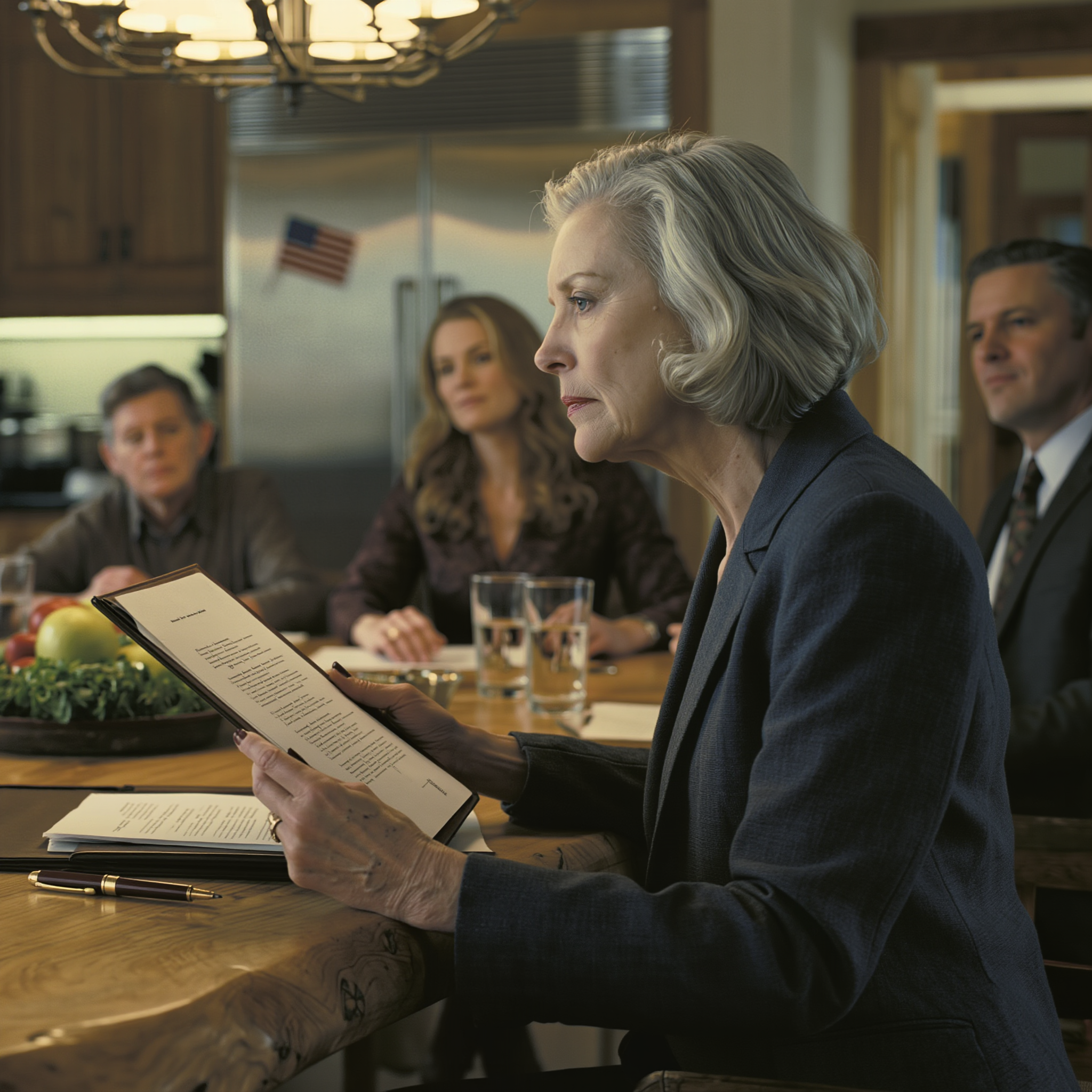
One week before my birthday, my three children slid a “life agreement” across my own kitchen table, smiling like waiters at a steakhouse, like I had a choice. Outside, the Wyoming wind worried the wind chimes. Inside, the only sound was the faint hum of my old refrigerator and the soft clink of ice in the pitcher of sweet tea sweating on the counter, right beside my chipped Route 66 coffee mug—the one with the little American flag printed on the side that I’d picked up at a gas station outside Fort Hood years ago. The polished oak table between us had seen science projects, Thanksgiving turkeys, and one emergency 911 call when Marcus broke his arm falling out of the cottonwood out back. Now it had a forty-two–page ambush laid out on it like evidence.
They slid the document across the polished oak table like it was a menu. At the top, in a cold, blocky font, were the words: “Property Transition and Succession Agreement.” Just like that, the 720-acre ranch my late husband and I had bled for—the house where I had raised them—was being offered back to me with conditions. My own children.
It wasn’t the title that stopped my breath. It was one sentence buried near the bottom, written in the cold, sterile language lawyers use when they want to pretend feelings don’t exist. “The occupant, Colonel Eleanor Vance, may remain on the premises in the guest quarters, contingent on behavior and mental clarity.”
Guest quarters. Contingent on behavior. As if I were a tenant on probation in the life I had built.
Marcus spoke first. He always did.
“We just want what’s best for the ranch, Mom,” he said, his voice smooth with a practiced reasonableness. “You’re not getting any younger. This gives you security.”
My daughter Clare leaned forward, her voice a sugary, condescending whisper. “You’ll still be here, of course,” she said. “In the little house by the creek. You’ve always loved the morning sun there.”
My youngest, Sophie, said nothing. She just watched me, her hands folded, her expression unreadable.
I let my eyes move from one face to the next. The children I had nursed through fevers and fought for in parent–teacher conferences now sat before me like a hostile board of directors.
The silence stretched. Finally, I picked up the pen they had placed so hopefully beside the document. I did not sign. I clicked it once, twice, feeling the weight of it in my hand, then set it back down.
“I see,” I said, my voice dangerously even. “So this is what it comes to.”
“No need to drag this out, Mom,” Marcus said with a sigh. “It’s just business.”
Business.
They had taken forty-two years of my sweat, my marriage, and my memories and reduced it to a transaction.
I looked down at the table, then back at them. “I will not sign this,” I said.
The air in the room went cold. Marcus’s jaw tightened.
“You’ll lose everything if you don’t,” he said.
But I was already standing.
“You’ve made your position clear,” I said. “Now allow me to make mine.”
I walked out of the room.
I made it to the back porch before the shaking started—not from fear, but from the sudden, shocking realization that the love I had given them might never have been enough.
Out there, the vast Wyoming sky stretched out, indifferent. The Bighorn Mountains were a dark blue-gray on the horizon. I had commanded three hundred soldiers on a field in Iraq. I had managed multi-million-dollar supply chains and evacuated convoys under fire. But nothing in my thirty years of service had prepared me for the moment your own children try to conquer you in your own kitchen, smiling while they do it.
They thought I would bend. They thought I was too tired, too lonely, too sentimental to fight back.
They had no idea what they had just awakened.
If you have ever been pushed to the edge by your own blood, then you know that moment where sorrow hardens into steel. I didn’t just walk away from that table; I walked into a quiet, smart, unforgiving war.
I stayed on that porch until the sun bled out behind the Bighorn Mountains. The wind picked up, rattling the tin roof. Inside, I could hear their muffled voices, strategizing, waiting for me to break.
I walked down the steps, my boots crunching on the gravel path. This wasn’t just property. This was bone and muscle and memory. This was the place where I had buried my husband, General Thomas Vance, under the shade of a cottonwood tree. And these were the children who had apparently forgotten whose daughter they were.
That night, I didn’t sleep.
I sat in my study, the house silent around me, and I began to assemble a timeline. Every strange visit. Every veiled suggestion from the past year. Clare offering to “help” manage my mail. Sophie asking if I’d updated my will. Marcus pushing me to “think about the future.” It hadn’t been concern. It had been reconnaissance.
At five in the morning I made coffee, strong and black, the same way I drank it in supply tents in the middle of nowhere. I stood at the window, watching the shadows recede from the fields.
I was not going to wait to be devoured.
From the back of a closet, I pulled out an old metal footlocker. My service files, land deeds, and, tucked between them, something I hadn’t touched in years: the original land survey from when we’d first bought the ranch. Salt Creek wasn’t just any piece of land. Portions of it had been used as military training grounds during World War II for equine logistics.
That land wasn’t just sentimental. It was historically protected.
My late husband never cared for paperwork. That was always my domain. I kept everything. In the military, you document, you file, you prepare—not for today, but for the day someone tries to rewrite your story.
By noon, I had filled two thick folders. One was labeled RANCH. The other, in red ink, TRUST—because my children had no idea that five million dollars sat quietly earning interest with a bank in Denver, locked inside language they could not touch.
I picked up the phone and called Sergeant Major Frank Russo, retired. We’d served together on my final deployment.
“Frank,” I said when he answered. “It’s Eleanor Vance. It’s time.”
He didn’t ask questions. He just said, “Where do you want to meet?”
He understood.
I wasn’t going to lash out. I wasn’t going to scream or plead. They wanted a war of paperwork. They were about to learn who had taught them how to fight.
Frank’s old truck pulled in that afternoon, tires crunching over the same gravel my boots had marked the night before. He was broader now, grayer, but he still had that unshakable steadiness.
He sat at my kitchen table, no small talk, and opened the folder. He flipped to the old map with the Department of Defense stamp. He whistled low.
“This land isn’t just yours, Colonel,” he said. “Part of it is still under a protected military designation. That’s going to matter.”
We spent two hours dissecting every legal angle. I laid out the land survey, the deeds, my service record, and a copy of the trust documents.
“I don’t just want to block them,” I said. “I want to build a wall of steel so high they can never try this again.”
Frank leaned back.
“Then you need someone meaner than me,” he said. “You need Judge Thorne.”
“I’ve already called him,” I replied.
Retired Judge Elias Thorne lived in a cabin with no internet and a deep distrust of anyone under sixty. He was blunt, brilliant, and had once shut down a corporate land grab on behalf of a Vietnam veteran in under a week. I had an appointment for the next morning.
That night, after Frank left, I walked the perimeter of the ranch with a flashlight. Every gate latch I checked, every barn door I secured, was a silent act of reclamation. This place was mine, not because of a deed, but because I had lived and breathed every inch of it.
If they thought I was going to fade quietly into the guesthouse, they didn’t know the woman who used to double-check manifest lists under tracer fire.
The next morning, I drove to Judge Thorne’s cabin. He was already on the porch with two mugs of coffee, steam curling up into the cold air.
“Frank told me,” he said, skipping any pleasantries. “Let’s see what you’ve got.”
We spent three hours at his table. He read every document, taking notes on a yellow legal pad. He was the only man I’d ever met whose silence was louder than most people’s shouting.
When he reached the clause about my “mental clarity,” he stopped.
“They want to control the narrative,” he said. “Paint you as unstable. But this”—he tapped my military commendations—“this shows a lifetime of leadership. We can flip that.”
“I don’t want pity,” I said.
“You won’t get it,” he replied, a grim smile tugging at his mouth. “After we flatten them, you’ll get respect.”
By the time I left, the plan was in place—legal counters, public positioning, and a quiet warning drafted to the right state and federal offices, including the agencies that cared very much about historically protected training grounds.
“They’ll never see it coming,” Thorne said as he walked me to the door.
“That’s the idea,” I said.
On the drive back, the sky was that hard, brilliant Western blue that makes everything look like it has sharper edges. I passed cattle trucks, hay bales, and one pickup flying a sun-faded American flag in the bed. People out here still believed in a handshake and a promise. My children, apparently, believed in fine print.
That afternoon, I called Isabel Diaz, the editor of the local paper. She was sharp, factual, and had a reputation for telling the truth even when it made people uncomfortable.
“I need you to print something,” I said.
“On the record?” she asked.
“Every word.”
I told her everything. No tears, no pleading—just the facts. The succession agreement. The mental competency clause. The land’s military history. My record. Their pressure.
She didn’t interrupt. When I finished, she just said, “I’m coming by in the morning.”
The article dropped online three days later. The headline was a blade: Decorated veteran and ranch owner pressured by children to sign away historic land.
The story spread. Local outlets picked it up. Comments flooded in from people who remembered me, who remembered my husband. People posted photos of him in uniform at the Memorial Day parade, of me speaking at the high school on Veterans Day, of the flag we used to raise at dawn by the barn.
My name meant something in this county. It meant integrity. It meant work.
I spent that Sunday in the garden, clipping roses. Clare’s SUV drove by twice. She didn’t stop.
The next day, Marcus called. I didn’t answer. That evening, Sophie sent a text: Can we talk without the drama?
I turned off my phone.
I had no interest in their performance of remorse. They had made their intentions clear. My only job now was to make sure they never got a second chance.
That resolve settled over me like a weighted blanket. Their story about a frail, confused woman was already unraveling in the court of public opinion—and we hadn’t even filed in an actual court yet.
The silence from my children broke on a Monday afternoon. Clare appeared at my gate in a tan trench coat, looking less like a daughter and more like a hostile negotiator.
She stood on the porch, waiting to be acknowledged. She didn’t knock.
I let her wait.
Finally, I opened the door and leaned on the frame. “Clare,” I said.
“We need to talk about the article,” she said, her voice tight. “The family is upset. Marcus has had calls from his office.”
I said nothing.
“We’re willing to revise the document,” she offered, as if this were a great concession. “So everyone can move on.”
A short, dry laugh escaped me.
“Clare, you were willing to have me sign away everything I built,” I said. “Now you’re concerned about reputation.”
Color rose in her cheeks. Then came the threat, veiled and ugly.
“If this continues, there will be damage,” she said. “To assets. To relationships. People could start looking into your past decisions, the tax filings, that inheritance you never reported in 2002. Nineteen thousand five hundred dollars, wasn’t it?”
They had been digging.
I wasn’t surprised. What she didn’t know was that I had nothing left to hide. Every dollar, every clause, every mistake I’d ever made had already been disclosed to Judge Thorne.
“Do what you need to do,” I said, my voice calm. “But do it quickly.”
And I shut the door.
That evening, a revised proposal arrived by courier—a forty-two–page monument to corporate jargon. Custodial flexibility. Legacy restructuring. Risk-mitigated transition. The clauses were softer now, wrapped in consultant language, but the intent was the same.
They wanted control.
I didn’t sign it.
Instead, I had Judge Thorne send a certified letter. Any further attempt to coerce, intimidate, or defame would be met with a formal civil complaint and a request for a public injunction. The letter was short, sharp, and very easy to leak if I decided the town needed new reading material.
The retaliation began in earnest.
An anonymous zoning complaint about an “unsafe” barn. A whisper campaign at church. Cold shoulders at the feed store. Women I’d known for thirty years wouldn’t meet my eyes, then sent me messages late at night saying they were “so sorry about all this” but “didn’t want to be in the middle.”
It didn’t hurt.
It sharpened me.
Then Marcus went too far.
He tried to access one of my inactive bank accounts tied to the ranch’s agricultural subsidies, using an old login, likely thinking I was too absent-minded to have changed it. The system flagged the attempt, and the bank called me directly.
“Mrs. Vance, did you just try to log in from Houston?” the woman on the phone asked.
“No,” I said. “But I know exactly who did.”
I reported it—not to press charges, not yet—but to document the attempt. In the military, you learn to write everything down. Paper doesn’t forget, and neither do digital logs.
A few days later, an unstamped envelope appeared in my mailbox. No return address. Inside, a single typed line:
They’re planning to sell the ranch behind your back. There’s a buyer already lined up.
I didn’t need to know who sent it.
I called McKenna, a retired Air Force officer turned estate consultant. She was ruthless in a way I recognized immediately.
An hour after I emailed her what I had, she called back.
“You’ve got an exploratory inquiry filed by a private equity group in Denver,” she said. “They’ve been sniffing around for months. Someone’s feeding them information.”
“How do we stop it?” I asked.
“We don’t stop it,” she said, her voice flat. “We expose it.”
That afternoon, my late husband’s old friend, Grace Weston, pulled up in a cherry-red truck. She worked for a conservation trust now, wore her gray hair in a long braid, and had a laugh like a truck starter.
“I saw something that made me think of you,” she said, handing me a worn folder.
Inside were handwritten notes from my husband, sketches, and a draft letter to the Department of Agriculture proposing a long-term conservation easement for the ranch. He’d never filed it, not wanting to push me while I was grieving. But even then, he’d been thinking about the future—about exactly this fight.
“The old man was ahead of his time,” Grace said. “This, with the military designation on part of your land? If we move quickly, they’re not selling so much as a fencepost without going through five agencies.”
The final piece of the puzzle clicked into place. The land would not be sold. The mother would not be erased.
The next move would not be defense.
It would be a public reckoning.
The night I invited them all for a “final dinner” was cold and still. I lit the fireplace, not for warmth, but for the memory of what this house used to be. I set the table with my mother’s bone-white porcelain, the same plates we’d used the night Thomas came home from his last deployment.
They all came. Marcus with his tight banker’s smile. Clare with her careful makeup and tense shoulders. Sophie with her eyes darting like she was braced for impact from both directions.
They sat, tense and watchful, waiting for my surrender.
We ate mostly in silence. Roast chicken. Potatoes. Green beans. Ordinary food on a not-ordinary night.
After the dishes were cleared, I stood at the head of the table, the same place my husband had stood for every birthday and Christmas blessing.
“I found the draft,” I said, my voice clear in the quiet room. “The conservation easement your father drew up years ago. I filed it this morning.”
Clare went pale. Marcus cleared his throat.
“I also know about the buyer in Denver,” I continued. “And the forged financial statements. And the power of attorney you attempted to file without my knowledge.”
Clare scoffed lightly. “Mom, we were protecting you,” she said. “You’ve always hated paperwork. We were trying to prevent a problem before it—”
“Protecting me?” I cut in, my voice sharper now. “You were protecting your inheritance.”
Marcus muttered something about my being “ungrateful.”
“I spent thirty years in the military,” I said, low and dangerous. “I have read classified documents in the dead of night with enemy drones overhead. I know how to read silence. I know how to see betrayal. And I have seen everything I needed to see in your eyes.”
I straightened.
“You need to leave now.”
Marcus pushed back his chair, taking a step toward me, his fists clenched. “You can’t throw us out,” he said. “We’re your children.”
“You stopped being my children,” I said quietly, “the moment you treated me like a legal problem to solve.”
For a heartbeat, the house was so silent I could hear the clock ticking in the hallway.
Upstairs, a soft voice came through the tiny speaker hidden in the scarf around my neck.
“Audio recorded. Video feed is stable,” McKenna said. “I have everything, Colonel.”
They froze.
“The sheriff’s deputy will be here in five minutes to deliver the official restraining orders,” I said calmly. “You’ll be escorted off the property. From now on, if you need to contact me, you can do it through counsel.”
Marcus’s face went red. Clare’s eyes shone, whether from anger or humiliation, I couldn’t tell. Sophie just sat there, her hands trembling in her lap.
They left in a storm of shocked silence and slammed doors.
After the door closed, I leaned against it, my legs trembling slightly—not from fear, but from release. The weight I’d been carrying since they slid that agreement across the oak table finally shifted.
By the time the sheriff’s cruiser rolled up the driveway, I wasn’t the one on trial anymore.
The next morning, frost glittered on the porch railing like ground glass. My attorney, Joseph Maddox, called before I’d finished my first cup of coffee—this time in my chipped Route 66 mug with the little American flag printed on the side.
“We’re in good shape,” he said, his voice all business. “The emergency motions are filed. Assets tied to the ranch and the family trust are frozen. The LLC your kids set up as a holding vehicle for a silent buyout is now dead in the water, flagged for fraudulent activity.”
“The judge?” I asked.
“Man I’ve known for twenty years,” Joseph said. “He’s seen this story before. Judges get tired of children who treat their parents like walking ATMs.”
The restraining order barred them from the property except under strict legal supervision. McKenna now held a limited but effective power of attorney for specific matters, a firewall between me and anyone who thought I was easy to manipulate. I started carrying a small recorder again. Old habits. Not out of paranoia, but precision.
A few days later, a letter arrived from Sophie’s attorney, full of thinly veiled threats dressed up as a plea for “restorative mediation.”
I didn’t respond.
Instead, I wrote a letter of my own—to the State Bar Association. A formal ethics complaint, backed by recordings and testimony. Let the law decide what lines they had crossed.
Clare’s visit, when it came, was not what I expected.
She stood on the porch with no makeup, her hair windblown, looking less like a strategist and more like a woman who had run out of road.
“I don’t hate you,” she said as soon as I opened the door. No hello. No preamble. “I never hated you.”
The words landed like a stone dropped into a still pond.
“I was jealous,” she continued, her voice cracking. “Of the trust Dad placed in you. Of the respect you got in this town. I see the difference now. You earned it. I demanded it.”
She apologized for not showing up at my promotion ceremony decades ago, when I pinned on full-bird eagle rank and Thomas stood behind me beaming. She admitted she had only ever known how to love people when they were beneath her, when she could manage them.
“I’m sorry,” she said finally.
I believed her.
And I forgave her.
But forgiveness and access are two different things.
“I accept your apology,” I said. “But I’m not reopening the door you tried so hard to slam on me. Not now.”
She nodded, tears in her eyes. She left behind a folder on the porch bench.
Inside were old photos of my husband proposing to me on a picnic blanket just off the north pasture, photos I thought had been lost for decades. Me, twenty-three and startled. Him, already in uniform, grinning like he’d just won the lottery.
Love had lived in this house once. It still did. It just wore different armor now.
The final meeting was with Marcus.
He had taken a plea deal—probation and restitution—after the DA saw enough in the paper trail to make charges stick. We met at his attorney’s office, a sterile room with neutral art that looked like it had never meant anything to anyone.
Marcus looked smaller, tired. The CEO swagger was gone.
“I don’t have an apology that will matter,” he said, staring at his hands. “I know that.”
He admitted he had lost me the day he decided I was expendable—a variable to be managed rather than a mother.
“Don’t contact me,” I said, my voice steady. “Not until you’ve lived one full year without lying, manipulating, or taking from another person. Document it. Show me. If you can do that, we’ll see.”
As I stood to leave, he spoke one last time.
“I kept the photo,” he said quietly. “Of you and Dad at your commissioning. I carry it in my briefcase.”
“Then remember who raised you,” I replied.
I walked away without looking back.
The lavender bloomed early that year, the air over the south pasture humming with bees. The land, like me, had finally unclenched.
I donated part of the property to a local women veterans’ shelter. They began building small cabins near the south fence line, a place for women caught between service and invisibility. I knew that place well. Some of the funding came from the trust my children had never known about. Five million dollars could do a lot of quiet good when it wasn’t being fought over at a dinner table.
My legacy would not be a name on a deed passed down to ungrateful heirs.
It would be a sanctuary.
One evening, Sophie came by with her daughter, now nine. They brought dinner in foil pans and a store-bought pie that tasted better than it had any right to.
At the table, Sophie looked around the familiar room and smiled, tentative but real.
“The place feels different,” she said.
“It is,” I replied. “Because I am.”
Her daughter leaned into me and whispered that she wanted to live here someday, on the ranch with the big sky and the horses and the lavender.
“Maybe you will,” I said, kissing the top of her head. “Or maybe you’ll go build something of your own. Either way, you’ll know where you came from.”
After they left and the house settled into its usual quiet, I rinsed my Route 66 mug and set it in the dish rack, the little American flag on its side catching the last of the evening light. That silly gas-station mug had been with me through deployments, late-night planning sessions, and too many lonely breakfasts to count. It had outlasted trends, storms, and now, one attempted family coup.
That night, I rehung the photo of my husband and me on the day of my promotion. In the picture, I’m in dress uniform, chin lifted, eyes steady. Thomas stands beside me, one hand on my shoulder, pride written in every line of his face.
I looked up at that young woman—the one who led with dignity and refused to back down from a just fight.
She still lived here.
She always had.
Spring settled in like it always did in Wyoming—not so much arriving as fighting its way through mud and late frosts. The cabins for the women’s shelter went up board by board. On some mornings I’d stand on the porch with my Route 66 mug warming my hands, the little American flag on its side lined up with the real one flapping out by the barn, and watch the crews work in their neon vests and worn ball caps.
The first woman arrived on a Tuesday.
Her name was Carla. Former Army mechanic. Two tours. A limp she tried to hide and a laugh she didn’t trust yet. She stepped out of the county van with one duffel bag and eyes that checked every tree line out of habit.
“Colonel Vance?” she asked.
“Eleanor,” I corrected. “You’re home for a while.”
She swallowed hard at that word. Home.
I showed her to the first cabin—pine boards still sharp with scent, a small porch looking out over the south pasture. The bed was made with a faded quilt my mother had sewn years ago. On the little table by the window sat a lamp, a worn paperback, and a frame waiting for whatever photo she’d decide mattered enough to print.
“I don’t want to be a burden,” she said quietly, setting her duffel down like she expected someone to grab it back.
“You’re not,” I said. “You’re the point.”
Her shoulders dropped as if someone had just taken a pack off her back.
That was the first night in a long time I slept straight through until morning.
The women kept coming. One by one. Some stayed three weeks, some ninety days. They arrived with stories that didn’t fit on intake forms, carrying scars you couldn’t see from a distance. I saw my younger self in all of them—mouth set, jaw tight, eyes always scanning for the next threat.
It didn’t escape me that the first real community I had built on this land in years was made up of strangers who understood me better than my own blood did.
Every Sunday, those who wanted to would gather in my kitchen after dinner. The cabins had their own little hot plates, but the women liked “real food,” they said—meatloaf, cornbread, chili that made your eyes water. We’d crowd around that same polished oak table and pass dishes back and forth.
Sometimes we talked about nothing at all. Sometimes about deployment stories that we softened with humor. Sometimes about the quiet hours back home when the world felt too loud and too empty at the same time.
One night, Carla ran her finger over a scar on the table, the one Marcus made with a screwdriver when he was eight and trying to carve his initials.
“Your kids?” she asked.
“Used to be,” I said before I could stop myself.
She glanced up at me, then back to the scar.
“Mine stopped calling when I got out,” she said. “Didn’t know what to do with the version of me that came home.”
We didn’t dig further. We didn’t need to. Sometimes the most honest conversations are the ones where both people know to leave certain details alone.
That night, after everyone had drifted back to their cabins, I sat alone at the table. I traced Marcus’s old initials with my thumb. For years, I’d thought that gouge made the table imperfect. Now it was just another line in a story I refused to let them finish for me.
The court dates came and went like storms.
The first big hearing on the injunction drew a small crowd. Small-town courthouses are like that. People pretend they’re just there to file paperwork, but they linger in the hallway when they know something worth whispering about is happening inside.
I walked up the courthouse steps in my navy blazer, dark jeans, and boots polished enough to honor the occasion. Joseph met me at the door, briefcase in hand, tie slightly askew.
“You ready?” he asked.
“I led a convoy through a sandstorm on three hours of sleep,” I said. “This is air-conditioning and seating charts.”
Inside, the courtroom smelled like wood polish and old paper. The judge sat high above us in his worn black robe, glasses perched at the end of his nose. I recognized a few faces in the gallery—people from church, the feed store, the diner where Thomas and I used to split hash browns on Sunday mornings.
On the other side of the aisle sat my children.
Marcus in a tailored suit that didn’t quite hide the tension in his shoulders. Clare in a dark dress, jaw clenched, eyes set to “professional neutral.” Sophie in a cardigan too big for her, as if she wanted to shrink into it.
For a moment, seeing them there, something under my ribs twisted. I remembered Claire’s kindergarten recital, the way she clutched the paper stars on her costume. Marcus’s first Little League game. Sophie asleep on my chest while I signed reenlistment papers.
Then I remembered the cold block letters on that agreement.
They remembered them too.
The judge read through the motions, voice dry. Joseph laid out our case methodically—fraudulent attempts to transfer assets, unauthorized inquiries to potential buyers, the pressure to declare me unfit while quietly setting up a holding company to strip the land.
Then came the part that changed the air in the room.
“Your Honor,” Joseph said, “we’d like to introduce Exhibit 19—audio and video recordings taken inside Mrs. Vance’s home on the evening of March 14th.”
The clerk queued up the file. The flat sound of my own voice filled the room.
You stopped being my children the moment you treated me like a legal problem to solve.
On the screen, my children’s faces tightened, flinched, hardened. Marcus’s hand balled into a fist on the table. Claire’s eyes closed for half a second like she’d been hit.
The judge watched it all, his expression unreadable.
When the recording ended, the room was so quiet you could hear the old ceiling fan ticking above us.
“The court finds,” the judge said eventually, “that there is substantial evidence of coercive behavior and attempted financial exploitation. The temporary orders will remain in place and be expanded. Any future attempts to interfere with Mrs. Vance’s control of the ranch or associated trust will result in sanctions.”
He looked over his glasses at my children.
“And if I see one more anonymous complaint about ‘unsafe barns’ that somehow only gets filed after a bad headline, we will be having a different kind of conversation.”
A low ripple of restrained amusement moved through the gallery.
As we filed out, Clara’s attorney leaned in to say something to her. She shrugged him off. Sophie kept her head down. Marcus stared straight ahead, jaw clenched so tight the muscle in his cheek fluttered.
Outside, on the courthouse steps, a reporter from a regional outlet approached.
“Colonel Vance,” she said. “Do you have any comment?”
“Yes,” I said. “If you’re lucky enough to live long enough to build something, you’re allowed to protect it.”
That quote ended up under my photo in the next day’s paper. They chose a picture Isabel had taken—a candid shot of me standing by the barn, flag behind me, hair pulled back, eyes squinting into the sun.
I hadn’t set out to become a symbol. I just refused to be a cautionary tale.
Life on the ranch settled into a new normal, if you could call it that.
On weekday mornings, I’d walk the property with McKenna, clipboards in hand, doing what she called “asset hardening” and what I called “common sense.” Making sure titles were recorded correctly. Ensuring every agreement had redundancy. Updating emergency contacts. Writing down passwords in a book that would go straight to the safe-deposit box in town.
“This is overkill,” I said one day as we checked a lock on a storage shed that hadn’t held anything more valuable than rusty tools since 1998.
“With respect, ma’am,” she said, “no, it’s not. Not anymore.”
Every few weeks, a new letter would arrive from one of three directions—the county, the bank, the Bar Association. The investigation into Sophie’s lawyer moved slowly, the way formal things always do. I didn’t crave vengeance. I just wanted a paper record that said, clearly, this happened and it mattered.
The shelter cabins filled and emptied, each woman leaving a different mark.
One painted tiny flowers along the edge of her porch. Another fixed the temperamental tractor on her second day without being asked. One planted a row of sunflowers near the lavender, tall and stubborn, always turning their faces toward the light.
One evening, as the sun went down in streaks of orange and pink across the pasture, Sophie parked at the gate and walked up the gravel drive alone.
I met her halfway without quite meaning to, our boots making the same small crunching sounds they always had.
“I brought cookies,” she said, holding up a Tupperware container like a peace offering.
“Store-bought?” I asked.
She winced. “You always did know.”
We walked to the porch in silence. I poured coffee into two mismatched mugs. I kept the Route 66 one for myself.
“The women staying here,” she said, watching two of them cross from one cabin to another, laughing about something only they understood. “They talk about you like you’re some kind of legend.”
“Legends are dead,” I said. “I’m just retired.”
She smiled, then it faded.
“I keep thinking about that night,” she said quietly. “About how I sat there and didn’t say anything.”
“You didn’t try to stop them either,” I said. No heat. Just the truth.
“I was scared,” she admitted. “They talked about numbers and taxes and how complicated everything was. They said if we didn’t ‘take action’ soon, we’d lose everything. I believed them. Or maybe I just wanted to.”
She twisted the edge of a paper napkin between her fingers.
“I kept telling myself I’d talk to you alone later,” she said. “That I’d make sure you were okay with it. But later never came.”
“That’s how most bad decisions happen,” I said. “Not with a big dramatic moment. Just a thousand ‘laters’ that never show up.”
She nodded, tears shining.
“I don’t know how to fix it,” she said.
“You can’t,” I said. “Not all of it.”
She swallowed.
“What can I do?”
I looked out at the cabins, at the faint glint of metal where someone had hung a set of dog tags from a porch hook.
“You can show up,” I said. “For them. For your daughter. For yourself. Not as penance. As practice.”
Sophie started coming by on Tuesday nights. At first, she cleaned the communal kitchen like a woman on a mission, scrubbing pots that didn’t need it, wiping down counters already clean. The women watched her, wary at first, then amused.
Slowly, they started handing her tasks that weren’t busywork.
“Sit with her,” Carla said one night, nodding toward a young woman at the edge of the group who was staring a little too hard at nothing. “She had a rough therapy session.”
Sophie sat. She listened. She didn’t try to fix anything.
One night, after everyone left, she turned to me.
“I thought I’d be giving something,” she said. “Turns out I’m the one getting rebuilt.”
“You’re not the only one,” I admitted.
Summer rolled in with scorching days and nights that buzzed with crickets.
The conservation easement paperwork came back fully approved, pages and pages of dense language that boiled down to one simple fact: this land would stay what it was. No development. No strip malls. No anonymous buyouts from companies with names that sounded like cough syrup.
I took the stamped copy out to Thomas’s tree—the cottonwood where we’d buried him. I sat in the grass and read the first page out loud, then set the folder at the base of the trunk.
“We did it,” I said softly. “They can’t touch it now.”
A breeze moved through the leaves, cool against the back of my neck. Maybe it was just wind. Maybe it was memory. Either way, it felt like an answer.
The Bar Association eventually sent a letter too.
After careful review… conduct inconsistent with ethical obligations… formal reprimand… mandatory supervision.
I folded it once, then again. People sometimes think justice looks like handcuffs and sirens. Often it’s just a stern letter on heavy paper that follows a person the rest of their working life.
Marcus stayed quiet for months.
I heard about him through other people. A neighbor of a neighbor mentioned he’d left his firm. Someone else said he was “working things out,” which could mean anything from therapy to hiding out on a friend’s couch.
I didn’t chase the details. I had fences to mend and women to welcome and tomatoes that insisted on splitting right before they were perfectly ripe.
My birthday came around again.
One year since the “life agreement” slid across my table.
I woke up before dawn out of habit. The house was quiet, full of the soft sounds of a place that had made it through another winter—old wood creaking, pipes ticking, the soft hum of the refrigerator.
I brewed coffee, poured it into my chipped Route 66 mug, and stepped out onto the porch.
The sky was just starting to blush pink. Down by the cabins, a porch light clicked on as someone got ready for an early shift in town. The flag by the barn hung limp in the still air, waiting for the day’s first breeze.
A county truck pulled into the driveway around eight. The driver hopped out with a clipboard.
“Morning, Colonel,” he said. “Got your new signage.”
He unloaded a wooden post with a carved plaque: SALT CREEK WOMEN VETERANS RETREAT. DONATED BY THE VANCE FAMILY TRUST.
The number underneath made me smile: EST. 2023.
I’d set that date on purpose. Not the year we bought the ranch. Not the year Thomas and I first moved in. The year I took it back.
We set the post near the main gate. I held it steady while he packed dirt around the base.
“Looks good,” he said, standing back.
“It looks right,” I corrected.
Later that afternoon, as the women headed back and forth from cabins to garden to tack shed, Sophie’s daughter ran up the drive, breathless.
“Nana, look!” she said, holding up a crumpled piece of notebook paper. “I had to do a ‘family hero’ project.”
On the page was a stick figure drawing of a woman in what I assumed was a uniform—blocky shoulders, a square hat, and an American flag in the corner.
Underneath, in shaky block letters: MY HERO IS MY NANA BECAUSE SHE DOESN’T LET ANYONE BOSS HER RANCH.
I laughed, a sound that surprised me with how light it was.
“That’s not bad,” I said. “Next time we’ll work on the boots.”
She grinned and ran off to show Carla the drawing.
That evening, after dinner, the women brought out a cake they’d somehow managed to bake without me noticing. There were too many candles on it to count.
“Speech,” Carla called out, because someone always does.
I looked around my kitchen. At the women leaning against the counters. At Sophie drying dishes. At my granddaughter staring at the cake like it contained every wish she’d ever thought about making.
“One year ago,” I said, “I thought my story was ending. Turns out it was just the end of a bad chapter.”
I paused, letting that settle.
“If you remember nothing else about me,” I added, “remember this: you are allowed to write your own terms. Even if you have to tear up the first draft.”
I blew out the candles. The room erupted in applause and off-key singing.
Later, when the house was quiet again, I went to my study. The old footlocker still sat in the corner, but its contents were different now—less evidence, more intention.
On the desk lay a new document.
Not a “life agreement” written by children who wanted my land.
A legacy plan written by the woman who built it.
It spelled out, in plain language, what would happen after I was gone. The ranch in trust, permanently tied to the women’s retreat and conservation easement. The remaining funds divided between organizations that actually lifted people up instead of waiting to collect when they fell. A modest scholarship set aside for my granddaughter—not because she was owed, but because I chose to invest in whoever she decided to become.
Joseph had reviewed it. McKenna had triple-checked the details. Judge Thorne had given it a gruff nod and said, “That’ll hold.”
All it needed was one last signature.
I sat at the oak table where this had all started. The pen in my hand felt lighter this time.
“This one’s mine,” I said softly.
I signed my name.
Outside, the wind picked up, rattling the tin roof, just like it had the night I first walked out onto the porch shaking with a different kind of realization.
Back then, I thought the war I was walking into was about land and money and power of attorney.
Now I knew better.
The real war had been for my own sense of worth.
And on that front, at last, I had won
Leave a Reply