I didn’t plan on making a scene. I didn’t plan on burning anything down. If anything, I planned on getting through one more week without losing my temper. But sometimes the match is already there, tucked under the edge of the door you’re told to close quietly, and all you do is breathe.
You know the type: the reliable one. The one people ask for favors without ever saying thank you. The one who ends up driving to school at 7:10 a.m. because someone missed the bus. The one who buys the groceries when the fridge looks empty and gets told, two hours later, “Oh, I was going to do that.” The one you can move around like a chair because chairs don’t complain. Chairs don’t have feelings. Chairs don’t speak.
I used to think being good was a protection. It wasn’t. It was a silence, and people filled it with themselves.
Bel is twenty‑one. She used to trail me through the neighborhood on a pink bike with tassels that caught the evening light, calling me Wez‑wee because she couldn’t say my name yet. We were close once. Saturday morning cartoons. Forts made of couch cushions. Two sisters believing that the tiny world of our house was the entire universe and we were astronauts with matching helmets.
High school is where we diverged. I went straight‑edge and AP classes. She went loose‑edge—skipped, drifted, dared the consequences and found out, over and over, that other people would pay them. By the time she dropped out of college and got pregnant with twins, the family had learned a new religion: whatever happens, Bel is fragile; Bel is brave; Bel is first.
I didn’t mind helping at the beginning. Babies are hard and the world is harder. But hardness isn’t the same as helplessness, and somewhere between midnight feedings and the morning dishes our house forgot the difference.
The night everything started, Mom was humming over the sink while Dad scrolled at the kitchen island. Bel had one of the babies nestled against her shoulder, swaying to a rhythm only exhausted mothers know. I was clearing plates, grateful for the quiet. Then Dad, without looking up, said, “We were talking. Bel could use your room.”
My hands slowed over the dishwasher handle. “What?”
“It’s just temporary,” Mom added, too quickly. “She needs space for the twins’ cribs. You’ll be fine in the basement.”
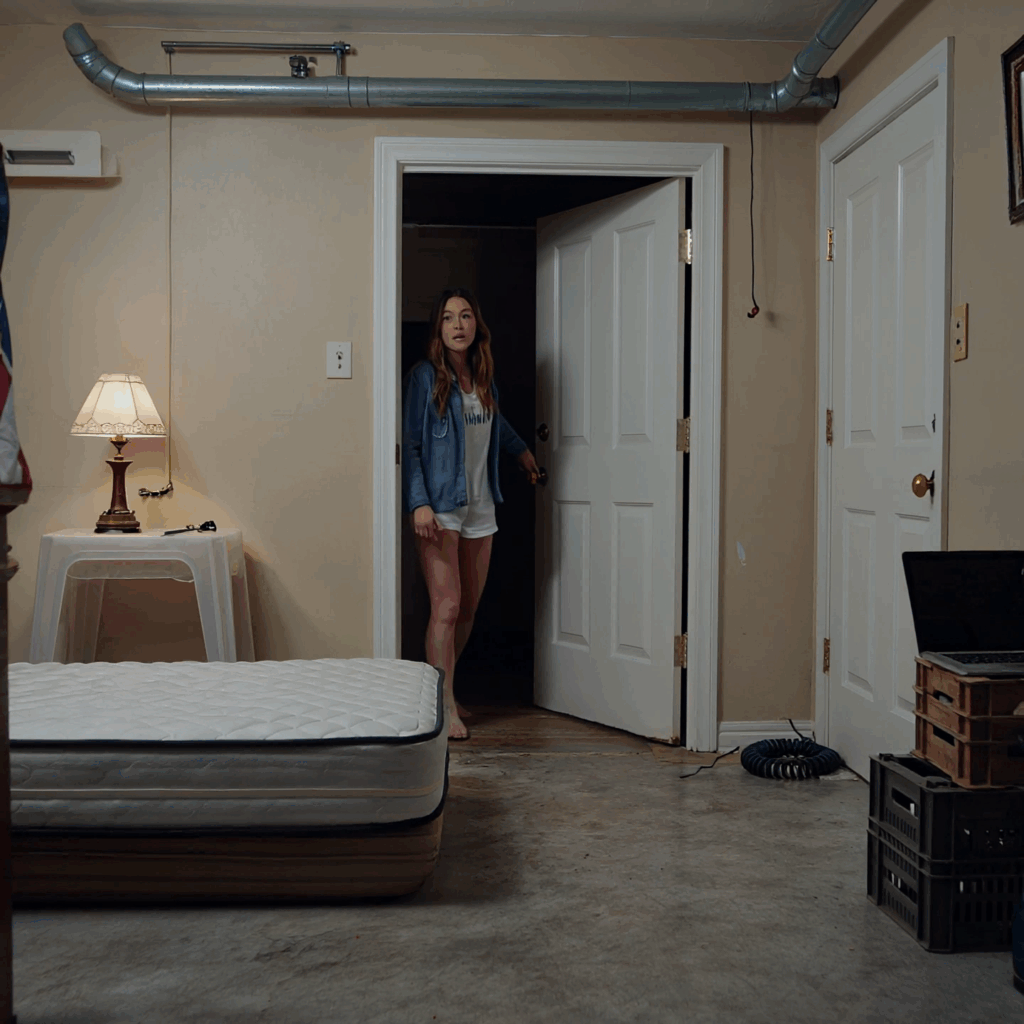
There are basements that smell like workshop cedar and lemon oil. Ours is not that basement. Ours is concrete and exposed pipes and the faint, permanent mildew of a place that was never meant for a person to sleep. Ours is the sound of other people flushing above your head.
“She can’t even fit both cribs in there,” Mom pressed. “And you’re barely in your room during the day. You’re working.”
“I’m up all night with them,” Bel said, not really looking at me. “The crying keeps you up, right? This way everybody sleeps.”
Everybody. As if I wasn’t in “everybody.” As if I were infrastructure.
It had already been decided. That’s how decisions worked in our house: made top‑down, then presented like a group brainstorm. I nodded. I said, “Okay.” I hauled my mattress downstairs that night because I could either comply quietly or argue until I became the problem.
The first night on concrete feels like a dare. You tell yourself this is temporary. You tell yourself your back doesn’t hurt from the floor. You tell yourself the lamp plugged into an old extension cord doesn’t look like a hazard. You tell yourself you’re strong—because you are—but strength isn’t the same as being treated like a person.
In the morning I went upstairs for coffee. The key bowl by the door—where I always dropped my keys—was empty.
“Hey,” I asked, keeping my voice neutral. “Anyone seen my keys?”
Bel scrolled without glancing up. “Oh, I took the Corolla. The babies have a checkup.”
“You took my car?”
“I was going to ask last night, but you were already… you know.” She gestured vaguely toward the floor. “I’ll be back by lunch.”
The sting wasn’t the transportation. It was the erasure. The subtle adjustment in tone from “This is your thing” to “This is our thing” to “This is my thing.” And in that adjustment I wasn’t even asked to participate.
It happened again. And again. One morning she didn’t tell me at all and I logged into a client call late and flushed, apologizing to a face full of patient, disappointed squares.
I tried to bring it up gently with Mom first. “She’s overwhelmed,” Mom said. “She needs a little help.”
With Dad: “You’re being selfish, Wesley.”
Selfish. After years of buying groceries, paying rent, doing the dishes, doing the driving, running the errands, cleaning up someone else’s crisis in a clean, quiet way so no one would be embarrassed in public. Selfish was the word.
On Thursday, after another long day staring at code and a Wi‑Fi signal that groaned every time it rained, Dad came down the stairs and didn’t knock—just walked in like the basement was a utility closet.
“Your sister needs the car full‑time now,” he said, arms crossed in a pose I recognized from a lifetime of pronouncements. “Appointments, daycare visits, groceries. You don’t leave most days.”
“It’s my car,” I said, careful. “I paid for it. I insure it.”
“And she’s your family.” His mouth went thin. “Family supports each other.” A beat. Then, colder: “You’re not special anymore, Wesley. You’re a grown woman living in our basement. Your sister has twins. She needs the space. She needs the car. Be useful.”
Useful.
It echoed inside the pipes. I nodded. Not because I agreed. Because I understood exactly who I was to them in that moment: a resource they expected to manage without complaint.
I didn’t sleep that night. I stared at the spider web near the ceiling beam and listened to the house shift over me. If I vanished, would they notice? Would my mattress become storage for bulk diaper boxes? Would the car title be a speed bump they’d pave over with “It’s just easier this way”? The answers felt obvious and impersonal—like terms of service I hadn’t noticed agreeing to, written in the font of somebody else’s convenience.
By Saturday, Aunt Melissa and Uncle Dan were visiting. The house smelled like roast chicken and rosemary. Laughter rose and fell upstairs, the kind of laughter that pretends nothing is wrong because nothing is wrong for the people laughing. I stayed in the basement—not to sulk, but because I was finishing something.
When the basement door opened, air moved. The smell hit Aunt Melissa first. Then the sight of concrete. Exposed pipes. My mattress. My laptop perched on stacked milk crates. “Oh my goodness,” she said, voice bright and horrified. “Wesley?”
I looked up. “Hey.”
“You’re sleeping down here?” She stood on the top step, hand gripping the jamb as if she needed permission to descend into this new information.
“Yep.”
“Where’s your bed? Your furniture?”
“Upstairs,” I said, and my face didn’t move. “They needed the room.”
Uncle Dan leaned over her shoulder, eyes narrowing. “What in the world…?”
I didn’t go upstairs. I didn’t have to. Aunt Melissa did that for me. Her heels on the hardwood were a metronome for indignation. She has a voice like a parade marshal—big hair, bigger heart, volume that could tame a marching band—and when she used it, the twins cried. The house fell quiet around the sound.
That was the crack in the veneer. Not the fight I refused to stage, but the truth someone else saw without me narrating it. I had been called selfish for weeks. Complicated for wanting my keys. Aggressive for trying to lock my own food. And then one look from someone who wasn’t used to being ignored, and the room rearranged around the shape of the facts.
Facts were going to save me.
Two weeks later, I opened the fridge to find half my meal prep gone. I labeled my containers like they teach you to do in shared houses: WES in black marker, dates lined up, a quiet boundary. Apparently boundaries are for people whose needs are inconvenient.
“Hey,” I said, keeping my voice even. “Did you see the containers labeled WES?”
Bel barely looked up from her phone. One twin slept in a bassinet; the other was splayed like a starfish across her chest. “Mom said I could have them.”
“You didn’t ask me.”
“They were just sitting there.” She shrugged. “You always make too much.”
“That’s not the point.”
“Well, maybe don’t leave food in a shared fridge if you don’t want people touching it.”
“This isn’t a dorm.”
“No,” she said, smiling without warmth. “It’s family. We share.”
I ordered a cable lock for the fridge that night. I’m not proud of how petty it felt twisting steel through handles like I was securing a mini‑mart at midnight. But there are only so many times you let a boundary be optional before you choose a boundary that’s made of metal.
Dad found me latching it and went red. “Are you insane? Locking up food like this is prison.”
“Then stop treating me like an inmate,” I said, and the line surprised both of us with how quickly it came.
The next day, the lock sat on the counter, cut clean through. The wire cutters—Dad’s—rested beside it like a calling card.
Control, I realized. This wasn’t about groceries or gas. This was about control. I had been highly manageable for years: the good daughter, predictable, pliable. When I started saying no, when I tried to shape my small corner of space, they didn’t argue the specifics. They argued the premise that I had a corner at all.
The worst moment wasn’t even dramatic. It was a Monday, heavy with the kind of cloudy afternoon that makes the whole house feel like early evening. I was mid‑script, automating threat detection logs, when my boss messaged: Hey, quick Zoom? Five minutes tops.
We sat across the screen from each other, both of us in our home offices, separated by hundreds of miles and one thick layer of corporate caution.
“This isn’t about your performance,” she began, which is how you always know it’s about something worse. “We’ve been notified of concerning activity from your IP address. Legal looped me in.” She inhaled like the sentence needed backup. “Multiple access attempts on restricted documents. Client reports. Expense audits. Password reset pages. It’s all logged under your device ID.”
“That’s not me,” I said. “I never touch client data outside protocol.”
She nodded. “I believe you. Your behavior doesn’t match. But the forensics point to your household.”
My heart beat in my ears. “What does this mean?”
“We’re putting you on temporary leave while we sort it out.”
When I closed the call, the basement hummed with fluorescent quiet. I stared at my hands and felt the air go thin. I went upstairs.
“Did you use my laptop?” I asked Bel. The question came out low, like it had walked up from the floor through my shoes.
She laughed, a short burst like a door slamming. “Oh my God, are you accusing me of hacking? What even is your job?”
“I’m telling you that if you or anyone accessed my files…”
Dad walked in. “What’s going on?”
“She compromised my work,” I said. “Now I’m on leave.”
Dad rolled his eyes, a performance I knew too well. “That’s paranoid. Who here would even know how to open half the junk you do on that thing?”
“I would,” I said, and I didn’t smile. “Enough to know that if I get fired, I lose my health care, my income, my rent.”
Mom stepped in with a wooden spoon, stirring soup like we were discussing seasoning. “You don’t pay rent anymore,” she said gently. “We waved it when Bel moved upstairs. You’d contribute in other ways.”
News to me. I had been paying in all the other ways since I could hold a job.
Something in me refused to perform the argument. I turned around and went back to the basement. I sat on the floor. I let the noise inside me empty out. Not the kind of crying that gets anyone’s attention. Not a tantrum. The kind of quiet that becomes resolve.
I documented everything.
I bought a used ThinkPad off Craigslist for ninety dollars cash in a grocery store parking lot under the flicker of a streetlamp that made everyone look like a character in a cheap noir. I set it up under the water heater, tucked behind a panel where no one in my house would bother to look because why would they ever look where I had been forced to live. I set the router to log every device, session, and packet, timestamped and saved in an encrypted repository. If you’re not in tech, that probably sounds like wizardry; if you are, you know it’s just patience with a dash of paranoia.
The logs stacked up. Bel’s secret browsing. Dad’s late‑night detours to places he wouldn’t describe at breakfast. Mom’s orders shipped to the house using my stored card without an OTP prompt because she’d memorized the last four digits that used to sit openly on a bill in my old room. When you grow up dismissed, you learn how to notice. When you work in security, you learn how to notice on purpose.
At night I freelanced quietly—Upwork, a Discord I trusted from college, small businesses with big problems and no budget who needed scripts and audits and someone who could talk to them like people instead of like a help desk. I took payment in crypto at first, then moved to a small PayPal business account under a neutral alias. I bought a burner phone, paid cash, stashed it in the ceiling panel with a magnet mount and an old index card to make it look like nothing was there if anyone ever happened to glance up.
I built routines like scaffolding. Push‑ups, squats, a resistance band. Instant ramen, protein bars. Screens off by midnight. Wake before the house. Clean the basement with bleach until the concrete no longer smelled like defeat. I bought blackout curtains and hung them behind the water heater to create a break in the view, a line that told my eyes I had made a room where there wasn’t one. I told myself I wasn’t hiding. I was building.
Money followed discipline. By the end of the second month, I had $2,400 in a separate account—enough for a deposit and first month’s rent on a small place if I found a landlord who believed in pay stubs more than stories. I pushed harder. I sent a cold email to a boutique cybersecurity firm in Austin I’d admired for years, attached a GitHub repo with exploit tests and an audit tool I wrote to prove a point: I don’t just fix problems. I design the way to see them coming.
“We’ve never had someone pitch us with their own tool,” the founder wrote back. “We need to talk.” Two Zoom calls later, I had an offer. Remote. Full‑time. More money than I’d ever made. Start date in three weeks.
I said nothing. I let the upstairs continue as if I were still the failure they preferred. Sometimes revenge is just patience with an agenda.
I cleaned the basement until it gleamed the way concrete can gleam—matte and honest. I set up dual monitors. A mechanical keyboard. Soundproof headphones that made the house become weather—present but far. I ordered everything through locker drop‑offs and gift cards so nothing traced to the front door. They didn’t notice. They had stopped noticing me a long time ago.
Aunt Melissa noticed. She called one night and said, “I have a feeling something big is coming.”
“You have no idea,” I said, and we both laughed, the kind of laugh that doesn’t ask for permission.
All I needed was a moment. A stage. They handed it to me, like they always had, wrapped in the confidence that I would be grateful.
“You’re invited,” Mom said, knocking on the basement door like we were roommates. “Aunt Melissa and Uncle Dan are coming again. Saturday. It’s important.”
Important in our house meant optics. It meant the good china. It meant everyone pretend.
Saturday. Too soon and not soon enough. I spent the morning in motion: printing, collating, tucking, sealing. Not dramatic. Practical. I shaved for the first time in weeks, tied my hair back, put on a clean button‑down and jeans that fit right, wiped my shoes, and looked in the mirror. The version of me who once believed being good would earn protection was gone. The version standing in her place didn’t need protection.
Guests arrived before six. There were hugs. There were the usual exclamations—Oh my God, the twins are so big—which landed like confetti that didn’t stick to anything real. Mom fluttered from dish to dish. Dad performed calm. Bel wore a low‑cut black top and gold hoops and the look of a person who had won a game she thought I’d agreed to play.
I took a seat near Uncle Dan, who respected the way computers worked even if he didn’t like them, and within earshot of Lloyd, Dad’s old business partner, a retired CPA who liked puzzles he could solve in one sitting. June—Mom’s cousin, a social worker—arrived with a smile that could slice through thick air. I mapped the table like a chessboard.
When the lamb had been carved and the wine had loosened everyone into their public best, I said, casual as weather, “How’s everyone feeling about taxes this year?”
Groans. Laughter. “Don’t remind me.” “TurboTax is a scam.”
“I filed early,” I said. “Wanted to make sure everything was clean. Especially since someone tried to claim me as a dependent without asking.”
Silence traveled like a ripple. Aunt Melissa blinked first. “Wait, what?”
“Turns out the IRS flagged a return with my name on it.” I turned to Dad. “It traced back to you.”
He laughed, fast and thin. “That’s a glitch. Autofill from last year.”
“Except I wasn’t your dependent last year either,” I said, and slid an envelope to Uncle Dan. “Copies of my rent checks, front and back, with deposits. Dated. Endorsed.” His hands shook, just a little, as he opened it.
“Why would you do that?” June asked, eyes on Dad. “You know that’s fraud.”
“She’s exaggerating,” Mom said, reflex turning my presence into a noun that could be minimized. “It’s not that serious.”
“He is a she,” I said, level. “And it is.” I placed my palms on the table, feeling the wood like ground. “I’ve been living in a basement without egress or ventilation. I paid rent for a room you gave away. You took my car. Someone accessed my documents and changed my auto insurance to make my sister the primary driver. Someone used my work laptop without permission. When I got put on leave, you shrugged.”
Color drained from Dad’s face like water from a sink. Mom’s jaw tightened. Bel shifted in her chair, a small animal looking for a hole in the fence.
“Wesley,” June said, professional now, “would you be willing to share your documentation?”
“Absolutely.” I nodded at the envelopes. “Three copies. Two backups.”
Aunt Melissa sat straighter, as if indignation could lift a person physically. “I knew something was wrong,” she said. “That basement is a hazard. You made her live down there like a dog.”
“Don’t be dramatic,” Mom snapped. “She chose that.”
“No,” I said. “You told me to move. I did.”
Uncle Dan’s voice was cool. “I thought you were helping with the babies. This sounds like exploitation.”
“It is,” I said. “And I’ve logged every minute.”
Right on cue, a knock at the door.
Mom frowned. “Who—?”
“I’ll get it,” I said, and walked to the entryway. The woman wore a blazer; the man carried a hard case. They smiled like the weather: professional, inevitable.
“Evening,” she said. “We’re here for the inspection.”
I stepped aside. “Come on in.”
Mom’s face went from pink to white. Dad stood so fast his chair scraped.
“What is this?” he demanded.
“Documentation,” I said. “The kind that doesn’t look away.”
The housing inspector spent twenty minutes in the basement. He didn’t need more. No window. No egress. Moisture. A bed on concrete. Evidence of occupancy without accommodations. He walked back up with a face that didn’t like being the villain in other people’s stories and handed a printed report to the advocate—Shauna, connected through June—and nodded. “I’ll submit to the housing authorities Monday. If she pursues it, she has a case.”
“I do,” I said.
Dad’s voice sharpened. “You want to bring the government into this house over a misunderstanding?”
“A misunderstanding,” I repeated. “You moved me into an illegal space. You accessed my documents and impersonated me to change my auto insurance. You filed false taxes. You endangered my job. That’s not a misunderstanding. That’s a pattern.”
He pointed a finger at me, the same finger he used when I was seven and forgot my lunch. “We gave you a place to live.”
“You sold me obedience,” I said. “When I stopped buying it, you took everything you could reach. I’m taking it back.” I set a thick envelope on the table. “This is a letter from my attorney. A formal demand for reimbursement of rent paid for an uninhabitable space, damages related to employment risk, and documentation of identity misuse.”
Mom clutched her wine glass like it might keep time from moving. “We’re family.”
“You stop being that,” I said, “when you let her—” I nodded at Bel “—treat me like staff.”
Bel scoffed. “You’re jealous of my babies.”
“I hope you take better care of them than you did your sister,” I said, and didn’t wait for her retort. I was done being interrupted. I pulled a smaller envelope from my jacket and handed it to Aunt Melissa.
She read the first lines and covered her mouth. “Oh my God,” she whispered.
“What is it?” Dad asked.
“It’s from your father,” she said, eyes wide. “A handwritten codicil to his will.”
Mom blinked. “Your father’s been gone for years.”
“Yes,” I said. “And before he died, he amended the inheritance. He left me his entire share of the family trust. Not Bel. Not either of you. Me.”
“That’s not binding,” Dad scoffed. “We had everything notarized.”
“Except this,” I said. “Witnessed by two caretakers who signed. I have an affidavit from one and a video from the other. If you contest it, the court sees everything I’ve documented. Every text. Every transfer.”
No one moved. Somewhere upstairs, one of the twins started to fuss and someone’s hands were too full to soothe him.
Uncle Dan’s voice was soft. “What are you going to do?”
“I signed a lease,” I said. “Yesterday. I’m moving Monday. But before I go, I’m clearing my name.”
Dad sat back, suddenly old. “You would destroy your parents over this?”
“You destroyed yourselves,” I said. “I’m just picking up the pieces you left on the floor and putting them where they belong.”
Aunt Melissa stood and pulled me into a hug. “He’d be proud of you,” she whispered. “Your grandfather. He always said you had fire. You just needed the right moment to let it burn.”
There was no shouting afterward. No slammed doors. Just a quiet that wasn’t peace. It was something else, eleven letters long and wafting off the good china like a new odor: consequences.
I packed in two duffel bags because I had learned that a person who can leave with their essentials can leave without anyone’s permission. Monday morning, I walked up the basement stairs with the hard drive I’d filled like a ledger—evidence, logs, copies, dates—and a set of keys to a place with sunlight.
The apartment was small and clean and the kind of quiet you choose. I set my mattress down and laughed, a little wild, when it didn’t thump against concrete. Three weeks later, I bought a used car and signed the title with a pen that felt heavier than it should have. I started the new job. The first paycheck hit my account like a proof I could hold up to the light.
Two months later, the housing board fined my parents $8,000 for the illegal unit. The IRS processed my case; I was awarded a refund and my identity theft investigation opened a file that would sit with theirs for a long time. Bel lost temporary custody because the court flagged the upstairs as unstable and her ex petitioned with photos. I didn’t plan that. I didn’t stop it either.
The trust is still in probate, but the court leans my way. Melissa stands steady. The caretakers did what kind people do when they realize their small signatures might prevent a large wrong: they told the truth. My parents sent me a letter—no apology, only a string of accusations and a handful of guilt. I shredded it and let the strips fall into the recycling. Some things you don’t save for later.
People like to imagine revenge as an explosion. Mine wasn’t. It was a blueprint. It was a series of boundaries written in ink on the blueprint of a house that had always been drawn around me without asking where I wanted the walls.
I am not the good daughter who makes it easy for everyone to pretend I’m fine. I am not the chair someone can move without asking and call it support. I am not a resource to be managed. I am Wesley, a woman who built a life in a basement and walked out of it with a spine and receipts.
I still keep the ThinkPad under my bed—not because I’m hiding, but because I like remembering the feeling of lifting the panel, the cool edge of metal, the certainty that if I needed to, I could build the whole thing again from scratch. I won’t need to. But knowing I can is a kind of freedom I wouldn’t trade for any clean upstairs room someone decided to hand back because it looked bad when the relatives visited.
On good days, I make coffee and water the little succulent on my windowsill and let the morning sun wash into the room like a promise. On hard days, I remind myself of something simple: nobody can call you selfish for protecting a self they refused to acknowledge. And no one can make you small once you’ve learned how to stand up in a room with no windows and measure where the door should be.
When my phone rings and I see Aunt Melissa’s name flash across the screen, I answer. We talk about nothing—the weather, the twins, the new soup place off Main that puts too much dill in everything—and about everything. She asks if I’m okay and I say yes, and it’s true. She tells me Uncle Dan remembers the look on Dad’s face the night the inspector came and wonders if that will be the day he finally tells himself the truth. I say maybe. I don’t say it’s not my business. I don’t have the energy to mother an entire house that chose not to mother me.
Every once in a while I dream I’m back on the concrete. The pipes groan like a chorus. The lamp flickers. I wake up with my hand on the edge of the mattress, ready to steady it against the cold. Then the sun hits the wall, and the dream goes quiet, and I remember that basements are for foundations. Not for daughters.
I tell myself: you chose to build. You chose to leave. You chose to let the truth do what it does when you don’t rush it—arrive on time. And when I think of Bel, I hope the part of her that once followed me down the sidewalk on a pink bike with tassels grows up into someone who learns to apologize without conditions, who keeps better boundaries for her boys than anyone kept for me.
If she ever asks for help the right way, I’ll answer the right way. But that’s a door she will have to knock on, not a basement she gets to assign.
Sometimes, when the city is quiet and the sound outside my window is just wind moving through a tree, I stand barefoot in my small kitchen and say it out loud, so the walls hear me and repeat it back in their own dry voice: You are not special because someone tells you you’re useful. You are special because you are a person. And people are not furniture.
The rest? The rest is paperwork. And I’ve always been good at that.
Leave a Reply