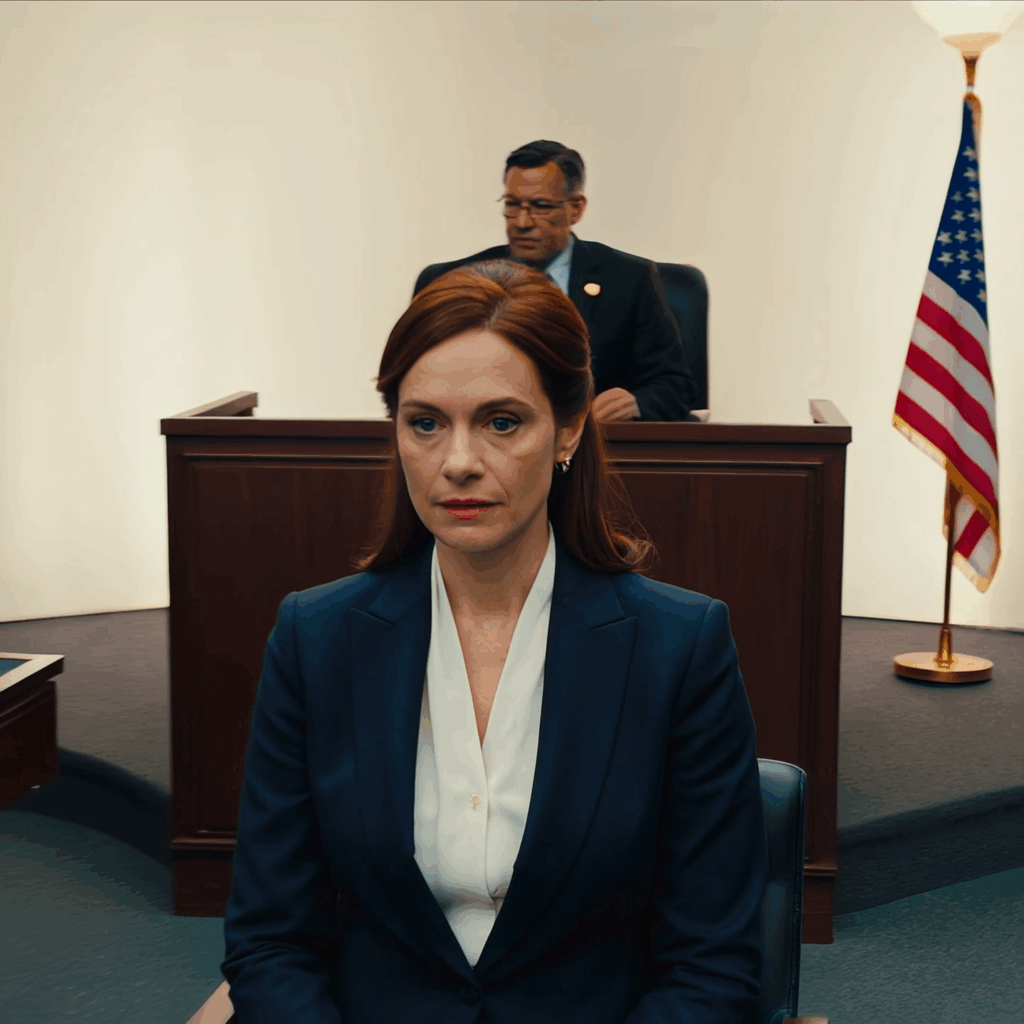
When I pushed through the heavy door, I saw them.
Victoria sat at the plaintiff’s table in a beige suit that had a lot of shoulder but not much structure. She did not look at me at first. Michael leaned in to murmur something to their attorney, a tall man with a jaw he probably paid to keep that square. When Victoria finally turned, she rolled her eyes—slow, theatrical, a teenager’s gesture preserved in amber—and put a hand on her pearls like I’d offended her by breathing. Behind them, Emma sat with her arms wrapped around herself. She was twenty‑one and beautiful in the way youth is beautiful—clear skin, glossy hair, a collarbone like a soft underline—and she stared through me as if I were a window.
The judge entered. We stood. Judge Davis had her hair pulled back tight, a posture that said she didn’t waste the court’s minutes. Karen had told me once, in the clipped way she says anything useful, that Davis had been one of my grandmother’s students a lifetime ago. None of that mattered here, she’d added, not unless the evidence marched in straight and didn’t stumble.
Evidence. I had boxes of it. Thirty years of it.
When the bailiff called the case, the name hit the hard surfaces: Victoria Mitchell and Michael Mitchell versus Sophia Mitchell, challenge to the will of Eleanor Mitchell, deceased. My mouth went dry at the sound of my own last name next to theirs, like a stapler had misfired and attached what was never meant to be bound.
Jonathan Stevens—jaw, cufflinks, billable hours—stood first. He talked about diminished capacity, about isolation, about how I had supposedly taken an old woman and walled her off from her only daughter. He said my name as if it were a symptom. He said only daughter like it was a spell, as if words could rewind a childhood that never occurred.
Karen didn’t button her jacket. She rose and let the room settle before she spoke. “Your Honor, this is a case about who stayed.” She didn’t raise her voice. She didn’t have to. “The record is going to show that Eleanor Mitchell made a deliberate, informed decision—over a decade ago and repeatedly reaffirmed—to leave her estate to the person who showed up every Sunday. We will show who called, who came, who didn’t. We will show what love looks like when it’s measured not in sentiment, but in attendance.”
Attendance. If you’ve spent any time in the ER, you know that word can be a lifeline. Who attended? Who stayed with the patient? Who knows the medication list because they were there when the pills were set in the little day‑of‑the‑week container? That’s what Karen meant. She meant the one who holds a hand when the ambulance lights fade out of the window. She meant me.
I am a cardiologist. I measure time in EKG intervals, in troponin bumps and blood pressure cuffs velcroed to anxious arms. I learned early that the body tells the truth even when people don’t. I learned it at a kitchen table before I learned it in medical school.
I was two when Victoria and Michael decided they were not interested in the project of me. They were very young, my grandmother said later. Young is a condition that passes. Disinterest endures if you feed it. Robert and Eleanor—Grandpa and Grandma—adopted me. They became my legal parents. People ask, sometimes, and they always do it sidelong, whether I miss the parents I “lost.” I never had them to lose. What I had were the ones who showed up.
My earliest memory is not of a face but of a smell: coffee and rose mulch. Grandpa would come in from the yard with gloves damp at the fingertips, flecks of soil on his wrists, and set me on the counter so I could see the world at an adult height. Grandma would say, “Counter’s not a playground, Soph,” and hand me the whisk anyway. Their kitchen had a window over the sink, and if you leaned in just right, you could watch the roses shake their heads in the afternoon breeze like they were laughing.
When I was ten, I asked why other kids had moms who showed up to pickup and dropped off brownies for class parties, and I had grandparents who knew exactly how long to bake a carrot cake so the edges caramelized without going dry. Grandma folded her hands on the oilcloth tablecloth and told me the truth. “They were very young,” she said. “They wanted to live their lives first.”
“Did they not want me?” I asked. Ten‑year‑old mouths are built for blunt instruments.
Grandma’s face was so gentle I thought it might break. “They thought about not having you at all,” she said. “We promised to help. We promised to love you, no matter what. We hoped they would, too.” She cleared her throat. “They tried. For two years. Then they made another choice. So we made ours official.”
I did not cry. The thing about a child’s heart is that it can accept an x‑ray without anesthesia. It can look at the outline of itself and say, Okay. That’s the shape of me.
A year later, I learned why you shouldn’t walk downstairs for water after bedtime. The kitchen light was on. Grandma was mad in a way that made the air look tight around her. “You have another daughter now, Victoria. You can still see Sophia sometimes. Just once in a while.”
On speaker, my mother sounded bored. “We love Emma. We want to raise Emma. Sophia was a mistake. She was a burden we couldn’t handle.”
Words are instruments, too. Some cut. Some cauterize. I stood in the shadow of the hall and let that one seal something shut that hadn’t fully formed yet. Grandma didn’t bring them up again after that. Neither did I.
They became the sort of parents who sat in the front row. Elementary school graduation with a paper cap folded along lines that never matched the staples; there they were. High school, where I gave a speech in a gym that sounded like a flood in reverse when everyone stood to leave; there they were. College, where the wind snapped at the gown sleeves like it wanted to lift us all; there they were. Medical school, where I shook a hand and thought, I have the right to walk into rooms where hearts are complicated. There they were, each time crying like the miracle never got old.
Sundays belonged to us. Even after I moved into my own apartment and the clinic hired me and the days started to rinse and repeat with patients who held their breath when I pressed the cold of the stethoscope to their chests, Sundays were for the house on a street with roses out front. We would work in the garden in the morning—Grandma teaching me to deadhead, to cut on a slant, to resist the temptation to overwater. We would bake in the afternoon. The carrot cake took discipline. She let me fail it into existence: too much nutmeg, not enough time for the cream cheese to come to room temperature, a frosting that split because I beat it too fast. When it finally came out right, she clapped her hands and said, “There. Now you can feed people.”
Three years ago, Grandpa went out to the yard and didn’t come back in. The ambulance lights made their small confetti on the living room ceiling, then disappeared. He was gone before they could do anything. I learned then that the worst sounds can be quiet ones: a kettle that never whistles, a chair that doesn’t scrape back, a door that doesn’t open at the usual hour.
After that, I made Sunday stricter. No matter the week, I went. We cooked, we baked, we watched old black‑and‑white movies that made me feel like memory had a picture to attach to it. Grandma never used a timer for the cake. She could smell it finish. “Pull it now,” she’d say, and she was always right.
Ten years before Grandpa died, they changed their will. They discussed it in the living room in voices low enough to be polite and loud enough that I could hear if I wanted to. Finally, Grandpa called me in and patted the cushion next to him. “We’ve decided,” he said. “The house, our savings, all of it. We’re leaving it to you.”
I cried then—not for the numbers but for the choice. There’s a kind of love that feels like a bone you can lean your whole body on. It doesn’t buckle. It holds.
The email arrived on a Wednesday afternoon, the kind of hour when clinic schedules start to lag and everyone’s five minutes late to everything. The subject line said: Legal notice, estate of Eleanor Mitchell. I skimmed it first, the way you triage a chart to see if the labs are catastrophic, and then I read it three more times as if repetition could smooth out meaning.
It said my parents were suing me. They were challenging the will. They had decided, thirty years after abdicating, to appear now with a claim that I had manipulated an elderly woman whose capacity had diminished. That language—diminished capacity—is so bloodless it almost feels clean. It isn’t. It covers every bad faith action like a crisp sheet covers bruises.
I hired Karen because she didn’t smile unless you said something earned. She specialized in estate litigation and carried a fountain pen that looked like it could sign treaties. “They’re going to say you isolated your grandmother from her daughter,” she said in our first meeting. “They’ll use that phrase exactly. They’ll say you cut off contact. They’ll try to tug on the court’s sense of family.”
“They never called,” I said. “They never came.”
“Can you prove that?” she asked, not unkindly, as if we were talking about cholesterol levels.
“Grandma kept diaries. Every day for three decades.”
Karen’s eyebrows lifted exactly one quarter of an inch. “Do you have them?”
“In boxes,” I said. “All of them.”
“Bring them,” she said. “We’re going to let Eleanor narrate this case.”
So I did the thing doctors do when the data matters: I read. I sat on my living room floor with cardboard flaps like open mouths and pulled out spiral notebooks and leather‑bound journals and a set of little calendar books whose elastic still bit at the corners. I read December 20, 1998: Victoria called today, says she’ll come for Christmas this year. Sophia is so excited. I baked extra cookies. I read December 15, 2000: Victoria says she’s definitely coming this time. She has gifts for Sophia. Told Sophia not to get her hopes up. I read December 20, 2001: Victoria called crying. Sorry for missing the last three years, swears she’ll be here Christmas Eve. Sophia says she doesn’t care anymore.
The entries went on like that—birthdays, Easters, graduations—like the steady drip of a faucet no one bothered to fix. Between the lines, sometimes, there was joy. Notes about my speeches, about the faces we made trying not to cry at ceremonies that expect composure. The pages smelled like paper and time.
When I handed Karen the first stack, she said, “We’ll authenticate these. We’ll pick representative dates. But we’ll bring them all. The court needs to see how routine this pattern became.”
Karen subpoenaed phone records for the landline that still hung in my grandparents’ kitchen. She highlighted calls to Victoria and Michael—dozens of them over fifteen years—most unanswered, the answered ones sputtering out after ninety seconds. She pulled photographs from my albums and Grandma’s, built a timeline of visual proof: kindergarten with the too‑big cap, high school with the printed program still folded into the frame, college, medical school. In every photograph, the same two people flanked me. They were the constant.
We called neighbors. Mrs. Chan next door. Mr. Patterson from across the street. Mrs. Rodriguez two houses down. Rosa, the housekeeper who had cleaned the corners of our lives for twenty‑five years and learned the same cake recipe standing at the same counter where I learned it. Each of them had a version of the same truth: Sundays were ours. Victoria’s car never appeared.
“We’re going to get a medical opinion from her primary physician,” Karen said. “Longitudinal records speak.”
“Dr. Johnson,” I said. “He’s had her chart since I was small.”
Karen nodded. “We’ll bring him. And we’ll prepare for surprises.”
Surprises look like certainty until they don’t. Jonathan Stevens called Dr. Christopher Wilson to the stand on the first day and asked him to speak like a man who loved hearing himself in a room built to make echo.
“Dr. Wilson, you treated the decedent in her final year?” Jonathan asked, his voice the shape of a leading question even when it wasn’t.
“I did,” Wilson said, smiling at the judge as if they’d split a bottle of wine once and agreed to be friends.
“What was your assessment of her mental state?”
“Significant cognitive decline,” he said. “She was frequently confused. Anxiety. Difficulty with dates.” He folded his hands in his lap like he had done a kindness by reciting this fiction.
“Did she ever express concerns about her granddaughter, the defendant?” Jonathan asked.
“She said she was worried Sophia only wanted her money,” Wilson said smoothly. “She said Sophia pressured her to change her will and cut her daughter out.”
My stomach dropped as if the floor had been a false level. Across the aisle, Victoria straightened, as if the story finally had a shape she knew how to inhabit.
Karen stood without theatrics. “Dr. Wilson,” she said, “when did you open your practice in San Diego?”
“About eight months ago,” he said.
“With whom?”
He hesitated. “Dr. David Thompson.”
Karen looked down at a paper she did not need to read. “David Thompson is Michael Mitchell’s cousin, correct?”
Wilson adjusted his cuff. “Yes.”
“How many times did you see Eleanor Mitchell?”
“I don’t recall exactly.”
“Twice,” Karen said. “Once in January. Once in February.” She did not look up. “And you prescribed sedatives for anxiety at whose request?”
Wilson paused longer this time. “Victoria Mitchell asked me to evaluate her mother.”
“Did you consult her primary physician, Dr. Paul Johnson?” Karen asked, “the physician who had treated her for thirty years?”
“No,” he said, and there it was—the hinge that lets the door swing back in your face.
“Dr. Johnson’s records will show no cognitive decline,” Karen said. “No dementia, no confusion. Eleanor Mitchell was oriented, independent, and managing her own affairs within two weeks of her death.” She let that sit in the air until its weight became a visible thing. “No further questions.”
Dr. Johnson followed like a steady pulse after a bad arrhythmia. He carried a file so thick it made a soft thud when he set it down. “I have treated Ms. Mitchell for thirty‑two years,” he said. “Routine visits every three months. I saw her two weeks before she passed.”
“Your assessment of her cognition?” Karen asked.
“Excellent,” he said. “Sharper than many of my younger patients. She could recall detailed histories without prompts. She made her own medical decisions. She managed her finances.”
“Was she capable of making informed decisions about her estate?”
“Absolutely,” he said, and the word was a gavel.
Jonathan Stevens didn’t try to cross. The jury box was empty—it was a bench trial—but even the benches felt like they were leaning toward Dr. Johnson.
Karen put Eleanor’s diaries on a cart and had the clerk swear them as exhibits. We didn’t cherry‑pick. We made a stack the size of a bedside table. Karen read entries with the clean precision of a nurse noting vitals: April 15, 2003—Called Victoria about Sophia’s piano recital next week; she said she’d try. I know she won’t. June 8, 2007—Sophia graduates high school next week with honors. Called Victoria and Michael. Michael said they’d think about it. I’m not holding my breath. June 15, 2007—Graduation day. Sophia gave the valedictorian speech. She was brilliant. Victoria and Michael weren’t there. They sent a card with $50.
She ran phone logs like an EKG strip: calls out, calls unanswered, calls that flatlined after two minutes. She showed photographs—me with paper caps and satin hoods; Robert in the front row with a camera that clicked; Eleanor in sunglasses that made her look like a movie star in a backyard. In none of them did Victoria or Michael appear—not blurry in the background, not cropped at the elbow. Absence can be proof if you have enough of it.
Neighbors testified. Mrs. Chan said, “Every Sunday like clockwork.” Mr. Patterson said the same. Mrs. Rodriguez nodded along. Rosa, in her church dress and flats, told the court about carrot cakes and a garden that always needed just a touch more water than you thought. Jonathan tried to suggest that I discouraged visits. Rosa shook her head. “Eleanor would have told me,” she said. “There was never a door closed on Victoria. She just never came.”
Then Karen called the numbers. She asked the financial adviser—Robert Chun, stern in a way that suggested he liked rules because they keep people honest—to testify. He had spreadsheets and bank statements tight in binders. “Did Eleanor provide financial support to Victoria and Michael?” she asked.
“Yes,” he said. “One thousand two hundred fifty dollars per month for twenty years. Fifteen thousand per year. Three hundred thousand dollars total.”
The amount sat in the room like a new piece of furniture no one knew what to do with. People shifted around it. Victoria looked at her hands. Michael’s jaw tightened.
“What was the stated purpose of those payments?” Karen asked.
“Support while raising Emma,” Chun said. “Eleanor wanted to ensure the child had what she needed.”
“Did Sophia ever request financial assistance beyond college tuition?”
“Never,” he said. “Not once.”
Karen had one more witness, and it wasn’t a neighbor or a doctor; it was Michael. He had to walk past me to reach the stand. His cologne smelled like something an airport sells in a glass case.
“How many of Sophia’s graduations did you attend?” Karen asked.
He frowned. “I’m not sure I understand the question.”
“Kindergarten. Elementary. Middle school. High school. College. Medical school.” Karen kept her tone neutral, almost conversational. “How many?”
He stared at the table as if the wood grain might give him a hint. “I don’t recall.”
“Zero,” Karen said. “You attended zero.” She waited. “What did Sophia study in college?”
“Law,” he said, then glanced at Jonathan. “Or maybe business.”
“Medicine,” Karen said softly. “She’s a cardiologist.” She let the word float over the room like a diagnosis finally spoken aloud. “Have you ever been to Sophia’s home?”
“No.”
“Do you know her address?”
“No.”
“Can you name any of her friends?”
Silence that lasted long enough to hear the clock. “No.”
“No further questions.”
When he stepped down, he did not look at me. Emma didn’t either.
The judge called a recess. The trial would resume in three weeks for closing arguments. I walked out of the courthouse with Karen. The sun on the steps felt like the kind that makes you squint even behind sunglasses.
The calls started two days later. I almost didn’t pick up when I saw Victoria’s name, but curiosity is an old muscle.
“We should settle this,” she said without hello. “It’s tearing the family apart.”
“There’s nothing to settle,” I said.
“Half for you, half for Emma,” she said briskly, like we were dividing a restaurant tab. “That’s fair. You’re both Eleanor’s granddaughters.”
“You want to talk about fair?” I said, something in me finally curious about the shape of my own voice when it’s not trying to be kind. “You abandoned me. You forgot I existed for thirty years. Now you want half of what my mother left me.”
“She’s your grandmother,” she said quickly, as if the term could erase the decades.
“She is my mother,” I said. “She raised me. She chose me.” I didn’t say you didn’t. I didn’t have to.
Emma texted once. You’re being cruel. You ruined our family. I stared at the little gray bubble until it lost its outline. I didn’t answer. The truth about DNA is that it’s not a promise. It’s a map someone else can crumple.
The messages shifted tones like a radio dial—pleading, threatening, performatively sad. You’ll regret turning your back on your family, Michael wrote. Please, Sophia. I’m your mother, Victoria wrote, and I had to set the phone down on the counter and walk away, because calling yourself something doesn’t make it true.
Karen read the messages with a face that edited nothing. “Tell them to stop,” she said. “Document that you consider this harassment. If they continue, the court can consider sanctions.”
The next time Victoria called, I said, “My attorney says your calls and messages constitute harassment. If you don’t stop, the court will hear about it.”
“You’re threatening your own mother,” she said.
“You are not my mother,” I said, and the sentence fit like a shoe that had been waiting on the mat for years. “Eleanor was my mother. Stop calling.”
They stopped.
In the quiet between then and closing arguments, life kept going the way life insists. I woke up early, saw patients, explained that palpitations have more than one cause and some of them aren’t dangerous, adjusted medications, reassured, ordered tests, called with results. At lunch, I would think about Karen’s questions, about the way the diaries looked when stacked—like a tower you could climb into the past. At night, I would cook something simple and then sit with a notebook I didn’t write much in. I visited the house on Sundays. I brought roses to the cemetery. I told the stones what was happening, which is a ridiculous thing to do if you aren’t the person I am.
Three weeks later, we went back to court. The same bench. The same smell of wood polish and old dust. The same bailiff who said “All rise” like he could do it forever.
Jonathan Stevens spoke first, and this time his voice had a sheen I recognized from patients who tell you they’ve quit smoking while you can still smell last night on their clothes. He talked about family obligations, about the “natural order,” about daughters and mothers and the moral wrong of being left out. He used the word stolen twice. He used the word rightful three times. He didn’t use the word evidence at all.
Karen stood with a single sheet of paper in her hand. “Your Honor,” she said, “Eleanor Mitchell asked that this be read if anyone ever challenged her will.” She didn’t raise her voice. She read.
I am leaving my estate to Sophia not because she is my granddaughter, but because she stayed. When my daughter abandoned her child, Sophia could have been bitter. Instead she became the light of our lives. She never missed a Sunday dinner—not in thirty years. She held my hand when Robert died. She made sure I was never alone. Victoria left me behind decades ago. She remembers me when she needs money. Sophia earned this inheritance through love and loyalty. This is my choice, made with a sound mind and a full heart.
Karen set the page down. The room was so quiet I could hear the squeak of leather as someone shifted in a seat three rows back. Victoria dabbed at her eye with a tissue. I didn’t feel sorry for her. I had, once. Pity is a kind of currency; I had spent enough of it.
Judge Davis looked at the letter for a long time. Then she looked at us. “I had the privilege of being taught by Professor Mitchell fifteen years ago,” she said, and for the first time her voice had softness in it, an old student’s awe threaded through a judge’s authority. “She taught me to look at evidence, not emotions.” She lifted her hand to the stack Karen had built. “Thirty years of diaries documenting broken promises. Phone records showing unanswered calls. Photographs showing absence at every major event. Financial records showing three hundred thousand dollars in support with no reciprocation, not even a visit. A letter written weeks before death by a woman whose primary physician testified unequivocally to her capacity.” She paused. “The law is clear.”
She looked directly at Victoria and Michael. “Eleanor Mitchell knew exactly what she was doing. She left her estate to the person who earned it through decades of love and loyalty. This suit is without merit.” She reached for the gavel. “I rule in favor of the defendant, Sophia Mitchell. The will stands as written. Furthermore, I am ordering the plaintiffs to pay the defendant’s legal fees for bringing this unfounded claim.”
The gavel struck. A small sound. A tectonic shift.
Outside, light pooled on the courthouse steps as if the building were pouring it. Karen put a hand on my shoulder the way you press a bandage—firm, not forever. “You won,” she said, and her mouth almost made a smile.
Victoria collected her bag without looking at me. Michael followed, face pinched. Emma drifted after them, a shadow not attached to anything. They walked down the steps and into a light that did not belong to them.
Karen and I did not linger. There is a way some victories insist on silence. In the car, I felt the odd lightness that comes when your muscles finally believe the weight is off. There was nothing to say but thank you, and I said it.
A year passed. I was thirty‑three. The clinic promoted me to deputy director because I could keep fifteen moving parts from knocking into each other while talking a sixty‑seven‑year‑old through why the statin would help more than it hurt. My hours got longer. I liked the work more. It is a specific feeling to be good at something that matters. It feels like the moment a stethoscope catches the exact sound you needed and you know what to do next.
I kept Sundays, but I widened the table. Instead of me and an empty chair across from me, there were colleagues, neighbors, friends. The first time, there were twelve of us. We ate roasted chicken and vegetables and someone brought a salad that tried too hard and still got eaten. Rosa arrived with the carrot cake. She had refused to retire, telling me I was impossible in a tone that made the word into affection. She is sixty‑seven now and still appears in my kitchen on Saturdays, humming, her hands knowing the recipe like a prayer.
I still live in my apartment during the week. On weekends, I stay at the house that will always be Eleanor’s in my head. The furniture is the same. The photographs are the same. The rose garden still insists on blooming with that stubborn generosity roses have when someone learns them well and then keeps learning them, year after year. In summer, I pick a vaseful and drive to the cemetery. I tell my grandparents about the dinners, about the promotion, about the neighbor who told me a story I hadn’t heard yet about me at six insisting on being helper in the kitchen and then getting bored and stealing frosting with my finger.
My phone does not ring with their names. My birthday came and went. I had cake at work and the sort of party that looks like an accident but feels orchestrated by someone kind. Rosa sent flowers with a card that said, “Happy birthday to my favorite person,” and I cried in a way that felt like something washing instead of something breaking.
Emma messaged me once on social media six months after the decision. “You ruined our family,” she wrote. “You’re selfish.” I blocked her and didn’t feel noble about it. There are doors I am no longer obligated to leave unlocked.
People like to say family is complicated in a tone that excuses sins they would call crimes if a stranger committed them. Family is not complicated. Family is attendance. It is the person who shows up at the right time and keeps showing up when there is no right time. It is the woman who taught me to deadhead roses and to pull a cake the minute before it looks done. It is the man who sat in the front row like he was witnessing a moon landing, every single time.
What I inherited feels incidental sometimes, like a receipt. The house is an address. The money is a series of numbers that keeps the lights on and would have kept them on for anyone who had sat across from Eleanor and fed her cake on a Sunday. What matters is the habit of love they taught me. The ritual of a table. The calibration of attention that lets you catch a flutter in a wrist pulse and know there’s more to ask.
On certain afternoons, the light in the kitchen falls just so and I can see Grandma’s hand on the back of the chair across from me. I can hear her laugh when the frosting goes glossy at last. I can feel the counter under my palms, the way it did when I was small and believed counters were high places meant for seeing better. The roses outside nod like they agree.
I say their names out loud then. “Robert,” I say. “Eleanor.”
Some days I add, “Mom.”
And because I can, because the court said so but mostly because the life said so, I mean me when I say family. I mean the people inside the house on Sundays. I mean the neighbors who testify with casseroles. I mean Rosa with her careful hands and a recipe that tastes like a promise kept.
The law gave me what was already mine. The rest, we built.
On the day I first walked into that courtroom, Victoria rolled her eyes like my presence offended the weather. Judge Davis walked in and measured us against the only thing that mattered: what happened. What happened is that I stayed. It is a simple sentence. It took thirty years to write.
When I leave the cemetery now, I take the long way home. I drive past the ocean and let the air scrub the week from my hair. At a red light, I look down at my hands on the wheel and think about how they didn’t shake that morning in October. How they closed around a folder that smelled faintly of cardboard and roses. How a gavel made a small sound and the world made a new shape around it.
Back at the house, I set the oven to 350°F. I line the pans. I shred the carrots. I beat the cream cheese until it agrees to be soft. It’s not complicated. It just takes attention. The timer is still unnecessary. I pull the cake when the room smells exactly like the afternoon it always has.
The table is set for whoever is coming. I don’t ask for RSVPs. People show up or they don’t. When they do, I make room. When they don’t, there’s leftover cake for breakfast. That’s the secret no one tells you: sometimes the happy ending is just a habit repeated in a house that remembers you. Sometimes it’s a garden that blooms because you learned how. Sometimes it’s the absence of a phone call you once waited for, and the presence of laughter that means you never will again.
On Sundays, we eat. We argue about movies. We take plates to the sink. Someone puts on coffee. The roses tilt their heads at the window. And every now and then, if the light catches just right, I can almost see Eleanor at the threshold, wiping her hands on a dish towel, saying what she always said when something turned out the way love says it should: “There. Now you can feed people.”
Leave a Reply