By the time the crowd in the university arena rose to their feet, the giant American flag hanging over the scoreboard barely moved in the air‑conditioning. The announcer’s voice crackled through the speakers, reading names in a steady rhythm while cameras flashed and families waved homemade signs. Somewhere behind the rows of folding chairs, a little girl shook a tiny flag on a plastic stick, its red and white stripes blurring as she jumped up and down. A family two rows ahead of me held a glitter poster with their son’s name outlined in blue lights. When the spotlight slid toward my section of the stage, the sound in the room swelled into a single roar.
My name echoed through the auditorium, sharp against the lights, and I walked across that stage holding my diploma case like it was something alive. I had ironed my gown three times that morning, smoothed my hair into a low knot, checked the mirror enough to convince myself I looked like someone who belonged there. For half a second I let myself hope I’d been wrong, that they were just late, that traffic or weather or one more excuse had finally broken in my favor.
Eight chairs with my last name taped neatly to the backs waited in the family row. My mother’s handwriting curled across each card: MITCHELL, printed in careful block letters.
All eight stayed empty.
No wave, no nod, not even a shadow. Just silence staring back at me while every other family screamed their pride into the air. A mom in a red cardigan cupped her hands around her mouth and yelled, “That’s my baby!” A dad in a ball cap whistled so loud the graduate onstage flinched and laughed.
I laughed once, quietly, the sound swallowed by applause, and kept walking. The photographer snapped a picture of me shaking the dean’s hand, my smile practiced and steady. Somewhere in that frozen image, it almost looked like I belonged to someone.
I stepped off the stage, headed down the ramp, and felt my phone buzz in the pocket of my gown. For one wild second I thought maybe, maybe, a text from my mother saying they were outside, that they were hurrying, that they were sorry.
There was nothing.
Under the fluorescent lights of the back corridor, with the American flag still hanging like a backdrop to other people’s pride, I scrolled through my notifications. Three marketing emails. One reminder about my student loan grace period. A spam text about an extended car warranty.
Zero from anyone who shared my last name.
I leaned my shoulder against the cool cinderblock wall and let the noise from the arena fade into a muffled roar. The smell of popcorn and floor cleaner floated down the hallway. A girl in the same black gown brushed past me, clutching a bouquet of sunflowers.
“My whole family showed up,” she said to her friend, her voice bright. “I didn’t think they’d all make it.”
“I barely found two tickets for mine,” the friend answered. “You’re lucky.”
I folded my phone into my palm until the case edges bit into my skin.
If there was a promise made that day, it wasn’t from them.
It was from me.
One quiet vow, tucked behind my teeth like a secret: if they weren’t going to show up when I had nothing, they didn’t get to rewrite the story when I had something.
Eight months later, when my five‑million‑dollar penthouse made the real‑estate headlines, that promise came due.
My name is Nora Mitchell, and for as long as I can remember, I learned to take up as little space as possible in my own family. Not because anyone said it outright, but because the rules were carved into the walls of our house long before I understood how families were supposed to work.
Elise, my older sister, was the bright one, the girl who never had to ask twice. Teachers used words like gifted and exceptional around her. My parents used words like proud. Her science fair trophies lined the mantel for years, polished every spring before guests came over. Her soccer medals dangled from her doorknob, clinking softly every time she shut it.
Ryan, the youngest, was the one everyone protected, even from the consequences he created himself. He was the golden boy with scraped knees and a permanent second chance. When he crashed Mom’s SUV into the mailbox at sixteen, Dad called it “a learning experience” and laughed about it over barbecue in the backyard. Later that week, when I accidentally dinged the side of my own beat‑up Civic on a parking garage column, he shook his head and said, “You have to be more careful, Nora. We can’t afford mistakes like that.”
And me? I became the quiet gap filler, the steady pair of hands, the person who stepped in whenever someone else stepped out. If there was a forgotten chore, I did it. If there was a missing form, I signed it. If there was a mess, I cleaned it before anyone noticed it had ever been there.
The pattern started early.
I still remember the morning Elise left her science project at home the day it was due. She had built a scale model of the solar system with Styrofoam balls and silver spray paint, and she left it on the breakfast table when she rushed for the bus.
Halfway down the driveway, she realized and burst into tears as if the world were ending. My mother panicked right along with her, fluttering between the car keys and Elise’s backpack, saying, “Oh honey, oh honey, we don’t have time, you’re going to lose so many points.”
I stood in the kitchen holding my own project, a carefully drawn blueprint of our house, each room measured and labeled, every doorway sketched with a ruler I’d borrowed from Dad’s toolbox. I had spent a week building it, staying up late with a flashlight under my covers, tracing lines until my eyes blurred.
Without thinking, I heard myself say, “She can take mine.”
My mother spun around. “Are you sure, sweetheart?”
I nodded because nodding was easier than watching Elise fall apart. Mom barely glanced at the blueprints before sliding them into Elise’s folder.
“See?” she said, kissing my sister’s hair. “Your sister always figures things out.”
Elise won second place at the fair. In the photo my parents framed on the mantel, she held my drawing in front of her ribbon. No one asked why I didn’t turn in anything. When my teacher pulled me aside and gently asked what had happened, I heard my mother’s voice in my own.
“I forgot,” I said. “It’s okay. I’ll figure something out next time.”
On the car ride home that night, Mom glanced at me in the rearview mirror.
“You’re such a problem solver, Nora,” she said, as if it were praise instead of dismissal.
That was the first time I realized being useful wasn’t the same thing as being seen.
It didn’t stop at school projects. When Elise got her driver’s license, Dad took the entire day off work to help her practice on quiet side streets, one hand braced on the dashboard, his voice patient as he talked her through every turn.
“Relax your shoulders,” he’d say. “You’ve got this.”
When it was my turn two years later, he tossed me the keys in the driveway and said, “You’re a careful kid. You’ll be fine. Just don’t scratch the car.” Mom stayed inside finishing a grocery list. Ryan sat in the backseat, playing on his phone.
I drove around the block twice, my heart hammering so hard my fingers shook on the wheel. At a four‑way stop, a truck eased forward and I hesitated too long. A car behind me honked, sharp and impatient.
Ryan laughed. “Come on, Nora, even I can do better than that.”
I swallowed, pressed the gas, and pretended I didn’t hear.
Years later, when I got my first part‑time job at a coffee shop off the highway, I saved every extra dollar in a glass jar in my closet. I wrote DRAFTING TOOLS on a strip of masking tape and stuck it to the side. It wasn’t much, just tips and the occasional overtime hour, but it was the first money that felt like it belonged to a dream I was brave enough to name.
Architecture sounded too big when I said it out loud, like something reserved for other people’s kids. So instead, I called it drawing buildings. I doodled floor plans on the backs of receipts, sketched staircases on napkins, and filled an entire notebook with different versions of the same front porch. In the corners of the pages, I wrote little numbers—square footage, dimensions, imaginary budgets.
Sometimes, when the shop was slow, I would stand at the window and stare at the older brick buildings across the street, counting windows, tracing cornices with my eyes, imagining what I would do if someone handed me the keys.
One afternoon, after months of saving, I finally had enough to buy a small set of professional drafting tools: mechanical pencils, a metal ruler, a triangular scale, and a battered secondhand drawing board I found on a local listing for $79.
The day the package arrived, I carried it to my room like it was made of glass. I hadn’t even opened the box when Dad knocked on my door.
“You got a minute, kiddo?” he asked, stepping inside without waiting for an answer.
“Sure,” I said, pushing the box onto my bed, my fingers still dented from the cardboard.
He cleared his throat, already looking uncomfortable.
“I’m in a bit of a bind,” he said. “Your sister forgot to pay a bill, and there’s a late fee stacking up. Nothing huge, just one of those things. You know how she is.”
I knew how she was. Forgetful. Charming. Untouched by consequences.
“I was wondering if I could borrow that money you’ve been saving.” Dad nodded toward the envelope on my desk, the one that held the cash I hadn’t yet traded for my tools.
My stomach tightened. “It’s for—” I started.
“You’re responsible,” he said, already walking over, already picking it up. “She has a good heart. She just needs time to learn this stuff.”
The envelope felt light when he lifted it, like the air had been sucked out of my room. I opened my mouth, searching for the right words, something that would explain that this wasn’t just money, it was the first solid step toward the future I could almost see.
“I’ll pay you back,” he promised, patting my shoulder. “You always land on your feet, Nora. That’s what I love about you.”
He loved my ability to bend.
I nodded because nodding was easier than arguing. After he left, I sat on the edge of my bed with the unopened box beside me, palms pressed against the cardboard like I could will it to fill the empty space the envelope had left behind.
That night, I told myself it was just a delay, that being the responsible one meant sometimes giving up what you wanted so other people didn’t have to feel uncomfortable. It felt like maturity. It felt like love.
It also felt like erasure.
Even birthdays followed the same script. One year, when I turned eighteen, I baked a cake for everyone. Chocolate, the kind Mom liked. I spent the afternoon in our narrow kitchen, measuring sugar with the good measuring cups and sifting cocoa powder until the air smelled like warmth. I wrote Happy Birthday in careful white icing along the top and set it on the counter, proud of the even layers and smooth frosting.
Elise arrived late, breezing in with her hair still damp from a salon appointment, carrying a box of store‑bought cookies shaped like flowers. The label from the high‑end bakery downtown was impossible to miss.
“Oh, you shouldn’t have,” Mom said, her face lighting up. She kissed Elise’s cheek and held the box up to admire the logo. “You always think of the sweetest things.”
I stood there holding the cake server, the words Happy Birthday starting to blur. No one commented on the cake. No one asked if I had made it. When we sang, the candles flickered on the dessert I had baked, but the thanks went to Elise’s cookies.
Later that night, after everyone had gone home and the dishwasher hummed in the background, I scraped the last dried frosting from the mixing bowl. Mom walked in, scrolling through her phone.
“Next year we should just order from that bakery again,” she said. “It makes things so much easier.”
“Sure,” I replied, rinsing the bowl. My fingers pruned under the hot water.
Somewhere between the first slice and the last crumb, I realized I had been erased without anyone noticing.
The memory that binds it all together, the one that still sits like cold metal in my chest, came years later in the tiny studio apartment I could barely afford. Winter in Seattle doesn’t always mean snow, but the damp finds every crack. My building’s heater had chosen that month to die, and the landlord had chosen that month to ignore every email.
I was wrapped in two jackets, fingers stiff inside fingerless gloves, leaning over my chipped desk revising a floor plan for a duplex I hoped to renovate. Rent reminders blinked on my phone. A stack of bills, each stamped with a due date, sat fanned out beside my laptop. My breath made small clouds in the air when I exhaled.
The duplex wasn’t even mine yet. It was a hypothetical deal I was doing on spec—running numbers, drafting potential layouts, teaching myself to see not just what a space was, but what it could be. I traced new walls in pencil, imagining where light would fall, where people would drop shoes by the door, where a kid might build a blanket fort.
For the first time, I thought about asking my parents for help. Not for a handout, just for advice. Just Dad’s voice. He’d been in the construction world for years, flipping houses with his partner Gerald, talking about leverage and loans over Sunday dinner while I washed dishes in the background.
I stared at his contact on my phone for a full minute before pressing call.
He answered on the third ring. “Yeah?”
“Hey, Dad,” I said, tucking the phone between my shoulder and ear. “Do you have a minute?”
“I’m in the truck,” he said. I could hear the blinker clicking, the low rumble of the engine. “Make it quick.”
“I’m looking at a duplex,” I said, spreading the plans out with my free hand. “It needs work, but the numbers could make sense if I structure the offer right. I was wondering how you’d approach—”
He cut me off with a low chuckle that didn’t sound amused.
“Real estate is for men who understand numbers, Nora,” he said. “You should try something safer.”
The words landed harder than the cold. My pen paused over the paper.
“I do understand numbers,” I said softly. “I’ve been working on—”
“I gotta go,” he interrupted. “We’re backing up a trailer. Be careful, okay? Don’t get in over your head.”
Then he hung up.
The silence in my apartment surged back, louder than the city outside. The radiator stayed dead. A siren wailed a few blocks away and faded. Upstairs, someone dropped something heavy and cursed.
I stared at my phone for a long time, thumb hovering over the screen like I could rewind what he’d said.
That night, the stitching on my black portfolio tore open. I’d had it since college, a cheap thing I’d bought on sale, its seams worn from too many interviews and too many projects. When the corner split, papers spilled onto the floor like they were trying to run.
I didn’t throw it away. I sat under the weak light of my desk lamp and sewed it shut by hand, the needle shaking each time I pushed it through the fabric. My fingers were so cold the thread kept slipping, but I kept going until the seam held, crooked in one corner but solid.
That portfolio became the only thing that stayed with me through every project afterward. Every time I picked it up, I remembered two things at once: my father’s voice telling me real estate was for men, and my own hands quietly refusing to let go.
That was the night I made myself a quiet promise. If they were never going to take me seriously, then one day I would build something so undeniable that they would have to see it—and when that day came, I would decide how much of me they were allowed to touch.
And then came graduation.
My name echoed through the stadium, the applause rising like a wave. I turned toward the family section, toward those eight chairs with little cards showing my last name. All eight were empty. They hadn’t forgotten. They had chosen not to come.
That was the day I understood exactly where I stood in my family.
After the ceremony, I stood alone under a concrete overhang while classmates posed for photos. A girl from my studio handed her phone to her dad and pulled me into the frame.
“Get one of us too, Mr. Harris,” she said.
He smiled at me. “Your folks around here somewhere?”
“Running late,” I lied. “You know how it is.”
He nodded, completely believing me. “They’ll be proud when they get here,” he said.
I swallowed the answer that wanted to come out and smiled for the picture instead.
Eight months slipped by after that ceremony. Quiet, clean months where no one said my name unless they needed to compare it to someone else’s. When relatives asked how we were doing in the family group chat, Elise sent photos of her new condo. Ryan posted gym selfies and shots of boat days with friends. My parents sent pictures of barbecues and weekend getaways, American flags waving in the background on Memorial Day and the Fourth of July.
I worked. I saved. I signed whatever deals I could reach. I took every valuation the firm would throw my way, staying late to run numbers for developers who barely remembered my face but always remembered my accuracy. I learned interest‑rate spreads and cap rates and the language of risk. I drank bad office coffee and learned the shape of Seattle’s neighborhoods by the way the light hit their rooftops at different times of day.
And I didn’t tell my family a single thing.
Silence felt safer than offering them something they could overlook again.
The penthouse didn’t drop into my lap. It started as a whisper—an older high‑rise near the waterfront, half empty and stuck in the 1990s, its top floor sitting vacant because no one wanted to invest in bringing it up to modern standards. The owner was tired, the building tired with him.
I saw the listing during a late‑night research spiral, the kind where tabs multiplied across my browser like a skyline. The price looked wrong: lower than it should have been, buried under a stack of contingencies and disclaimers about needed upgrades.
I printed the details and slid them into my black portfolio, the stitched seam pulling just faintly when I closed it.
For weeks, I ran numbers on that building during my lunch breaks. I took the long way home to drive past it, circling the block like a plane waiting for clearance. I stood across the street with a to‑go cup of coffee and counted balconies, traced the vertical lines of the facade, watched how the light hit the top floor in the late afternoon.
I knew I was supposed to wait. Wait until I had more savings, more backing, more permission. But the longer I stared at that building, the more it felt like an echo of the duplex plans on my cold desk years before. Only this time, I wasn’t calling my father for advice.
I called a lender I’d worked with on smaller projects, a woman named Denise who had once told me she trusted my numbers more than some senior associates.
“I have a question,” I said, sending her my spreadsheets. “Tell me if I’m out of my mind.”
She called back fifteen minutes later.
“You’re not out of your mind,” she said. “You’re ambitious.”
“The bad kind or the good kind?” I asked.
“The kind that makes people uncomfortable,” she replied. “Which usually means you’re on to something. You’ll need partners. You’ll need to be prepared for everyone to doubt you. But the math holds.”
We spent the next three months assembling a structure that wouldn’t collapse under the weight of one misstep. A small group of investors. A renovation budget that looked terrifying on paper. A timeline that left no room for disaster. I walked contractors through the building with my portfolio pressed to my chest, scribbling notes as they listed off plumbing issues and wiring limitations.
“You know this is a heavy lift, right?” one electrician said, shining his flashlight into a shadowy ceiling.
“I do,” I answered. “But I’m not planning to do it alone.”
I learned how to speak the language of permits and inspections, how to negotiate with a tile supplier at nine o’clock at night, how to politely but firmly push back when a contractor called me “sweetheart” on a job site.
When the sale closed, I signed my name at the bottom of a stack of papers so thick it left an imprint on my fingers. The seller slid the keys across the table—a small, scratched key ring that didn’t look like it could possibly unlock something worth millions.
“Good luck, Ms. Mitchell,” he said. “She’s a stubborn building.”
“So am I,” I replied.
Those months blurred together. I spent mornings at the office, afternoons at the site, evenings at my kitchen table with my laptop open and my black portfolio spread out beside it. Some nights I fell asleep on the couch with floor plans stuck to my cheek. I learned exactly how many light fixtures could be upgraded without blowing the budget and precisely how much natural light you could coax into a corner unit if you opened a wall.
It was exhausting. It was terrifying. It was mine.
The first time I stepped onto the finished penthouse floor with everything in place—the new hardwood gleaming, the open kitchen catching the reflection of the city lights, the floor‑to‑ceiling windows framing the skyline—I stood very still.
The realtor whistled under her breath. “You sure you don’t want to keep this for yourself, Nora?” she asked.
I ran my hand along the edge of the island countertop, the stone cool under my fingertips.
“One day,” I said.
One day came sooner than I thought. An out‑of‑state buyer walked through, took one lap around the space, and said, “We’ll take it,” like she was ordering dessert.
The sale price: $5,000,000.
On paper, it was just a number. In real life, it was proof that the girl who once gave away her science project and her savings could build something no one could ignore.
One afternoon, I was sitting in my aging Honda Civic outside a job site, letting the engine hum under my hand while I reviewed a revised valuation for the next project. The dashboard had a tiny American flag magnet stuck to the vent, a freebie from a Fourth of July parade years earlier. The edges had faded, red turned almost pink, but I never took it down. It reminded me that even the smallest things could stake a claim.
A notification slid across my screen, an article forwarded from a colleague I barely remembered from a networking event downtown.
Thought you’d want to see this. Congrats, the message read.
I opened the link without thinking. The headline took up half the screen.
Local Developer’s $5 Million Penthouse Renovation Makes Seattle Real‑Estate Headlines.
My name was printed right under it, bold against a photo of the building I’d rebuilt inch by inch. The article listed numbers, timelines, the renovation process, projected returns. It talked about how we’d turned a tired high‑rise into a lighthouse for the skyline, about how the top‑floor unit—my top‑floor unit—had set a new price point for the district.
My phone buzzed with more links, more congratulations, most from people I barely knew. A lender. An inspector. A junior associate who’d once rolled her eyes at my spreadsheet color coding. Notifications stacked up like a skyline of their own.
None of them were from my family.
I set the phone face down on the passenger seat, staring through the windshield as late‑afternoon clouds pulled over the sky. For a long moment, I didn’t feel proud or relieved. I just felt still, like the world had paused to see what I would do next.
Then the phone vibrated again.
This time, the name on the screen wasn’t a colleague.
It was my father.
The message was short, direct, written exactly in his tone. No greeting, no softness.
Family dinner. 6 p.m. Important discussion.
There was no how have you been, no congratulations, just a summons. Ten seconds later, another message followed.
Don’t be late.
I held the phone between my fingers, feeling the weight of eight silent months pressing through the glass. This wasn’t a reunion. It was a transaction dressed as family.
Outside my windshield, a kid on a skateboard rolled past, hoodie up, earbuds in, completely unaware that my entire life had just tilted a few degrees.
I didn’t breathe for a moment. Somewhere in the distance, a siren wailed and faded, swallowed by the steady rush of traffic on the freeway.
Then, in the familiar rhythm I’d learned long ago, I inhaled once through my nose, let my shoulders settle, and typed the only answer he deserved.
I’ll be there.
I dropped the phone back onto the seat, started the engine again, and watched the streetlights flicker to life as the sky shifted toward evening. Whatever they wanted from me, they had already shown me something more important.
They only remembered me when the world did.
The message stayed on my screen long after the engine stopped rumbling beneath me. I sat there in the fading light, my hands still on the wheel, the cold plastic buzzing faintly from the vibration of one more notification—another article, another forwarded congratulations. The world suddenly had a lot to say. My family, after months of silence, suddenly did, too.
But I didn’t drive to my parents’ house.
Not yet.
Instead, I pulled into the small lot behind my office building, a place no one from my family had ever bothered to visit. The sky was sinking into that bluish gray that always makes Seattle feel quieter than it really is. I locked the car, climbed the stairs, and let the heavy door close behind me.
Inside, the familiar hum of the fluorescent lights settled into my bones. The office looked different at that hour—rows of cubicles emptied of their daytime chatter, computer screens dark, the break‑room fridge humming like a distant engine. I walked past the framed rendering of our firm’s first big project, the one my father always bragged about at barbecues as if he’d drawn the plans himself.
In my small corner office, I set my black portfolio on the desk, the same one I’d stitched by hand years before. The seam was still there, crooked in one corner, a reminder of that freezing night in the studio when I told myself I wasn’t going to give up.
I opened it slowly. Paper brushed against paper—contracts, valuations, spreadsheets, progress reports. My entire professional life, organized in signatures and dates. Not one sheet owed anything to my family.
I didn’t feel angry. I didn’t feel triumphant either.
I felt precise.
I turned on my laptop, and the room filled with the soft whirring of the fan. My fingers moved automatically, checking the project ledger, reviewing payments, highlighting the line items that would close in the next six weeks. Numbers steadied me in a way people never had. Email. Spreadsheet. Signed. Filed. Archived. Deleted. Each action landed like a quiet heartbeat.
At one point, my coworker Maya popped her head into my doorway, jacket slung over one arm.
“You’re still here?” she asked. “It’s almost seven.”
“Just finishing up,” I said.
She smiled. “I saw the article, by the way. You’re kind of a big deal.”
“Just a girl with a stubborn building,” I said.
Maya rolled her eyes fondly. “You’re allowed to be proud, you know.”
I shrugged. Pride felt too close to inviting people in. “Maybe later.”
“If you ever need backup with your family, I’m happy to pretend to be your terrifying lawyer,” she joked.
I laughed. “I’ll keep that in mind.”
When she left, the office felt even quieter.
At 6:42 p.m., I stood and crossed the room to the long window overlooking the city. The building across the street had already turned on its interior lights, making its glass glow in a soft amber grid. My reflection hovered there, blazer creased from work, hair tied back, exhaustion sharpening my jawline.
It was the face of someone who had earned every inch of the $5 million penthouse the article mentioned.
I watched my reflection breathe. I hadn’t done that in a long time.
My phone vibrated on the desk. Another message, not from my father this time—someone from a firm downtown wanting to congratulate me on the penthouse. I let it buzz. Ten seconds later, another message. A reporter requesting a quote. Then another. My phone became a nervous animal rattling across the wood.
I flipped it over and turned off the sound.
Silence returned. This was what mattered, not their noise.
My plan was already in motion.
I sat again and pulled out the acquisition file I had finalized that morning, the one for the commercial plaza that had taken four months of negotiations, dozens of site visits, and far too many late‑night calls with inspectors. It was a modest complex on paper—twenty‑three rental units, a corner café, a small grocery, and a surface lot—but it sat on a piece of land every serious developer in the district had circled on their maps.
It was, without question, the most important purchase I had ever made.
It also wasn’t lost on me that the plaza was a key piece of almost every major development plan in the area. I didn’t know officially that my father and Gerald wanted it, but real estate is a small world, especially in a city shaped like Seattle. You hear things when you work quietly, when you don’t brag, when you keep your head down and listen.
At a networking breakfast two weeks earlier, I’d heard Gerald say to another investor, “Once we lock down that plaza, the whole warehouse district will fall into place. It’s our anchor. Without it, nothing pencils.”
He hadn’t noticed me standing a few feet away, pouring coffee, my name tag slightly askew.
I ran my fingers along the edge of the final signed page now, tracing the ink I had pressed into it only hours earlier. My signature looked small next to the purchase price, but it was there, in blue ink, under the words Buyer of Record.
They wanted me at dinner. They wanted something from me, something big.
I didn’t need a confrontation.
I needed clarity.
I reread every clause, every footnote, every closing condition. I double‑checked the deadlines and the contingencies. The plaza was mine, legally and cleanly. There was nothing they could take, only something they might try to negotiate.
Then I slid the entire packet into the black portfolio, pressing it flat with the palm of my hand. The action felt like sealing a door.
By the time the office clock blinked to 7:19 p.m., the windows had faded into a deep navy. The cleaning crew rattled their carts down the hallway, their quiet greetings echoing off the walls. I reached for my coat, then stopped.
The coat felt unnecessary, too soft, too personal.
I left it hanging and walked out with only the portfolio in my hand.
The hallway lights clicked off behind me as I moved. Outside, my Honda waited, its faded paint catching what little streetlight it could. I unlocked it, placed the portfolio in the passenger seat, and slid behind the wheel. For a moment, I watched the city breathe—traffic easing, lights flickering, wind riffling through the last leaves of early autumn.
Everything I had built came from this silence.
As I pulled onto the freeway, the city spread out ahead of me like a map I had already memorized. I drove past the buildings I’d helped renovate, past the corners where I’d once stood waiting for buses because my family never offered to pick me up, past the bridge where I’d walked home more times than I wanted to remember.
Every landmark felt like a tally mark.
Here’s where they weren’t. Here’s where I learned to live without them.
The portfolio lay still beside me. At a red light, I brushed my fingers against the stitched seam.
I didn’t rehearse what I would say at dinner. Words had never worked with them. They talked over apologies, talked past explanations, talked through every boundary I ever tried to draw.
So I’d stopped trying.
This time, I wouldn’t bring anger. I wouldn’t bring explanations.
I would bring proof.
When I reached the turn toward my parents’ neighborhood, I slowed the car. The houses lined the street like well‑behaved witnesses—quiet, trimmed, almost identical. Porch lights clicked on as the sun disappeared behind the hill. A few driveways sported basketball hoops and minivans. One house had a full‑size American flag mounted beside the front door, its fabric stirring in the evening breeze.
I pulled into my parents’ driveway at 6:59 p.m. My father would appreciate the punctuality.
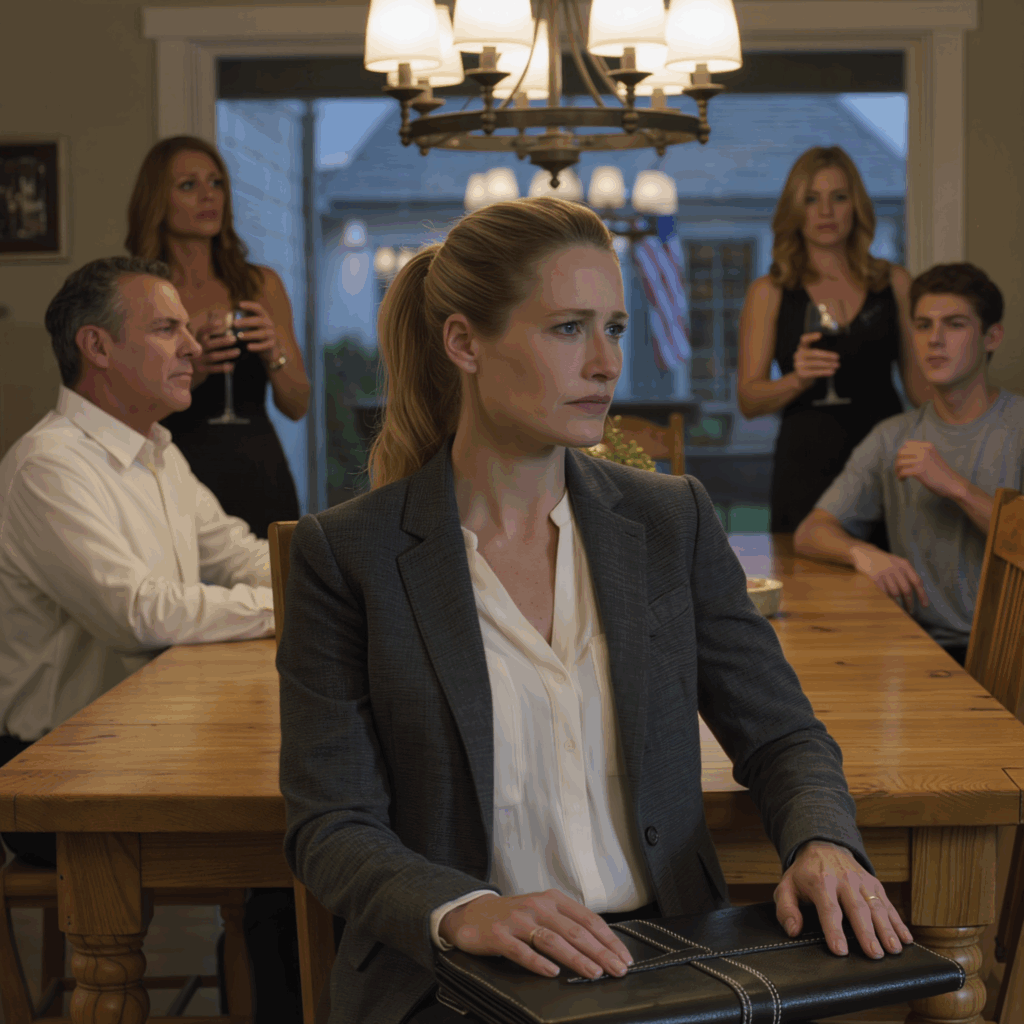
The house glowed in that familiar heavy gold, every window lit as if they were staging the evening for a holiday ad. Through the dining room window, I saw silhouettes moving—Elise leaning forward, Ryan gesturing, Dad pacing. My mother’s shadow passed between them, smoothing, soothing, arranging.
None of them knew what was sitting in the passenger seat of my car.
I opened the door, stepped out, and adjusted the collar of my blazer. One slow breath in, one steady breath out.
They wanted an important discussion.
Fine.
I had something important, too.
The front door opened before I could knock. My father filled the frame, shoulders squared like he was greeting a client instead of a daughter he hadn’t spoken to in eight months.
“You’re right on time,” he said, stepping aside. No hug, no warmth, just approval for punctuality.
“Traffic was clear,” I replied, brushing past him with the portfolio in my hand.
The smell of roast chicken and garlic drifted from the kitchen, layered with the scent of my mother’s floral candles. The dining room was already set—white plates, cloth napkins, wineglasses that only came out for company.
I supposed I counted as company now.
Elise sat straight‑backed at the table, swirling her wine like she was at a tasting. She wore a blazer more expensive than the car I used to drive, her nails painted a color that probably had a designer name.
“Look who decided to show up,” she said, her smile tight. “The woman of the hour.”
Ryan leaned back in his chair, one ankle resting on his knee, fingers tapping the table in a restless rhythm. “Big‑time developer now, huh?” he said. “Saw your face on my news app. Nice building.”
“You read something that didn’t have a score at the bottom?” I asked lightly.
He snorted. “Relax. I skimmed.”
Gerald, Dad’s business partner, adjusted his tie like he was preparing for a board meeting. My mother hovered behind her chair, smiling too hard.
“It’s so good to have everyone together,” she said. “Feels like old times.”
Old times, I thought, had never once involved them celebrating me.
“Sit, sit,” Dad said, gesturing toward the empty chair farthest from the head of the table, the one left open intentionally, an empty space they’d decided was mine.
I took the seat, set the portfolio on the chair beside me, within reach, and placed my napkin across my lap.
Dad cleared his throat. “Let’s get straight to it,” he said, as if we were already in the middle of a presentation. “We have an opportunity on the table.”
Of course we did.
My mother reached for the serving spoon. “Maybe we eat first?” she suggested.
“No time like the present,” Gerald said. He leaned forward, clasping his hands. “There’s a redevelopment project in the warehouse district. Valuable land, strong projections. We’re ready to move, but we need to finalize our capital stack.”
Elise nodded like she understood every word. Maybe she did. Maybe she just knew how to look like she did.
Dad continued, “We thought this could be a family partnership. You come in with funding, we guide the project. Everyone wins.”
“What kind of numbers are we talking about?” I asked, my voice calm.
Gerald brightened. “Acquisition around $8.2 million, renovation another $4 to $5 million over eighteen months, maybe twenty‑four if permitting drags. Conservative projections put returns at roughly twenty percent over five years. With your recent windfall”—he nodded toward me—“we figured you’d want to put that money to work instead of letting it sit.”
Elise lifted her glass. “It’s generous, honestly, considering how new you are to all this,” she said. “Dad and Gerald have decades of experience. You’d get to learn from the best.”
Ryan snorted. “Yeah, you’d be on the fast track instead of, you know, learning the hard way like we did.”
He had never once gone without a safety net in his life.
My mother placed a hand on my arm. “Sweetheart, this is a chance to be part of something bigger than yourself,” she said. “Your father knows this business. You don’t have to do everything alone.”
Their words spilled into the room one over the other, overlapping like static. Not a single apology. Not a single acknowledgement of the empty chairs at graduation, of the eight months of silence, of the years I’d spent sewing my life together with cold fingers while they toasted each other at barbecues.
Just their plan, wafting through the air like the smell of the roast cooling on the table.
I let them talk for another full minute. Elise chimed in with a story about a “networking dinner” she’d attended with Dad, dropping names I recognized from the local business section. Ryan bragged about a “small” flip he’d helped with—one I knew for a fact had been mostly managed by Gerald’s project manager.
I reached for my black portfolio and set it down in front of me. The sound—soft, controlled—cut through the conversation like a dropped coin.
The room stilled.
“I did come for an important discussion,” I said quietly.
Just not yours.
Dad frowned. “Nora, we don’t have time for—”
“I think you do,” I replied.
I unfastened the portfolio and opened it. A stack of documents, clipped and ordered, slid into the candlelight.
Gerald leaned forward, his brow tightening. “Is that—”
“The commercial plaza,” I said, my voice steady. “The one every development firm has been circling for months.”
Dad inhaled sharply. “You’re exaggerating,” he said. “That property isn’t even available.”
“It was,” I replied. “Four months ago.”
I placed the signed acquisition documents on the table. The glossy pages reflected the candle flames, and for a moment, their names floated across the numbers like ghosts.
Elise stopped breathing. Ryan’s chair creaked under him as he shifted. My father’s jaw clenched so tightly the muscle jumped in his cheek.
Gerald reached for the pages with trembling fingers. “You bought it,” he whispered.
“The entire plaza,” I said, nodding once. “Twenty‑three units, that corner café you love, the surface lot you’ve both been drooling over in your projections. Purchased, under contract, and already in the early stages of redesign.”
I tapped a line item with my finger, the key one.
“Which means your warehouse district project has no anchor property,” I said. “And no anchor means no funding, no approval, no investors.”
Dad finally found his voice. “Why would you do this?” he demanded. “You knew we were going after it.”
“No,” I corrected calmly. “I knew the city was going after it. And unlike you, I don’t wait for opportunities to come to me.”
“You don’t understand how these deals work,” he said. “You’re in over your head. If you’d brought this to me first, we could have structured it properly, protected you.”
Protected me.
The same man who had watched eight seats sit empty at my graduation was suddenly worried about my exposure to risk.
“I understand exactly how it works,” I said. “I ran the numbers. I negotiated the terms. I secured financing. And I closed. You’re not the only one who understands leverage.”
My mother’s voice cracked. “Nora, we’re supposed to be a family.”
“A family shows up,” I replied, the words landing one by one. “You skipped my graduation. You skipped my calls. You skipped my life. But you didn’t skip the headlines.”
Elise flinched. “We were busy,” she said weakly. “Things came up. You know how crazy that month was.”
“There are 168 hours in a week,” I said quietly. “My ceremony took two.”
No one argued with the math.
Silence expanded across the table, thick and unmoving. The only sound was the faint ticking of the wall clock and the low hum of the refrigerator in the kitchen.
“So what now?” Ryan asked finally. “You’re just… what? Cutting us out?”
“I’m owning what I built,” I said. “That’s different.”
“I could help you manage it,” Gerald said quickly, desperation seeping into his voice. “You’re taking on a lot, Nora. We have systems, crews—”
“I have a team,” I cut in. “Investors who believed in this when it was just a risky spreadsheet and a stubborn building. I’m answerable to them, not to people who only called when the number five million appeared next to my name.”
My mother’s eyes filled, but no tears fell. She had always been good at stopping them before they messed up her mascara.
“We didn’t know how to talk to you after…” She trailed off.
“After you didn’t show up?” I offered.
Her gaze dropped to her plate.
I gathered the documents, slid them neatly back into the portfolio, and closed it with a soft click.
“You wanted an important discussion,” I said. “This is it.”
Dad’s shoulders sagged, the authority leaking out of his posture. Elise looked down at her plate as if the pattern on the china could rescue her. Ryan mouthed something like a curse, barely audible, more habit than conviction.
“You’re making a mistake,” Dad said finally.
“I’ve made plenty,” I answered. “Letting you borrow my savings for Elise’s bill. Giving away my science project. Baking my own birthday cake and pretending it didn’t hurt when you thanked someone else. Showing up for people who never saved me a seat.”
I picked up the portfolio and stood, adjusting my blazer collar the way I always did when I was done explaining myself.
“Dinner’s yours,” I said, nodding toward the table. “But the future? That’s mine.”
No one followed me as I walked out. Chairs scraped softly, but no one stood. They just sat there, finally quiet.
The night air felt colder than I expected when I stepped outside, sharp enough to cut through the thin fabric of my blazer. The porch light behind me hummed quietly, flickering the way it always had when I was growing up. I stood there for a moment, letting the warmth from the house fade off my skin.
Then I walked to my Honda, opened the door, and slipped inside. The cabin smelled faintly of old upholstery and the vanilla air freshener I kept meaning to replace. The little flag magnet on the vent shivered with the first blast of air.
I rested both hands on the steering wheel, letting my breath settle.
Through the windshield, I could see the front window of my parents’ dining room. Shadows moved—someone gesturing, someone else sinking into their chair. I couldn’t hear a single word.
That silence felt earned.
My phone buzzed once on the passenger seat. A message from my mother.
We didn’t know how to make things right. Please don’t give up on us.
I didn’t open the thread. I didn’t delete it either. I just turned the phone face down and started the engine.
The drive home traced the same streets I’d taken a thousand times—past the corner store where Elise once made me wait in the cold while she talked to friends, past the park where Ryan used to brag about how Dad never let him fail, past the hill that had always looked bigger when I walked it alone at sixteen.
Each place looked smaller now, like it belonged to someone else’s memories.
Halfway back to the city, my phone buzzed again against the seat. Then again. I didn’t look. The car’s clock glowed in the dark, numbers flipping quietly from 7:43 to 7:44.
When I reached downtown, the city lights rose to meet me, white‑gold and steady. My penthouse building stood at the end of the block, its glass facade catching the glow of the streetlamps like a lighthouse. I parked, rode the elevator up, and unlocked the door.
The quiet inside was nothing like the quiet at my parents’ house. There was no tension clinging to the walls, no unfinished sentences hovering in the air. Just space—clean, open, mine.
I set the portfolio on the kitchen island. The stitched seam caught the light, casting a thin shadow across the marble. I traced it with one finger, remembering the cold night I’d sewn it shut in that studio apartment with no heating. Back then, the silence had felt like punishment.
Tonight, it felt like clarity.
I kicked off my shoes and walked barefoot across the warm hardwood. The penthouse still smelled faintly of fresh paint and new wood. Floor‑to‑ceiling windows framed the city, the water, the dark line of the horizon. Headlights drifted along the freeway like beads on a string. A ferry moved slowly across the bay, its lights a gentle line.
I crossed to the window and leaned my forehead against the cool glass. Far below, a couple walked a dog past the building’s entrance. Someone in a neighboring tower flicked off their lights, their window going from bright to dark in a blink.
For the first time in years, I didn’t feel the need to explain myself to anyone.
I finally understood: silence isn’t what hurts.
It’s who breaks it—and why.
My phone buzzed again on the counter, a faint rattle against the stone. I walked back and flipped it over. A string of messages filled the screen.
Mom: We didn’t mean to hurt you.
Elise: You blindsided us. That wasn’t fair.
Dad: We need to talk about next steps. Call me.
A missed call from Gerald. A voicemail notification.
I set the phone down without listening to any of it.
Instead, I opened my email and pulled up the folder labeled PLAZA – COMMUNITY PLAN. Inside were notes from local tenants, sketches for potential shared spaces, a draft outline for a small scholarship fund I’d been considering—$2,500 a year, just enough to help a kid in the neighborhood take a first step toward whatever dream felt too big to say out loud.
I had written the words Working title: Seat at the table across the top of the document.
Looking at it now, I felt something in my chest loosen.
All my life, I had been trying to earn a chair at a table where my place card kept getting moved. Maybe the trick was to stop begging for a seat and start building new tables.
Over the next few days, the fallout from dinner settled like dust.
Dad left two voicemails about “finding a way to collaborate” and “keeping this in the family.” Gerald’s email asked if I would consider selling them a controlling interest in the plaza or at least structuring a long‑term master lease.
Elise sent a message that started with I’m sorry you feel that way and ended with You didn’t have to make us look small.
Ryan texted once: Guess you really showed us, huh.
I didn’t answer any of them immediately. I let their words pile up while I met with my architect, sat down with my property manager, and walked through the plaza with a notebook in hand, jotting down which brickwork needed repointing and which storefronts could use better lighting.
In the mornings, I brought coffee to the woman who ran the corner café and asked what hours actually made sense for her staff. In the afternoons, I watched kids cut through the parking lot after school, their backpacks slung low, their sneakers dragging lines through the gravel.
“This place could be more than numbers,” I told Maya one evening as we stood on the sidewalk, looking up at the row of second‑floor units. “It could be something steady. A place people count on, not just pass through.”
“You’re allowed to make money and a point at the same time,” she said. “Both can be true.”
A week later, Dad finally showed up at my office.
He didn’t call ahead. He just walked in, his boots leaving faint traces of dust on the polished floor, and stopped at my doorway.
“Got a minute?” he asked.
I looked up from my screen, then at the black portfolio resting open on my desk. The acquisition file for the plaza sat on top, corner of the stitched seam curling up just slightly.
“I have ten,” I said. “Then I’m due at a site visit.”
He shut the door behind him and sat down in the chair across from me. For a moment, he just stared at the framed floor plan on the wall—a print of the penthouse layout, lines crisp and clean.
“You did good work there,” he said finally.
“Thank you,” I replied.
He cleared his throat. “Look, about the other night—”
I held up a hand. “If you’re here to talk me into selling you the plaza, you’re wasting both our time.”
His jaw tightened. “You’re being stubborn.”
“So is that building,” I said. “We’ll get along fine.”
He let out a breath, something between a sigh and a laugh. “You know, your grandfather started with one duplex he could barely afford. Nobody took him seriously either.”
“I know,” I said. I’d heard the story a hundred times. “The difference is, I didn’t have him cheering me on from the sidelines.”
He shifted in his chair. “I didn’t think you needed us,” he said. “You always landed on your feet. Elise… Ryan… they needed more.”
“That’s the thing about always landing on your feet,” I said quietly. “People stop wondering how far you had to fall first.”
He looked at me then, really looked, the way a home inspector peers at a foundation crack and finally admits it’s not just cosmetic.
“So what do you want, Nora?” he asked. “To cut us out forever? To prove a point?”
“I already proved my point,” I said. “I built something without you. What I want now is simple.”
I tapped the edge of my portfolio.
“I want you to understand that access to what I build is not automatic. It’s earned. You don’t get equity just because we share a last name.”
He bristled. “Families help each other.”
“Did you help me when I called from that freezing studio?” I asked. “When I asked for advice on a duplex and you told me real estate was for men who understand numbers?”
He flinched, just slightly.
“I don’t remember saying it like that,” he muttered.
“I do,” I said. “My hands were shaking too hard to forget.”
We sat in silence for a moment.
“I’m not selling you the plaza,” I continued. “I’m not giving you a master lease. If you or Gerald want to bid on a small tenant space like anyone else, you can go through the property manager. You’ll get the same terms as every other applicant. No better, no worse.”
“That’s… cold,” he said.
“It’s clear,” I replied. “Boundaries aren’t punishment. They’re conditions.”
He looked like he wanted to argue. Instead, he stood.
“You’re really not the little girl who gave her science project away anymore,” he said.
“I never should have been,” I answered.
After he left, I sat for a long moment, staring at the door he’d closed behind him.
The ache was still there. The part of me that had once baked her own birthday cake and hoped for praise still wanted someone to walk in with balloons and apologies.
But the rest of me—the part that had signed on dotted lines and climbed scaffolding and stood alone in an empty penthouse—knew better.
That night, back at my own place, I stood again at the floor‑to‑ceiling window, the city stretched out below me like a blueprint I had finally learned to read. The American flag on the building across the street snapped once in a gust of wind, then settled.
I watched my reflection in the glass: a woman with tired eyes and steady hands, a black portfolio on the counter behind her, its crooked seam catching the light.
All my life, I had kept saving seats for people who never showed up, leaving room for apologies that never came.
Now I understood something simpler.
Boundaries aren’t cruelty.
They’re quiet doors we close so our lives can breathe again.
I turned off the lights, letting the room fall into a calm, earned darkness, and listened to the hush settle around me like a new kind of home.
If you’ve ever rebuilt yourself in the silence someone left behind, I hope you know this much: you’re not invisible. You’re just building somewhere they never thought to look.
Some stories don’t begin when people show up.
Some begin the moment we stop waiting.
Leave a Reply