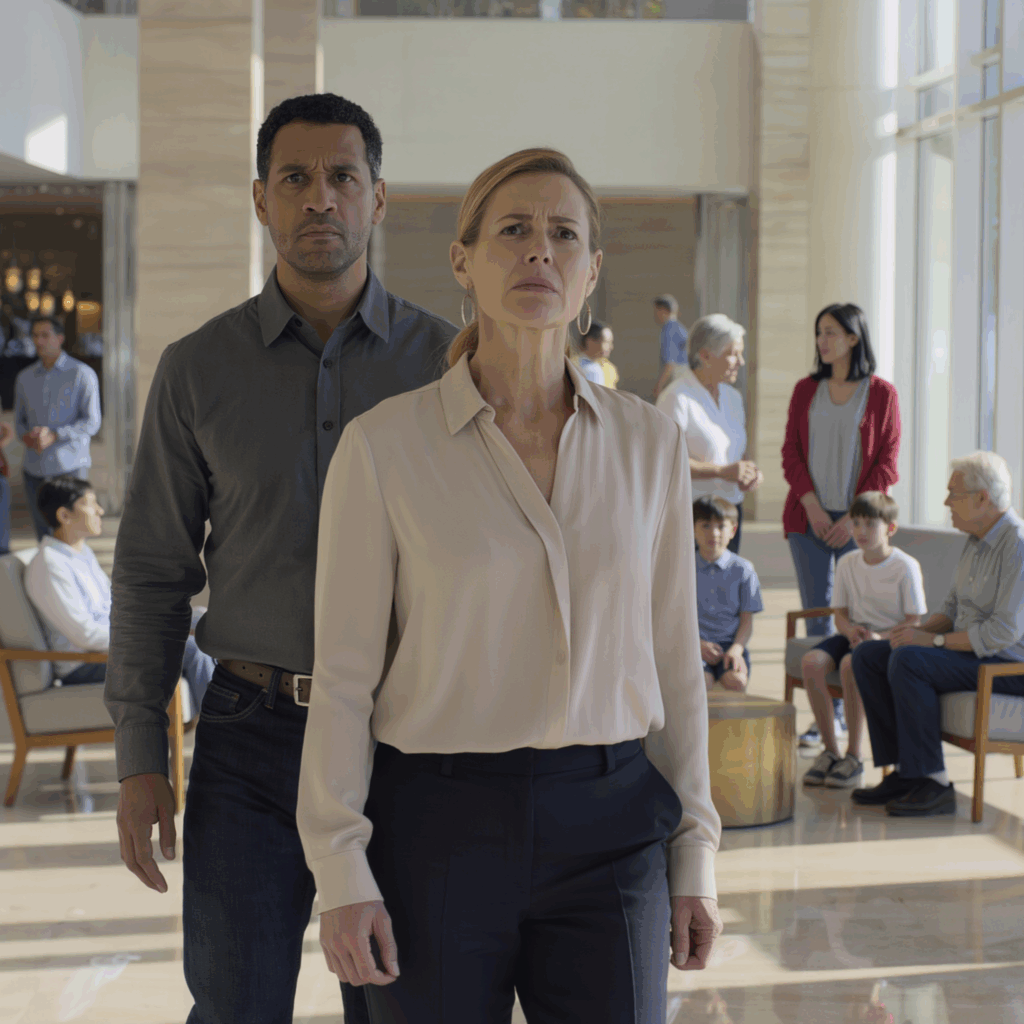
Resort security was pounding on the door two rooms down from mine so hard the framed evacuation map on my wall rattled. I could hear every word through the thin plaster and over the hum of the AC: my father insisting this was a mistake, my mother snapping about her rights, my sister threatening to call a lawyer back in the States like any sheriff’s office in America could do a thing for her in a beachfront hotel three time zones away. A child started crying. A calm male voice—security—said, “Ma’am, your reservation was cancelled. Checkout time was at eleven. If you do not leave voluntarily, we will have to involve local police.”
Twenty‑four hours earlier, my family thought it was hilarious.
Back then, the lobby smelled like citrus cleaner and too-strong coffee. Ceiling fans lazily pushed cool air down onto polished tile, and some old Frank Sinatra song was playing just loud enough to feel expensive. I’d picked this resort after three straight weeks of scrolling reviews while nursing iced tea at my kitchen table beneath the faded red-white-and-blue fridge magnet Dad brought back from D.C. when I was twelve. “Family deserves the best,” he’d said then.
Apparently, the definition of “family” had narrowed since.
They came in together, all smiles and chatter, like they were walking into a Fourth of July barbecue instead of the lobby of a hotel they hadn’t paid for. My parents in matching linen, my sister Kendra in a sundress that probably had no right to be that white after airport seating, her kids Max and Savannah already arguing over who got the first turn on the lobby Wi‑Fi.
But not Rose.
My daughter, eighteen years old, should’ve been right there between them, complaining about jet lag or asking where the nearest decent latte was. Instead, as they swept toward us, laughing, rolling their suitcases over the tile, there was a Rose‑shaped gap that made my brain stutter.
I scanned behind them once, twice. Maybe she was lagging, maybe she’d stopped at the restroom, maybe she was grabbing a bottle of water. My husband, Darius, shifted beside me; I felt the movement more than I saw it. He noticed it, too.
“Where’s Rose?” I asked.
I was aiming for casual. It came out sharp.
Dad didn’t even slow his pace. “She’s probably on the next flight,” he said, like we were talking about baggage, not a human being.
“The next flight,” I echoed. “What do you mean, the next flight?”
Mom waved a hand like she was batting away a fly. “She lost her passport during the layover. Some confusion at the airport. She’s sorting it out.”
Something in my chest clenched—a deep, animal warning that hits before your brain catches up. A plane, a layover, a missing passport, an eighteen‑year‑old girl.
“She lost it during the layover,” I repeated. “Where? London?”
There was a beat of silence. The kind of silence that makes your stomach drop.
“Not quite,” Dad said.
Darius turned fully toward them. “What does ‘not quite’ mean?”
“Oh, well,” Mom said, shrugging, like she was telling us about a cute sale at Target. “Our original flight got canceled, but your dad found us a much better deal. Two layovers and we saved a fortune. The airline didn’t even want to tell us about it, but your dad insisted.”
Dad puffed up a little. “They didn’t list it online,” he said proudly. “Khartoum was quicker and cheaper. Total win.”
Darius blinked. “Khartoum,” he repeated.
I turned to face them, every nerve ending suddenly awake. “You rerouted through Sudan?”
Dad shrugged again. “There were lots of open seats. Plus, they compensated us for the canceled flight. We came out ahead.”
“And where exactly did she lose the passport?” I asked, though I already knew what he was going to say.
“In Khartoum,” he replied.
“You’re joking.”
I scanned their faces, hunting for a smirk, a twitch, some sign this was a bad prank. Mom’s expression was mildly annoyed, like I was making a big deal out of the wrong thing. Kendra looked bored. Savannah was already half‑buried in her phone. Max nudged her and laughed.
“You should’ve seen her when she figured it out,” he said. “It was priceless.”
Savannah snorted. “She flipped out. Full panic. I thought she was gonna pass out.”
“I wish I’d recorded it,” Max added. “She looked like one of those prank show people.”
I stared at them. I didn’t know what shocked me more—the words themselves or the casual, amused tone under them. Like they’d watched someone get pushed into traffic and thought it’d make a good TikTok.
“You left her,” I said. My voice was barely above a whisper. “You actually left her behind.”
Mom folded her arms. “We didn’t leave her. She lost her passport.”
“She’s eighteen,” Dad said flatly. “She’s not a child.”
Kendra rolled her eyes. “You’re blowing this way out of proportion. She said she’d handle it.”
I laughed, a short, humorless sound. “So let me get this straight,” I said slowly. “My daughter lost her passport in a do‑not‑travel zone, and you all just… left her there. Alone.”
“She’s smart,” Mom said. “You’ve always said that.”
Darius stepped forward, his voice calm but his jaw tight in that way I recognized as dangerous. “Why didn’t one of you stay with her? One adult. Just one of you could’ve stayed behind and missed the flight.”
Dad looked genuinely confused. “We’re already here,” he said. “What else were we supposed to do?”
“You were supposed to not route through a high‑risk country in the first place,” Darius said. “You were supposed to tell us. You were supposed to not treat my daughter like a spare carry‑on.”
“We didn’t want drama,” Kendra muttered.
“And now you have it,” I snapped.
I pulled out my phone and started calling. Straight to voicemail. Darius tried, too. Nothing. The little flag icon by her contact—Rose had set it when she got back from Toronto last summer—felt like a joke now.
“Maybe her phone died,” Mom offered. “We told her to stay near the desk.”
“Which desk?” I asked. “The airline counter? The transfer desk? The information desk? The coffee stand? Which desk, Mom?”
“The one in the airport where we left her,” Dad said, like that cleared it up.
My vision tunneled. “You always act like she can’t function without you,” Mom added. “Maybe this will teach her.”
Darius let out a quiet breath that sounded louder than a scream. “She is alone in Sudan with no passport, no local contact, no U.S. embassy, and you thought she could ‘function’ her way out of that?”
Savannah finally looked up. “She said she didn’t even want to go through Sudan anyway,” she said. “She kept going on about how unsafe it was—‘It’s not safe for women this, we shouldn’t be rerouting that.’”
Max snorted. “She was acting like a baby. I said maybe she should just stay there. She fits in better.”
Everything in me went still.
“What did you just say?” I asked.
He looked up, grinning, unbothered. “I mean, her dad’s Black, right? So she fits in more than we do.”
Darius’s arm tensed like he was holding himself in place. Kendra jumped in fast. “He didn’t mean it that way.”
“I didn’t say anything bad,” Max said. “I’m just saying she was freaking out over nothing.”
I looked at the boy I’d bought Christmas presents for, at the sister I’d bailed out of more bad car loans than I could count, at the parents who’d framed Max’s first macaroni craft but called Rose “too sensitive” when she cried at age four because she didn’t want to hit a piñata.
Something in me slipped. Not loudly, not like bone snapping—more like a joint easing out of socket. Painful, but quiet. Easy to miss if you’re not the one feeling it.
I turned back to Darius. “We’re fixing this,” I said. My voice didn’t shake.
He nodded once, already pulling flights up on his phone.
Mom called after us, “You don’t have to make a scene!”
But I wasn’t making a scene.
Not yet.
I wish I could say this was the first time my family had treated my kid like she was optional. It wasn’t. It was just the first time the stakes were life‑or‑death and not just dignity.
Growing up, the rules were simple: Kendra could set the house on fire and my parents would say she was “expressive.” I asked one question about a word I’d seen in a biology textbook—“What does ‘bioethics’ mean?”—and got grounded for “being smug.” She was the golden child, the sun we were all supposed to orbit. I learned early that my best move was to shrink myself to fit whatever space was left.
You’d think adulthood would reset the score. You’d be wrong.
When Kendra had Max and Savannah, every meltdown became a brave struggle of a single mom “doing her best.” If she let them eat candy for dinner or screamed at a cashier in Target because they were out of her brand of diapers, my mother would pat her shoulder and whisper, “Parenting is hard.”
When Rose cried at a birthday party because she didn’t want to hit the piñata, Dad didn’t comfort her. He pulled me aside. “She’s too sensitive,” he said. “You have to toughen her up. Can’t baby her forever.”
By high school, Rose was winning awards—honor roll, math club champion, a citywide science grant at seventeen. Every time she accomplished something, someone in my family redirected the spotlight.
“That’s great,” Mom said once when we showed her the email about the grant. “But you don’t want to be just academic. You should try a sport too. Like basketball.”
“She’s five‑two with asthma and two left feet,” I’d said, half‑joking.
Mom shrugged. “It’s more well‑rounded.”
This from the same people who had framed Max’s macaroni art like it was a gallery piece.
They loved to say Rose was “so mature for her age,” but it always came with an asterisk. Mature meant she was expected to swallow every comment about her hair being “distracting” or her voice being “sharp,” to endure remarks about “attitude” or “tone” any time she stood up for herself.
For years, Darius told me maybe we were imagining it. “Maybe it’s not about race,” he’d say. “Maybe it’s just generational. They don’t know better.” I clung to that because the alternative—that they did know, that they just didn’t care—hurt more than I was ready to face.
But standing there in that hotel lobby, listening to my nephew gleefully describe my daughter’s panic in an airport the State Department had flagged in red, any illusion I’d been holding onto shriveled.
Who found the passport? Who made the call to leave? Who laughed?
Back in the suite, I asked them to check their bags.
“Just to be sure,” I said, keeping my tone even. “It’s possible it got mixed up at security. Those bins, all the shuffling—maybe it slipped into someone else’s backpack.”
Kendra rolled her eyes so hard I thought she might sprain something. “You think we hid it?”
“No,” I said carefully. “I think if there’s even a small chance it got packed by mistake, it’s worth looking.”
They resisted. Dad muttered something about not being the enemy. Mom sighed like I’d asked her to donate a kidney, not unzip a suitcase. But I didn’t back down. The image of Rose standing alone in a crowded terminal wouldn’t let me.
That’s when the weirdness started.
Max, eleven and newly obsessed with his own reflection, suddenly couldn’t look at me. Savannah looked like she was trying not to laugh. Kendra’s mouth was tight.
“It was already too late,” Kendra blurted.
I turned to her. “What?”
She froze. “I mean—”
“The point is, it’s not like we planned any of this,” Dad cut in. “It was chaos. The airline was rushing us. Things happen.”
“What exactly do you mean, ‘too late’?” Darius asked, his voice calm, his eyes anything but.
Silence.
So I said it for them.
“You found her passport,” I said. “After she couldn’t board.”
The silence turned heavy, suffocating. My pulse thundered in my ears.
“You found it and you left anyway.”
Still nothing.
Savannah leaned back on the couch like she was watching a movie. Max suddenly looked very interested in the carpet pattern.
It was Max who cracked.
“I just hid it as a joke,” he muttered. “She was being annoying. Kept saying Sudan was dangerous and we were going to get grabbed or something. I figured she needed to chill out.”
My mouth went dry. “She told you it wasn’t safe,” I said slowly.
He nodded. “Yeah. She kept looking stuff up and warning us. It was getting on our nerves. Like, okay, we get it. It’s not Disneyland.”
I looked at my parents. “And you knew this?”
Mom waved a hand. “We thought she was being dramatic. Like always.”
“She’s not dramatic,” Darius said, voice low. “She’s cautious. She’s smart. She’s eighteen and you left her in Khartoum without a passport, and you’re calling her dramatic.”
“She could’ve gone to the embassy,” Dad said.
“There is no U.S. embassy in Sudan,” I snapped. “She probably figured that out after you left her.”
Kendra rolled her eyes. “She’s legally an adult. What were we supposed to do? Cancel the whole trip because she was being difficult?”
“Yes,” Darius said.
“Yes,” I echoed. “That is exactly what you were supposed to do.”
Silence again.
Then Max, like he was offering a helpful detail: “You should’ve seen her face when she realized. It was hilarious.”
Savannah nodded. “She looked like she was gonna cry.”
Darius stepped between me and the others like he was afraid I might lunge. My nails dug crescents into my palms. Every part of me wanted to throw something—a lamp, a chair, the entire couch.
Instead, I said, very quietly, “She’s not dramatic. You’re just cruel.”
Then I walked out.
They thought that was the end of it. They thought she’d be fine, that we’d all chalk it up to a misunderstanding and move on.
They were wrong.
By the time we confirmed that Rose’s passport—navy cover, tiny American flag sticker and all—was sitting in Kendra’s bag, I had stopped listening. Not because I wasn’t shocked. I was. But because something in me had shifted into motion.
Darius stared at the passport like it might sprout horns. “They found it before boarding,” he said, voice quiet. “They knew. They knew she didn’t have it, and they left her anyway.”
I didn’t answer. I walked straight to the desk, opened my laptop, logged into the airline site, and started scanning for flights to Khartoum.
There was one. It left in five hours.
Was it dangerous? Yes. So was leaving my daughter overnight in a do‑not‑travel country with no identification, no adult, no embassy, and until now, no way to reach us.
Darius leaned over my shoulder. “You stay. I’ll go,” he said, already pulling out his wallet.
I didn’t argue. Sudan wasn’t exactly a tourist hot spot for an American man, but it also wasn’t a great place for a woman alone trying to negotiate with security or airline staff. We needed someone there and someone here coordinating every worst-case scenario. He was right. I stayed.
We booked one one‑way ticket for him and two return tickets for the next morning—one for him, one for Rose. The total popped up on the screen: $2,947.48. I stared at the number, at the way it pushed our vacation cost north of $9,500, and felt a bitter laugh rise in my throat.
All this so my father could brag about saving a few hundred bucks.
The clock started ticking.
We still hadn’t heard from Rose. I had tried calling so many times my call log was just her name over and over. Twenty‑nine attempts. Twenty‑nine little red “call failed” messages.
On the thirtieth try, while I was refreshing the airline confirmation page, I heard it.
A ring.
Then another.
Then: “Mom?”
I nearly dropped the phone. “Rose. Oh my God. Are you okay?”
A shaky breath crackled through the line. “I’ve been trying to call. Nothing was working. The Wi‑Fi is trash. My SIM won’t connect. I couldn’t get anything to load. I thought something was wrong with my phone.”
“No, no, it’s not your phone,” I said, forcing my voice to stay calm. “We found your passport. I’ll explain later. The important thing is, Dad’s coming to you tonight. He’s flying out in a few hours. He’s bringing it.”
Silence.
Then, quietly: “You found it.”
I closed my eyes. “Yeah. In Aunt Kendra’s bag.”
Another silence, longer this time. Then a sound I will never forget—a small, broken exhale, like disbelief and hurt colliding in her throat.
“It wasn’t lost,” she said.
“No,” I said. “It wasn’t.”
“I knew it,” she whispered. “I told them I had it. I told them not to reroute through Sudan. I told them this would happen.”
“I know,” I said. “I believe you.”
She didn’t cry, not exactly, but her voice cracked. “They said I was being dramatic,” she said. “That I watch too much social media. That an airport’s an airport. But the staff didn’t even want us there. It wasn’t on the rebooking list at first. Grandpa made a scene, and suddenly it was an option.”
“Of course he did,” I muttered.
“I tried to tell them it wasn’t safe,” she went on. “They laughed. And then Max said I was freaking everyone out and should go ‘cool off.’ Then I couldn’t find my passport.”
I gripped the edge of the desk until my knuckles went white. “You’re still in the airport?”
“Yeah. They almost made me leave earlier. I said I was waiting for someone, found a food stall, and just… sat. I haven’t moved. It’s loud and gross and weird. Some guy asked if I was married. And another one offered to ‘fix it’ if I owed him a favor.”
My stomach turned.
“Listen to me,” I said. “Dad is on his way. He’ll be there in the morning. Just stay put. Don’t tell anyone you’re alone. Stick near the busiest areas. You’ve done everything right.”
There was a pause. “Can you tell him to hurry?”
I nodded even though she couldn’t see me. “He’s already packing.”
After I hung up, I sat still for a few seconds, listening to the hum of the mini fridge and the buzzing in my ears from pure rage. Then I opened the group reservation portal.
Our suite. Kendra’s suite. My parents’ room. The family block I’d graciously booked on my card because, as Dad had put it, my business was “finally doing well enough to give back.”
I highlighted each reservation, one by one.
Cancel.
Cancel.
Cancel.
They’d figure something out. They were resourceful, remember?
Darius came out of the bathroom with his shaving kit. “Did she sound okay?” he asked.
“She’s holding it together,” I said. “But she’s scared.”
“Of course she is,” he said. Then he noticed my screen. “What are you doing?”
“Taking back my generosity,” I said.
He smiled tightly. “Need help?”
I shook my head. “Nope. I’ve got it.”
By the time he zipped his bag and kissed my forehead goodbye, I had also opened the airline portal. Our return flights were under my account. All of them. I stared at their tickets, at the flight numbers and seat assignments I’d carefully selected so everyone would be comfortable.
Let’s see how comfortable they were now.
One click, then another.
Cancel. Cancel. Cancel.
If they could leave my daughter in Khartoum, they could figure out how to get home from this resort on their own dime. Preferably with three layovers and no legroom.
If that sounds petty to you, imagine your eighteen‑year‑old kid alone in a dangerous foreign country, her passport treated like a party favor, while her cousins laughed about how funny it was to watch her panic. Then talk to me about petty.
By the time Darius’s rideshare pulled away from the resort entrance, the sun was dipping low over the water. I watched his car disappear, the taillights swallowed by traffic, and felt something tighten in my chest.
I went back upstairs and waited.
I tracked his flight all night. The airline app showed a little plane inching across a map. I refreshed so often my thumbs ached. I made coffee I didn’t drink. I didn’t sit down. I didn’t sleep.
By morning, I was running on caffeine and cold fury.
And that’s when the banging started.
It echoed through the hallway, angry and insistent. I cracked my door open and peeked out.
Two doors down, at my parents’ room, resort security stood flanked by a manager in a crisp button‑down. My father’s voice boomed from inside, talking about rights and contracts and “my lawyer back in Ohio.” My mom’s voice cut through, sharp and brittle. Kendra’s kids were crying.
“You can’t do this,” Dad shouted. “We have children.”
“Sir,” the manager replied, perfectly polite, “your reservation was cancelled yesterday by the cardholder. Checkout time was at eleven. It is now twelve‑thirty. If you can’t pay, you must vacate. That’s our policy.”
I went back into my room and shut the door. Not to block the sound.
To keep myself from laughing.
They’d tried to spin the story the night before, of course. Dad had pounded on my door like I owed him something. Kendra had fumed. Mom had brought her best “This isn’t how we raised you” face.
I opened the door just enough to let them see my expression.
“You canceled the rooms,” Mom hissed. “Without telling us.”
“I thought I’d let the front desk break the news,” I said.
Kendra folded her arms. “That’s cruel. Even for you.”
“Cruel,” I repeated. “You rerouted my daughter through Sudan to save a few hundred dollars. You watched your son hide her passport. You found it. You said nothing. Then you left her there and made fun of her for being scared.” I shook my head. “I didn’t do this to you. You did it to yourselves. I just stopped paying for it.”
“We have kids with us,” Mom said, stepping forward like she could still ground me. “Savannah’s crying. Max is scared. Are you really going to make us move hotels or pay for our own rooms?”
I stared at her. “I’m not making you do anything,” I said. “I’m just done subsidizing your choices.”
Kendra’s lip curled. “So that’s it? One mistake and we’re cut off?”
“One mistake?” I almost laughed. “You rerouted my daughter through a high‑risk country because you wanted to brag about how cheap you got the flights. You let your son turn her passport into a joke. You abandoned her. Then you mocked her.” I stepped back. “So, yes. That’s it.”
They stood there, stunned, like they expected me to fold the way I always had.
“This conversation is over,” I said.
I closed the door.
Now, in the hallway, security finished what I’d started.
Eventually the shouting quieted, replaced by the rolling rumble of suitcases being dragged over tile. A few hours later, a message popped up in the family group chat I’d created for this trip.
From Savannah: This place is disgusting. No AC. The beach is like two hours away. Can we please come back?
I muted the chat.
Naturally, they tried to spin the story to the rest of the family, too. My aunt texted. Then my cousin. “Your mom said there was some misunderstanding with the hotel. What happened? Is Rose okay?”
I replied with the same message every time.
“They rerouted Rose through Sudan to save money. Max hid her passport. They found it after she couldn’t board. They left her there anyway.”
No extra commentary. No adjectives.
Most replies were silence. One aunt sent back, “Oh.” That was it.
I guess it hits different when you say it out loud.
That evening, around eight, my phone buzzed with a new notification.
Flight landed.
I practically ran to the lobby.
Darius came through the sliding doors first, shoulders tense, eyes scanning until they landed on me. Behind him, thinner somehow despite the short time, was Rose. Same face, same hair, same tiny American flag sticker on the passport she clutched so tightly her knuckles were white.
She looked older.
I wrapped her in a hug so tight I felt her ribs. “Do we have to go anywhere else?” she whispered into my shoulder.
“No,” I said. “We’re not going anywhere.”
We extended our stay for another week. Just the three of us.
We ate fresh seafood by the water and argued about fries versus wedges. We swam in clear blue waves. Rose slept in, then spent afternoons reading under an umbrella, her passport locked in the room safe with our laptops and a handwritten note in my journal: Never again.
Every time my phone buzzed with a new message—Mom, Kendra, some relative who wanted “both sides”—Darius would glance at me, then gently rub my shoulder until I set the phone back down.
I didn’t answer a single one.
When we got home, I didn’t send a long text or write a speech. I just stopped.
I stopped paying their cell phone bills.
I stopped covering the car insurance my parents had conveniently forgotten was still in my name.
I stopped “spotting” Kendra her half of Mom’s prescription costs “just until the check clears.”
No big announcement. No fight.
Just… silence.
Around tax season, Mom called. “Are you still paying for the supplemental insurance?” she asked. “Your father said—”
“No,” I said. “We’re not.”
Silence stretched between us.
“I still feel guilty,” I admitted to Darius one night, weeks later. We were at the kitchen table, Rose’s passport sitting in the ceramic bowl by the door where we keep keys and spare change, the tiny American flag sticker catching the light.
“You know what guilt really is?” he said. “Sometimes it’s just the echo of boundaries that should’ve been there a long time ago.”
He was right.
I don’t know what bothers them more—that I finally stood up for myself, or that I never had to raise my voice to do it.
For the first time in my life, I don’t feel like the black sheep.
I feel free.
Maybe I overreacted. Maybe cancelling their rooms and flights and cutting off the financial drip was too much. Or maybe it was the only thing that could ever come close to making them feel a fraction of the helplessness my daughter felt sitting in a terminal half a world away while her family laughed about her fear.
What do you think? Was I justified in pulling the plug on their trip, or did I take it too far? Let me know in the comments. I really do want to hear what you’d have done if it were your kid standing in that airport, clutching a passport with a tiny flag sticker, waiting to see if anyone was really coming back for her.
A funny thing happens when you stop being the family safety net. At first, there’s outrage. Then there’s the bargaining. After that, there’s silence.
The outrage phase lasted exactly nine days.
On day one, my phone lit up like a Christmas tree. Mom called three times in an hour. When I didn’t answer, she switched to texts.
I can’t believe you humiliated us like that.
We could have been arrested.
Your father’s blood pressure is through the roof.
Do you feel good about that?
Then: This is not how we raised you.
I stared at that line for a long time, my thumb hovering over the keyboard. Darius glanced up from his laptop at the kitchen island, where he was reviewing a contract with a client.
“You okay?” he asked.
I tilted the screen so he could read. He let out a low whistle.
“Tempted to reply?” he said.
“Very,” I admitted.
“What would you say?”
I thought about it. I could write a novel: about the double standards, the years of comments, the way they’d praised me when I was useful and iced me out when I wasn’t. About the time Dad told Rose at twelve that her hair would be ‘more professional’ if she straightened it. About Mom insisting in front of a waiter that Darius must be “so proud” his daughter was “doing so well in school,” like she wasn’t my child, too.
Instead, I put the phone face‑down on the counter.
“I’d say too much,” I said. “And none of it would land.”
He reached over and slid the phone further away until it bumped the ceramic bowl where Rose’s passport now lived. The little American flag sticker glinted up at us.
“Then that’s your answer,” he said.
On day three, Kendra tried a different tactic.
You’re really gonna let money come between family? she wrote.
I had to read it twice to be sure I’d seen it right.
Money.
As if this whole thing was about a couple of cancelled vacations and not the moment her son decided that hiding his cousin’s passport was hilarious.
Darius, reading over my shoulder again, snorted.
“Ask her if she’s really gonna let almost getting your kid stuck in a war zone come between family,” he said.
I didn’t type it.
I wanted to.
Instead, I deleted the thread.
By day nine, the messages slowed. The outrage took on a different flavor—less volcanic, more passive aggressive. A cousin posted a vague status on Facebook about ‘some people forgetting where they came from once they hit six figures.’ Mom left a voicemail telling me she was ‘praying for my hardened heart.’
“Guess we’re in the religious guilt era,” Darius said dryly when I played it on speaker.
Rose was at the dining table, working through a stack of scholarships. She looked up but didn’t say anything. Her pen hovered over the form, where a question about ‘obstacles overcome’ sat blank.
“Use it,” Darius told her gently. “If you want to. You don’t have to name names. Just tell the truth.”
She twirled the pen between her fingers. “Which part?” she asked. “The part where my family treated me like a suitcase they could forget at baggage claim, or the part where my cousin turned me into a joke?”
Both, I thought. All of it.
Out loud, I said, “Start with whatever hurts the least to say. Work up from there.”
She nodded slowly and bent back over the form.
The bargaining phase started about three weeks later, when reality caught up with my parents’ bank account.
“Your mom called again,” Darius said one afternoon, walking in from the porch with his phone in his hand. “She left a message this time.”
“I blocked her number,” I said. “How did she—”
“House phone,” he said. “They went old school.”
I laughed despite myself. “Of course they did.”
He held out his phone. “You want to hear it?”
I didn’t, but I also did.
He pressed play before I could decide.
“Hi, honey,” Mom’s voice said. She sounded… careful. “We, um… Your father and I were talking, and we think things have gotten out of hand. Family shouldn’t be about keeping score. We’ve all made mistakes. We’re willing to move past what happened on the trip if you are.”
Darius hit pause and looked at me. I raised my eyebrows.
“Past what happened on the trip,” I repeated.
“Apparently they’ve graciously decided to forgive you,” he said.
“For what?” I asked. “For rescuing my own kid?”
He shrugged. “For embarrassing them, maybe. For messing up the story they want to tell about themselves.”
He hit play again.
“We’re willing to sit down as adults and have a calm conversation,” Mom went on. “We can do Sunday dinner. I’ll make that lemon chicken you like. Maybe we can talk about the insurance and the phones then. Your father is worried about the coverage lapsing. Anyway… call me back. Love you.”
The message ended.
I stared at the floor for a long moment.
“They’re not actually saying sorry,” Rose said quietly from the hallway. I hadn’t realized she was there.
I looked up. She leaned against the wall, arms folded, headphones resting around her neck. The T‑shirt she wore was one I’d bought her at seventeen after she won the citywide science grant—NAVY BLUE with a tiny white atom graphic and the words, ‘Data Over Drama.’
“I know,” I said.
“They’re acting like it was a… misunderstanding,” she said. “Like they ordered the wrong pizza toppings or something.”
“You’re not wrong,” Darius said.
She picked at the edge of her sleeve. “Do you think they’ll ever actually say it?”
“What?” I asked.
“That they were wrong,” she said. “That they chose saving a couple hundred bucks over keeping me safe. That they heard me when I said I was scared and decided the story of me being dramatic was more convenient.”
A familiar ache twisted behind my ribs. “I don’t know,” I said honestly.
She nodded once. “Okay,” she said. “Then I don’t see why you should go eat lemon chicken.”
The way she said it—matter‑of‑fact, not bitter—hit me harder than any guilt trip my mother had ever deployed.
That night, I stood at the kitchen sink, staring out at the dark yard while the dishwasher hummed. The bowl by the door was in my peripheral vision, Rose’s passport just visible from where I stood. The little flag sticker glowed faintly when the under‑cabinet lights hit it.
“You’re thinking too loud,” Darius said, coming up behind me.
I smiled without looking away from the window. “Is that a thing now?”
“With you?” he said. “Always.”
I turned. “Did I go too far?” I asked. “Be honest.”
He didn’t answer right away. Instead, he walked over to the bowl, picked up the passport, and flipped it open.
“Ten years,” he said.
“What?”
“It’s good for ten years,” he said, tapping the expiration date. “We paid the fee two summers ago, remember? You stood in line at the post office for three hours because the photo machine was broken. She was mad about the picture because her hair wouldn’t cooperate. You bought her an iced tea with too much syrup afterward to make up for it.”
I remembered every detail. The fluorescent lights. The sticky‑fingered toddler in front of us in line. The feel of Rose’s hand in mine when she finally held the little navy book and grinned like someone had handed her the keys to the universe.
“She stuck the flag on it that night,” I said. “Said it made it feel ‘officially official.’”
Darius nodded. “Ten years,” he repeated. “That’s how long this thing is supposed to mean something. That if you get in trouble somewhere, you’re not alone. That someone has your back. That the country that issued it doesn’t just throw up its hands and say, ‘Well, she’s eighteen, she’ll figure it out.’”
He closed it gently and set it back in the bowl.
“If a government passport is supposed to mean that much,” he said, “what do you think a parent is supposed to mean?”
I swallowed hard.
“So no,” he said. “I don’t think cancelling a few hotel rooms and plane tickets comes close to what they did. I think it was the first time in your life you let your actions say what your words have always been too generous to say.”
“Which is?”
“That abandoning our kid disqualifies you from the group chat,” he said.
The silence between us wasn’t heavy this time. It was steady.
A week later, my father tried a different approach.
He didn’t call me.
He called Darius.
I found out when Darius handed me his phone one afternoon with a raised eyebrow. “Your dad emailed me,” he said.
“Emailed?” I repeated. “Like, with an attachment?”
“Just words,” he said. “Lots of words.”
I took the phone.
Subject line: Man to Man.
“Wow,” I said. “That’s already a red flag.”
“Keep going,” Darius said, leaning back in his chair.
I opened it.
Darius,
I’m reaching out to you because I think you can see this from a male perspective. Women sometimes get emotional about things and can’t see the big picture.
I actually laughed out loud.
“Off to a blazing start,” Darius said.
The email went on.
I admit things could have been handled better on the trip. But you know how travel is—chaotic, stressful. Flights were changing, the airline wasn’t helpful, the kids were tired. I was trying to do what I always do: provide. I found a cheaper route so everyone could still have a vacation. I didn’t realize until later that Rose was taking it so hard.
We never meant for her to feel abandoned. We thought she’d go to the embassy or get on the next flight. She’s always been capable. You said so yourself.
This whole thing has gotten out of proportion. Hotels get cancelled. Flights change. Money comes and goes. Family is what matters. We’re willing to move forward if your wife is.
You’re the head of your household. I hope you’ll encourage her to make the right decision.
Sincerely,
Bill
I finished reading and set the phone down slowly.
“The ‘head of your household,’ huh?” Darius said.
“He wants you to handle your emotional wife,” I said.
“He thinks if he says ‘man to man’ enough times I’ll forget he left my daughter in an airport with no passport,” Darius said.
I pinched the bridge of my nose. “He really wrote, ‘We thought she’d go to the embassy,’” I said. “He still hasn’t bothered to Google whether we have one there.”
“He doesn’t want facts,” Darius said. “He wants absolution.”
“Are you going to answer?” I asked.
He considered it. “Do you want me to?”
That was the question, wasn’t it?
Part of me wanted him to unleash every controlled syllable he’d been swallowing since the moment he heard the words ‘She fits in better.’ To spell out exactly what ‘high‑risk country’ meant, to paste in the State Department warnings I’d memorized while booking his emergency ticket.
Another part of me knew it would be like screaming into a hurricane. Satisfying for a second. Useless long‑term.
“I don’t know,” I said finally.
He nodded. “Then I’ll wait,” he said. “Silence is also an answer.”
In the end, he did reply—but not the way my father expected.
Three weeks later, we sat in a beige‑walled office across from a woman with gray curls and the calmest eyes I’d ever seen. A framed diploma hung behind her, along with a photo of her shaking hands with someone in a suit. A small American flag pin glinted on her blazer lapel.
“Thank you for meeting with us, Ms. Alvarez,” Darius said.
“Happy to,” she said. “And please—call me Teresa.”
She was an attorney a colleague of Darius’s had recommended. International incidents. Travel law. Words I’d never put together before I heard a security briefing at work and thought, Huh. That sounds familiar.
I’d resisted the idea at first. I wasn’t looking to sue anyone. We had Rose back. She was physically safe. Dragging my family into court felt like pouring gasoline on a dumpster fire.
But I couldn’t stop thinking about the fact that if anything had gone wrong during those thirty‑six hours, if one person with bad intentions had decided my daughter looked alone and vulnerable, we would have had nothing. No recourse. And they would have comforted themselves with the story that it had been a tragic accident.
So when Darius asked again—“Just a consultation, babe. Information is power.”—I said yes.
Teresa listened while we told the story. All of it. The rerouting. The hidden passport. The jokes. The abandonment. I watched her face the whole time, looking for a flicker of judgment, of suspicion that I was exaggerating.
It never came.
When we finished, she laced her fingers together on the desk.
“First of all,” she said, “I’m glad your daughter is okay. That could have ended very differently.”
I swallowed.
“Second,” she said, “you’re not crazy for being as angry as you are.”
Something in my chest loosened half an inch.
“In most states,” she continued, “what your relatives did would meet the threshold for neglect or endangerment if they were her guardians. They’re not, which makes it messier legally. She’s eighteen, which also muddies the water—adults are expected to advocate for themselves. But adults also have the right to expect basic care when they’re traveling under someone else’s authority, particularly in high‑risk environments.”
“So there’s nothing we can do,” I said.
“I didn’t say that,” Teresa said. “I said it’s messy.”
She pulled a legal pad closer.
“You could pursue a civil case,” she said. “Emotional distress. Negligence. You have documentation?”
Darius nodded. “Screenshots. Texts. The airline records. The State Department advisory. The charges from the emergency flights.”
Teresa smiled faintly. “Of course you do,” she said. “I like organized clients.”
“Would we win?” I asked.
She tilted her head. “Maybe,” she said. “It would depend on the jurisdiction, the judge, how it’s framed. The fact that she verbalized fear and they dismissed it? That’s significant. The fact that they found the passport and chose to leave her anyway? That’s very significant.”
I stared at my hands. “But it would be ugly,” I said.
“Very,” she agreed. “They would paint her as hysterical. You as vindictive. It would drag on. It would cost money and time and energy you might prefer to spend on healing.”
I appreciated that she didn’t try to sugarcoat it.
“So why are we here?” I asked quietly.
“Because sometimes just knowing you have options is enough,” Teresa said. “You’re not the one who should feel powerless here.”
She slid a card across the desk.
“If you decide you want to send a formal letter,” she said, “laying out the facts and the potential consequences, without filing anything yet, I can draft one. Sometimes people need to see their actions in a legal font to understand they weren’t just ‘family drama.’”
A laugh escaped me, sharp and surprised.
“I’ll give you space to think,” she said. “No pressure. Whether you choose to act formally or not, I strongly recommend documentation. Write it all down while it’s fresh. Dates. Times. Names. Not for them—for you. For your daughter. It’s a way of saying, ‘This happened, and it mattered.’”
On the drive home, my brain buzzed.
“Do you want to do it?” Darius asked finally.
“I don’t know,” I said. “Part of me wants to drop a lawsuit on their doorstep with a bow. Another part of me doesn’t want to spend the next two years of my life explaining to a courtroom that my daughter’s terror wasn’t an overreaction.”
He nodded, hands steady on the wheel. “Then we don’t decide tonight,” he said.
At home, Rose was on the couch, legs tucked under her, a blanket around her shoulders despite the late‑spring warmth. The TV was playing some comfort show she’d watched a hundred times. Her passport sat on the coffee table in front of her, like she wanted it in sight.
“How was the lawyer?” she asked.
“Smart,” I said. “Honest.”
“Can we, like… throw them in jail?” she asked.
“Probably not,” I said. “It’s more complicated than that.”
She nodded. “Figures.”
“But she did say something that matters,” I added.
Rose looked at me.
“She said what they did wasn’t just ‘family drama.’ It was wrong,” I said. “Legally questionable. Not just morally.”
Rose’s shoulders dropped half an inch. “Good,” she said. “I was starting to feel like maybe I’d… made it bigger in my head.”
“You didn’t,” I said.
She nodded again, looking at the passport.
“Can I… repaint the sticker?” she asked suddenly.
I blinked. “What?”
She gestured toward the tiny flag. “It’s peeling on the corner. I was thinking I’d cover it with something else. Like a patch. Or a different flag. Or a planet or something.”
Something in my chest ached.
“You can do whatever you want with it,” I said. “It’s yours.”
She thought about it. “Maybe I’ll leave it,” she said. “As a reminder. Not of them. Of you two. Of the fact that you came.”
Darius sat down beside her and pulled her into his side. “We will always come,” he said.
Summer slid in. Graduation season. Our mailbox filled with announcements featuring kids in caps and gowns. Rose’s own ceremony was in early June, in the high school gym that always smelled faintly of sweat and popcorn no matter how much they cleaned it.
I sat between Darius and an empty chair. The empty chair was for my parents. They’d been invited because Rose wanted it that way. “I don’t want them to say you shut them out,” she’d said. “I want to know what choices they make.”
They didn’t come.
We watched other grandparents hug their kids on the football field afterward, watched cousins and aunts take photos on the track. Rose posed with her friends, with her teachers, with her principal. She didn’t say anything about the empty spot at her side.
But when we got home, she put her diploma on the kitchen table next to her passport and walked away.
Later that night, when she was in her room and Darius was folding laundry, I snapped a photo of the two rectangles side by side. The navy cover with its little flag. The embossed school seal.
Two promises, side by side.
I printed it and slid it into the front of my planner.
The social fallout came slowly, like a leak instead of a flood.
Some relatives drifted. Calls that used to come every few weeks stopped. Holiday group texts shrank. I noticed I wasn’t tagged in Facebook posts about ‘family movie night’ anymore.
Others surprised me.
My Aunt Lisa, my mother’s younger sister, called one afternoon while I was in the parking lot outside the grocery store.
“I heard what happened,” she said without preamble.
“Let me guess,” I said. “Mom told you I’m being dramatic.”
“She told me you overreacted and ruined everyone’s trip,” Lisa said. “So I asked her why you were so upset. It took ten minutes of digging before she admitted they left Rose at an airport and found her passport later.”
My throat tightened. “What did you say?”
“I said, ‘And you’re mad because she cancelled your hotel?’” Lisa said. “She hung up on me.”
I let out a breath that turned into a laugh.
“I brought it up with your dad, too,” she added. “He said you’re being ‘influenced.’”
“Influenced by what?” I asked.
“Reality, I think,” Lisa said dryly. “Look, I just wanted you to know someone in this family hasn’t completely lost their mind.”
“Thank you,” I said, my voice a little unsteady.
“And if Rose ever wants to talk to someone who will believe her without asking for a PowerPoint, give her my number,” she said.
I did.
Rose called her that night and spent two hours in her room with the door closed. When she came out, her eyes were swollen, but her shoulders looked a little less hunched.
“What did she say?” I asked.
“She said Grandpa’s been like this forever,” Rose said. “That when you were little and said you didn’t like it when he yelled at you in public, he told everyone you were ‘turning into one of those sensitive kids.’ That Grandma always acts like she’s stuck in the middle but she’s really just picking the side that causes her the least discomfort.”
I exhaled slowly. “Sounds about right.”
“She also said she’s proud of you,” Rose added. “For once.”
I blinked. “For once?”
Rose shrugged. “Her words.”
That night, I slept better than I had in months.
Months turned into a year.
We built new rituals. Sunday dinners that were just the three of us, sometimes four when one of Rose’s friends joined. Game nights where the only yelling was over board game rules. Road trips where the only rerouting involved avoiding construction, not State Department warnings.
Every once in a while, a text would slip through—Mom on a new number, Kendra on a social media app she thought I didn’t use.
Holidays are coming. It’s silly to still be mad.
Your father isn’t getting any younger.
Family is all you have.
I’d look at the messages, then at the bowl by the door.
The passport sat there, still navy, still bearing that tiny flag sticker, its edges now worn from countless unconscious touches as we came and went. A symbol of what should have been guaranteed, and what we’d had to fight for instead.
More than once, I caught Rose picking it up and flipping it open, like she was reminding herself it was real.
One evening, on the anniversary of the day security pounded on my parents’ hotel door, we found ourselves back on a beach.
Not the same one. This was closer to home, a road trip instead of a cross‑ocean flight. We sat in collapsible chairs, toes buried in cool sand, watching the sun melt into the horizon. People around us flew kites, tossed footballs, built lopsided sandcastles. Somewhere, someone’s speaker played a Sinatra song scratched enough to sound like it came from another lifetime.
Rose pulled something out of her backpack.
“What’s that?” I asked.
She handed it to me.
It was a small, hardbound notebook. On the cover, she’d stuck a tiny vinyl sticker of the Earth as seen from space.
“I started writing it down,” she said. “Like the lawyer said. Everything I remember. Not just the airport. The comments. The ‘jokes.’ The stuff from when I was little that I thought was just… me being weird.”
I opened it.
Her handwriting filled page after page. Dates. Snatches of dialogue. Descriptions of rooms, of facial expressions, of the way her stomach had clenched when my father told her at nine that her curly hair made her look ‘unprofessional’ at church.
“You wrote all this?” I asked, my throat thick.
“Yeah,” she said. “It helps. It makes it feel… less like it’s all in my head. Like if someone says it wasn’t that bad, I can open this and remember exactly how it felt.”
“That’s smart,” Darius said softly.
“I thought maybe, someday, I’ll turn it into something,” she said. “An article. A book. I don’t know.”
“You absolutely could,” I said.
She took the notebook back and, to my surprise, slid her passport out of the backpack next.
“I travel with it now,” she said. “Even if we’re not leaving the country. It’s dumb, I know.”
“It’s not dumb,” I said.
She ran her thumb over the little flag sticker.
“I thought about covering it,” she said. “But I think I’m going to add to it instead.”
She opened her palm to reveal a tiny vinyl sticker of a heart.
“It’s like… this was supposed to mean the government has my back,” she said, tapping the flag. “Now it means you do.”
She pressed the heart beside the flag and smoothed it down.
Two tiny symbols. Two promises.
I looked out at the water, at the sky streaked in pink and gold, at my daughter sitting between us, alive and here and whole in ways that had nothing to do with the people whose DNA she shared.
“What do you think?” she asked, holding the passport up.
“I think it’s perfect,” I said.
Later that night, after Rose went to bed in the rental house and Darius fell asleep on the couch halfway through a movie, I sat at the little dining table with my laptop open.
The cursor blinked in a blank document.
Title: Family Trip.
I stared at it for a long time.
Then, slowly, I started to type.
Not for my parents.
Not for Kendra, or for Max, or for the relatives who thought I’d become ‘too sensitive’ with success.
For me.
For Rose.
For anyone who’d ever been told they were overreacting while the people who hurt them waited for the world to move on.
I wrote about the resort lobby that smelled like citrus cleaner and too‑strong coffee. About the way my father’s voice sounded when he said, “Khartoum was cheaper. Total win.” About the little navy book with the flag sticker tucked in a stranger’s bag while my daughter sat alone in a terminal.
I wrote about the knock on the door two rooms down and the voice saying, “Checkout time was at eleven.” About the wave of relief and guilt that hit me when Rose’s voice finally said, “Mom?” on the phone.
I wrote until my eyes ached and my fingers cramped and the document word count ticked past numbers I’d never expected to see.
Somewhere between sentences, the shame I’d been carrying—shame for making a scene, for cancelling the rooms, for refusing to put the mask of ‘nice daughter’ back on—started to dissolve.
This wasn’t about being nice.
It was about being a parent.
When I finally closed the laptop, it was past midnight. The house was quiet. The only sound was the distant crash of waves.
I walked to the front door, where we’d dropped our bag when we came in. The bowl from home wasn’t there, but the habit was. I checked the side pocket of my purse.
Rose’s passport, tucked inside, heart sticker shining faintly in the hallway light.
I smiled.
For years, I’d felt like the black sheep—the one who didn’t quite fit the family mold, who was always a little too much or not enough.
Now, standing in that rented beach house with my daughter safe in the next room and my husband snoring softly from the couch, I realized something.
I was never the black sheep.
I was the one who finally stopped pretending the wolf was just ‘old‑fashioned.’
Maybe my family will never get it. Maybe they’ll tell their version of the story at holidays I don’t attend, about the ungrateful daughter who cancelled their vacation over ‘one little mistake.’ Maybe they’ll leave out the part where that mistake could have cost my kid her life.
I can’t control that.
What I can control is this: whose trips I fund, whose emergencies I answer, whose calls I pick up.
And whose passports I will cross an ocean to return.
So no, I didn’t yell.
I didn’t throw things.
I cancelled some rooms and some flights. I stopped paying some bills. I drew a line in sand that they never thought I’d defend.
And when it mattered most, I showed my daughter that the little flag on her passport isn’t the only promise she can rely on.
She can rely on mine.
Maybe you think I went too far. Maybe you think I didn’t go far enough. I can live with that.
What I couldn’t live with was the version of me who heard my nephew laugh about my daughter’s fear, heard my sister shrug off my child’s terror, heard my parents call it ‘drama’—and did nothing.
That woman is gone.
The one who’s left knows exactly what that little navy book with the flag and heart on the cover really stands for now.
It stands for this: She will never again be the one left standing at a gate, wondering if her family is coming back.
Because I already did the hardest part.
I left them first.
Leave a Reply