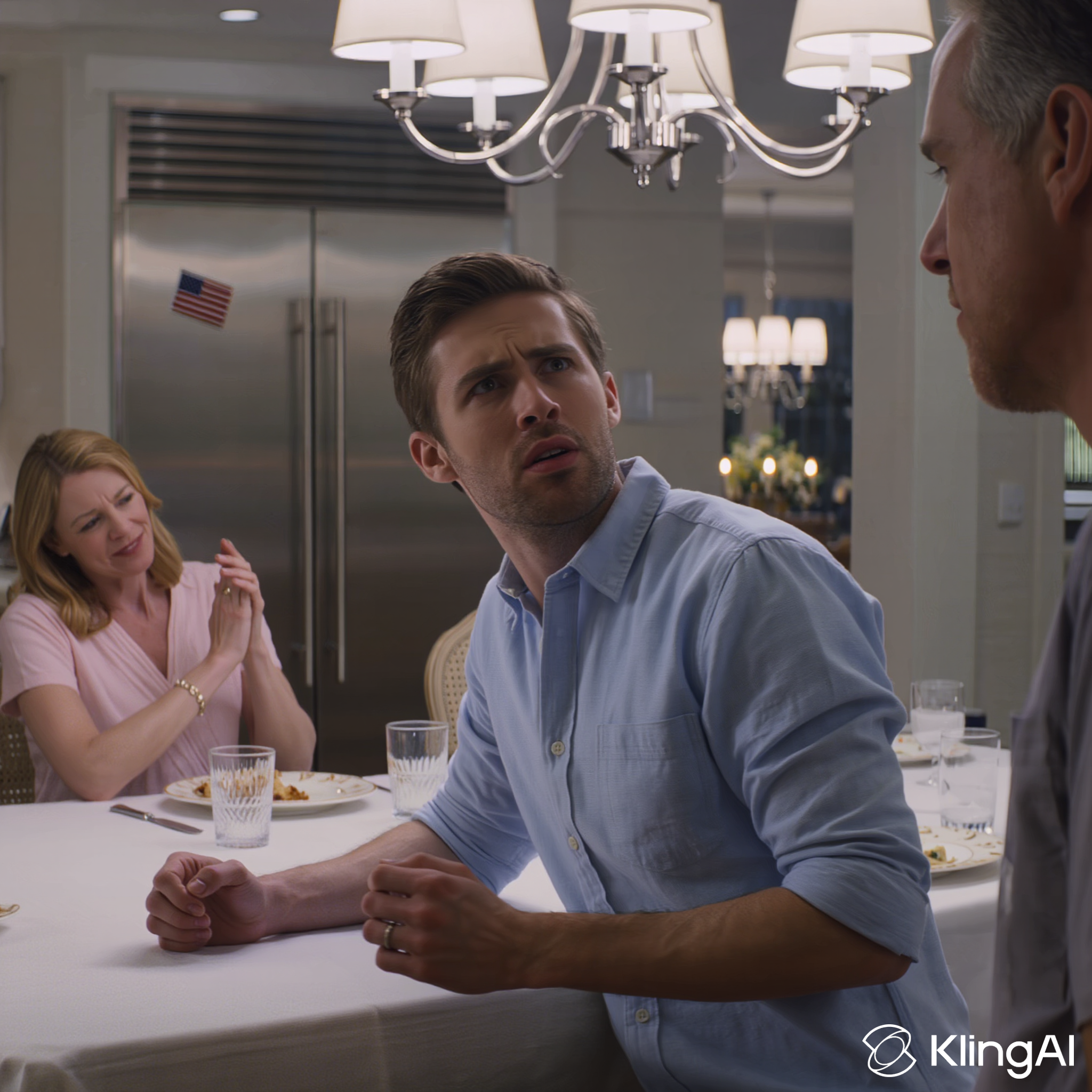
At family dinner, my dad looked up from his plate of chicken wings, glanced at me, then did a double take. The old American flag magnet on our stainless-steel fridge caught the light behind him, holding up one of Olivia’s glossy postcards from Paris, the Eiffel Tower printed in perfect twilight blue. It felt like the universe was trolling me.
I gave a half-shrug, picking at my salad. “I mean… as okay as a broke med student can.”
He frowned. “Is the money I’ve been sending enough? If it’s not covering things, you need to tell me.”
For a second I thought I’d misheard him. The words didn’t match the life I’d been living. I set my fork down. “What money?”
Dad went still. “Your allowance. The two thousand dollars a month I’ve been transferring for you.”
The room went quiet except for the hum of the fridge and the soft clink of ice in Mom’s glass of sweet tea.
“Dad,” I said, every word suddenly heavy, “I haven’t gotten a single dollar.”
I just had no idea yet that the real number was seven thousand dollars a month—and none of it had my name on it.
To understand how we got to that table, with the flag magnet glaring at us like a tiny judge, you have to go back four months, to when I first moved from Dallas to New York City.
I’m Logan. I was nineteen, fresh out of a private high school in Texas, starting med school in Manhattan. My dad’s a surgeon at a big university hospital in Dallas. My mom’s a full-time homemaker who runs our house and, more importantly, our bank accounts. Growing up, money was just this invisible thing that made life smooth: neighborhood with big lawns, Dad’s luxury car in the driveway, vacations that magically appeared on the calendar.
When I got into med school in July, it felt like I was stepping into Dad’s footsteps. He was proud. Mom said she was proud, too, but there was always this extra sparkle in her eye when she talked about my older sister, Olivia. She was in Paris, studying fashion design at some elite school that sounded like a perfume brand.
My parents agreed to pay my tuition, but everything else—rent, groceries, books, subway, everything—was on me. I told myself that was fair, adult even. I got a tiny apartment in New York, the kind where the shower pipes hiss at you and you can hear your neighbor floss, and I lined up jobs: tutoring high school kids in chemistry, working event staff on weekends, and eventually picking up shifts at a bar.
Med school plus three jobs is not the college experience you see in brochures.
I wanted what my classmates had—study groups that turned into late-night pizza, random club meetings, people who had time to argue about which coffee shop had the best cold brew. Instead, I sprinted from campus to work and back, my backpack digging into my shoulders like an extra rib. I’d get home at midnight, stare at my anatomy notes, and feel my eyes blur. I started sitting in lectures with that gross buzzing fatigue you get when your body is running on caffeine and panic.
The worst part was knowing that if I slipped, I could end up repeating a year. Med school is not big on participation trophies.
One night, after checking my bank app and seeing a balance that wouldn’t cover groceries and rent in the same week, I called my mom.
“Hey, honey,” she said, voice bright. I could hear the TV in the background, some sitcom laugh track.
“Mom, I’m okay,” I started, “but it’s been really tight. Do you think you and Dad could help a little with living expenses? Just… something to take the edge off?”
She sighed dramatically. “Logan, your father and I are already stretched paying your tuition. Medical school isn’t cheap, sweetheart. We just don’t have anything extra. Things are tight right now.”
“Tight?” I repeated, thinking of Dad’s car and our house in our gated neighborhood.
“Very tight,” she said quickly. “We’re doing what we can. You’re practical. You’ll figure it out. Besides, learning to be independent is good for you.”
I swallowed whatever was left of my pride. “Yeah. Got it.”
I hung up and stared at my cracked phone screen, feeling stupid for even asking. Most of my friends who lived on their own got help: rent checks, grocery money, parents’ credit cards for emergencies that looked a lot like brunch. I lied and said I just liked working.
By then, the dynamic between me and Olivia was already a script I knew by heart.
Olivia is twenty-one, two years older, and has always been the “golden child.” Mom literally calls her that—“my golden girl,” “my special one,” the kind of phrases that sound sweet until you realize they’re always delivered in front of someone else.
When I was ten and Olivia was twelve, I brought home a report card with straight As. I handed it to Mom, waiting for that warm, fizzy feeling my classmates talked about.
She skimmed it, nodded once. “Well, that’s what we expect from you, Logan,” she said, already turning away.
An hour later, Olivia strolled in with a report card full of Bs and a couple of Cs. Mom practically staged a parade in the kitchen. “Look at this! You worked so hard! Grades aren’t everything, you’re an artist. We should celebrate.” She baked cookies. Dad watched, uncomfortable, but he didn’t say anything, just squeezed my shoulder like that made us even.
It was the first time I understood that in our house, effort from me was baseline. Effort from Olivia was magic.
Years later, sitting under harsh fluorescent lights in the med school library, I told myself I was imagining it. But my body knew better. I was exhausted, short on sleep, long on shift hours, and seriously considering the possibility that I might have to repeat my first year if I didn’t catch up after midterms.
By the time summer break rolled around, my plan was simple: work every possible job, hoard cash, and live like a monk. I told myself if I white-knuckled my way through these months, I could cut back on work later and focus on lectures, labs, and not flunking out.
That meant no eating out. I lived on instant noodles, day-old bread, dollar-store peanut butter, and whatever prepackaged meals were on clearance. When I needed to get across town, I took my beat-up bike instead of paying for the subway. My classmates joked about being broke; I quietly memorized which bodega had the cheapest eggs.
It was surreal. I’d grown up in a house where the pantry was always full and we ordered takeout just because someone didn’t feel like cooking. I never imagined I’d be calculating whether I could afford cafeteria food. At five dollars a meal, the answer was usually no.
Every so often, my phone would buzz with texts from a friend.
“Road trip after finals? I’ll drive. We can keep it cheap,” one guy from my anatomy group offered.
“Can’t,” I typed back. “Working every day. Plus I’m heading home for the holidays.”
“You sure you’re okay?” he replied. “You always look wiped in class. You’re doing too much, man.”
“I’ve got the stamina,” I lied. “I need the money. We’ll hang when school starts again.”
I tucked my phone away and headed to my night shift at the bar, telling myself one more weekend like this wouldn’t kill me.
By the time I hit the floor behind that bar, I wasn’t just out of strength—I was out of excuses for not asking what was really going on.
It happened on a packed Friday night. The place was wall-to-wall bodies, music thumping, glasses clinking. My tray was loaded with cocktails, my head buzzing in that hollow way it does when all you’ve eaten is a packet of ramen and a granola bar.
I remember crossing the room, weaving between tables, when suddenly the edges of my vision started to go dark. The tray got heavier, like someone had added bricks.
“Hey, Logan, you good?” my coworker called.
“I’m fine,” I managed, reaching for the edge of the bar to steady myself.
The room spun. The last thing I registered was the sound of glass shattering and someone yelling my name.
When I opened my eyes, fluorescent lights stared back at me. There was a blood pressure cuff around my arm and an IV in my hand. A nurse was adjusting something on the monitor.
“Welcome back,” she said. “You scared your coworkers. You passed out at work.”
A doctor stepped in, flipping through a chart. “Logan, you’re in the ER. Your labs show you’re dehydrated and undernourished. You’re exhausted. When’s the last time you had a real meal?”
I tried to answer and realized I couldn’t remember.
They pumped me full of fluids, kept me a few hours, and discharged me with a stack of instructions about rest, nutrition, and not trying to live on caffeine and air.
On the subway ride home, hospital wristband still on my arm, I called my boss to apologize.
“Logan, stop,” he cut in. “You scared us. You hit the floor and you didn’t respond when we shouted your name, so I called 911. The paramedics took you straight to the ER.” He exhaled. “You’ve been taking every shift I throw at you. That’s on me. Take the rest of the month off, okay?”
“That’s… a lot of hours,” I said weakly, already calculating the lost income.
“Your health matters more than my Friday crowd,” he said. “Rest. That’s an order.”
Rest sounded great. My bank balance disagreed.
I sat on the subway, the car swaying, wondering if I should pick up more tutoring students, or find some other gig I could do sitting down. The idea of walking back into the bar made my legs ache.
The next morning, instead of going to work, I stayed in bed, scrolling through my phone. There was a missed text from the friend who’d been checking on me.
“Dude, you went radio silent. You okay?”
I called him and explained what had happened.
He showed up an hour later with grocery bags—pasta, sauce, eggs, vegetables, actual food. He moved around my tiny kitchen like he’d been there a thousand times, boiling water, browning meat, like this was just what you did when your friend face-planted at work.
“I can’t believe you’re not getting any help from home,” he said as we ate spaghetti off chipped plates. “Your dad’s a surgeon. You shouldn’t be living like this.”
“I asked my mom,” I said. “She said tuition is all they can handle. She made it sound like they’re barely keeping up.”
He frowned. “But you’re not an only child, right? Don’t you have a sister? The one in Paris?”
“Yeah. Olivia.”
“How’s she paying for all that?” he asked. “Paris isn’t exactly budget-friendly.”
I opened my mouth, then closed it. “Mom said she has a special arrangement for Olivia’s stuff. I never really asked.”
“That doesn’t make sense,” he said quietly. “I hate to say it, but… what if something’s going on that you don’t know about?”
His words hung in the air, heavier than any tray I’d dropped.
Later, after he left, I lay on my bed staring at the water stain on the ceiling, replaying my life like a bad movie marathon. Our house in Dallas. Dad’s old luxury sedan. The private schools. The vacations. The way money had always seemed… available.
So why was I living on dollar-store noodles while Olivia’s Instagram looked like a lifestyle ad?
I opened the app and scrolled through her feed. There she was at trendy Paris cafés with tiny cups of espresso and perfect pastries. Front row at fashion shows. Weekend trips to Monaco and Milan. Every picture had a new designer dress, a new bag, a new pair of shoes.
One post stopped me cold.
Olivia stood on a rooftop with the Eiffel Tower glowing behind her, wearing a Dior dress that probably cost more than my monthly rent. Her caption read, “Mom always knows exactly what I need. #blessed #fashionlife #Paris.”
I stared at those hashtags for a long time, the contrast between her life and mine sharp enough to cut.
Mom had told me they had no extra money. So how was she paying for a Dior dress, Paris rent, and a life that looked like a magazine spread?
Whatever this was, it wasn’t just favoritism anymore; it felt like a full-on accounting error in what love was supposed to look like.
That night, my mind wouldn’t let it go. I texted my mom: “Are you and Dad okay?”
She replied twenty minutes later. “We’re fine, honey. Why?”
“No reason. Just checking,” I lied.
Fine. Everything was always fine—until it wasn’t.
On impulse, I did something I almost never did: I called Olivia.
She answered on the second ring. “Logan? What’s wrong? You never call. Did something happen?”
“Just wanted to see how you’re doing,” I said. “How’s Paris?”
“Amazing, obviously,” she said, and I could hear the smile in her voice. “Mom just sent me the cutest Chanel bag for my birthday next month. She’s the best.”
My stomach twisted. “That’s… nice.” I forced my voice to stay casual. “Hey, random question. How do you manage financially over there? I know Paris is expensive.”
She laughed lightly. “I don’t worry about that stuff. Mom transfers me about three thousand dollars a month for expenses. Plus extra if I need something major, like the bag. You know how she is with me.”
Three thousand. Plus extras. I felt like the room tilted again.
“Yeah,” I said quietly. “I know how she is.”
“You sound weird,” Olivia said. “Are you okay?”
“I’m just tired. Exams.” I cleared my throat. “I’ll let you get back to your… whatever glamorous thing you’re doing.”
“Love you, little brother,” she said.
“Love you too,” I replied, though the words tasted different this time.
After I hung up, I sat in the dark for a long time. Part of me tried to rationalize it. Maybe Mom was downplaying their finances to push me toward independence. Maybe the money “wasn’t available” for me for some complicated tax reason I didn’t understand. Maybe this was some test of my resilience.
Or maybe, a quieter voice suggested, it was exactly what it looked like.
I decided I wasn’t going to argue with anyone over text anymore. I was already planning to fly home for the holidays, even if I could only afford one overnight. I’d ask my parents face-to-face what was going on. No more vague answers over the phone.
Before he left that day, my friend had clapped me on the shoulder. “Bring me something cool from Dallas,” he’d joked. “Like those weird Texas-shaped magnets with flags on them.”
At the time, it sounded like a throwaway line. Later, standing in front of our fridge, it would feel a lot more like foreshadowing.
If I’d known how fast one simple question about cafeteria prices would peel the paint off our family, I might’ve stayed in New York and eaten noodles.
The holiday break came fast. I booked the cheapest flight I could find, the kind that makes you question your life choices when you see the departure time. I could only stay for a day and a night because I needed to be back for work, but I was weirdly excited.
Home smelled like polished wood and whatever candle Mom had decided was “festive” that year. When I walked through the door, Dad’s face lit up, then shifted.
“You’ve lost a lot of weight,” he said, stepping back to look at me properly.
“Really?” I tried to play it off. “Med school diet.”
Mom came in from the kitchen, wiping her hands on a dish towel. For a second, her expression froze. “Logan,” she said slowly. “You look… different.”
“Hi, Mom.” I hugged her, feeling how small I’d gotten in her arms.
She didn’t say anything else.
Lunch was salad, soup, and crispy chicken wings laid out on the table like something from a commercial. For the first time in months, there was more food than I could eat in one sitting.
We sat—me, Dad at the head of the table, Mom to his right. The flag magnet on the fridge behind Dad held up Olivia’s Paris postcard, the one with the Eiffel Tower at sunset.
“You look thinner,” Dad said again once we started eating. “Are you eating properly up there?”
I looked down at my plate, suddenly honest. “Not really. This is the nicest meal I’ve had in a long time.”
“What do you usually eat?” he asked.
“Instant noodles. Bread. Discounted prepackaged stuff,” I admitted. “Sometimes eggs, if they’re on sale.”
“What about the cafeteria?” he asked, frowning.
“It’s like five bucks a meal,” I said. “Too expensive for me to do regularly.”
Dad blinked. “Is it really that bad?”
“Yeah,” I said, stabbed a piece of lettuce. “But I’m managing.”
He set his fork down. “Is the money I’ve been sending enough for you?”
I froze. “What money?”
“Your allowance,” he said slowly. “The two thousand dollars a month I asked your mother to transfer into your account. Is it not covering things?”
I stared at him. “Dad, I haven’t received any money. Not once. I thought you guys couldn’t afford it.”
His face drained of color. He turned to Mom. “Paisley, what is he talking about?”
My heart dropped. Maybe he’d lost his job. Maybe there’d been some huge emergency. “Did something happen?” I asked carefully. “Did you get sick? Is the hospital—”
“No,” Dad cut in quickly. “I’m working like normal. Nothing’s changed there.”
“Then why didn’t I get anything?” I asked. The question came out sharper than I intended. “And how is Olivia affording Paris if things are so tight?”
“What do you mean, ‘so tight’?” Dad asked, looking between us.
“Mom told me you guys are barely managing my tuition,” I said. “That there’s nothing extra. But Olivia told me she gets three thousand dollars a month. Plus extra for stuff like a Chanel bag.”
Mom’s head snapped toward me. “How do you know that?” she demanded.
“Because I called her,” I said. “I wanted to understand how she was living like that while I’m working myself into the ground.”
Dad’s eyes narrowed. “Paisley,” he said, his voice suddenly very calm. “Have you been sending money to Logan like I told you to?”
Mom looked down at her plate. The air in the room tightened.
“Paisley,” Dad repeated, louder this time. “Answer me.”
She let out a breath. “No,” she said quietly. “I haven’t.”
I felt like I’d been punched.
“What?” Dad exploded. “You haven’t sent him anything? For four months?”
“There are a lot of things we have to pay for,” Mom said, her voice sharp now. “You don’t understand what it takes to keep this house running.”
“Our mortgage is paid off,” Dad shot back. “What exactly are you paying for with two thousand dollars a month that was supposed to go to our son?”
She hesitated, then straightened, like she was bracing herself. “I’ve been keeping the money for Olivia.”
My fork slipped from my fingers and clattered onto my plate. “What do you mean, for Olivia?”
“She needs it more than you do,” Mom said, as if that explained everything. “She’s in Paris, Logan. Fashion school. It’s expensive. She has to look the part and make connections. That doesn’t come cheap.”
“I asked you for help,” I said quietly, heat rising behind my eyes. “Even a little. You told me you couldn’t afford ten dollars for groceries. Meanwhile you’re sending her three thousand a month.”
Mom looked at me, eyes flashing. “You’re practical. You’ve always been the strong one. You’ll be fine. Olivia is… delicate. She needs support.”
“And Logan doesn’t?” Dad asked, incredulous. “He’s in medical school. He collapsed at work from exhaustion and malnutrition.”
Mom jerked her head toward him. “Collapsed?”
“You didn’t tell me his boss called?” Dad demanded. “The bar called the house. They said he passed out. That they had to call an ambulance. When were you planning on mentioning that?”
“I was scared,” Mom said, voice rising. “I knew you’d blame me for not sending the money. I thought he’d be okay. He’s tough.”
“Let me get this straight,” Dad said, voice low and dangerous. “You withheld his allowance, lied to him about our finances, let him work himself to the point of collapsing, and you’re funneling his money to Olivia for what? Shopping sprees in Paris?”
“It’s not like that,” Mom snapped. “Olivia has real potential in fashion. She has to maintain an image, go to events. You don’t understand this world. Logan is just like you. He’ll land on his feet. Olivia is special.”
“So he doesn’t have potential?” Dad asked. “Our son, in med school, following in my footsteps, doesn’t need help, but our daughter needs Dior and Chanel to get through class?”
Mom crossed her arms. “You’re twisting my words.”
“How much have you been giving her?” Dad asked, his voice flat.
Mom hesitated. “Three thousand a month for living expenses,” she said finally. “And maybe… a little extra some months.”
“How much extra?” Dad pressed.
“I don’t know. Two, three thousand, depending on what she needs. Networking events. Proper clothes. Accessories.”
Dad stared at her. “So you’ve been diverting five to six thousand dollars a month to Olivia,” he said slowly. “While Logan’s working sixty hours a week on top of med school and living on instant noodles.”
“When you say it like that, it sounds bad,” Mom said defensively. “But Olivia is building a career. She needs these things.”
“And what exactly has she been buying?” Dad demanded.
“Things she needs,” Mom answered vaguely.
“Like the Chanel bag you just bought her for her birthday,” I said quietly.
Her eyes widened. “How did you—”
“I told you. I called her.”
Dad shook his head, looking suddenly older. “Unbelievable. Logan nearly works himself into the ground because he thinks we’re broke, while his sister struts around Paris with designer bags on money that was meant for him.”
“Olivia has always been special,” Mom said, lifting her chin. “She needs more support. You’ve always known that.”
“No,” Dad said firmly. “What she needs is a reality check. And so do you.” He turned to me. “Logan, I am so sorry. I thought you were getting that two thousand every month. I never would’ve let this happen if I’d known.”
“It’s okay,” I started, but he cut me off.
“No. It’s not okay. None of this is okay.” He looked back at Mom. “From now on, I’m handling the finances. I’ll transfer money directly into Logan’s account. And we’re going to have a serious talk about Olivia’s expenses.”
“You can’t just cut her off,” Mom protested. “She needs—”
“She needs to learn the value of money,” Dad snapped. “She’s twenty-one, living like a celebrity on our dime. That ends now.”
The rest of lunch was mostly silent. I picked at my food, appetite gone. Mom dabbed at her eyes with her napkin like she was the injured party. Dad sat rigid, jaw clenched, the flag magnet behind him slightly crooked, like even it had been knocked off balance.
For the first time, my mother’s “golden child” routine had an actual dollar amount attached to it, and it made me feel cheaper than any discount meal I’d ever bought.
After lunch, I went up to my old room and lay on my bed, staring at the ceiling I’d once covered in glow-in-the-dark stars. Downstairs, their voices rose and fell, sharp, then muffled, then sharp again. It sounded like a storm trying to decide whether to break the windows or move on.
I thought about all the little moments that suddenly made sense. Olivia getting a car for her sixteenth birthday while I was told I could save up for one. Her artwork framed and displayed all over the house while my academic awards were stacked in a drawer. The summer I wanted to go to a science camp but was told it was too expensive, only to find out she’d been sent to an art program in Italy that same year.
The favoritism had always been there. I’d just never realized it came with wire transfers.
There was a knock on my door. “Logan? Can I come in?” Dad’s voice.
“Yeah,” I said.
He stepped in and sat heavily on the edge of the bed. Up close, the lines on his face looked deeper.
“I’m so sorry,” he said quietly. “I had no idea your mother was doing this. I thought you were getting your allowance. I thought Olivia was on a much more modest budget.”
“It’s not your fault,” I said automatically.
“It is, though,” he said. “I should have been more involved. I handed everything over to your mother and assumed she was being fair. I was too busy with work, and I didn’t ask enough questions.”
He ran a hand through his graying hair. “I already called Olivia. I told her her allowance is being reduced to one thousand dollars a month. The same amount you’ll be getting from now on. Anything extra, she’ll have to earn herself.”
“She’s not going to like that,” I said, thinking of her rooftop photos.
“She didn’t,” he said dryly. “But it’s long overdue.” He hesitated. “There’s something else I need to tell you. About the future.”
My stomach tightened. “Okay.”
“We have a family trust,” he said. “It was supposed to be split evenly between you and Olivia when you both turned twenty-five. Your mother has been… diverting funds from it into a separate account in Olivia’s name.”
The room tilted again. “How much?”
“About three hundred thousand dollars so far,” he said quietly.
Three hundred thousand. I couldn’t even process the number.
“I’ve frozen that account,” Dad continued. “My attorney is already working on getting those funds returned to the trust. It’ll take some legal maneuvering, but it’s the right thing to do.”
He looked at me, eyes tired. “I keep thinking about you collapsing at work. About you telling the doctor you couldn’t remember your last real meal. And all this time, I thought you were fine. Your mother let me believe you were fine.”
“I didn’t want to worry you,” I said. “You work so much.”
“That’s not your job,” he said, his voice rough. “My job is to worry about you. To take care of you. And I failed at that.”
“You didn’t know,” I said again, quieter.
“I should have known,” he said. “I should have been paying attention. But that changes now. From here on out, I’m going to be much more involved in your life and Olivia’s. And I’m going to make sure things are fair.”
It turned out the only thing more fragile than my blood sugar was the version of our family my mom had been propping up with other people’s money.
That night, my phone lit up with Olivia’s name.
I answered. “Hey.”
“What did you say to Dad?” she demanded. No hello. No how are you.
“The truth,” I said. “That I’ve been working three jobs and barely affording groceries while you’ve been getting thousands of dollars a month.”
“That’s different,” she snapped. “Do you have any idea how expensive Paris is? How much it costs to dress appropriately for fashion school?”
“Do you have any idea what it’s like to hit the floor at work because you’re so exhausted and underfed your body literally gives out?” I asked.
Silence.
“Is that what happened?” she asked quietly.
“Yeah,” I said. “While you were buying Chanel, I was living on ramen and trying not to fail med school.”
Another pause. “I didn’t know.”
“Would it have mattered if you did?” I asked, not sure I wanted the answer.
She didn’t respond to that. “Dad says I’m only getting one thousand a month now,” she said instead, anger snapping back into her voice. “I can’t live on that.”
“Welcome to the real world,” I said. “Get a job. That’s what I did.”
“A job? I’m in fashion school. I don’t have time for a job.”
“I’m in med school,” I reminded her. “Somehow I manage.”
She hung up on me.
The next morning, the house felt like it was holding its breath. Mom moved around the kitchen like a ghost, setting out coffee cups without looking at me. Dad tried to make small talk about classes, New York, the weather, anything that wasn’t the seven-thousand-dollar elephant in the room.
At one point, he sighed and said, “Your mother and I are going to make some changes.”
“What kind of changes?” I asked carefully.
“For starters, I’m taking control of the finances,” he said. “All of them. And I’m going to be more present. I won’t be the guy who just signs checks and assumes everything’s fair.”
Mom finally looked up. “You’re overreacting,” she snapped. “You’re being too hard on Olivia. She needs what she needs.”
“What Olivia needs,” Dad said, “is to learn the same lessons Logan has had to learn the hard way. Independence. Responsibility. The value of work.”
“She’s different,” Mom insisted. “She’s sensitive.”
“No,” Dad said. “She’s just been treated differently. By you.”
He glanced at me, then back at her. “And there’s something else. We’re starting counseling. But I’m going to be honest with you, Logan. I don’t know if our marriage can come back from this. The trust between us is… damaged.”
Mom’s eyes flashed. “So now I’m the villain? For wanting to give our daughter the best chance at success?”
“I’m blaming you,” Dad said evenly, “for lying to me. For stealing from our son. For quietly draining joint accounts to fund our daughter’s shopping and calling it mentorship. That’s what I’m blaming you for.”
I flew back to New York the next day with more emotional baggage than my carry-on. Before I boarded, Dad pulled me aside at the airport.
“I transferred five thousand dollars into your account,” he said. “Consider it back pay for the allowance you should’ve been getting. Going forward, you’ll have a thousand a month, every month. Directly from me.”
“Dad, you don’t have to—”
“Yes,” he said firmly. “I do. Focus on your studies. That’s your job. Not playing human overtime machine.”
The first thing I did when I got back to my apartment was check my bank app. The number staring back at me didn’t look real. Then I went to the grocery store and bought food that didn’t come in dehydrated bricks: fresh vegetables, fruit, chicken, real bread. I filled my cart with things I hadn’t let myself even look at in months.
Back home, I cooked an actual meal—roasted chicken, rice, vegetables sautéed in a pan that had mostly known scrambled eggs and regret. I ate at my tiny table, lights on full instead of hunched over my notes, and every bite tasted like relief.
With the financial pressure eased, I dropped the event staffing job entirely, cut my bar shifts down to just weekends, and kept tutoring because, weirdly, I liked it. Suddenly I had time to sleep more than four hours and study without my brain glitching halfway through a chapter.
My grades climbed. My professors noticed. I joined the premed student association I’d kept meaning to sign up for and actually started making friends instead of just nodding at people from behind a coffee cup.
What started as one ambulance ride had quietly become a full-scale renovation of our entire family.
Back in Dallas, things shifted too.
Dad moved into a small apartment across town while he and Mom “worked things out.” Olivia, furious about her reduced allowance, threatened to quit fashion school and move home. When neither parent budged, she did something none of us expected: she adapted.
She got a part-time job at a small boutique in Paris. At first she called to complain about everything: standing on her feet all day, dealing with picky customers, having to budget.
“It’s actually kind of interesting,” she admitted one night over FaceTime, looking tired but different in a way I couldn’t name. “My boss is teaching me about the business side of fashion. Inventory. Margins. What sells and what doesn’t. I kind of like earning my own money.”
Mom struggled the most. She hated the financial limits Dad put in place during their separation. More than once, she tried to secretly send Olivia extra cash from her personal account. When Dad’s attorney uncovered it during the financial review, it became the final crack in something that had been splitting for years.
Dad filed for divorce.
The legal process was messy. Mom tried to claim half of everything—Dad’s income, retirement funds, whatever she could reach. But when Dad’s lawyer laid out the evidence of her funneling trust money, redirecting thousands of dollars a month, and lying about it, the judge was not sympathetic.
The final settlement favored Dad heavily. Mom had to downsize from our big suburban house to a small condo. It wasn’t poverty, but it was a long way from “we can secretly send seven thousand dollars a month overseas and still pretend we’re broke.”
Through all of it, I stayed in my lane: med school, work, health. I put the weight back on, the color slowly returning to my face in the mirror. My classmates noticed I looked less like a ghost. My professors commented on the change in my focus.
Olivia and I started talking more. At first our conversations were awkward, like two people scrolling for a channel they both wanted to watch.
“I never realized how much Mom’s favoritism messed with you,” she said once. “I just… liked being the favorite.”
“And I got used to being the reliable one,” I said. “The one who doesn’t need anything.”
“I’m sorry,” she said. “I should’ve seen it.”
“We were kids,” I replied. “It wasn’t our job to see it.”
We talked about her job at the boutique, her designs, my classes, my growing circle of friends. The more we talked, the less she sounded like the girl on the rooftop with the Dior dress and the more she sounded like my sister.
We were all finally on budgets, not just with money, but with how much of ourselves we were willing to spend on old habits.
About a year after that holiday dinner, things looked completely different.
I was doing well in med school, closer to the student I’d imagined being when I first got that acceptance letter. Dad, now officially divorced, seemed lighter. He visited me in New York every couple of months, taking me out to diners near campus, asking about my classes in a way that proved he actually knew what they were.
“I always knew you had what it takes to be a great doctor,” he told me during one visit, stirring his coffee. “But I’m even more proud of the kind of person you’re becoming.”
Olivia had changed too. She was still in fashion school, but the boutique job had turned into a kind of unofficial apprenticeship. She started designing a small collection of her own on the side, using budget fabrics and clever cuts to make pieces that looked expensive without actually being expensive.
“My professor said my new designs show a maturity that wasn’t there before,” she told me over video chat, holding up a sleek dress she’d made. “He says constraints are a designer’s best friend. They force you to be creative in ways unlimited budgets never will.”
“Who knew budget limitations could be a good thing?” I said, genuinely impressed.
“Certainly not the old me,” she laughed. “But I like the new me better.”
Mom had the hardest adjustment. The divorce meant less money, less status, less control. She complained constantly about her smaller place, about budgeting, about how “unfair” the judge had been.
She got a job at a local department store—her first job in over twenty years. She hated the hours, the customers, the manager who didn’t care that she used to host charity luncheons. But under the complaints, I heard something else: structure. Routine. Accountability.
Her relationship with me and Olivia was strained. She called me occasionally, but our conversations stayed on safe topics—weather, holidays, “How’s school?” With Olivia, she tried to resurrect the old dynamic, offering to send money she didn’t have, suggesting Olivia move home so Mom could “take care of her properly.”
Olivia, to my surprise, held her ground. “I appreciate it, Mom,” she’d say. “But I’m okay. I like taking care of myself.”
Last year, during one of our calls, Olivia lugged her laptop over to a dress form and spun it around for me. The pieces on it were clean, elegant, and looked like something you’d see in a minimalist boutique in SoHo, not put together in a student apartment on a budget.
“I never would’ve learned to design like this if I still had unlimited funds,” she said. “Turns out constraints really do breed creativity.”
“You’re really good at this,” I told her, and I meant it.
She smiled. “Thanks. And you’re going to be an amazing doctor.” She hesitated. “I’m sorry. For not seeing what was happening to you before. For not asking more questions.”
“It wasn’t your fault,” I said. “We were both caught in Mom’s system.”
“Are you going home for Christmas?” she asked.
“To Dad’s? Yeah,” I said. “You?”
“Yeah,” she said. “And I was thinking… maybe we could go visit Mom together. She’s having a rough time. I don’t think she knows how to fix what she broke, but… she’s trying.”
I thought about Mom in her smaller condo, about the department store name tag, about the way she’d always blurred love and control.
“Okay,” I said. “We’ll go together.”
This time, we weren’t coming home to pretend everything was fine—we were coming home to see if “fine” could mean something new.
Three years after that first holiday dinner blew everything open, my life looked nothing like the one I’d imagined the night I hit the floor at the bar.
I was in my fourth year of med school, near the top of my class, prepping for residency interviews. Dad called every week, not just to ask about grades but to check in on me as a person. He flew to New York for every big milestone—white coat ceremonies, presentations, anything where there was a program with my name in it.
Six months ago, he called with a different kind of news. “I met someone,” he said, sounding almost shy. “Her name’s Catherine. She’s a pediatric nurse at the hospital.”
I listened as he described how they’d started talking between cases, how she challenged him, made him laugh, reminded him that life was more than work and damage control.
When he told me he was going to propose, all I felt was happy for him.
Around the same time, Olivia launched her first independent collection in Paris. She sent me a link to the livestream.
What stunned me wasn’t just how good the clothes were—minimalist, practical, elegant—but the shot of the front row. There was Dad, sitting next to a stylish woman I recognized from his photos as Catherine, both of them beaming.
After the show, Olivia called me, eyes shining. “Several boutiques want to carry my pieces,” she said, barely containing her excitement. “I’m doing this, Logan. On my own. No secret accounts. No seven-thousand-dollar lifelines.”
“As someone who once almost passed out for lack of a sandwich, I’m very proud of you,” I joked.
We laughed, but we both knew how much it meant.
Mom’s journey was slower.
The divorce humbled her. Last year, after she was promoted to assistant manager at the department store, she called me late one night.
“I’m proud of you, Logan,” she said, voice thick. “I don’t think I ever said that right before.” She paused. “I was wrong. About so much. I’m… working on it.”
She’d started therapy, digging into her own past as the overlooked sibling in her family. Her therapist, she told me, said she’d tried to fix her childhood by making Olivia into the golden child she never got to be, without realizing she was repeating the same harm on me.
Our relationship is still complicated. We talk more now, but there are land mines we both carefully step around. She’s learning, slowly, to see both of her kids clearly instead of through the funhouse mirror of favoritism.
This Christmas, for the first time, we’re all going to be in the same place: Dad and Catherine, me, Olivia flying in from Paris, and Mom. It won’t be under one roof—the divorce papers made sure of that—but there will be shared meals, shared space, shared history.
When I walked into Dad and Catherine’s house a few days before Christmas, the first thing I noticed—after the smell of cinnamon and the sound of some old Sinatra song playing softly—was the fridge.
The old American flag magnet from our Dallas kitchen was there, holding up a new photo. In it, I’m standing between Dad and Olivia outside my school, white coat over my clothes, stethoscope around my neck. Catherine’s on Dad’s other side, laughing. Mom isn’t in that picture, but there’s another photo next to it of her and Olivia at the department store, both of them holding coffee cups and smiling awkwardly at the camera.
Dad caught me looking. “Thought we could give that magnet something new to hold,” he said.
I smiled. “Looks better here.”
Later, when we all sat down to dinner—different table, different city, same holiday—there was no question about who was getting what money. Olivia talked about negotiating contracts with boutiques. I talked about residency programs. Mom asked questions and actually listened to the answers.
At one point, she looked at me and said, “I know I can’t change what I did. But I’m grateful you’re still here. That you let me try to be better.”
I nodded. “We’re all trying,” I said. “That’s something.”
The collapse that started it all still crosses my mind sometimes—the sound of glass breaking, the brief weightlessness before the floor rushed up. It was one of the worst nights of my life, and the best thing that ever happened to my family.
Sometimes things have to fall apart so completely that there’s no way to tape them back together. You have to rebuild from scratch.
I used to look at that flag magnet and feel like one of the tiny stars no one noticed, just background decoration for someone else’s story. Now, when I see it holding up those photos, I know better.
I’m not the forgotten kid at the table anymore. I’m Logan—a med student, a son, a brother—with a seat, a voice, and a place in the picture that was always mine to claim.
The next morning, Olivia and I actually followed through on the plan we’d made over video chat months earlier. We borrowed Dad’s car and drove across town to Mom’s condo, a bakery box of pecan pie balanced on Olivia’s lap like a peace offering we weren’t sure how to deliver.
“This feels weird,” Olivia murmured, watching the strip malls and gas stations slide by. “Like we’re on our way to a performance review.”
“Pretty sure we’re the ones doing the review this time,” I said.
She huffed out a laugh, then fell quiet again.
Mom’s building was smaller than our old house, brick instead of stone, with a parking lot instead of a circular driveway. We climbed one flight of stairs and walked down a hallway that smelled faintly of laundry detergent and somebody’s burned toast.
Olivia hesitated outside Mom’s door, then knocked before she could change her mind.
Mom opened it wearing a cardigan I didn’t recognize and jeans instead of her usual tailored slacks. For a second, all three of us just stared at each other.
“Hi, Mom,” Olivia said first, the word sounding younger than she looked.
“Hi,” I echoed.
Mom’s eyes went shiny. “You came,” she said, as if she hadn’t been the one texting us both all week to “stop by if you have time.”
“We brought pie,” I said, lifting the box like proof that this was a normal visit and not a field trip into unfinished business.
If I’d learned anything in med school, it was that healing rarely starts with grand speeches. Sometimes it starts with paper plates and awkward small talk.
Inside, Mom’s condo was neat and a little too decorated, like she’d tried to shrink our old house into a smaller footprint. The same framed photos lined her shelves, only now there were more gaps—spaces where Dad’s face used to be.
She fussed over us at first, offering coffee, water, leftover Christmas cookies she claimed were “still good.” We sat at her small table, the three of us squeezed in closer than we ever had been at the huge dining room back in the old house.
After a while, the conversation ran out of safe topics.
“So,” Mom said, tracing the rim of her mug. “How was dinner at your father’s?”
“Good,” I said carefully. “Different. In a good way.”
“Catherine’s nice,” Olivia added. “She doesn’t pretend things aren’t awkward. I kind of like that.”
Mom flinched at Catherine’s name. “Of course she’s nice,” she said tightly. “She got everything she wanted.”
“Mom,” I said, my voice a warning.
She exhaled, shoulders slumping. “Sorry,” she said. “That’s not fair. I’m… still working on not saying the first thing that pops into my head.”
“Therapy helping?” Olivia asked, not unkindly.
Mom surprised me by nodding. “Yes. My therapist says I spent most of my life trying to prove I wasn’t the invisible one anymore. That I turned Olivia into my… project.” She swallowed. “And that I did it at your expense, Logan.”
Hearing her say it out loud felt like standing too close to a speaker when the volume jumps. Even when people change, the echoes of who they were don’t vanish overnight.
“I can’t undo what I did,” Mom continued. “Stealing from you. Lying. Treating you like the ‘strong one’ so I could justify giving Olivia everything. But I want to do better now. If you’ll let me.”
Olivia stared at her hands. “You know you almost ruined things for me too, right?” she said quietly. “If Dad hadn’t cut me off, I’d still be that girl on the rooftop thinking a seven-thousand-dollar wire transfer was just… love.”
Mom winced. “I thought I was giving you what I never had,” she said. “Attention. Resources. A spotlight. I didn’t realize I was teaching you that love is something you buy.”
“And teaching me that love is something you earn by not needing anything,” I added.
Her eyes filled again. “I am proud of you, Logan,” she said. “Not just for med school. For calling us out. For not collapsing quietly and disappearing. You could have. A lot of kids would have.”
I thought about the ER, the IV in my hand, the nurse asking when my last real meal had been. “Collapsing quietly wasn’t really a choice,” I said. “Gravity took care of that part.”
We all laughed, the sound thin but real.
“If we’re going to do this,” I said, sobering, “I need you to hear something. I’m not going to pick residencies or jobs based on what makes you feel better. I’m done being the kid who rearranges his life around your comfort.”
Mom swallowed, then nodded slowly. “That’s fair,” she said. “Painful. But fair.”
“And I’m not your project,” Olivia added. “You don’t get to decide what success looks like for me anymore. You can show up. You can cheer. But that’s it.”
Mom’s mouth trembled. “You two came here with boundaries,” she said. “My therapist would be very impressed.”
“Good,” I said. “Tell her it’s working.”
For the first time, sitting at that too-small table with store-brand coffee and bakery pie, it felt like we were three separate people trying to build something new, not actors in a script Mom had written alone.
On the flight back to New York, I replayed the visit in my head. Mom hadn’t begged, hadn’t guilted us about leaving, hadn’t hinted that we owed her more time. She’d cried, yes, but she’d also listened.
“I didn’t expect her to take that on the chin like that,” Olivia said, leaning her head back against the seat. “The old Mom would’ve thrown a fit.”
“The old us would’ve let her,” I said.
The plane climbed through the clouds, Dallas shrinking below us. Somewhere down there was the old house with the big dining table. Somewhere else, a condo with too many framed photos and a woman learning how to be a mom without an audience.
By the time the seat belt sign dinged off, my phone buzzed with a text from Dad: “Proud of you for going. How did it go?”
I typed back, “Messy, but honest,” then added, “For us, that’s progress.”
In medicine, you learn to distinguish between wounds that are clean and those that look fine on the surface but are infected underneath. That visit made it clear: we’d finally opened things up enough to start healing for real.
Residency applications hit like a second job the last semester of med school. Personal statements, recommendation letters, interviews. My classmates obsessed over program rankings and city vibes. I obsessed over something else: distance.
“Are you going to rank Dallas first?” one of my friends asked as we walked out of the hospital one cold evening, breath fogging in the air.
“I don’t know,” I said. “Part of me wants to. My dad’s there. Olivia’s mostly in Europe but she pops back a lot. And then…”
“And then there’s your mom,” he finished for me.
“Yeah,” I said. “And then there’s my mom.”
That night, I called Dad.
“You should pick the program that makes sense for your career, not for us,” he said immediately, as if he’d been expecting the question. “If that’s New York, great. If it’s Dallas, we’ll set up a guest room. If it’s somewhere else, I’ll learn to like their football team.”
“What if Mom takes it personally?” I asked.
“She probably will,” he said. “That’s her work, not yours. You’re allowed to live your own life.”
Later, I had a similar conversation with Mom.
“So,” she said, trying for casual and not quite landing it. “Any chance you’ll come back to Texas for residency? It would be nice to have you closer. We could have dinner sometimes. I could finally come watch you in your doctor coat.”
I took a breath. “Maybe,” I said. “But I’m going to rank programs based on what’s best for my training. Not based on geography.”
Silence stretched between us.
“You really are serious about this boundary thing,” she said finally.
“I am,” I said.
“Okay,” she replied, surprising me. “Then my job is to be proud of you wherever you land.” She paused. “And to scream at the TV politely when they show your hospital on medical dramas.”
It wasn’t a perfect answer, but it wasn’t manipulation either. For us, that counted as growth.
Match Day came in March. The auditorium was packed with students in suits, parents with cameras, siblings who’d flown in for the big reveal. A banner with our med school logo hung over the stage like a finish line.
Dad and Catherine sat on one side of me; Mom and Olivia sat on the other. A year ago, I couldn’t have imagined all four of them in the same row without security on standby. Now, they were passing around a program like semi-functional humans.
“You look very official,” Catherine whispered, straightening my tie. “All grown up.”
“Don’t tell Dad,” I whispered back. “He still thinks I’m twelve.”
Dad snorted softly. “I think you’re the guy who survived med school while half our family fell apart,” he said. “Everything after this is just electives.”
Mom leaned over. “I brought tissues,” she said, patting her purse. “For me, not for you. You’re not allowed to cry before I do.”
Olivia nudged my shoulder. “You ready?”
“No,” I said truthfully. “But that’s never stopped me before.”
When the dean finally told us to open our envelopes, the room erupted in the sound of tearing paper and nervous laughter.
My hands shook as I broke the seal. For a second, the words blurred. Then they snapped into focus.
New York. My first-choice program.
I exhaled a breath I didn’t know I’d been holding.
“Well?” Dad demanded.
“I’m staying,” I said, my voice rough. “New York. I matched here.”
Catherine let out a delighted squeal. Dad pulled me into a hug so tight it hurt in the best way.
On my other side, Mom was crying—in a good way, for once.
“I’m happy for you,” she said, and I believed her. “I really am. I was secretly hoping you’d pick Dallas, but… this is good. This is right.”
Olivia grinned. “Selfishly, I’m thrilled,” she said. “Paris to New York is a lot easier than Paris to Dallas. I can crash on your couch and pretend it’s for ‘work.’”
For the first time, the next step in my life felt like something I was walking toward, not away from.
That summer, Dad and Catherine had a small wedding in a garden behind a historic house in Dallas. It wasn’t the big country club production Mom would’ve planned; it was intimate, with friends from the hospital, a few neighbors, and family.
Mom came to the ceremony.
I’m not sure which surprised me more—that she accepted the invitation or that she showed up on time, wearing a simple navy dress instead of something designed to outshine the bride.
At the reception, she kept her distance at first, hovering near the back with a glass of iced tea in her hand like a shield. The social consequences of the divorce had hit her hard. Some of her old friends had quietly dropped her after the court transcripts made their rounds. Others stayed but with new boundaries.
I watched two women who used to be her lunch friends approach her, exchange polite hugs, then drift away after a few minutes of small talk. The old Mom would’ve spun that into a dramatic monologue later about betrayal. This Mom just watched them go, sadness flickering across her face and then settling into something calmer.
Halfway through the night, as fairy lights blinked on and the band played an old Sinatra song, she found me near the dessert table.
“You know,” she said, looking out at Dad and Catherine dancing, “if you’d told me three years ago that I’d be at your father’s second wedding, not the star of the show, and genuinely glad he was happy, I would’ve called you crazy.”
“If I’d told you I’d be eating cake at your condo and talking about boundaries, you’d have grounded me,” I said.
She smiled faintly. “Probably.” She hesitated. “I lost a lot when this blew up. Friends. Status. Money. But I gained something too. A chance to be someone other than the woman who always has to be right.”
“That’s a pretty good trade,” I said.
She looked at me. “You and Olivia walking into my apartment with that pie? That was the real invitation,” she said. “This”—she gestured at the party—“is just the reception.”
Later, when Dad and Catherine left for their honeymoon, they handed me a small envelope.
“Before you fly back,” Dad said. “Open it at home.”
Back in New York, in my tiny kitchen with my new resident badge hanging on the hook by the door, I slid my finger under the flap.
Inside was a photo of the four of us at the wedding—Dad, Catherine, Olivia, and me—standing under the arch of flowers. Taped to the corner of the photo, like the world’s smallest security blanket, was the old American flag magnet.
“Thought your fridge could use something familiar,” Dad had written on the back. “New chapter. Same team.”
I put the magnet on my fridge, holding up that photo. Next to it, I pinned my Match letter, curling a little at the edges.
Residency was its own kind of storm. Long shifts, rapid-fire decisions, the constant hum of responsibility. But every time I opened my fridge at 3 a.m. to grab leftovers between admits, that magnet was there, reminding me where I’d started.
One night on pediatrics, I admitted a teenager who’d fainted at school. Her labs showed anemia and dehydration, the kind of numbers that made my attending raise an eyebrow.
Her mother hovered at the bedside, talking a mile a minute about her daughter’s AP classes, her extracurriculars, her dream of getting into an Ivy League school.
“Does she ever eat?” I asked gently.
“Of course,” her mom said. “She just doesn’t have much time. Between school and her internships and her portfolio—”
The girl stared at the ceiling, eyes dull.
When I asked her privately what a typical day looked like, the story came out: skipped meals, late nights, parents who praised her achievements and dismissed her exhaustion.
“It’s fine,” she said. “I’m the strong one. My brother’s the sensitive one. They worry about him. I can handle it.”
Something in my chest twisted.
“You shouldn’t have to prove you’re strong by going hungry,” I told her. “Strength isn’t pretending you don’t need anything. It’s saying something when you do.”
Later, in the hallway, I talked to her parents about nutrition and stress, about rest being a medical need, not a luxury.
But I also added something I hadn’t read in any textbook.
“She needs to know she’s allowed to be more than what she produces for you,” I said. “That your love isn’t a reward she earns by not needing anything. If she doesn’t learn that now, her body will keep sending reminders. And next time, it might not just be a fainting episode.”
The mother bristled at first, then deflated. The father looked like someone had just replayed a scene from his own childhood in front of him.
“Thank you, doctor,” he said quietly.
After they left, my attending clapped a hand on my shoulder. “You okay?” she asked.
“Yeah,” I said. “Just… familiar story.”
That kid didn’t just get iron supplements and a nutrition consult. She got a referral to a therapist and a follow-up plan that included her parents.
She also became the final push I needed to walk into a therapist’s office myself.
I’d been telling everyone around me to get help, to talk, to set boundaries. It was time to practice what I preached.
Therapy didn’t magically erase the years of being the “strong one,” the one who didn’t get parties for straight As, the one who only got noticed when he finally hit the floor. But it gave me language for things I’d only ever felt as pressure in my chest.
We talked about the night at the bar, the holiday dinner, the $7,000 a month that had carved a canyon down the middle of our family. We talked about how easy it would be for me to recreate that dynamic with my own patients, my own future kids—reward the “good” ones who didn’t complain and subconsciously resent the ones who did.
“I don’t want to be that doctor,” I told my therapist. “Or that dad.”
“Then you won’t,” she said. “Because you’re paying attention now.”
Years slid by faster than I expected. Residency blurred into fellowship. Olivia’s small collection turned into a brand with her name on it, carried in a handful of boutiques in Paris and New York.
At her first New York show, I sat in the second row—fancy enough to see everything, far enough back that the models didn’t trip over my feet. The clothes looked like her: clean lines, smart details, beauty that didn’t scream money but whispered intention.
Afterward, in the chaos backstage, she found me.
“Well?” she demanded. “Honest opinion.”
“I liked the blue jacket,” I said. “And the pants with the side seams that looked like they were pinned wrong but weren’t.”
She laughed. “You noticed that?”
“I’m a doctor, not blind,” I said.
Mom was there too, sitting proudly next to Catherine in the front row, clapping so hard I thought her hands might bruise. At one point, during the finale, she leaned over and said something that made Catherine laugh, and for a second, they looked like two women united by shared pride instead of old rivalry.
Later, when we all went out for dinner, Mom raised her glass.
“To my kids,” she said. “Who turned out amazing in spite of my… learning curve.”
“In spite of?” Olivia teased.
“Okay, because of and in spite of,” Mom amended. “Life’s messy.”
We clinked glasses. Mine was just iced tea—I had an early shift the next morning—but the sentiment landed.
One night not long after, I came home from a late shift to find an envelope pushed through the mail slot in my apartment door. Inside was a letter from Dad’s attorney, updating Olivia and me on the final status of the family trust.
All funds restored. Split evenly.
Attached was a note in Dad’s handwriting: “Not that you need this to build your lives anymore. But I promised you both fairness. Took me too long to make sure of it.”
I stuck that letter under the flag magnet too, behind the photo and the Match letter, where I’d see the edge of it every time I grabbed milk or leftover takeout.
By the time I finished fellowship and took a permanent attending position, I had my own small apartment that actually fit more than one person in the kitchen at a time. On the day I moved in, Dad and Catherine brought a plant that I was statistically likely to kill. Olivia brought a framed sketch of a jacket she’d designed.
Mom showed up late, carrying a grocery bag.
“I didn’t know what to get you,” she said, unloading containers onto my counter. “So I made food. Actual food. You’re a doctor, but you still eat like a resident sometimes.”
There was chicken, rice, roasted vegetables. Enough to feed me for a week.
“Thanks, Mom,” I said. And I meant it, in a way I couldn’t have three years earlier.
When they left, the apartment was quiet except for the faint hum of the fridge.
I opened the door, looked at the collage on the front: the wedding photo, the shot from my white coat ceremony, Olivia’s first New York show invitation, the letter about the trust.
The American flag magnet held all of it in place.
Once, it had pinned up postcards from a life I wasn’t invited to share. Now, it held proof that the story had changed.
Families don’t get rewritten in a single dinner, or a single fight, or even in a judge’s ruling. They get rewritten in a hundred small choices: a father taking over the finances, a mother walking into a therapist’s office, a golden child getting a part-time job, the “strong one” admitting he needs help.
The night I collapsed at the bar, I thought my body had betrayed me. I thought hitting the floor in front of strangers was the worst kind of humiliation.
Now, years later, I can see it for what it was: the moment my life stopped being about surviving someone else’s story and started being about writing my own.
I still have days when old patterns tug at me—when I’m tempted to skip meals on a busy shift, to say yes to everything, to prove I’m still the kid who can handle it all.
On those days, I grab something from the fridge, feel the cool metal under my hand, and let my fingers brush the edge of that chipped little flag.
It’s a reminder that I don’t have to collapse to get anyone’s attention anymore.
I’m not just the less favored child or the reliable one or the kid who didn’t get an allowance.
I’m Logan. A doctor. A son. A brother. Someone who knows, finally, that support isn’t a secret deposit or a string attached to a gift.
It’s a seat at the table, a voice that’s heard, and a story that, for the first time, belongs to me.
Leave a Reply