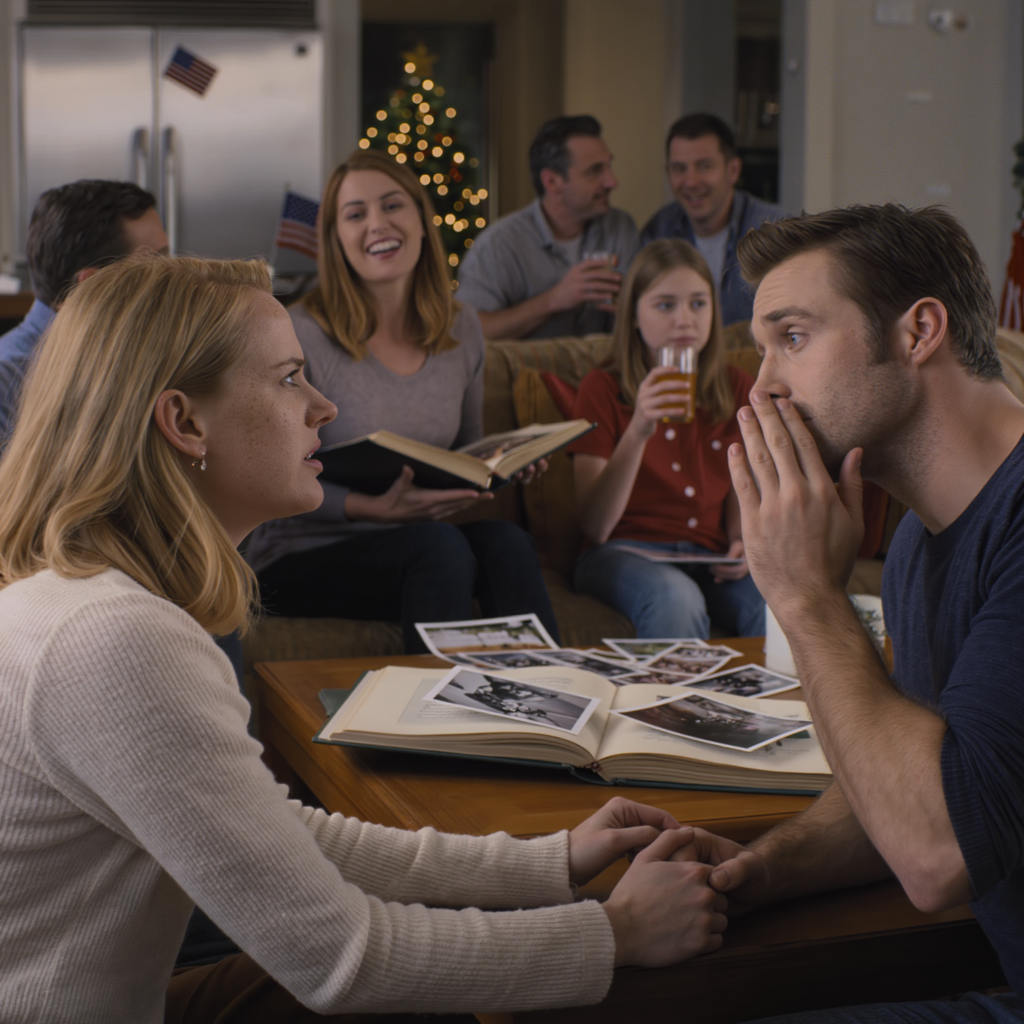
Five hours after Christmas dinner, I sat at my own kitchen table with a paper cup of iced tea sweating into a ring on the laminate. The apartment was quiet except for Frank Sinatra coming tinny through Lucas’s phone—he’d put it on because silence felt too much like a dare. On the fridge, a little U.S. flag magnet held up a grocery list in my mom’s handwriting from years ago, back when she still pretended my needs counted as a holiday tradition.In front of me, the photos lay in a neat, accusing row: glossy prints Lucas had slipped from the stack beside my mother’s albums. A girl in a pink coat. The same girl by a fence. The same girl by a swing set. The same smile, the same tilt of the head, the same shadow under the left cheekbone like someone had stamped me onto childhood and called it love.
Turns out it comes with potato salad.
It had started, like it always does, at my parents’ place—twinkle lights in the window, an artificial pine scent that never fooled anyone, my mom humming Mariah Carey while she wiped the counter like she hadn’t already sharpened nostalgia into a blade for the twentieth straight year. The house smelled like lemon cleaner and something vaguely burnt, the way it always does when my mother insists she’s “keeping things simple.”
I walked in and smiled like I always do. I hugged my mother like I always do. I waited for the familiar moment when the room would politely forget I existed.
Lucas came with me because I thought he could anchor me.
Joke’s on me.
My sister Nina was already there, swirling her wine like she was auditioning for a lifestyle blog, wearing something beige and expensive that probably had a name like oatmeal. Her boyfriend, Evan, nodded at everything as if approval was his whole personality. My parents smiled like they meant it. Dinner was dinner: familiar, tight-lipped, tense beneath the surface. The roast was dry. The plum brandy my dad insisted on calling “traditional” could’ve stripped paint.
Mom asked Nina about her new job. Dad asked Lucas about “computers” like he’d never met a millennial before.
No one asked me anything.
That part was standard.
I used to get upset. Now I just count how long it takes them to pretend I’m not there.
This year: nine minutes.
After dessert, my mom clapped her hands and said, “I brought the albums out!” like it was a whimsical surprise and not something she’d planned with military precision.
She always brings the albums.
She always acts like she just happened to find them in the hall closet under a pile of dish towels.
And we all smile like we haven’t seen the same stained pages a hundred times.
Nina leaned in like she was watching an awards show. Evan put on his best interested face. My dad sat back with his brandy and let my mother run the performance. Lucas took the spot beside me on the couch, calm and quiet, the kind of man who could make a living just by noticing things.
I watched him more than the pictures.
First album: birthdays, beach trips, awkward school photos—everyone’s hair tragic in the same decade.
Second album: Nina as a baby, Mom glowing, Dad proud. Baby books, camcorder stills, glitter letters—proof my parents could be tender when the child was theirs.
Third album: me.
That’s when Lucas changed.
At first he didn’t say anything, but I saw it anyway—the way his shoulders tensed, the way he squinted at one page and then another. The way he tilted his head the exact same way he does when he’s editing a photo and spots a bad crop.
He wasn’t looking.
He was scanning.
Measuring.
And then, without looking at me, he reached under the edge of the coffee table and grabbed my hand.
“Don’t you see it?” he whispered.
I blinked. “See what?”
His fingers tightened once, urgent. “How can you not see it?”
Before I could answer, he let go and sat up straight, smiling politely at my mom’s commentary about how I once tried to feed a pinecone to a stray cat.
I sat there with my skin suddenly too tight.
When I leaned closer and tried again, he shook his head just slightly. “I’ll explain later,” he murmured. “Just… go along with it.”
Which, honestly, is the emotional motto of my entire childhood.
And right then, with my mother turning pages like a magician, I felt something cold settle behind my ribs.
Because Lucas wasn’t wrong.
I just didn’t know yet what I was about to see.
We left twenty minutes later. Lucas made up something about an early flight, or maybe a late Zoom call. My mom fussed and wrapped leftovers like we were still a family. My dad didn’t care. Nina didn’t look up from her phone.
I kissed everyone goodbye like I wasn’t unraveling.
In the car, Lucas waited until we were three blocks away before he exhaled.
“I took a few,” he said.
I turned. “You took a few what?”
He reached into his coat pocket and pulled out loose photos. Not a couple. A stack.
“I didn’t want to make a scene,” he said. “But I couldn’t leave them there.”
“How many is that?” My voice sounded like it belonged to someone else.
He glanced down, counting without moving his lips. “Twenty-nine.”
“Twenty-nine photos?”
“Twenty-nine copies,” he corrected quietly. “Of the same face.”
He passed me the top one. Me—in a pink coat—standing in front of a stone wall. I’d seen it before. It lived in my memory like bad wallpaper.
“What am I supposed to see?” I asked.
“It’s not about the photo,” he said. “It’s about the math.”
“Lucas—”
“Same angle. Same smile. Same shadows,” he said, tapping the print with his finger. “Look at the highlight on your nose. Look at the fold of your lip. Now look at the next one.”
He handed me another. Me, supposedly older, by a wooden fence.
Then another. Me at a fountain.
Then another. Me by a swing set.
Different backgrounds. Different coats. Different seasons.
Same face.
Not similar. Not “kids look alike in photos.”
Identical.
I stared until my eyes hurt.
“Oh my God,” I whispered, and my voice broke on the last word.
He nodded once, like he’d been bracing for this.
“They reused my face,” I said.
“Like a sticker,” he said, and then he took a breath and softened his voice. “Like someone was building an album instead of remembering a life.”
My hands started shaking. I pressed my thumb against the edge of the photo, trying to convince myself that if I could feel the paper, I could feel reality.
Lucas slid one more print toward me.
A baby. Pale. Lighter hair. Different bone structure.
“That’s not you,” he said.
I tried to laugh. It came out thin, wrong. “Maybe I just—”
“Babe,” he said gently. “I’ve edited wedding portraits for people who wanted their ex cropped out. I know what it looks like when something’s been… arranged.”
He handed me the last one he’d pulled.
Me, Mom, and Dad in front of some old building. My outline was fuzzy. The shadows didn’t match. I looked like a cutout someone forgot to blend.
I stared at it so long my throat started to burn.
“So I’m… a collage,” I said.
Lucas didn’t laugh.
“Why would they do that?” I asked.
He didn’t answer.
Neither did I.
Because the question wasn’t why.
The question was what they were trying to hide.
That night, denial didn’t break all at once.
It leaked.
Like an old pipe under a sink that everyone agrees not to talk about.
You hear it, smell it, but you keep washing your hands and walking away.
I lined the photos up on my nightstand like they were evidence in a case I didn’t want to open.
Lucas fell asleep beside me eventually, his breathing steady, his hand still reaching for mine in the dark.
I didn’t move.
I kept staring, waiting for the prints to fix themselves when I wasn’t looking.
They didn’t.
My face stayed pasted, triplicated, frozen in some preset expression I didn’t remember making.
And then something I hadn’t said out loud in years rose up, plain and heavy.
I have no memories before I was five.
None.
When I was younger, I used to think that was normal. Or not normal exactly, but explainable. My parents said it was “the war.” I was little. They said I was traumatized. They said the brain protects itself. They said a lot of things.
I believed them because what was the alternative?
Telling your second-grade teacher you think you skipped being a toddler?
That your earliest memory is standing in a fluorescent-lit hallway in a new country, your mother telling you to smile at someone holding a clipboard?
Yeah.
That was my first real memory.
The immigration office. The buzz of lights. The feeling that everything was loud and cold and wrong.
I didn’t understand English yet, but I understood the look in my mom’s eyes.
Perform.
From there, it was “normal,” as normal as it could be. A small apartment outside Chicago. School. Lunches packed like the other moms did—except mine never wrote notes. She sent me off with perfectly folded napkins instead, like neatness could substitute for affection.
My dad read the newspaper like it owed him money.
They worked hard. They gave me what I needed.
But love—love was something else.
When Nina was born two years later, the temperature in the house changed overnight.
Suddenly there were baby books and camcorder footage and scrapbooks with glitter letters. Birthday parties with themes. Mommy-and-me classes. Hugs.
Warmth.
With me, it was always, “You’re strong. You’re independent. You never needed much.”
Which is just another way of saying, We didn’t give you much.
There were no aunts, no uncles, no cousins.
No one ever visited from “back home.” We never went back.
My parents said they had no one left. Everyone was scattered. It was complicated.
When I asked about family, my dad rubbed his face like I was the problem. My mom changed the subject.
And then there was the message.
I was fifteen. I walked into the kitchen and saw my mom on the laptop, frozen, staring at a Facebook message in a language I couldn’t read yet.
Serbian.
A name I didn’t recognize.
Hearts in the text.
My mom’s face went blank, like she’d been caught without makeup.
Then she deleted it.
Blocked the sender.
Closed the laptop.
When I asked who it was, she said, “Spam.”
Spam doesn’t make your hands shake.
But I let it go.
Because I always let it go.
I got diagnosed with PTSD at seventeen—nightmares, panic attacks, this dull, ever-present fear like something was always about to happen, like I was waiting for a door to slam that never did.
My therapist asked me about the war.
I told her I didn’t remember it.
She said that was probably why.
Except now I knew I hadn’t been scared of the war.
I’d been scared of the woman who taught me how to pretend.
That realization didn’t arrive like lightning.
It came in pieces.
That night, sitting at the kitchen table with Sinatra murmuring and the iced tea turning lukewarm, one memory blinked to life like a flashlight in a dark room.
A woman who wasn’t my mother.
Softer face. Dark eyes.
She smelled like citrus.
I was holding her hand.
Then another flicker: another woman, older, gentle hands. A voice speaking Serbian low and fast.
Then my “mom” walked in—young, smiling like she’d just arrived at a party—and the citrus woman leaned down and said something I only understand now:
“This is your babysitter.”
That was the first time I met her.
Another flash.
Me in a coat, crying, saying, “I want Mama.”
A hand on my shoulder—tight.
A cold voice, close to my ear.
Don’t say that again.
If you talk about her, you disappear.
I hadn’t remembered those words before.
But they were there.
Buried under years of being told to smile for the camera.
My breathing turned shallow. My vision tunneled. My palms went slick.
I slid off my chair and ended up on the kitchen floor, gasping like the air had decided I didn’t deserve it.
Lucas found me there.
He didn’t grab me. He didn’t demand. He just knelt beside me and put one steady hand between my shoulder blades.
“Hey,” he said softly. “You’re here. You’re safe. Breathe with me.”
I tried.
I tried.
And somewhere in the middle of my lungs refusing to cooperate, I reached for my phone and dialed 911.
The operator picked up on the third ring.
“911, what’s your emergency?”
My mouth opened.
Nothing came out.
Lucas stayed beside me, his hand grounding me like he could keep me from floating off the planet.
I finally forced the words out, broken and raw.
“I think… I think I was taken.”
There was a pause—sharper now.
“Ma’am, are you safe right now?”
“I—I think so. I’m home.”
“Is anyone with you who might hurt you?”
“No. No, it was… it was a long time ago.” I swallowed hard. “I think I just… remembered it.”
Another pause, then her tone shifted, gentler but controlled.
“Okay. Take a breath for me. You’re not in danger right now.”
“But it’s real,” I insisted. “My photos—my—”
Lucas leaned in and took the phone.
“Hi,” he said. “I’m her fiancé. She’s having a panic attack. We found childhood photos that look edited—like, clearly. There are inconsistencies, no baby photos that match. She just had a vivid memory. She believes she may have been separated from her biological family around age five. This would’ve been about twenty-five years ago, overseas. We’re in Chicago.”
The operator stayed calm, like she’d heard every kind of world collapse.
“I understand. What’s your address?”
Lucas gave it.
“I’m logging this as a welfare check and forwarding it to our investigative unit,” she said. “You’ll get a call from a detective to follow up. If either of you feels unsafe in the meantime, don’t wait. Call back immediately.”
Lucas thanked her and hung up.
I was still shaking, but the words had been said out loud to someone real.
And there was no un-saying them.
In the early morning hours, I did the things people do when their brains are trying to outrun their hearts.
I showered.
Changed clothes.
Folded laundry I didn’t remember washing.
Emptied the dishwasher like it was a prayer.
Lucas hovered, made tea, watched me like I was glassware in an earthquake.
“You should rest,” he said.
I nodded.
Didn’t move.
The apartment stayed quiet, humming softly like it didn’t care what was happening to me.
The next morning, I got an email: case file opened, pending contact from an assigned detective.
That was it.
Two lines and a reference number.
Lucas read it twice. “It’s real now,” he said.
Real.
As if it hadn’t been real when I was on the kitchen floor trying to remember if I’d ever actually had a mother.
Two days later, there was a knock.
Three taps.
Measured.
Calm.
Like a favor.
I opened the door and saw my mom holding a brown paper bag like she was dropping off cookies.
My dad stood half a step behind her, hands in his coat pockets, face neutral.
“Can we come in?” my mom asked, already leaning forward.
Lucas appeared beside me.
I stepped back.
They walked in like they owned the air.
They sat on the couch like guests.
My mom placed the bag on the coffee table with a soft thud.
“I brought you that soup you like,” she said. “The carrot one. From when you were sick that time.”
That time I was eight and she told me to stop crying because I wasn’t dying.
“That soup?” I said flatly. “Thanks.”
She smoothed her coat and looked around the apartment like the furniture might give her the right script.
My dad stayed standing.
“We spoke to the police,” my mom said finally. “They said you filed a report.”
“I did.”
Her mouth tightened. “You should have come to us first.”
I laughed once, short. “Would you have told me the truth?”
She blinked, like truth was a language she didn’t speak.
“We didn’t want to hurt you,” she said.
Lucas’s voice was calm, which somehow made it sharper.
“So it’s true,” he said. “She isn’t biologically yours.”
My dad’s jaw flexed.
Then he nodded.
“Yes,” he said. “You’re not ours by blood.”
The room didn’t tilt. The ceiling didn’t crack.
I just exhaled, slow, like confirmation was its own kind of bruise.
My mom rushed in with the version she preferred.
“Your mother was young,” she said. “Very young. She couldn’t take care of you. She begged us to take you.”
“Begged,” I repeated.
“She wanted you to have a better life,” my mom insisted. “We were leaving. She was staying. It was war. She knew what that meant.”
“So where is she now?”
My mom folded her hands. “We don’t know.”
“You never checked.”
“It was complicated.”
Lucas crossed his arms. “Why fake the photos?”
My dad didn’t flinch. “We didn’t want her to feel like she didn’t belong.”
“So you erased her real life and invented one?” Lucas asked.
My mom’s voice cracked, and for a second it almost sounded like a person.
“You were five. You cried for her for weeks,” she whispered. “It was awful. But you adjusted. You forgot. We thought… we thought it was better.”
“You could have told me,” I said.
“And say what?” she snapped, finally letting the anger show. “That we took you from your mother? That you had a life you’d never remember? You would have hated us.”
I stared at her.
“You think I don’t?”
Silence filled the room like smoke.
Then my mom dug into her bag again and pulled out a photo like it was a peace offering.
Me, maybe six, holding my dad’s hand.
“This one’s real,” she said.
Like one real photo could erase twenty-nine counterfeit smiles.
I didn’t touch it.
My dad finally looked at Lucas, then at me.
“We didn’t steal you,” he said. “We rescued you.”
And for about ten seconds, the part of me trained to perform almost believed him.
Then I heard my own voice, clear and hard.
“Tell me her name.”
My mom blinked like she didn’t understand the question.
My dad rubbed his face like he was exhausted by my existence.
“You were five,” my mom said quickly. “Your memories—”
“Try me,” I cut in.
They looked at each other.
And then my dad said the name like it tasted like guilt.
“Mara Petrovic.”
No address.
No phone number.
Just a name dropped on my coffee table like a match.
When I asked for more, my mom said, “We lost touch. It was war.”
Right.
And apparently war also erases your ability to type a name into Google.
That night, Lucas and I became detectives the way people do when the system takes too long and the heart takes over.
He was on his laptop. I was on mine.
My Serbian was passable when I was talking to elderly neighbors about food, but online research is a different sport.
Mara Petrovic is not an uncommon name.
We hit dead ends.
A florist outside Novi Sad.
A retired gym teacher in Belgrade.
A memorial page that made my stomach drop until I realized the birth date was wrong.
Hours passed.
At some point, Lucas slid a blanket over my shoulders.
“At least drink water,” he said.
“I can’t,” I whispered, eyes glued to the screen.
He didn’t argue.
Then I clicked a grainy Facebook profile.
No filters.
No smile.
Just a woman in her early fifties with dark hair pulled back, faint lines around her eyes, and a face that made my stomach go quiet.
I stared.
Lucas leaned over my shoulder.
“She looks like you,” he murmured.
I shook my head, slow.
“No,” I said. “I look like her.”
It wasn’t a resemblance.
It was the kind of similarity that makes your skin prickle.
Same jawline.
Same eyes.
Same resting expression when she wasn’t trying to be anything for anyone.
Her posts were sparse. Months since the last one. But her “About” section listed a small town in southern Serbia.
The same town I’d heard once when I was ten and my mom slipped up on the phone.
Lucas opened a new message.
We used Google Translate.
It probably sounded robotic. Lucas checked it three times anyway.
I watched the cursor blink like it was a heartbeat.
Hello. I was given your name. I think I might be your daughter.
We sent it.
Then we waited.
She replied the next morning.
One line.
Can we talk?
Lucas set up a video call like his hands were steadier than mine.
I don’t remember agreeing to it.
I just remember sitting on our couch wrapped in a blanket, feeling like I was about to meet someone from a dream I didn’t know I’d been having.
The screen lit up.
Her face appeared.
Older than the profile picture.
Tired.
Still her.
Still… me.
She didn’t speak at first. She just stared, her eyes scanning me the same way Lucas had scanned those photos.
Then her hand went to her mouth like she needed to hold something in.
“I wasn’t sure,” she said in Serbian, voice shaking. “But now that I see you…”
I couldn’t breathe.
Words gathered behind my teeth and refused to come out.
“I’ve been looking for you for twenty-five years,” she whispered.
She said my name.
Not Isabelle.
Not Izzy.
“Milena.”
The sound didn’t feel familiar.
It felt… right.
Like a shoe I hadn’t worn in decades that still fit.
My vision blurred.
Lucas was the one who found his voice.
“Did you give her up?” he asked gently.
The woman on the screen—my mother—broke in a way that wasn’t dramatic, not cinematic, just quiet collapse.
“No,” she said. “God, no.”
She looked off-screen like she needed to ground herself, then turned back.
“You were five,” she said. “I left you with someone I trusted—my neighbor—for a couple hours. I had to go to the municipal office to finalize papers. I was approved for resettlement. Families with children had priority. I needed the documents stamped that day.”
She swallowed.
“When I came back, you were gone.”
The room felt too small.
“They told me the babysitter left early,” she continued, voice tight. “She said you went with her. But you never came home. I went to every police station. Every camp. I posted flyers. I begged. People said children get lost in war.” Her eyes flashed, fierce even through grief. “But I knew you didn’t get lost.”
Lucas’s hand found mine.
I squeezed so hard my knuckles hurt.
“Did you ever try to leave after?” Lucas asked.
Mara nodded. “I was on the list. But after you disappeared, they took me off. They said I couldn’t prove I had a child anymore.”
She laughed once, bitter. “Not that I would have gone without you.”
And that’s when the shape of the lie finally snapped into focus.
They didn’t take me because they loved me.
They took me because I was a ticket.
I sat there, staring at the woman who had been hollowed out by my absence, and something in me hardened.
Not into hatred.
Into clarity.
“They changed my name,” I said, voice small.
“I know,” Mara whispered. “I saw it later, years later, on a list someone smuggled out. They called you Isabelle.”
My throat tightened.
“My Lena,” she said softly, and the words landed like a hand on my head. “That was your grandmother’s name.”
I didn’t know what I expected to feel.
Rage.
Relief.
Instead I felt hollow, like someone had scooped everything out but politely left the shell so I could keep showing up to work.
After the call ended, I didn’t cry the way people cry in movies.
I just sat there.
Lucas sat beside me.
The photos were still on the table.
Twenty-nine identical smiles.
One woman on a screen who looked like my future.
And one truth that had been waiting under my ribs for decades.
I wasn’t dramatic.
I wasn’t confused.
I was done.
Two weeks later, Mara and I stood side by side at a Chicago precinct that smelled like coffee and copy paper.
She wore a navy coat like armor.
I carried the photos in a manila envelope.
The detective—Detective Alvarez—took our statements in a small interview room with a clock that ticked too loud.
He asked questions I barely remember answering.
Dates.
Addresses.
Names.
“Do you have any documentation from your childhood overseas?” he asked Mara.
She reached into her purse and pulled out something creased and worn like it had been held a thousand times.
A flyer.
The original missing-child notice.
My name—the first one—printed beneath a grainy photo.
Milena Petrovic, age five, last seen wearing a red scarf.
My stomach dropped.
That red scarf wasn’t in my albums.
That red scarf wasn’t in my parents’ curated history.
But I could feel it in my hands anyway, like a ghost of warmth.
“This is her,” Mara told the detective, voice steady now. “This is my daughter.”
For the first time in my life, someone in authority nodded like my story mattered.
The investigation moved faster than I expected and slower than I could stand.
There were phone calls.
Requests for records.
Old immigration files pulled from storage.
Lucas and I gave Alvarez everything we had—the twenty-nine altered photos, the timing, the names, the screenshots of my mom’s old blocked messages.
When Alvarez asked if my parents had ever mentioned using a different surname, Lucas didn’t even look at me.
“They keep their Serbian passports,” he said. “I’ve seen them. They’re in a drawer with birth certificates.”
I stared at him.
“You saw them?”
He shrugged once, apologetic. “I notice things. Remember?”
I wanted to scream.
I wanted to laugh.
Instead I took a breath and thought about that red scarf.
Proof doesn’t always come in a confession.
Sometimes it comes in the thing they forgot to fake.
My parents tried to call.
First my mom.
Then my dad.
Then Nina.
I didn’t answer.
Lucas listened to my voicemail like it was weather.
“They’re scared,” he said.
“Good,” I replied.
One afternoon, my mom showed up again at our door, eyes bright with a kind of frantic sweetness that made my skin crawl.
“We can fix this,” she insisted, hands pressed together like prayer. “We can talk to a lawyer. We can explain. People will understand. It was a different time.”
“It was a crime,” I said.
Her face tightened. “Don’t say that word.”
“I’ll say it as many times as it takes,” I told her.
My dad stood behind her, silent, like he was trying to outlast the truth.
“You’re going to ruin us,” my mom whispered.
I held her gaze.
“You built your life on a ruin,” I said. “I’m just naming the rubble.”
Her mouth opened.
Nothing came out.
Lucas stepped closer, calm and unwavering.
“You should go,” he said.
My mom stared at him like he was the villain in her story.
My dad finally spoke.
“We gave you everything,” he said, voice flat.
I nodded.
“You gave me a life you stole,” I said. “Those aren’t the same.”
They left.
And the air in the apartment felt lighter in a way that scared me.
Because letting go is its own kind of free fall.
The case didn’t go to trial.
It didn’t need to.
The paper trail was too clean.
The edits in the photos were too obvious once someone trained looked for them.
The resettlement documents didn’t match the timelines.
The names were inconsistent.
The fingerprints—literal and metaphorical—were everywhere.
Detective Alvarez called on a Tuesday afternoon.
“I wanted you to hear it from me,” he said. “We’ve referred the immigration-related issues to federal partners. There will be charges at the state level related to falsified records and concealment. Your parents have been advised to retain counsel.”
I sat down on the edge of my bed like my legs had forgotten their job.
“And Mara?” I asked.
“There’s a pathway,” Alvarez said. “Family reunification. It’s not quick, but it’s possible.”
I closed my eyes.
Lucas took the phone from my hand and asked the questions I couldn’t: timelines, forms, next steps.
When he hung up, he sat beside me.
“What do you want to do?” he asked.
The question should have been hard.
It wasn’t.
“I want my name back,” I said.
He nodded. “Then we start there.”
We filed paperwork.
We gathered documents.
We printed and reprinted forms until the printer jammed like it had opinions.
Mara sent copies of everything she had—old school records, the original flyer, photos that hadn’t been curated by someone else’s guilt.
In one of them, I was five and furious, cheeks flushed, eyes wet, wearing that red scarf.
Real.
Not pasted.
Not blended.
Just me.
I stared at that photo until it felt like the girl in it stared back.
My parents’ consequences arrived the way consequences usually do in America: quietly, officially, in envelopes.
Not sirens.
Not a dramatic courtroom monologue.
Just notices.
Interviews.
Appointments.
At some point, their American citizenship was revoked.
At some point after that, they were ordered removed.
Six months after the case opened, they were gone.
No appeals that worked.
No second chances.
No coming back.
People asked me if I felt guilty.
If it was “too far.”
If I’d regret it.
I looked at the twenty-nine altered photos in my drawer and felt nothing like guilt.
I felt accurate.
Nina stayed.
Of course she did.
She was born here. She didn’t build her life on someone else’s paperwork.
For a while she didn’t say much, just stared at the floor like she was watching her own childhood rerun with different subtitles.
Then one day she came over, sat on my couch, and said, “That was really messed up.”
It wasn’t an apology.
It wasn’t accountability.
But it was the closest she’d ever gotten to truth.
We talk more now than we ever did growing up.
She’s not my sister by blood.
But she still knows how I take my coffee, and that counts for something.
Mara—my mother—moved to the U.S. about six months after everything settled, once the paperwork finally cleared.
Lucas and I met her at O’Hare.
She walked through arrivals with a small suitcase and eyes that looked like they’d been waiting in airports for a quarter century.
When she saw me, she didn’t rush.
She didn’t perform.
She just stepped forward and touched my cheek like she was confirming I was real.
“Milena,” she whispered.
I swallowed.
“Isabelle,” I corrected automatically.
She smiled, sad and soft. “Whatever you want,” she said. “You are you.”
We helped her get settled in a one-bedroom near our place.
She got a job at a bakery down the street.
She said it reminded her of the one she worked at when she was twenty-one, before everything.
Sometimes she brings over bread still warm, flour dusting her hands like snow.
Sometimes she sits at my kitchen table under the same light where my world cracked open and tells me stories I never got to live.
The first time she asked me what I remembered from before I left, I told her the truth.
“I remember the smell of citrus,” I said.
Her eyes filled.
“That was me,” she whispered. “I used to peel oranges for you and leave the rind by the window. You liked the smell.”
Something in my chest loosened.
Not healed.
Just… less clenched.
Lucas and I are planning the wedding.
The venue is small. The guest list is careful.
Mara is on it.
When she got the invitation, she held it like it might disappear, and her face crumpled in the quiet way grief does when it’s finally allowed to exhale.
My mother—the one who raised me—won’t be there.
My father won’t be there.
They built their life on a lie.
So when it collapsed, I didn’t feel guilty.
I felt free.
Last week, I opened one of my mother’s old albums one more time.
Not because I missed them.
Because I wanted to see it with new eyes.
I flipped through the pages where my face was pasted into places I barely remember, into backgrounds that were supposed to prove I belonged.
Then I set the album aside and pulled out the real photo Mara sent.
Five years old.
Red scarf.
Eyes swollen from crying.
Alive.
Unedited.
I held it in my hands until the paper warmed.
In the reflection of the dark TV screen, I could see myself—older now, steadier—looking back.
And for the first time, the question in my head wasn’t Why would they do that?
It was simpler.
How did I ever survive being taught to call a counterfeit life home?
Sinatra still plays sometimes when the apartment gets too quiet.
The iced tea still leaves rings if I forget a coaster.
The little U.S. flag magnet is still on the fridge, stubborn as ever.
But that red scarf—real, undeniable—sits folded in my dresser drawer now, the only thing I never knew I’d been missing.
Because once you see the edit, you can’t unsee it.
And once you find the original, you stop apologizing for wanting it back.
I thought that sentence would be the end of it—the neat button at the bottom of a story people could consume and move on from.
But the truth doesn’t end.
It keeps showing up in the small spaces, like dust you can’t stop seeing once the sun hits it.
Two days after I stopped answering my parents’ calls, I went to work like everything was normal, because that’s what I’d been trained to do. I packed a lunch. I grabbed my keys. I checked my reflection by the door and practiced the same “I’m fine” face I’d used in those albums.
Then I caught myself.
The mirror wasn’t lying, but it wasn’t telling me the whole truth either.
Lucas stood behind me, tying his boots. “You don’t have to go,” he said.
“I have to do something,” I replied.
“Okay,” he said, like he was filing the word away. “Then do it with a plan.”
I stared at the little U.S. flag magnet on the fridge, the one that had survived three apartments and a breakup and one very dramatic attempt at homemade kombucha. It held up my grocery list like a badge.
A flag magnet.
A fake album.
A real life.
America is wild like that.
Lucas poured my coffee and slid it to me. “Remember what I said in the car?”
“You said a lot of things in the car,” I muttered.
He leaned on the counter. “I said if I was right, I wasn’t going to let you carry this alone.”
I swallowed.
“I’m not asking you to fix it,” I said.
“I’m not fixing it,” he replied. “I’m standing in it with you.”
That should’ve been corny.
It wasn’t.
Because I realized, in that quiet kitchen, that the biggest lie my parents taught me wasn’t my name.
It was that I had to survive everything by myself.
That was the first time I let someone help without feeling like I owed them my silence.
At work, I lasted forty-seven minutes.
I know the exact number because I started counting again, the way I used to count the seconds until dinner was over so I could escape to my room. Forty-seven minutes of pretending to type while my brain replayed the photo edits like a slideshow.
A coworker—Janelle, kind, too cheerful—stopped by my desk and said, “How was your Christmas?”
My mouth tried to form the usual lie.
Fine. Good. Busy.
Instead, I heard myself say, “I found out my childhood was… complicated.”
Janelle blinked. “Oh.”
“Yeah,” I said, staring at my monitor like it could save me. “So. Anyway.”
She hesitated, then put a hand on my shoulder. “Do you want to get lunch later?”
The kindness hit me like a wave.
I flinched.
“I can’t,” I whispered.
And then my body decided we were done performing.
My hands went numb. My vision sharpened too much, like someone turned up the contrast on the world. The hum of the fluorescent lights grew teeth.
I stood so fast my chair rolled back.
“I’m going to the bathroom,” I said, voice too loud.
I didn’t make it.
I made it to the stairwell instead and sat on the steps, breathing in that dusty concrete smell that every office building in America shares.
Lucas texted: You okay?
I stared at the screen.
I could’ve typed I’m fine.
I typed the truth.
Not really.
Three dots appeared.
Then: I’m coming.
I didn’t argue.
That was the moment I understood that truth isn’t just about what happened.
It’s about what you stop tolerating.
When Lucas got there, he didn’t ask for a summary. He didn’t demand details.
He just sat next to me on the stairwell like it wasn’t weird for a grown man to be in an office building stairwell holding his fiancée’s shaking hands.
“Breathe,” he said.
“I feel stupid,” I whispered.
“You feel betrayed,” he corrected. “That’s not stupid.”
I pressed my palms against my eyes until I saw stars.
“We need to talk to my boss,” I said.
“I’ll walk with you,” he replied.
So we did.
I told my manager I was dealing with a family emergency. She offered me HR pamphlets and a sad look and said, “Take the time you need.”
I nodded like a person with an actual stable history would nod.
In the parking lot, Lucas opened the passenger door for me. “We’re not doing this alone,” he repeated.
“I know,” I said.
But my voice sounded like it was still learning.
Two hours later, Detective Alvarez called.
Not a dramatic ringtone.
Not a siren.
Just my phone vibrating on the counter while Sinatra murmured in the background and my iced tea left another ring on the laminate like a tiny, circular reminder that time keeps going whether you’re ready or not.
“Ms. Harper?” he asked.
“Hearing you say my name feels weird,” I blurted.
He paused, then said carefully, “Okay. Isabelle. I’m Detective Alvarez with CPD. I’m following up on the report you filed.”
Lucas leaned in, one hand braced on the counter.
Alvarez’s voice was calm in that practiced way that makes you trust him and resent him at the same time.
“I reviewed your initial statement,” he said. “I want to bring you in for a longer interview. I also want to look at the photographs you mentioned. And I want to ask you some questions about your parents’ immigration history.”
My stomach tightened. “Is this… is it real? Like, will anything actually happen?”
“Something already happened,” Alvarez said. “Now we figure out what, who, and how.”
I stared at Lucas.
He nodded once.
Alvarez continued, “Do you feel safe right now?”
“Yes,” I lied automatically.
Lucas spoke over me, gentle but firm. “She’s physically safe. Emotionally, not great.”
Alvarez didn’t laugh. “That tracks. Bring whatever documentation you have. Birth certificate, passport copies, school records—anything. We’ll start building a timeline.”
Timeline.
My whole life had been a timeline someone else edited.
After the call, Lucas opened a folder on his laptop and titled it in all caps: ISABELLE.
Then he added another folder beneath it: MILENA.
He looked at me. “You get to decide,” he said.
I stared at the screen.
For years, I’d been told who I was.
Now I had to choose.
That was the moment I realized freedom comes with homework.
The interview room at the precinct was beige in a way that felt intentional, like the walls were designed to make you forget you ever had color in your life.
Alvarez brought a second detective in—Detective Kim—who had a neat bun and eyes that didn’t miss anything.
Lucas sat beside me. He wasn’t allowed to answer for me, but he was allowed to exist as a steady presence.
Alvarez started simple.
“Tell me about the albums,” he said.
So I did.
I told him about my mom clapping her hands like nostalgia was a game show.
I told him about Lucas freezing.
I told him about the stack of prints in the car.
Alvarez held one up, squinting.
Kim leaned closer. “Do you have the originals?” she asked.
“These are originals,” Lucas said. “Printed originals. But the edits are in the source image.”
Kim’s gaze flicked to him. “You work in photography?”
“Post-production,” Lucas answered. “I know what cloning looks like. I know what a sloppy mask looks like. And these…” He hesitated, then said bluntly, “These aren’t even subtle.”
Alvarez laid the photos on the table in two rows.
I watched his finger move from one to the next.
“One,” he murmured.
“Two.”
“Three.”
He stopped at twenty-nine like the number carried weight.
“You said there were twenty-nine?” he asked.
Lucas nodded. “In that stack. There are more in the albums. But those were the clearest.”
Kim tapped a photo where my face looked slightly too sharp against a blurry background. “This is composited,” she said.
Hearing her say it out loud made my throat tighten.
Alvarez leaned back. “Okay,” he said. “So we have altered photos. Now we need motive.”
“Motive?” I echoed.
He looked at me carefully. “You said you don’t remember before age five. You said you came to the U.S. around then. That’s not nothing.”
Kim slid a notepad toward me. “What do you remember about arriving?”
I stared at the paper like it was a test.
“Lights,” I said. “Buzzing lights. A clipboard. Someone telling me to smile.”
Alvarez nodded. “Any names? Any uniforms? Any badges?”
I shook my head.
Kim’s voice softened. “It’s okay. We’re not expecting perfect memory. We’re looking for patterns.”
Patterns.
My whole childhood had been one long pattern of being told I was lucky.
Alvarez asked, “What do your parents say happened?”
I repeated my mom’s story: a young mother, war, begged them.
Alvarez didn’t write it down right away. He just looked at me.
“And you believe them?” he asked.
My laugh came out sharp. “I don’t know what I believe. I know they lied. I know they edited photos. I know they hid things. I know they called me strong whenever they didn’t want to show up for me.”
Kim nodded once, like she’d filed that sentence as evidence.
Alvarez said, “We’ll request your immigration file. We’ll pull the original applications. If there are inconsistencies, we’ll find them.”
Lucas asked, “How long does that take?”
Alvarez sighed. “Longer than any of us want. But there are ways to expedite. And if there’s fraud, it gets attention.”
I stared at the beige wall.
“Do I have to confront them again?” I asked.
Alvarez’s eyes narrowed. “You don’t have to do anything. But I’m going to ask you not to warn them. Don’t give them time to destroy evidence.”
I pictured my mom wiping counters, humming, cleaning away traces.
“Trust me,” I said, voice flat. “She already did that for years.”
That was the moment I understood that my parents’ biggest skill wasn’t lying.
It was cleaning.
Outside the precinct, Lucas held my elbow like I might drift into traffic.
“I hate that they made you do this in an interview room,” he said.
“I hate that they made me do it in my own living room,” I replied.
He looked at me. “Do you want to tell Nina?”
I hesitated.
Nina had always existed in that bright, warm space I wasn’t allowed into.
But she was also the only other person who’d lived in that house.
“She knows something,” Lucas said quietly, reading my face. “Even if she doesn’t know she knows.”
I stared down at the sidewalk.
“Okay,” I said. “But not today.”
We went home and sat on the couch like we were waiting for a verdict.
Lucas opened his laptop and started a spreadsheet.
“What are you doing?” I asked.
“Building your timeline,” he said. “If the system is slow, we get organized.”
I watched him type dates, places, notes.
He added a column labeled QUESTIONS.
Then he typed: WHY TWENTY-NINE?
I swallowed.
Because it wasn’t just twenty-nine photos.
It was twenty-nine years of being told to be grateful.
That was the moment I realized counting can be a kind of rebellion.
The first social consequence came from someone I didn’t expect.
My aunt—technically my dad’s cousin’s wife, which in immigrant families counts as immediate—called me three days after the precinct interview.
She hadn’t called me in years.
Her voice was honeyed and sharp. “Izzy, sweetheart,” she said. “Your mother is beside herself.”
I stared at my phone, thumb hovering over the speaker button like it might explode.
“Okay,” I said.
“She says you accused them,” my aunt continued. “Of terrible things. You know how people talk.”
I felt my jaw tighten. “People talk because my parents lied.”
A pause.
Then my aunt sighed like I’d disappointed her personally.
“They gave you a home,” she said.
“They gave me a story,” I corrected. “And they edited it.”
Honey turned to vinegar fast.
“You’re ungrateful,” she snapped. “You don’t understand what it was like back then.”
“I understand enough to know they didn’t have to fake my face,” I said.
Silence.
Then, quieter, she said, “If you keep pushing this, you’ll ruin them.”
I laughed, once. “They ruined themselves. I’m just not carrying it anymore.”
I hung up before she could respond.
My hands shook.
Lucas looked up from his laptop. “Who was that?”
I exhaled. “The family grapevine.”
He nodded slowly. “So it starts.”
“What starts?”
“The story they’ll tell,” he said. “They’re going to paint you as the villain. Because if you’re the villain, they’re just misunderstood heroes.”
I sank onto the couch.
“I don’t want to be a headline,” I whispered.
Lucas’s hand found mine. “Then don’t perform for their audience.”
Easy to say.
Harder to do when the audience includes people who used to hug you at weddings and now won’t meet your eyes at the grocery store.
That was the moment I realized the truth doesn’t just expose the liar.
It exposes everyone who benefited from believing them.
Nina texted that night.
Hey. Can we talk?
My stomach flipped.
I typed back: Yes.
She showed up an hour later with her hair pulled into a tight ponytail and a face that looked like she’d been crying in a bathroom she didn’t want anyone to know she used.
Lucas made tea and left us on the couch.
Nina held the mug between her hands like warmth might keep her from breaking.
“I heard…” she started, then stopped.
“Heard what?” I asked.
She swallowed. “That you went to the police.”
I didn’t flinch. “I did.”
Her eyes darted to the hallway, like she expected our parents to appear.
“Mom says you’re having some kind of… episode,” she said.
My laugh was short and bitter. “An episode. Sure.”
Nina’s jaw tightened. “I’m not saying I believe her,” she snapped, then softened immediately. “I’m just saying that’s what she’s telling everyone.”
“And what do you believe?” I asked.
Nina stared down at her tea.
“I believe,” she said slowly, “that Mom and Dad can be… intense.”
“That’s a cute word for it,” I replied.
She flinched.
I hated myself for enjoying that tiny hit of vindication.
Nina looked up. “Is it true?” she asked. “Are you really not… ours?”
The word ours landed heavy.
“I don’t know how to phrase it gently,” I said. “So I won’t. I’m not biologically related to them.”
Nina’s breath caught.
“And you think they… took you?”
I held her gaze. “I think they lied. I think they forged. I think they built a life that required me to exist in it.”
She shook her head, fast. “No. No, they wouldn’t—”
“Wouldn’t what?” I asked. “Wouldn’t do something illegal? Nina, you’ve watched Mom return a sweater she wore for three years and act offended when they didn’t refund her.”
A startled laugh escaped her.
Then it died.
She pressed a hand to her forehead. “I don’t know what to do with this,” she whispered.
I leaned forward. “You don’t have to do anything. You just have to stop repeating their story.”
Nina’s eyes filled.
“I feel like my whole childhood is…” she gestured helplessly. “Like it’s built on something I didn’t know.”
I nodded. “Welcome.”
The word came out harsher than I intended.
Nina wiped at her cheek with the back of her hand. “I’m sorry,” she said, voice small. “For… for all of it. I didn’t see it.”
I swallowed hard.
“I didn’t see it either,” I admitted. “Not until someone who wasn’t raised inside it pointed at the seams.”
Nina stared at the kitchen counter. “So what happens now?”
I hesitated.
“Now,” I said, “we let the truth be inconvenient.”
That was the moment I realized Nina wasn’t my enemy.
She was just the child my parents actually practiced loving on.
The next week was a blur of paperwork and emotional whiplash.
Detective Alvarez emailed us a list of what he needed: copies of my parents’ passports, any immigration documents we could find, photos with dates, anything that could place us in specific locations.
Lucas suggested we get a lawyer.
“Not to fight Alvarez,” he clarified. “To protect you. To make sure the system doesn’t swallow you whole.”
I hated that he was right.
We sat in a glass-walled office across from an immigration attorney named Denise Patel, who wore red lipstick and didn’t waste time.
She flipped through our documents like she was speed-reading a nightmare.
“Okay,” she said finally. “So. Based on what you’re telling me, there are potentially multiple issues here. Name changes, identity documents, possible fraud in the resettlement process, and—” she looked up at me, eyes sharp—“the way you were brought here.”
My throat tightened.
Denise held up a hand. “I’m not going to use dramatic words,” she said. “But I’m not going to sugarcoat either. If you were brought into the U.S. under false pretenses, federal agencies will care. That means this can get big.”
Lucas’s hand found my knee under the table.
Denise continued, “For you, the priorities are: one, your legal identity. Two, your relationship to your biological mother for reunification purposes. Three, your safety.”
“My safety?” I echoed.
Denise’s expression softened just slightly. “People don’t always respond well when their secrets become public. Especially when those secrets have consequences.”
I thought about my mom showing up with soup.
I thought about my dad saying, We rescued you.
I thought about the way my parents’ smiles had always been too controlled.
“Okay,” I whispered.
Denise slid a form toward me. “We start by requesting your A-file,” she said. “Your immigration file. It’s tedious. It’s bureaucratic. But the file doesn’t lie the way people do.”
Lucas let out a breath. “Thank you,” he said.
Denise nodded. “Also,” she added, tapping the photos, “your fiancé is right. These are edited. If a forensic analyst testifies to that, it becomes strong evidence of intent.”
Intent.
My mother’s favorite weapon was intent.
I didn’t mean it.
You misunderstood.
I was trying to protect you.
Now a professional woman in an office was looking at my parents’ handiwork and calling it what it was.
Evidence.
That was the moment I realized I wasn’t crazy.
I was documented.
The federal part crept in quietly.
Alvarez called one afternoon and said, “I’m looping in a partner agency.”
He didn’t say the name at first, like saying it would make it more real.
Lucas asked, “Homeland Security?”
A pause.
“Yes,” Alvarez admitted. “Specifically their investigations unit. They handle document fraud and related issues.”
My stomach dropped.
“That sounds… huge,” I said.
“It’s procedural,” Alvarez assured me. “But yes. It’s serious.”
After we hung up, I sat on the couch and stared at the blank TV screen.
Lucas sat beside me.
“Do you regret calling?” he asked.
The question was gentle, but it landed heavy.
I thought about the albums. The fake smiles. The missing years.
I shook my head.
“No,” I said. “I regret that I didn’t see it sooner.”
Lucas nodded once. “Then we keep going.”
That was the moment I realized courage isn’t loud.
Sometimes it’s just showing up again tomorrow.
The smear campaign arrived right on schedule.
My mom posted on Facebook.
Not naming me.
Just vague enough to look innocent.
A photo of her holding a mug. A caption about “how hard it is when someone you love struggles with mental health.”
Comments poured in.
Prayers.
Heart emojis.
People telling her she was “such a good mother.”
I stared at the screen until my eyes burned.
Lucas looked over my shoulder. “Don’t,” he said.
“Don’t what?”
“Don’t let her turn your pain into her performance,” he replied.
I wanted to throw my phone.
Instead, I texted Nina.
Did you see Mom’s post?
She replied a minute later.
Yeah. It’s disgusting.
I stared at the message.
That sentence from Nina hit me harder than any apology.
Because it meant she was seeing it too.
The next day, my dad emailed me.
Subject line: FAMILY.
The email was short.
We are willing to forgive you if you stop this.
Forgive.
Like I’d stolen something.
Like I owed them my silence.
Lucas read it and his jaw tightened.
“Delete it,” he said.
“No,” I replied.
I forwarded it to Detective Alvarez.
Then I forwarded it to Denise.
Then I saved it in the folder labeled QUESTIONS.
Because if my parents wanted to play power games, they were going to do it in writing.
That was the moment I realized my father’s pride was never about dignity.
It was about control.
Mara and I started talking every day.
At first, the calls were stiff. Awkward. Full of pauses where neither of us knew who was allowed to speak.
Our relationship was twenty-five years late, and there’s no etiquette guide for that.
Sometimes we just sat on video chat and watched each other breathe.
Lucas would hover in the kitchen, pretending to make coffee while he listened for any sign I was breaking.
Mara would hold her phone like it was a fragile thing.
She told me about the town she grew up in. The bakery where she worked. The apartment she used to rent with cracked tiles and a balcony full of plants.
She told me about the day she lost me, not like a story she enjoyed repeating, but like she’d been trapped in it for decades.
“I keep thinking,” she said once, voice rough, “if I had taken you with me to the office. If I had carried you on my hip. If I had been annoying and overprotective—”
“You were doing paperwork,” I said softly.
She flinched at my accent in her language.
“I was trying to build a way out,” she whispered.
Lucas sat beside me and said in English, “You don’t have to carry the blame, Mara.”
Mara blinked, surprised he’d used her name without stumbling.
“You understand?” she asked him in Serbian.
Lucas tried, carefully. “I… learn. Little.”
Mara laughed through tears.
And something about that laugh made my chest ache.
Because it sounded like mine.
One night, Mara asked, “What did they call you?”
I hesitated.
“Izabelle,” I said in Serbian, the word tasting foreign.
She nodded slowly. “And what do you call yourself?”
My throat tightened.
“I don’t know anymore,” I admitted.
Mara leaned closer to the camera. “You can be both,” she said. “You can be the girl who survived and the woman who chooses. You are not a document.”
I pressed my lips together.
I wanted to believe her.
I wanted to feel like I wasn’t split in half.
After we hung up, Lucas wrapped his arms around me.
“You don’t have to pick tonight,” he murmured.
“But I will,” I whispered.
He kissed my hair. “When you’re ready.”
That was the moment I realized identity isn’t discovered.
It’s built.
The A-file arrived in pieces.
Not all at once.
Not like a neat packet labeled THIS IS WHO YOU ARE.
More like a slow drip of scanned forms and stamps and bureaucratic notes, each page a little slap to the face.
Denise called me into her office when she got the first batch.
Lucas and I sat across from her while she spread the pages out like a deck of cards.
“Here’s the resettlement application,” she said. “Here’s the affidavit. Here’s the medical form. Here’s the name change.”
She tapped one section with her pen.
“This is where it gets interesting,” she said.
My pulse jumped. “What?”
Denise slid the page toward me.
There, in a section labeled DEPENDENTS, was my name.
Not Isabelle.
Not even Milena.
A different name.
A name I’d never heard.
My mouth went dry.
“What is that?” I whispered.
Denise’s expression was grim. “That,” she said, “looks like a placeholder. Like someone didn’t know your name or didn’t want to use your real one. And it’s crossed out.”
Lucas leaned forward. “Crossed out by who?”
Denise shrugged. “Hard to say. But the handwriting here differs from the rest.”
She pointed to another section.
“And this,” she said, “is an affidavit claiming your biological mother surrendered custody.”
My stomach twisted. “She didn’t.”
“I know,” Denise said. “Because there’s no signature from her. It’s notarized, but the notary stamp is… questionable.”
Lucas’s jaw tightened. “So they forged it.”
Denise didn’t blink. “It appears so.”
I stared at the page until the letters blurred.
“So they didn’t just edit photos,” I whispered. “They edited the government.”
Denise nodded. “They attempted to. And if they succeeded long enough to get citizenship, that tells me the system didn’t look too closely at the time.”
Lucas sat back, breathing hard.
I heard my own voice, small. “What happens to them?”
Denise’s gaze held mine. “Consequences,” she said. “Slow ones. Official ones. But consequences.”
I swallowed.
I expected to feel joy.
I felt tired.
That was the moment I realized the justice system doesn’t heal you.
It just confirms you weren’t imagining the wound.
My parents didn’t go quietly.
They hired a lawyer who sent Denise a letter demanding I “cease defamatory claims.”
Denise laughed when she read it.
“Defamation requires falsehood,” she said. “And you have documents.”
My mother called Nina and begged her to “talk sense into me.”
Nina showed up at my apartment instead.
She looked exhausted.
“They’re spiraling,” she said, dropping into a chair.
“Good,” I replied, then immediately hated myself again.
Nina rubbed her face. “Mom keeps saying you’re going to destroy the family.”
I stared at her. “What family, Nina?”
Her eyes flashed. “Don’t,” she snapped. “Don’t make me choose like that. I didn’t ask for this either.”
I softened, just a little. “I know,” I said. “But they did.”
Nina’s shoulders slumped.
“I went to their house,” she admitted.
My stomach tightened. “Why?”
“Because I needed to see it,” she said. “I needed to know if there were… things. Documents. Anything.”
Lucas’s head lifted from the kitchen doorway.
“And?” he asked.
Nina swallowed. “There’s a drawer in Mom’s dresser,” she said. “The one she never lets anyone touch. I opened it.”
My pulse pounded.
“What did you find?” I asked.
Nina reached into her bag and pulled out a small envelope.
It was old. Yellowed. The kind of paper that smells like a basement.
Inside were photocopies of passports.
My parents’ old passports.
And a folded document in Serbian with a stamp I didn’t recognize.
Nina’s voice shook. “I took pictures of everything,” she said. “I didn’t steal it. I just—”
“You did the right thing,” Lucas said immediately.
Nina looked like she might cry. “I feel like I’m betraying them,” she whispered.
I leaned forward. “Nina,” I said, carefully, “they betrayed both of us. They just did it in different ways.”
She nodded, tears slipping down her cheeks.
“I’m sorry,” she whispered again.
I didn’t forgive her.
I didn’t blame her.
I just reached across the table and squeezed her hand.
Because sometimes the closest thing to justice is someone finally seeing what you saw.
That was the moment I realized Nina and I were both collateral.
We just got different receipts.
Detective Alvarez took Nina’s photos seriously.
He called me the next day.
“This helps,” he said. “A lot.”
“What happens now?” I asked.
A pause.
“Now,” Alvarez said, “we move into enforcement.”
My throat tightened. “What does that mean?”
“It means,” he said, choosing his words, “your parents may be interviewed by federal agents. They may be asked to surrender documents. There may be administrative hearings. And based on what we’re seeing, their citizenship could be challenged.”
I stared at the wall.
Lucas asked, “Is there any risk to Isabelle?”
Alvarez’s voice was firm. “We’ll protect the victim,” he said. “But that doesn’t mean it won’t get ugly.”
Ugly.
My childhood had been pretty on the surface and ugly underneath.
I wasn’t afraid of ugly.
I was afraid of being quiet again.
After the call, Lucas found me standing at the window, staring down at the street.
“They’re going to blame you,” I said.
Lucas nodded. “Of course they are.”
“I hate that,” I whispered.
He came up behind me and wrapped his arms around my waist. “Let them,” he said. “Blame is their favorite language. You don’t have to translate it anymore.”
That was the moment I realized letting people be wrong about you is its own kind of power.
When the federal agents showed up at my parents’ house, my mom called me within an hour.
She’d found a way around being blocked.
She called from Nina’s number.
I answered because I thought it might be Nina.
My mom’s voice hit my ear like a slap.
“What have you done?” she hissed.
My stomach dropped.
“Don’t call me from her phone,” I said.
“Don’t you dare tell me what to do,” she snapped. “They were here. In our home. Asking questions. Looking in drawers. Like we’re criminals.”
I laughed once, sharp. “If it walks like a criminal, Mom.”
Her breath caught.
“You are ruining everything,” she whispered.
I heard something in her voice then—not just anger.
Fear.
Real fear.
Good.
“You ruined everything,” I said quietly. “I’m just letting the truth breathe.”
“You were safe,” she insisted, voice rising. “You were fed. You were educated. You had a home. We gave you a life.”
“You gave me a script,” I said. “And you punished me when I forgot my lines.”
Silence.
Then, softer, she said, “You would have died there.”
The words were meant to stab.
They did.
Not because they were true.
Because they revealed what she told herself to sleep at night.
“I don’t know what would have happened,” I said. “But you don’t get to use hypotheticals as a defense for what you did.”
My mom’s voice broke, suddenly, theatrically. “After everything we sacrificed—”
I cut in. “Stop.”
She froze.
I’d never interrupted her like that.
“Stop making this about you,” I said, voice trembling but steady. “Stop trying to turn my life into your redemption arc.”
Another pause.
Then my mother’s tone changed.
Cold.
“You think Mara is going to save you?” she whispered. “You think she’s going to be your mother now?”
My breath caught.
“She is my mother,” I said.
My mom laughed, bitter. “She left you.”
I felt the old training rise—defend, perform, apologize.
I swallowed it.
“No,” I said. “You took me.”
I hung up.
My whole body shook.
Lucas came running from the kitchen. “Was that her?”
I nodded.
He wrapped me up in his arms, and I let myself fall into him like I was finally allowed to be held.
That was the moment I realized my mother’s greatest weapon wasn’t the lie.
It was the insult wrapped in concern.
The hearing notice came in the mail two weeks later.
Not addressed to me.
Addressed to my parents.
But it arrived at Nina’s apartment.
She brought it over like it was radioactive.
“I don’t think they wanted it sent to their house,” Nina said quietly. “They moved.”
“They moved?” I echoed.
Nina nodded. “They’re staying with some friends. They said it’s for ‘privacy.’” She made air quotes. “Mom told people you’re dangerous.”
Dangerous.
Me.
A person who still apologized when strangers bumped into her.
Lucas took the notice from Nina’s hands and read it.
His face went tight.
“It’s removal proceedings,” he said.
Nina stared. “Like… deportation?”
Lucas nodded.
Nina sank onto the couch.
“I didn’t think it would actually—” she whispered.
“Actually what?” I asked.
“Actually happen,” she said. “I thought they’d talk their way out of it.”
I stared at the notice.
My parents had always talked their way out of everything.
That was the point.
They’d talked their way into this country.
They’d talked their way into being called heroes.
They’d talked their way into my childhood.
Now the system was asking them to show receipts.
And they didn’t have them.
That was the moment I realized charm only works when the audience wants to believe you.
Friends started choosing sides.
Not my friends.
My parents’ friends.
People who’d watched me grow up and never once asked why I had no baby photos.
One woman from their church messaged me on Instagram.
I barely knew her.
Her message was long and heavy with scripture and guilt.
Honor thy father and mother.
We’re praying for your heart.
Satan loves division.
I stared at it until my brain felt numb.
Lucas read it and deleted it off my phone before I could spiral.
“You don’t owe anyone a response,” he said.
“But what if they believe her?” I whispered.
Lucas held my face in his hands. “Let them,” he said. “If they believe her without asking you, they were never really looking at you in the first place.”
That sentence hurt more than the message.
Because it was true.
My parents’ community had always looked at me like an accessory.
Now they were treating me like a threat.
Same energy.
Different label.
That was the moment I realized belonging built on silence isn’t belonging.
It’s captivity.
Mara’s paperwork moved slowly.
Every time we thought we had everything, the system asked for one more thing.
A certified translation.
A notarized copy.
A stamp from an office that didn’t exist anymore.
Lucas started making jokes about fighting printers and bureaucrats in hand-to-hand combat.
Mara would laugh on the phone, then sigh.
“I used to stand in lines like this,” she said once. “But back then, I stood in lines hoping someone would tell me you were alive.”
My throat tightened.
“I’m sorry,” I whispered.
Mara shook her head. “No,” she said firmly. “Don’t apologize for surviving.”
The word surviving tasted bitter.
Like something I’d been doing without consent.
One evening, Mara said, “I kept a box.”
“A box?” I asked.
She nodded. “Of you,” she said. “Of what I could keep. A baby sweater. A toy. A picture. I didn’t throw it away because if I threw it away, it meant you were gone.”
I stared at the kitchen counter, throat tight.
Lucas squeezed my hand.
“Do you want me to send it?” Mara asked cautiously.
My heart pounded.
Part of me wanted everything.
Part of me was terrified of touching proof.
“Yes,” I whispered.
Mara nodded, eyes wet. “Okay,” she said. “I will send it.”
After the call, Lucas asked, “Are you okay?”
“No,” I said.
Then I added, “But I want to be.”
That was the moment I realized healing is just permission to feel what you avoided.
The box arrived in late spring.
A battered cardboard package with foreign stamps and tape that looked like it had been peeled and re-sealed too many times.
My hands shook so hard Lucas had to hold the box steady while I cut it open.
Inside was a smaller box wrapped in brown paper.
When I unfolded it, the smell hit me first.
Not lemon cleaner.
Not burnt lamb.
Something bright.
Something that made my eyes sting.
Citrus.
Lucas’s breath caught.
I pressed the paper to my face like a ridiculous person.
Like I could inhale my way back to five years old.
Inside the box was a tiny sweater, hand-knit, faded but soft.
A toy—an old stuffed rabbit missing one button eye.
A photograph.
Me as a toddler, hair messy, mouth open mid-laugh.
Not posed.
Not pasted.
Not trying to perform.
Just… existing.
I sat down hard on the floor.
Lucas sat with me.
I held that photo like it could snap.
“I was real,” I whispered.
Lucas nodded, tears in his eyes. “You were always real,” he said. “They just tried to edit the proof.”
I laughed once, broken. “They didn’t even pick a good smile,” I said.
Lucas’s laugh came out wet. “No,” he agreed. “They picked the easiest one to reuse.”
I stared at the toddler version of me, wild and laughing.
I didn’t recognize her.
And that hurt.
Because it meant my parents hadn’t just stolen my past.
They’d trained me out of my own face.
That was the moment I realized the most valuable evidence wasn’t for the case.
It was for me.
My parents’ removal process happened the way bureaucratic consequences happen: on paper first, then in real life.
They had hearings.
They had deadlines.
They had a lawyer who tried to argue hardship and community and decades of “good character.”
Denise told me what she could without violating anything.
“They’re throwing the kitchen sink at it,” she said. “But the fraud is significant.”
“And me?” I asked.
Denise’s voice softened. “You’re not on trial,” she said. “You’re the person the lie was built on.”
Lucas and I didn’t attend any hearings.
I refused.
Not out of fear.
Out of refusal to give them the satisfaction of my face in the room.
Instead, I went to therapy.
A new therapist.
Not the one who’d nodded politely when I said “war trauma” and never asked why my mother’s eyes looked like a threat.
This therapist’s name was Dr. Ellis.
She had kind eyes and a habit of letting silence sit until it told the truth.
On the first day, she asked, “What would safety feel like to you?”
I stared at the carpet.
“I don’t know,” I admitted.
She nodded. “Okay,” she said. “Then we start by learning what it doesn’t feel like.”
I talked about the albums.
About the edits.
About the way my mother made soup sound like forgiveness.
Dr. Ellis listened.
Then she said, “It sounds like you were raised inside someone else’s story.”
I swallowed.
“Yes,” I whispered.
“And now,” she continued, “you’re writing your own. That’s why it feels like free fall.”
I laughed, bitter. “I didn’t ask to be a writer.”
Dr. Ellis smiled gently. “None of us do,” she said. “We just wake up one day and realize someone else has been holding the pen.”
That sentence stuck in my chest.
Because it was true.
That was the moment I realized therapy isn’t about forgetting.
It’s about reclaiming authorship.
Six months after the case opened, the decision came down.
Alvarez called.
His voice was steady, professional.
“They’re being removed,” he said. “No appeal that changes it. They’ll be out within weeks.”
I sat very still.
Lucas sat beside me.
I expected to feel triumph.
I felt… quiet.
Like the part of me that had been bracing for impact finally realized the impact already happened years ago.
“What happens to me?” I asked Alvarez.
“You’re fine,” he said. “Your status isn’t in question. You’re a citizen. But we’ll work with federal partners to ensure your records reflect what they can. Denise can guide you on name changes if you choose.”
“And Mara?” I asked.
Alvarez paused. “There’s a pathway,” he repeated. “Family reunification. It’s moving.”
I closed my eyes.
“Thank you,” I whispered.
After the call, Lucas asked, “Do you want to tell Nina?”
I nodded.
Nina came over that night.
She looked numb.
“I can’t believe it’s happening,” she said.
I stared at her. “Can’t you?”
Nina flinched.
“I mean,” she corrected quickly, “I can. I just… it feels like the ground moved.”
I nodded. “Yeah,” I said. “That’s what truth does.”
Nina’s eyes filled. “They’re still my parents,” she whispered.
I watched her carefully.
“I know,” I said. “And I’m not asking you to stop loving them. I’m asking you to stop pretending what they did wasn’t real.”
Nina wiped her cheeks. “It was really messed up,” she said.
The sentence landed exactly the way it had the first time.
Not pretty.
Not performative.
Just honest.
And I let it be enough.
That was the moment I realized closure isn’t a perfect apology.
Sometimes it’s a person finally calling the thing what it is.
Mara’s visa approval came a few weeks later.
Denise called me with the news.
“You should sit down,” she said.
I sat.
“It’s approved,” Denise said. “She’s coming.”
My breath caught.
Lucas’s hand flew to his mouth.
I stared at the wall.
“It’s happening,” I whispered.
Denise laughed softly. “Yes,” she said. “It’s happening.”
When we met Mara at O’Hare, the airport felt like a cruel joke.
The same place so many people arrive hopeful.
The same place my life had been rewritten.
The same place I was now meeting the person the story tried to erase.
Mara walked through arrivals with a small suitcase and eyes that looked like they’d been waiting in airports for decades.
She spotted me and stopped.
Not because she didn’t recognize me.
Because recognition was too big for her body.
I stepped forward.
My legs felt like they belonged to someone else.
Mara didn’t rush.
She didn’t perform.
She just reached up and touched my cheek like she was confirming I wasn’t a hallucination.
“Milena,” she whispered.
My throat tightened.
“Isabelle,” I said automatically.
Mara smiled, sad and soft. “Whatever you want,” she said. “You are you.”
Lucas stepped forward and held out his hand.
“Hi,” he said. “I’m Lucas.”
Mara took his hand and squeezed it, eyes shining. “Thank you,” she said in English, careful.
Lucas swallowed. “I didn’t do enough,” he replied.
Mara shook her head. “You saw,” she said. “That is everything.”
In the car, Mara sat in the back seat, staring out the window at highway signs like they were a new language.
She kept touching the seatbelt strap like it was strange.
I glanced at her in the rearview mirror.
“Are you okay?” I asked.
Mara nodded slowly. “I am here,” she whispered. “That is… impossible.”
I didn’t know what to say.
So I said the only honest thing.
“It’s weird,” I admitted.
Mara laughed softly. “Yes,” she said. “It is very weird.”
That shared weirdness felt like a bridge.
Not perfect.
But real.
That was the moment I realized reunion isn’t a movie scene.
It’s a slow, awkward rebuilding of trust where time used to be.
Mara moved into a small one-bedroom near our apartment.
Lucas and I helped her set up a bank account.
We helped her get a phone plan.
We explained that in America, you can buy twelve different kinds of milk and none of them taste like milk.
Mara started working at a bakery a few blocks away.
She came home smelling like sugar and flour, and every time she handed me a warm loaf wrapped in paper, I felt something inside me unclench.
Not because bread fixes trauma.
Because it was proof of ordinary love.
The kind I hadn’t known how to ask for.
Some nights, Mara would come over and sit at our kitchen table.
Lucas would put on Sinatra low, like background comfort.
I’d make iced tea.
Mara would watch me stir sugar into my glass and say, “You do that like me.”
I’d roll my eyes and say, “Everyone stirs sugar.”
Mara would smile. “No,” she’d insist. “You do it like me.”
And sometimes that would make me happy.
Sometimes it would make me angry.
Because similarity can feel like a gift and a theft at the same time.
One evening, Mara asked, “Do you want to learn more Serbian?”
I hesitated. “I know enough,” I said.
Mara tilted her head. “Enough for food,” she teased.
I laughed.
She reached across the table and covered my hand with hers.
“You don’t have to become someone else,” she said gently. “But you can have the language back if you want.”
My throat tightened.
“I’m scared,” I admitted.
Mara nodded. “I am too,” she said. “But we can be scared together.”
That was the moment I realized family isn’t blood.
It’s consent.
Wedding planning happened in the middle of all of this like a surreal side quest.
Lucas and I had already picked a date before Christmas.
We’d already toured venues.
We’d already argued about whether a DJ was cheesy or necessary.
Now every decision felt heavier.
“What name are we putting on the invitations?” Lucas asked one night, sitting at our table with a stack of sample cardstock.
My stomach tightened.
Isabelle Harper.
Milena Petrovic.
Two versions of me.
One legal.
One true.
Lucas watched my face.
“You don’t have to decide tonight,” he said.
I stared at the cardstock.
Then I heard my own voice, clear.
“I want Isabelle on the invitations,” I said. “That’s the name my friends know. That’s the name I built a life with.”
Lucas nodded slowly.
“And?” he prompted gently.
“And I want Milena in my vows,” I whispered. “I want Mara to hear it. I want myself to hear it.”
Lucas’s eyes softened.
“Okay,” he said. “Then that’s what we do.”
I exhaled like I’d been holding my breath for years.
That was the moment I realized I didn’t have to erase either version of myself to be whole.
The day my parents left the country, I didn’t get a dramatic notification.
I found out from Nina.
She texted me two words.
They’re gone.
I stared at the screen.
Lucas looked over. “Is that Nina?”
I nodded.
He waited.
I didn’t cry.
I didn’t celebrate.
I just sat on the edge of the couch and let the absence settle.
It felt like someone had finally stopped humming over the truth.
Like the house I grew up in had gone quiet.
Nina came over that night.
She looked smaller somehow.
“I drove them to the airport,” she admitted.
My stomach twisted. “Why?”
She shrugged helplessly. “Because I couldn’t not,” she said. “Because they’re still… them.”
I nodded slowly.
Nina stared at her hands. “Mom cried,” she said. “Dad didn’t. Mom kept saying you’d regret this.”
I swallowed.
“What did you say?” I asked.
Nina’s voice shook. “I told her to stop,” she said. “I told her she didn’t get to make you the villain anymore.”
My breath caught.
Nina looked up at me, eyes wet. “She looked at me like she didn’t know who I was,” she whispered.
I nodded. “Yeah,” I said softly. “That’s what happens when you stop playing your role.”
Nina let out a broken laugh. “I don’t know how to be in the middle,” she confessed.
“You don’t have to be,” I said. “You can just be Nina.”
She wiped her cheeks. “That sounds terrifying,” she admitted.
“Welcome,” I said again, but this time it was gentler.
That was the moment I realized my parents didn’t just lose me.
They lost the version of Nina they could control.
On a quiet Sunday, weeks later, I opened my mother’s album one more time.
Not because I missed her.
Because I wanted to see the edits without flinching.
I sat at the kitchen table.
Sinatra played low.
Lucas drank coffee and pretended to read.
Mara sat across from me, hands wrapped around a mug, watching my face.
I flipped through the pages.
The glossy paper.
The staged smiles.
The repeated face.
The careful lies.
When I reached the page where my outline looked wrong, Mara leaned forward.
“They did that,” she whispered.
I nodded.
Mara’s jaw tightened.
“I used to think,” she said softly, “that if I found you, I would want to hurt whoever took you.”
Lucas’s eyes lifted.
Mara looked at him, then at me.
“But now,” she continued, “I only want you to live.”
My throat tightened.
I closed the album.
Then I slid it across the table.
“I don’t want it,” I said.
Mara blinked. “Are you sure?”
I nodded. “I don’t want their version of me,” I said. “I want mine.”
Lucas reached over and laced his fingers with mine.
Mara’s eyes filled.
She nodded slowly. “Okay,” she whispered. “Then we keep yours.”
That was the moment I realized letting go isn’t forgetting.
It’s choosing what deserves space in your hands.
Now, when people ask me if I went too far, I think about what “far” means.
My parents crossed an ocean with a lie.
They built a home on paperwork that wasn’t theirs.
They curated my childhood like a scrapbook project.
They told me to be grateful for the privilege of being edited into their life.
And I spent twenty-nine years trying to make myself small enough to fit their frame.
So no.
I don’t think I went too far.
I think I finally went to the truth.
Sometimes, late at night, I still catch myself listening for a knock at the door.
Old habits.
Old fear.
Lucas will pull me closer and murmur, “You’re here.”
Mara will text me a picture of bread cooling on a rack and write, In the morning.
Nina will send me a meme and pretend it’s not her way of checking if I’m okay.
And I’ll look at the little flag magnet on the fridge and the rings my iced tea leaves on the counter and I’ll realize something that still surprises me.
My life is ordinary.
Not because it always was.
Because I fought for it.
Because once you see the edit, you can’t unsee it.
And once you choose the original, you stop living like you have to earn the right to exist.
Leave a Reply