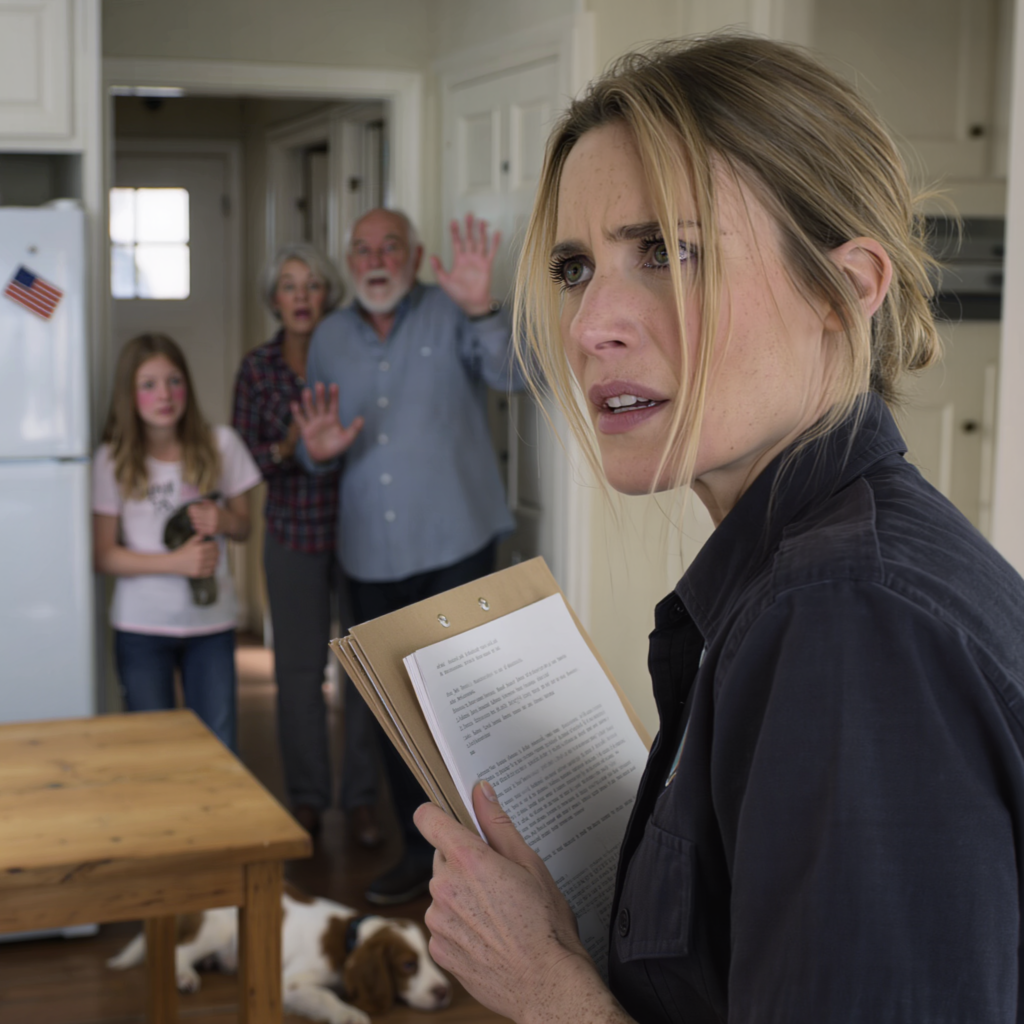
I was at the kitchen table with a sweating mason jar of iced tea, the kind I’d started drinking once I got too tired to pretend I still liked hot coffee. The little flag magnet on Brenda’s fridge—stars and stripes, chipped at one corner—caught the morning light like it was proud of itself. Somewhere in the house, an old Sinatra station was murmuring through a speaker, tinny and cheerful, like the soundtrack didn’t get the memo.
Then the knocking came again, harder.
And upstairs, Brenda started screaming.
Some people think losing a dog is sad.
They don’t understand it can also be a line.
The day before, when I pulled into the driveway after work, the house looked normal from the outside.
The porch light was on. The hydrangeas Brenda insisted on fussing over were still drooping in their planters. Alicia’s SUV was parked crooked in the spot she always took like she owned it. That should’ve been my warning, right there.
Inside, the air felt different—too still, like the house was holding its breath.
Sophie wasn’t in the living room like usual. No cartoon noise. No half-finished homework on the coffee table. No socks abandoned on the rug.
arrow_forward_ios
Đọc thêm
00:00
00:01
01:58
I set my keys down slowly.
That quiet wasn’t peaceful.
It was rehearsed.
“Elena?” Brenda called from the kitchen, voice bright, fake-bright. “You’re home early.”
I didn’t answer. I followed the sound of a soft, stuttering breath.
Sophie was standing in the hallway in her school clothes, backpack still on one shoulder like she hadn’t even made it to the hook by the door. Her hands were clenched into fists at her sides, knuckles white.
Her eyes were swollen and red. Her lashes stuck together. Her nose was raw and pink like she’d been wiping it with the back of her hand all afternoon.
“Mom,” she said.
Her voice came out thin, like it had been pressed flat.
“You have to see this.”
My stomach dropped. “What happened?”
She didn’t answer. She just turned and walked toward her room.
I followed, past the framed family photos Brenda loved to dust and straighten like they were awards. Sophie moved slowly, like she was afraid if she went too fast she’d break apart.
At her bedroom door, she stopped.
There was a sheet of printer paper taped right at her eye level.
White paper. Black marker. Big block letters pressed hard enough to dent.
WE GAVE YOUR DOG AWAY.
Your cousin didn’t want it around.
DON’T MAKE A SCENE.
For a second, the words didn’t make sense. They sat there like a bad joke with no punchline.
Then my brain caught up.
My chest went cold.
I peeled the paper off the door and flipped it over, stupidly hoping there was a softer version on the back. An apology. A note that said it was a prank. Something.
There wasn’t.
“Where’s Sadie?” I asked.
Sophie’s face crumpled. “She’s gone,” she said, and the word broke in the middle. “Her bed is gone. Her bowls are gone. Her toys—everything.”
She sucked in a shaky breath. “I came home and Grandma was in the kitchen. Madison was here. Grandma said…”
Sophie’s throat bobbed. “She said, ‘We did what we had to do.’”
Her voice shifted, mimicking Brenda’s clipped tone. “‘Don’t you dare start crying about it, young lady. It’s just a dog.’”
My jaw tightened so hard it hurt.
I pushed open Sophie’s door.
The room looked like someone had erased a person.
The corner where Sadie’s bed always sat—her soft blanket pile with the little chew marks in the baseboard behind it—was empty.
The metal bowls beside the dresser were gone, leaving faint circles on the wood floor.
The rope toy that lived under the desk was missing.
Even the little bag of treats I kept in the top drawer of the nightstand was gone, drawer left slightly open like a taunt.
The room didn’t just look clean.
It looked edited.
And the missing piece had fur.
I turned in a slow circle, taking it all in like I was cataloging a crime scene.
“Did you look outside?” I asked, though I already knew she had.
Sophie nodded quickly. “I went in the backyard. I called her. I shook the treat jar but—” She swallowed. “Grandpa said, ‘Don’t start.’ And Madison just… she just stood there.”
I pictured Madison in the kitchen, perfectly manicured hands wrapped around a can of soda she wasn’t supposed to drink, watching my daughter fall apart like it was entertainment.
Sophie’s voice got smaller. “I asked where she went, and Grandma said it wasn’t my decision. She said Madison doesn’t like Sadie and Madison is family and… and if I made a scene, I’d go to my room without dinner.”
I felt something in me go very still.
Because that wasn’t about a dog.
That was about control.
I walked down the hall and opened the linen closet where we kept extra towels.
No dog towels.
I opened the mudroom cabinet.
No leash.
I checked the laundry room.
No dog shampoo.
Someone hadn’t just moved Sadie.
Someone had scrubbed away the evidence that she’d ever been here.
“Mom?” Sophie whispered behind me.
I turned back and forced my face into something that wouldn’t scare her.
“Come here,” I said.
I pulled her into my arms. She shook against me, hot tears soaking through my work shirt. She smelled like pencil shavings and cafeteria pizza and salt.
“It’s okay,” I lied into her hair. “I’ve got you.”
I didn’t say it’s just a dog.
I didn’t say we’ll get another one.
I just held her until the shaking slowed.
Because you don’t replace a promise.
Sadie wasn’t just a dog.
She was a small red-and-white spaniel mix with long silky ears Sophie used to braid when she was little. She had one cloudy eye and a careful way of moving, like she never wanted to bump into anyone.
Sophie used to say Sadie understood her better than people did.
Some days, I believed that.
They’d grown up side by side—bedtime stories, backyard adventures, storm-night cuddles. A kid and her dog in that quiet, unspoken way that feels more like family than half the people you share a house with.
Losing Sadie wasn’t losing a pet.
It was losing the one creature Sophie trusted completely.
And trust is not a small thing to steal.
I pulled back and wiped Sophie’s cheek with my thumb.
“Go sit on my bed,” I said softly. “Take your pillow. I’m going to talk to them.”
Sophie nodded without looking at me and shuffled down the hall.
I stared at the note again.
Your cousin didn’t want it around.
Don’t make a scene.
Like my daughter’s grief was an inconvenience.
Like what they’d done was a favor.
I folded the paper once, then again, and tucked it into my purse.
If they wanted quiet, I would give them quiet.
But not the kind they meant.
That was the moment I stopped asking for permission.
Downstairs, Brenda and Gordon were at the kitchen table like they’d been expecting me.
Brenda had her tea. Gordon had his newspaper spread open, sports section folded just so.
Alicia’s voice floated from the living room, laughing too loudly at something on TV. Madison’s laugh followed—sharp and practiced.
Brenda looked up and smiled the way she smiled at cashiers. “Elena,” she said. “You’re home early.”
“Where is she?” I asked.
Brenda tilted her head. “Who?”
“Sadie,” I said. “Our dog. Where is Sadie?”
Gordon folded the paper with a sigh like I was wasting his time. “We found her a new home,” he said. “Some nice people from church. It was time.”
“No,” I said, voice calm enough to fool strangers. “It wasn’t.”
Brenda rolled her eyes. “We’ve talked about this. Madison doesn’t like that dog. She’s afraid of it. She told us she didn’t want to come over anymore.”
Madison wasn’t afraid of anything.
Madison was bored.
“You have two granddaughters,” I said.
Brenda’s mouth pinched. “You know what I mean.”
I kept my hands flat on the counter, anchoring myself. “Where does this ‘nice family’ live?”
“That’s none of your concern,” Gordon snapped.
“What are their names?”
“We handled it,” he said. “You should be thanking us. Less hair, less smell, less responsibility for you.”
“She wasn’t your responsibility,” I said.
Gordon’s eyes narrowed. “It’s our house,” he said slowly, like he was spelling it out for a slow child. “We make the rules here.”
“This isn’t a rule,” I said. “It’s theft.”
Brenda slammed her cup down hard enough that tea sloshed. “Oh, for heaven’s sake. You’re being ridiculous. We rehomed a dog. That’s it.”
She sat back like she’d won. “Children come first.”
By children, she meant one.
“My daughter is a child,” I said.
“And very sensitive,” Brenda said pointedly. “You’ve made her that way.”
I stared at them and felt the kitchen air thicken.
“You left a note on her door,” I said. “You didn’t even look her in the eye.”
“We knew you’d blow it out of proportion,” Gordon said. “We didn’t want a scene.”
There it was again.
Don’t make a scene.
“The people who took Sadie,” I said, “did you tell them she wasn’t yours to give?”
Gordon’s jaw clenched.
He didn’t answer.
Brenda stood up and started stacking plates that didn’t need stacking, her favorite way of pretending a conversation was beneath her.
“We’re not having this argument,” she said. “The decision is made.”
She turned her back on me and reached for the dish towel like she was done.
“You can either accept it and help Sophie move on,” she said over her shoulder, “or you can keep stirring her up and make this harder than it needs to be.”
I looked at her, at him, at the kitchen where I’d spent years cooking and cleaning and swallowing small insults in exchange for a roof.
“Okay,” I said.
Brenda relaxed, just slightly, like she’d won. “Good,” she said. “I’m glad you’re being sensible.”
I walked away without another word.
Not because I was giving in.
Because I was taking inventory.
Upstairs, Sophie was sitting on our bed, clutching Sadie’s old collar so tightly her knuckles were white. The brass tag caught the lamp light as if it was trying to remind me: this is ours.
“She’s not coming back, is she?” Sophie asked.
“They won’t tell me where she is,” I said. “Yet.”
Sophie’s eyes filled again. “Grandma said if I cry about it, I’m being selfish,” she whispered. “She said Madison is scared and Madison is family, like Sadie isn’t.”
My throat hurt like I’d swallowed something sharp.
I sat beside her and pulled her close.
“You are allowed to be sad,” I said. “You are allowed to be angry. What they did was wrong.”
Sophie pulled back just enough to look at me. “Are you going to make them bring her back?”
I thought of the note.
The empty corner.
Brenda’s calm voice.
“I’m going to do everything I can,” I said. “I’m not promising it will be easy. But I’m not going to pretend this didn’t happen, and I’m not going to tell you to get over it.”
Sophie nodded against my shoulder, and I felt the last soft part of me harden into something else.
That’s the thing about quiet women.
People mistake silence for surrender.
They don’t realize sometimes silence is just the pause before you move.
The truth is, this wasn’t the first time Brenda had tried to tell my daughter what she was allowed to feel.
It was just the first time she did it with a marker and tape.
Colin and I moved in with his parents when Sophie was still in diapers.
We were broke, young, and drowning in the kind of optimism only people in their twenties have.
“We’ll help you,” Brenda said, which meant we’ll supervise you.
“You’ll get back on your feet,” Gordon said, which meant you’ll be grateful forever.
It was supposed to be temporary.
Just until finals were behind us.
Just until we could afford rent.
Just until student loans cleared.
Just until became, “Why don’t you stay a little longer?”
And before I knew it, five years had passed.
By then we had money.
Colin had a steady job.
I had stable hours.
We could have afforded our own place.
But every time I brought it up, Brenda found a new way to twist the knife.
“Oh, Elena,” she’d say, voice sweet as iced cake. “It’s cute you think you can manage on your own. You’re not ready. Not with your… background.”
Background meaning not as polished as Colin’s sister, Alicia.
Not from a family they approved of.
Not from the right part of town.
Not with the right kind of parents.
Brenda never said that last part out loud.
She didn’t have to.
It showed up in how she corrected my pronunciation in front of company.
How she’d take a serving spoon from my hand and say, “Let me, honey, you’re doing it messy.”
How she’d smile at my mother’s thrift-store sweater and ask if she wanted to borrow one of Brenda’s “nicer cardigans” because “the house can get chilly.”
Even Gordon got in on it.
If I mentioned paying part of the mortgage, he’d grunt and say, “Well, you’re living here, aren’t you?”
Like we were squatters who’d wandered in and never left.
We paid for groceries.
We paid the electric bill.
We paid a chunk of the mortgage every month “because interest went up.”
Colin fixed whatever broke.
I cleaned and cooked and ran errands because Brenda always had a headache or a long day.
And still, every time something didn’t go their way, Gordon would remind us, “This is our house.”
As if we lived here on luck, not labor.
Colin used to flinch when he said it.
Then he got used to it.
That’s the slow poison.
You don’t notice it at first.
You just stop fighting because you’re tired.
Then one day you can’t remember what it felt like to breathe without someone else’s permission.
Alicia didn’t help.
Alicia floated in like royalty.
Long hair, perfect makeup, heels clicking across the floor like applause.
She always had a new story—her job, her workout group, her new “friend circle.”
Brenda stared at her like she invented oxygen.
Behind Alicia came Madison.
If Alicia was royalty, Madison was the heir.
Brenda adored her.
Gordon catered to her.
Madison sneezed and Brenda brought tissues like it was a medical emergency.
Meanwhile Sophie could cough all night and Brenda would say, “She should drink more water.”
The favoritism wasn’t subtle.
When Madison visited, the whole house shifted.
Brenda cooked her favorites.
Gordon changed the TV to whatever she wanted.
If Madison didn’t like a blanket on the couch, Brenda removed it.
If Sophie didn’t like something, Brenda said, “She’s old enough to adjust. Don’t indulge her.”
For Sophie’s birthdays, we got a store cake.
For Madison’s, Brenda hired entertainment, ordered catering, filled the yard with balloons.
“It’s just a bigger family thing this year,” Brenda insisted. “Don’t be jealous, Sophie. It’s not attractive.”
Sophie learned how to swallow her feelings like pills.
Sadie was the only one in the house who never asked her to.
Sadie belonged to my mom first.
She wasn’t a puppy when I got her. She was already trained, already steady.
My mom had vision problems and some mobility issues.
My uncle hired a private trainer and Sadie took to it like she’d been born for the job.
She learned how to guide around obstacles.
How to fetch dropped items.
How to sense panic rising and ground a person just by pressing against them.
When my mom died, Sadie sat by the door for two days.
She refused to eat. Refused to move.
The vet said dogs grieve differently.
Like that made it easier.
When Sadie finally came home with me, she walked straight into Sophie’s room and lay down next to her crib like she was clocking in.
And that was that.
Sophie had a dog.
And the dog had a child.
When Sophie was three, Sadie saved her from a bad fall.
It wasn’t dramatic.
No sirens.
No movie moment.
Just Sophie climbing a toy box she shouldn’t have, reaching for a stuffed animal on the top shelf, losing her balance.
I was across the room folding laundry.
I couldn’t get there in time.
Sadie did.
She wedged herself just enough to break the fall.
Sophie hit carpet instead of the dresser corner.
She cried, terrified, more startled than hurt.
Sadie stood over her the rest of the afternoon, eyes alert, body between Sophie and every sharp edge like she was daring the universe to try again.
Sophie never forgot that.
Neither did I.
But Brenda did.
Brenda hated dogs in houses.
“They smell,” she’d say.
She hated fur.
“It floats,” she’d say.
She hated Sadie’s bed in Sophie’s room.
“This isn’t a barn,” she’d mutter.
Then Madison started complaining.
“That dog looks at me weird,” Madison said one day in the hallway.
“She’s blind in one eye,” I said. “She’s not staring. She’s trying to figure out who you are.”
“Well, it creeps me out,” Madison said. “I don’t want to come over if she’s here.”
Brenda acted like Madison had made a proclamation from a throne.
“We’ll figure something out, sweetheart,” she cooed, brushing Madison’s hair. “You shouldn’t feel unsafe in Grandma’s house.”
Unsafe.
From a dog who tripped over dust bunnies.
I tried compromise after compromise.
I offered to keep Sadie upstairs during their visits.
I offered to crate her for short periods.
I offered to take long walks when Alicia and Madison came.
Not enough.
“Madison shouldn’t have to worry,” Brenda said.
“Children come first,” she repeated.
By children, she meant one.
One afternoon, Madison refused to come inside because Sadie was asleep on her cushion.
Brenda said loudly, “This dog is ruining family time.”
I said quietly, “She’s family, too.”
Brenda looked at me with pity disguised as patience. “It’s just a dog,” she said.
Sophie was behind me when she heard it.
She didn’t say anything.
She just knelt beside Sadie and buried her face in her fur.
That was when I understood Brenda didn’t just dislike Sadie.
She disliked what Sadie represented.
A loyalty she couldn’t manage.
A comfort she couldn’t control.
And if she couldn’t control it, she’d get rid of it.
So when the note showed up, it wasn’t a snap decision.
It was a plan.
And they chose exactly which child came first.
That night, Sophie barely ate.
She pushed peas around her plate like she was trying to rearrange reality.
Brenda acted like it was a normal dinner.
Gordon asked Colin about work.
Alicia talked about a new yoga studio.
Madison scrolled on her phone and didn’t look up once.
Sadie’s absence sat at the table like an extra person.
Sophie’s chair creaked when she shifted.
I watched her swallow every emotion because she’d been trained to.
Colin caught my eye once, like he wanted to say something.
He didn’t.
After dinner, when Sophie went upstairs and the sound of her door closing floated down the hall, Colin finally spoke.
“This is… bad,” he said quietly.
He stood at the sink, rinsing a plate that was already clean, hands moving like he needed something to do.
My voice was steady. “Do you know where she is?”
He froze.
Then he shook his head.
“They didn’t tell me,” he said. “They said it was handled. Dad said it was for the best.”
I dried my hands slowly.
“Did you believe him?” I asked.
Colin’s throat worked. “I didn’t—”
His face tightened. “I didn’t want to fight them in front of Sophie.”
I stepped closer.
“And you think what they did wasn’t a fight?” I asked.
He looked down.
That was Colin’s habit. Look down until the storm passes.
“I’m going to fix it,” he whispered.
“Good,” I said. “Because I’m not doing peace at any cost anymore.”
That was the wager.
Either Colin stood with his family, or he stood with the people who controlled the house.
He didn’t get to stand in the middle.
The next morning, the house felt like it was holding its breath.
I called out of work before I even brushed my teeth.
“Family emergency,” I said, and hung up before anyone could ask questions.
Sophie wasn’t going to school.
She looked like she hadn’t slept.
Sadie’s absence had made her smaller.
Gordon left for work like he hadn’t wrecked a child the day before.
Brenda stayed in the kitchen, clanking dishes—her usual signal that she was busy and therefore untouchable.
Colin sat at the table with a mug of coffee gone cold.
I set the note between us.
“I’m asking one more time,” I said. “Where is Sadie?”
Brenda didn’t even turn.
“We told you,” she said. “A nice family from church. A yard. Space. She’ll be better off.”
“And their names?” I asked.
“Address?”
“That’s private,” Brenda snapped. “We’re not dragging strangers into your tantrum.”
Tantrum.
Like my child’s grief was childish.
“You’re only upsetting Sophie more,” Brenda said. “Let it go.”
“I’m making it worse?” I repeated, slow and careful.
“Not the people who took her dog while she was at school?”
From the hallway, Gordon barked without looking in. “She’s gone. End of story. You should be grateful we didn’t dump her at a shelter.”
I picked up the note, folded it, and walked upstairs.
I didn’t slam the door.
I didn’t yell.
Rage would’ve been easy.
Clarity needed quiet.
I pulled Sadie’s file box from under the bed.
All her papers were there: vet records, vaccine sheets, training receipts in my mom’s handwriting, microchip documents.
Everything I needed to prove she belonged to me.
To Sophie.
Not to the people downstairs who treated her like clutter.
When I came back down, Sophie was curled on the couch hugging her knees.
The TV was off.
The house was heavy.
“Do you want to help me find her?” I asked.
Sophie’s head snapped up so fast it made my heart ache.
“We can find her?”
“We’re going to try,” I said. “And we’re not going to be quiet about the right parts.”
We sat at the coffee table like it was a war room.
First, I called the vet.
“My dog is missing,” I said. “She was taken from my home.”
The receptionist’s voice softened immediately.
They flagged her file.
They confirmed the microchip number.
They told me to call them the second I had any lead.
Then I called the microchip company.
I reported her stolen.
I asked them to put an alert on her record.
I asked them what would happen if someone tried to change ownership.
“They can’t without your authorization,” the rep said.
Good.
I made a list on a legal pad.
Shelters.
Rescues.
Animal control.
Neighborhood groups.
Websites.
Anything that moved information.
Sophie watched me write, eyes tracking the pen like it was a lifeline.
“Can I do something?” she asked.
“Yes,” I said. “Pick your favorite picture of you and Sadie. The clearest one.”
Sophie ran upstairs and came back with a photo she’d printed for a school project.
It showed her on the couch, head bent over a book, Sadie’s chin resting on her knee like she was listening.
I opened the neighborhood Facebook group.
Then Nextdoor.
Then the community bulletin board page Brenda loved because it was mostly people arguing about trash cans.
I typed:
My dog Sadie was taken from my home and rehomed without my permission. She is older, small, calm, and trained to help with mobility and anxiety. She belonged to my late mother and is my daughter’s dog. If you’ve seen a post offering an older trained dog recently, please message me. Photo attached.
I hit post.
Within minutes, sympathy.
Within an hour, dead ends.
A woman said she saw a dog like that at a park last week.
A man asked if Sadie was chipped.
A teenager typed “OMG that’s so messed up” and got scolded by someone’s aunt.
Sophie kept twisting the sleeve of her sweatshirt.
“Maybe she’s in another city,” she whispered.
“Maybe they drove far.”
“We only know they lied,” I said. “Everything else, we find out.”
And that was when the hunt became real.
I drove Sophie and Colin to the nearest shelter.
We didn’t bring Sadie’s bed or toys.
We brought paperwork.
We brought a photo.
We brought the kind of calm that makes front desk workers take you seriously.
A volunteer met us at the counter.
“Is she missing?” she asked softly.
“She was taken,” I said. “From our home.”
The volunteer’s eyes widened.
She took the photo.
She took the microchip number.
She told us they hadn’t had any senior spaniel mixes come in.
But she also told us something else.
“If someone’s trying to sell her,” she said, lowering her voice, “they might list her as ‘rehoming fee’ to make it sound legit.”
My stomach twisted.
“Where would they post?” I asked.
She rattled off a few sites.
I wrote them down.
Back in the car, Colin’s hands gripped the steering wheel.
“My parents wouldn’t sell her,” he said, like he needed to hear it.
I looked at him.
“Do you know that,” I asked, “or do you need to believe it?”
He flinched.
Sophie stared out the window, jaw tight.
“You said we’re going to find her,” she murmured.
“We are,” I said.
That promise wasn’t a comfort.
It was a contract.
We drove home.
On the street, Mrs. Kline from two doors down was watering her hanging baskets.
She watched our car with the kind of curiosity that comes from living in a neighborhood long enough to recognize tension.
When I got out, she called softly, “Elena?”
I walked over.
She leaned in, eyes darting toward Brenda’s windows.
“I don’t want to get involved,” she whispered, then paused, like she realized how that sounded.
“I mean— I do,” she corrected quickly. “I just… I saw something yesterday.”
My pulse jumped.
“What did you see?”
She swallowed.
“I saw Gordon loading a dog crate into his trunk,” she said. “Right after the school bus dropped Sophie off. I thought maybe he was taking your dog to the vet or something. But then I saw you posting online…”
Her mouth tightened.
“Do you remember what time?” I asked.
“About three-thirty,” she said. “Maybe three-forty.”
“Did you see which direction he went?”
Mrs. Kline pointed. “Toward Maple Road.”
I wrote it down.
“How sure are you?” I asked.
She looked offended. “Honey, I’ve lived here eighteen years. I know Gordon’s walk and I know your dog. I’m sure.”
I nodded.
“Thank you,” I said.
She hesitated. “And Elena?”
“Yeah?”
Her eyes softened. “Your little girl didn’t deserve that.”
I felt my throat tighten.
“I know,” I said.
Then I turned back toward the house.
Because now I didn’t just have feelings.
I had a witness.
By noon, I had four browser tabs open on my laptop and a notebook full of scribbles.
I searched “rehoming fee trained dog.”
I searched “senior spaniel assistance dog.”
I searched “calm small dog guidance.”
Sophie sat beside me on the couch, knees tucked to her chest, watching every scroll.
Colin paced behind us.
Brenda’s voice carried from the kitchen, talking on the phone.
I caught snippets.
“…so dramatic… over a dog… Elena always—”
My fingers tightened on the mouse.
Then, just after two, my phone buzzed.
A message from someone I didn’t know.
Hi, Elena. Someone in my church group shared this yesterday. Thought it might be her.
Below was a screenshot.
My breath left my body like it was trying to get away.
Sadie sat on an unfamiliar porch, patient and brave the way she always looked, even when she didn’t understand what was happening.
The caption read:
Older assistance-type dog. Well-trained, calm. 2,500 USD rehoming fee. Call for details.
The phone number underneath belonged to Gordon.
Sophie made a sound—half gasp, half sob.
Colin stopped pacing so hard he almost stumbled.
“That’s my dad’s number,” he said.
“Yeah,” I said. “It is.”
Sophie looked between us, eyes wide. “What does that mean?”
“It means,” I said, keeping my voice steady for her, “this wasn’t charity.”
Colin’s face went gray.
“They’re selling her,” he whispered.
I didn’t correct him.
Because the screenshot did it for me.
This is the part people misunderstand.
They think anger makes you loud.
Sometimes anger makes you precise.
I stood.
I walked into the kitchen.
Brenda was at the counter, stirring something she didn’t need to stir, phone pressed to her ear.
When she saw my face, she ended the call fast.
“What?” she snapped, defensive already.
I set my phone down on the counter and turned the screen toward her.
Brenda’s eyes flicked down.
She went still.
For half a second, her mask slipped.
Then it snapped back in place.
“That’s not—” she started.
“That’s Gordon’s number,” I said.
Brenda’s lips tightened. “You don’t know what you’re looking at.”
“I’m looking at my daughter’s dog on someone else’s porch with a price tag,” I said.
Brenda’s nostrils flared.
“You’re being dramatic,” she hissed. “It’s a rehoming fee. People do that so strangers don’t take advantage.”
“So your ‘nice family from church’ paid Gordon 2,500 dollars?” I asked.
Brenda blinked.
Just once.
Like her brain had to adjust.
“That’s… none of your business,” she said, weakly.
“It’s my business,” I said. “Because that dog is microchipped to me.”
Brenda’s eyes widened.
And there it was.
The first crack.
Behind me, Sophie’s footsteps creaked on the stairs.
She’d followed.
She stood in the doorway, small and pale, like she’d turned into a ghost in her own home.
“Grandma,” she said, voice shaking, “why would you sell her?”
Brenda’s face tightened.
“This isn’t your conversation,” she snapped.
Sophie flinched.
I stepped in front of my daughter.
“It is her conversation,” I said. “You left a note on her door like you were passing out chores.”
Brenda’s eyes darted toward the window, like she could see the neighborhood watching.
“You’re trying to embarrass me,” she said.
I almost laughed.
“No,” I said. “You embarrassed yourself when you decided a child’s heart was negotiable.”
Gordon’s car door slammed outside.
His footsteps thudded through the mudroom.
He walked in, saw the phone on the counter, and his face changed.
“What is this?” he demanded.
“It’s the ad,” I said. “With your number. With 2,500 dollars.”
Gordon’s jaw clenched.
He glanced at Brenda.
Then at Sophie.
Then at Colin, who had appeared behind Sophie, eyes hard.
“You weren’t supposed to see that,” Gordon said.
There.
Not denial.
Not confusion.
Just irritation.
Like we’d peeked behind the curtain.
“You sold her,” Colin said, voice low.
“It was for the house,” Gordon snapped. “You live here. You all benefit.”
Sophie’s hands balled into fists.
“She’s mine,” Sophie whispered.
Gordon’s eyes flicked to her like she was an inconvenience.
“Dogs don’t belong to kids,” he said. “They’re animals.”
Sophie’s face crumpled.
I didn’t let her break.
Not alone.
I picked up my phone.
“Where did you send her?” I asked.
Gordon’s mouth tightened.
“We’re not giving you strangers’ information,” Brenda said quickly, stepping in.
“They didn’t do anything wrong,” she added, voice climbing. “They’re good people. You’ll harass them.”
“I won’t harass them,” I said. “I’ll explain that you lied.”
Gordon leaned forward, eyes sharp. “You don’t want to make this ugly,” he warned.
I held his gaze.
“It’s already ugly,” I said. “The only difference is now it’s documented.”
His eyes narrowed.
Brenda’s mouth opened.
Then Sophie spoke again, tiny voice, devastating.
“You told me not to make a scene,” she said. “But you made one in my room.”
Brenda’s face flashed.
“Sophie,” she snapped. “Go upstairs.”
Sophie didn’t move.
And that was when I realized something.
They’d trained us to move.
To step back.
To quiet down.
But training only works when you cooperate.
I turned to Colin.
“You said you’d fix it,” I said softly.
Colin’s throat worked.
He looked at Sophie.
Then at his father.
Then at me.
“I will,” he said.
His voice was steady now.
The middle ground disappeared.
I walked out of the kitchen and back to the couch.
My hands were shaking, but my mind was clear.
I messaged the woman who’d sent the screenshot.
She responded within minutes with a name and number.
Martha.
My thumb hovered over the call button.
Then I pressed.
A cautious voice answered. “Hello?”
“Hi,” I said. “Is this Martha? My name is Elena. I think you might have my dog.”
Silence.
Not rude.
Stunned.
I told her everything in one breath—my mom, the training, Sophie, the note, the ad, Gordon’s number.
When I finished, I heard her inhale sharply.
“He told us she was his,” Martha said, voice wobbling. “He said you didn’t want her anymore. He said he was doing you a favor.”
My jaw clenched.
“We paid him 2,500,” she added quietly. “I’m so sorry. We didn’t know.”
“I believe you,” I said. “Can we meet somewhere public today?”
“Of course,” she said immediately. “Please. Bring whatever papers you have. We’ll give her back.”
Sophie let out a broken sound from the couch.
I turned the phone slightly so she could hear.
“Martha?” I said. “My daughter is here. Her name is Sophie.”
Martha’s voice softened. “Hi, sweetheart,” she said gently. “I’m so sorry. We’ll bring Sadie. We’ll make this right.”
Sophie’s tears spilled over.
“Please,” she whispered.
“We will,” Martha promised.
I hung up.
Then I sat very still.
Because now, the problem wasn’t whether we could get Sadie back.
It was what we were going to do with the truth once we did.
We met near sunset in a shopping center parking lot outside a big-box store, neon sign buzzing overhead.
Martha and her husband, Jim, stood beside their car.
A blanket was spread on the pavement.
Sadie lay on it like she’d been trained to wait.
When she saw me, she stood.
Tail thumped once, twice.
Then she trotted over and pressed her head into my leg like she was saying, You took your time.
I dropped to my knees and wrapped my arms around her neck.
“Of course,” I whispered into her fur. “Of course I found you.”
Sophie fell beside me, sobbing into Sadie’s ears.
Sadie licked her cheek slowly, like she was saying, I’m here, I’m here.
Martha’s eyes were wet.
Jim swore under his breath as he stared at the screenshot on my phone.
“I feel sick,” Martha said. “We thought we were helping. He kept saying he didn’t want her to go to a shelter.”
My laugh came out sharp and humorless. “He says a lot of things.”
Jim shook his head. “We have the messages,” he said. “The payment record. We’ll show whoever we need to show.”
Martha handed me a folder—receipts, a printout of the ad, screenshots of Gordon’s texts.
She looked at Sophie.
“I’m sorry,” Martha said again, voice cracking. “I would never take a child’s dog.”
Sophie wiped her face with her sleeve.
“I know,” she whispered.
And something in me loosened.
Because it meant Sophie still believed people could be good.
On the drive home, Sadie stretched across the backseat with her head in Sophie’s lap.
Sophie kept one hand on her like she was anchoring the world.
Colin drove in silence, jaw tight.
“They sold her,” he said finally.
“My parents sold your mom’s dog.”
“They did,” I said.
He blinked hard.
“I kept telling myself they were strict,” he murmured. “Old-school. But this…”
He swallowed.
“This is different.”
He looked at me.
“We’re leaving,” he said.
No hesitation.
“We should have left a long time ago.”
That was the turn.
Not because I didn’t already know we needed to go.
Because Colin finally knew it too.
When we got home, I tucked Sophie into bed with Sadie curled beside her like she’d never left.
Sophie ran her fingers through Sadie’s fur until her breathing slowed.
Then I drove straight to the police station.
I didn’t call 911.
There wasn’t an emergency in progress.
But there was still a crime.
And I was done letting “family” be a magic word that erased wrongdoing.
At the front desk, the officer asked, “How can I help you?”
I slid the note across the counter.
Then the screenshot.
Then the microchip paperwork.
Then Martha’s folder.
The officer’s eyebrows lifted higher with each piece.
He took a long breath.
“Okay,” he said, voice careful. “Tell me from the beginning.”
So I did.
I explained the living situation.
The dog’s ownership.
The note.
The sale.
The money.
I watched his pen move steadily.
He asked questions.
Who wrote the note?
Who posted the ad?
Who took payment?
Who met the buyers?
Did I have witnesses?
“Yes,” I said. “My neighbor saw Gordon load a crate. Martha and Jim have the messages.”
He nodded.
He asked if Sadie was safe now.
“Yes,” I said.
He gave me a case number.
He told me someone would follow up.
He didn’t promise an outcome.
But he did say one thing that made my shoulders drop.
“You did the right thing coming in,” he said.
Not dramatic.
Not emotional.
Just factual.
Sometimes that’s what you need.
When I walked back into the house, Colin was at the table with a notepad like he’d been waiting for me.
“We can afford to move,” he said. “I ran the numbers.”
I sat across from him, exhaustion hitting like a delayed wave.
“I don’t want to stay here another day longer than we have to,” I said.
He nodded. “Tomorrow we start packing.”
We went to bed that night with the kind of tired that feels clean.
Brenda and Gordon went to bed smug and satisfied, thinking the house was quiet again.
For the first time in a long time, I wasn’t the one lying awake wondering what they’d do next.
I already knew.
They’d try to make it disappear.
They’d try to make me the villain.
And they’d count on the fact that I hated scenes.
The knock came the next morning just after nine.
Three hard knocks.
Not a neighbor knock.
Not a delivery.
Gordon muttered something and got up.
I could hear his slippers shuffling across the hardwood.
The front door opened.
“Morning, sir,” a man’s voice said. Calm. Official. “Are you Gordon Thompson?”
“Yes,” Gordon said. “Who wants to know?”
“This is Officer Green with the town police,” the man replied. “We’re following up on a report about a dog taken from this address and sold. May we come in?”
Silence.
The kind that fills your ears.
“What?” Gordon barked. “That’s ridiculous. It was just a family thing. Who called you?”
“We’ll explain,” a second voice said—this one a woman, steady but not unkind. “Can we step inside?”
I heard the door close.
Footsteps.
The living room TV snapped off.
Sadie lifted her head and huffed under the table.
Sophie’s eyes were huge.
“Is Grandpa going to jail?” she whispered.
“No,” I said softly. “Probably not. But for the first time, someone is telling him he can’t just do whatever he wants.”
She nodded slowly, like she was trying the idea on.
From the living room, voices rose and fell.
I couldn’t catch every word, but I caught enough.
“…advertisement posted from this number.”
“…couple who paid you 2,500.”
“…microchip registered to your daughter-in-law.”
Then Brenda’s voice—sharp, high. “This is none of your business.”
“It is our business,” the male officer replied, and his voice didn’t rise. That made it worse. “It is a crime to sell property that isn’t yours, especially if ownership is misrepresented.”
A chair scraped.
Brenda said something I couldn’t hear.
Then footsteps stomped.
Alicia’s voice suddenly cut in from the hallway.
“What is going on?” she demanded.
Madison’s voice followed, high and indignant.
“Grandma? Why are there cops here?”
My stomach tightened.
Of course Alicia had chosen today to drop by.
Of course Madison was here to witness the consequences of a decision made for her comfort.
The officers moved down the hall toward the kitchen.
They appeared in the doorway.
A tall man and a shorter woman with her hair in a bun.
Their eyes flicked over me, over Sophie, over Sadie at my feet.
“Elena?” the woman asked.
“Yes,” I said.
“Thank you for coming in last night,” she said. “We’ve spoken with your in-laws. We’ll file our report. The prosecutor will determine how to proceed. At minimum, they’ll be required to repay the buyers and may face fines. If the case moves forward, you’ll get a letter.”
“Understood,” I said.
The man nodded. “We’re sorry this happened,” he said. “You did the right thing reporting it.”
Behind them, Alicia stood frozen in the hallway, mouth open.
Madison clutched her phone like she was ready to record something for attention.
“What did they do?” Alicia snapped.
The female officer kept her voice neutral. “Ma’am, we’ve explained the situation. Please let us exit.”
The officers left.
The front door shut.
The house went too quiet for three full seconds.
Then Brenda erupted.
“How could you do this?” she screamed, voice cracking. “You called the police on us! In front of Alicia!”
Gordon’s face was red.
Brenda’s was white.
Alicia’s expression shifted from shock to fury like a switch flipped.
“You sold their dog?” Alicia demanded.
Brenda whipped her head around. “Alicia, don’t start.”
Madison’s eyes darted to Sadie.
She made a noise—half squeal, half performance.
“That dog is still here?” Madison said loudly. “I thought you got rid of it!”
Sophie stiffened.
Sadie stayed calm, pressed against my leg.
It made Madison’s dramatics look even worse.
I spoke before my anger could.
“I reported a theft,” I said. “They decided to investigate it.”
“You’re destroying this family over a dog,” Brenda said, voice trembling with rage. “Over a dog, Elena, do you hear yourself?”
“I hear you,” I said. “I also heard you tell my daughter not to make a scene when you ripped away the last thing she had from my mom.”
Alicia blinked.
“What note?” she asked.
I reached into my purse and pulled out the folded paper.
I set it on the table.
Alicia read it.
Her mouth tightened.
Madison leaned over her shoulder.
Madison’s face flushed.
“Grandma,” Madison said, suddenly defensive, “I didn’t tell you to do that.”
Brenda snapped, “Don’t act innocent.”
Madison recoiled like she’d been wronged.
“I just said I didn’t like the dog!” she insisted. “She stares at me!”
“She has one cloudy eye,” Sophie whispered.
Everyone turned.
Sophie stood at the edge of the kitchen, small but planted.
Her voice shook, but she didn’t back up.
“She doesn’t stare,” Sophie said. “She listens. She stays with me when I’m scared. You don’t even know her.”
Madison rolled her eyes. “It’s a dog.”
Sophie’s chin lifted.
“It’s my dog,” she said.
The air went tight.
Alicia stared at Sophie like she was seeing her for the first time.
Gordon stepped forward, pointing at me.
“That money was for this house,” he snapped. “Bills. Repairs. You have no idea what it takes to keep this place going.”
“I do,” I said. “I’ve been paying for it with you.”
He opened his mouth.
Closed it.
The muscle in his jaw jumped.
Brenda jabbed a finger toward Sadie. “She’s here now,” she said. “What more do you want? You got your way. Why drag the law into it?”
She leaned forward, eyes bright with fury. “You think the neighbors aren’t going to talk? You think we won’t hear about this at church?”
“For once,” I said, “you get to worry about what other people think. Not me.”
Gordon sneered. “We took you in when you had nothing. We gave you a place to live. We helped raise your child.”
“You also taught her that in this house, she comes second,” I said.
Sophie flinched like the truth had weight.
“I’m not letting that lesson sink in any deeper.”
Colin came down the stairs carrying a box of books.
He stopped in the doorway.
He looked from Brenda’s face to Gordon’s, then to Sophie.
“Mom. Dad,” he said.
His voice was flat in a way I’d never heard.
“Enough.”
Brenda turned to him like she’d been waiting for backup. “Tell her she’s gone too far,” she pleaded. “Tell her you won’t stand for this. You are our son.”
“I am,” Colin said.
He stepped into the kitchen, set the box down, and spoke so quietly the room leaned in.
“And that’s exactly why I’m not pretending this is okay.”
Brenda froze.
“You lied,” Colin said. “You took Sadie while we were out. You sold her. You told strangers we didn’t want her.”
He pointed toward the stairs like he could see yesterday on them.
“You watched Sophie come home to a note on her door instead of her dog.”
He swallowed once.
“You knew what that dog meant to us. And you told us to let it go.”
“We were going to talk about it,” Brenda protested, voice shrinking. “We were going to work something out.”
“No,” Colin said.
He looked at his father. “You were hoping Elena would cry, calm down, and move on like always. And when she didn’t, you got caught.”
Gordon snorted, but it sounded thin. “So what? You’re moving out in a huff? Where will you go? You can’t afford—”
“We can,” Colin cut in.
He didn’t raise his voice.
He didn’t need to.
“We ran the numbers. We’ll manage.”
He looked at Brenda like he was finally seeing her instead of imagining her.
“And at least when we pay rent,” he said, “the landlord won’t sell our dog.”
Alicia made a sound—half laugh, half gasp.
Madison’s face went crimson.
“That’s not fair!” Madison snapped.
Sophie stared her down.
“Neither was your note,” Sophie said.
Brenda’s head whipped toward Sophie.
“Sophie!” she barked.
Colin’s voice cut through, sharp as a snapped thread.
“No,” he said. “Don’t you do that. Don’t you scare her into silence. You already tried.”
Brenda’s mouth opened.
Nothing came out.
Colin picked up the box again.
“We’ll be out by the end of the month,” he said. “We won’t be paying your bills anymore. We won’t be your backup plan.”
Brenda sat down hard in a chair.
For once, she didn’t have anything clever to say.
Alicia grabbed Madison’s arm.
“Come on,” she hissed.
Madison yanked away.
“I don’t want to go!” Madison whined.
Alicia’s eyes flashed.
“You’re going,” she said through her teeth. “Right now.”
Madison shot one last resentful look at Sophie.
Sophie didn’t look away.
The front door slammed a minute later.
The house still felt crowded.
But the roles had shifted.
The next weeks were loud in all the wrong ways.
Brenda slammed cabinets like punctuation.
Gordon muttered about “people who don’t appreciate what they have.”
They stopped speaking to me unless they were trying to stab the air with a comment.
“Must be nice to think you’re above family,” Brenda said while wiping an already-clean counter.
“Hope your pride keeps you warm,” Gordon muttered when Colin carried boxes past him.
But they never apologized.
They never said Sadie’s name.
They never looked at Sophie and said, I’m sorry we hurt you.
Sophie moved through the house like a guest waiting to leave.
She started keeping her bedroom door shut.
She started packing her own things in small piles like she didn’t trust anyone.
One night I found her on the floor with a stack of books.
“What are you doing?” I asked.
“Packing,” she said, like it was obvious.
Her voice was calm.
Too calm.
I sat beside her.
“You’re allowed to feel things,” I reminded her.
Sophie pressed her lips together.
Then she whispered, “I don’t want them to take something else.”
My heart cracked.
“They won’t,” I said.
And for the first time, I knew it was true.
Because we were leaving.
I spent lunch breaks touring apartments.
Two bedrooms.
Pet-friendly.
Close enough to Sophie’s school that we wouldn’t have to uproot her again.
Not too expensive.
Not too loud.
A place that felt like ours.
It wasn’t glamorous.
It didn’t have granite counters or a big backyard.
But it had something Brenda’s house never had.
A lease with our names.
No one else’s.
The day we signed it, Colin exhaled like he’d been holding his breath for years.
“I didn’t realize how heavy it was,” he said quietly.
“What?”
“Always trying to keep them happy,” he admitted.
I nodded.
“They trained you,” I said.
He flinched, then nodded again.
“They trained me too,” I added.
“But Sophie doesn’t have to be trained.”
That line sat between us like a vow.
On moving day, Brenda stood in the hallway with her arms folded, watching us carry out boxes.
She didn’t offer help.
She didn’t offer a goodbye.
She offered commentary.
“Don’t come crawling back when it’s hard,” she said.
Colin didn’t even slow down.
“It was hard here,” he replied.
That was all.
Gordon didn’t come out of his office.
He stayed behind a closed door like he could pretend we weren’t leaving.
Sophie took one last look at her empty room.
“I’m not going to miss it,” she announced.
“What about the tree in the yard?” I asked gently. “And your pink curtains?”
Sophie shrugged, wiping her face with the hem of her shirt like she was erasing the past. “We can plant a new tree,” she said. “We can get new curtains.”
She looked down at Sadie.
“It’s not worth being sad here,” she said.
She wasn’t wrong.
The first night in our apartment, I lay awake listening to normal sounds through thin walls.
Someone’s TV.
Someone’s shower.
Someone laughing.
It was the kind of noise that used to irritate me.
That night, it sounded like freedom.
Sophie unpacked her things with the seriousness of someone building a new life on purpose.
Sadie followed her room to room, nails clicking on the laminate floor, tail wagging whenever Sophie looked back.
The next week, I took Sadie to the vet for a checkup.
Not because she was sick.
Because I needed the world to say, out loud, that she was ours.
The vet scanned the microchip.
My name popped up.
My phone number.
Sophie’s eyes filled with relief.
“It’s official,” the vet said, smiling.
Sophie nodded like she’d been holding her breath for months.
“It’s always been official,” I thought.
But it helped to hear it.
Then the letters started coming.
First, a notice about restitution.
Then fines.
Then a final statement that said, in formal language, that Gordon and Brenda had consequences.
No dramatic courtroom scene.
No handcuffs.
Just paperwork.
And sometimes paperwork is the most satisfying kind of justice.
Martha and Jim got their 2,500 back.
They sent me a card later.
Inside, Martha wrote that she still felt awful.
That she’d learned to ask more questions.
That she hoped Sophie would forgive her.
Sophie taped the card to her bulletin board.
“See?” she said. “Not everyone is like them.”
I kissed the top of her head.
“No,” I agreed. “Not everyone.”
The social fallout hit Brenda and Gordon the way it always does in towns like ours.
Not with fireworks.
With distance.
People stopped asking Brenda to organize potlucks.
People stopped handing Gordon the microphone during announcements.
A woman Brenda used to gossip with stopped returning her calls.
A man Gordon used to golf with suddenly had “other plans.”
Brenda cared more about that than any legal document.
I know because she called Colin one night, voice trembling with outrage.
“They’re treating us like criminals,” she hissed. “Do you know how humiliating this is?”
Colin held the phone away from his ear.
Then he said something that still makes my chest tighten.
“Mom,” he said, “if you didn’t want to be treated like someone who steals, you shouldn’t have stolen.”
Brenda made a strangled sound.
Then she hung up.
Without our money and Colin’s repair work, their house became too heavy to hold up.
Six months after we moved out, a FOR SALE sign went into the yard.
I drove past it once on my way to work.
I didn’t stop.
I didn’t gloat.
I just felt relief.
Because it meant the house that had swallowed so much of my life was finally facing the truth.
It wasn’t built on control.
It was built on other people’s labor.
Alicia didn’t reach out.
Not to apologize.
Not to check on Sophie.
Madison stopped visiting Brenda once the yard was gone, the extra bedroom gone, the reasons to perform gone.
For the first time, Brenda and Gordon learned what it felt like not to be the center of their own little universe.
People told me they still argued.
Not about the note.
Not about Sophie.
About the money.
“Maybe we shouldn’t have gotten rid of that dog,” Gordon would mutter, as if Sadie had been a bad investment.
Still no apology.
Not one word.
But apologies aren’t always the point.
Sometimes the point is distance.
Sometimes the point is safety.
A year later, Sophie and Sadie are thriving.
Our apartment is small, but it’s peaceful.
No one tells Sophie not to make a scene.
No one ranks her feelings against someone else’s comfort.
On weekends, Sophie takes Sadie to the little park down the street.
Sometimes they sit on a bench and Sophie reads out loud while Sadie’s head rests on her knee.
The same way she used to.
Only now, when Sophie laughs, she doesn’t glance over her shoulder first.
One night, months after we moved, I found the brass tag on the kitchen counter.
Sophie had taken it off to clean the collar.
It caught the light—just a small piece of metal, worn at the edges.
It reminded me of everything that had tried to be taken.
And everything we refused to lose.
Sophie walked in, saw it, and smiled without trying.
“I like that it says our number,” she said.
“Me too,” I said.
She ran her finger over the engraved digits like she was tracing a map back to safety.
“Mom?” she asked.
“Yeah?”
She hesitated. “Did we go too far?”
I thought of the note taped to her door.
Don’t make a scene.
I thought of Brenda’s tea cup.
Gordon’s newspaper.
The ad with 2,500 dollars.
The officers’ calm voices.
I thought of Sophie’s swollen eyes.
Sadie’s patient face on a stranger’s porch.
And the way my daughter looked now, lighter.
“No,” I said. “We didn’t go too far.”
Sophie’s shoulders loosened.
“What if they still think we did?” she asked.
I slid the collar back toward her.
“Let them,” I said.
She clipped it on gently.
A soft chime.
A tiny sound that felt like closure.
Some scenes are worth making.
Especially when the alternative is teaching your child to stay quiet while someone takes what she loves.
If I had it to do over again, I wouldn’t ask myself whether we went too far.
I’d ask why we ever thought we had to stay small to keep other people comfortable.
That was the real lesson.
Not for Brenda.
Not for Gordon.
For Sophie.
And for me.
We don’t live under anyone now.
We live in our own place.
With our own rules.
And if someone ever leaves another note on my child’s door telling her not to make a scene, I already know what I’ll do.
I’ll keep my voice calm.
I’ll keep my hands steady.
I’ll pick up the proof.
And I’ll make sure the right people knock.
Leave a Reply