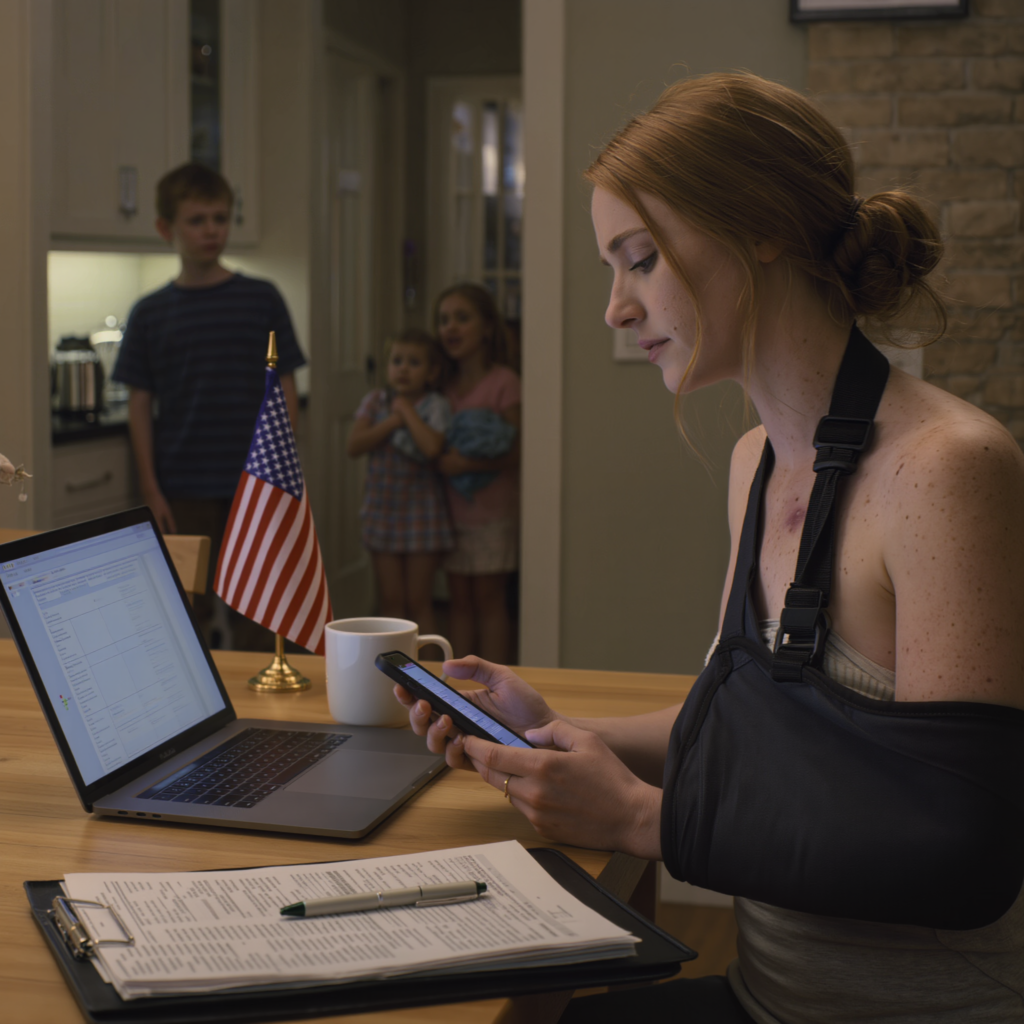
The ER curtain kept fluttering like it couldn’t decide whether to hide me or expose me. Every time it moved, I caught a sliver of the hallway—nurses in navy scrubs, a janitor pushing a mop bucket, a wall-mounted TV turned low with an old Frank Sinatra song bleeding through the tinny speaker. I lay there in a stiff collar with dried blood in my hair, my phone in my good hand, my keys in the other. The cheap little Stars-and-Stripes keychain on my ring dug into my palm like it was trying to remind me what I’d always told myself: I could handle it. I could handle anything.
Please—someone needs to pick up Leo and Maya from school.
I hit send, stared at the message bubble, and waited for the tiny gray dots that meant someone, anyone, was typing.
None came.
That was the first time I felt the cold start.
The accident itself was already blur and noise. One second I was driving down Highway 26 outside Portland with a reusable coffee cup between my knees and my kid’s chorus concert flyer on the passenger seat, and the next there was a flash of headlights where there shouldn’t have been any. Metal screamed. Airbags exploded like a punch from a giant. The world went white, then gray, then sharp again—smoke and powdered fabric and the taste of pennies in my mouth.
Someone had called 911. Someone always does.
A firefighter leaned in, asked my name, asked me if I could move my toes. I said, “My kids,” over and over like it was the only language I had left. He told me, “We’ve got you,” the way people say things they can’t actually promise.
By the time I landed under fluorescent lights, pain had become a landscape I lived inside. They taped an ID band around my wrist and asked about allergies and insurance and last meal. The nurse offered water and I asked for my phone.
That’s when I texted the family chat.
My mother read it. I could see the little “Seen” tag under my message like a verdict. My sister, Chloe, read it too.
Still no dots.
Leo was ten. Maya was seven. Both of them carried their backpacks like they were bigger than they were, straps cutting into little shoulders. Both of them knew exactly what time I picked them up because I never ran late. Not once.
I stared at my phone until my eyes burned.
At 3:27 p.m., my sister posted an Instagram story.
A boomerang of two champagne flutes clinking together over a marble spa counter. Her nails were freshly done and her wrist had a gold bracelet I didn’t recognize.
Caption: Treat Yourself Tuesday.
It wasn’t the spa selfie that broke me.
It was that my mother tapped a little heart on it.
That coldness settled deeper. It didn’t feel dramatic. It felt… factual. Like learning the earth isn’t the center of the universe.
By 4:02 p.m., my phone was still silent except for the hospital’s automated texts asking me to rate my “care experience.” I could barely breathe around the collar.
I called my cousin Annie.
She answered on the second ring. “Laney? Why are you calling during school pickup?”
I didn’t make my voice pretty. I didn’t have energy for pretty. “I’m in the ER. I got hit. I need someone to get the kids. Please.”
There was a beat—just one—and then her tone changed like a switch flipped. “Okay. Okay, breathe. What school?”
“Leo’s at Cedar Ridge. Maya’s at Maple Glen. I—” My throat tightened. “I texted my family. They didn’t—”
“Stop. Don’t waste breath on them.” Annie’s voice went sharp with purpose. “I’m leaving work right now. Ben’s meeting me at your house. We’ll get them. We’ve got them.”
She didn’t ask for a thousand details. She didn’t ask me to explain why my own parents weren’t going.
She just showed up.
And somehow, that made it hurt more.
When the doctor finally came in, he had the calm face of someone who sees broken people all day. “You’re lucky,” he said, like luck had anything to do with my minivan being crumpled on the side of the road.
A concussion. A fractured wrist. Deep bruising across my ribs where the seatbelt had saved me and punished me at the same time. “Pain management,” he said. “Rest. Limited lifting. Follow up with your primary. And no driving for a bit.”
“No driving,” I repeated, thinking of school pickups and grocery runs and how my whole life ran on driving.
They sent me home with a prescription and a list of warning signs and a polite smile that said, Good luck.
At home, Annie was already there. She’d fed the kids pizza at the kitchen counter, and Ben had packed overnight bags like he’d been doing it for years. Leo sat on a barstool, his foot bouncing. Maya had her math workbook open but wasn’t looking at it.
When Leo saw my wrist splint, he slid off the stool so fast he almost fell. “Mom!”
I knelt carefully, ribs screaming, and wrapped my good arm around both kids. Maya’s hair smelled like strawberry shampoo. Leo’s cheek was damp.
“Are you okay?” he whispered.
I lied. “I will be.”
Because what else can a mother say?
Later, after Annie got the kids into pajamas and Ben washed the dishes without being asked, Annie sat on the couch beside me like she was guarding something precious.
“You want me to call your mom?” she asked gently.
I stared at my phone, at the family chat, at my own message sitting there like a stranded flare.
“No,” I said.
The word surprised me with its steadiness.
Annie nodded like she’d been waiting for it. “Good.”
Around midnight, my pain pills made the edges of the room soft, but they didn’t touch the sharpest ache. That one lived in my chest.
I’d spent thirty-six years believing I was the strong one. The dependable one. The one who could be counted on.
I paid for Chloe’s “creator boot camp” when she decided she was going to be famous online. “It’s an investment,” she’d told me, eyes sparkling, as if I’d get dividends in hashtags.
I gave my parents money for a new roof when rain started dripping into their living room, right onto my dad’s beloved recliner. I didn’t make them grovel. I didn’t even make them sign anything.
When my brother wrecked his last car and needed another loan, I co-signed because “family,” because “it’s temporary,” because “you always come through, Laney.”
I’d never made them ask twice.
I’d called it love.
But in the space between my crash and my kids’ pickup, love had been missing.
And that absence was its own kind of answer.
Two days later, my mother finally called.
Not to ask how my ribs felt when I inhaled.
Not to ask if the kids were scared.
Not to ask anything that sounded like mothering.
Her voice came through my speaker bright and breathless. “Laney! Okay, listen, your dad and I found something amazing.”
I was sitting at my kitchen table with an ice pack on my wrist and a stack of permission slips I couldn’t sign because my hand shook too much. Leo was in the living room watching cartoons too loudly. Maya was coloring a dolphin.
“Mom,” I said, and even that word felt strange on my tongue.
“We’re doing a cruise,” she barreled on. “It’s this once-in-a-lifetime deal. The ship leaves out of Seattle, and the deposit is non-refundable and due Friday. We have to lock it in now.”
There was a moment where my brain tried to catch up, like a car sliding on ice.
“A cruise,” I repeated.
“Yes! Isn’t that exciting?” She laughed like she was calling to tell me I’d won something. “It’s only three thousand two hundred dollars. Just the deposit. We’ll pay you back. You know we will.”
I stared at the family chat again—at my unanswered message, at the read receipts, at Chloe’s spa story still pinned in my mind like a cruel postcard.
“You didn’t ask about the accident,” I said.
There was a tiny pause. “Of course I’m sorry you had a little fender bender, honey, but—”
“It wasn’t a fender bender,” I said, my voice quiet.
“Laney, don’t get dramatic. This is important. We need the deposit by Friday. Otherwise we lose the deal.”
The cold in me spread with a slow, deliberate certainty.
Friday wasn’t their deadline.
Friday was mine.
“No,” I said.
The line went so silent I thought the call dropped.
“What do you mean, no?” she asked, genuinely baffled, as if I’d told her gravity wasn’t real.
“I mean no,” I said. “I’m not paying for your cruise.”
“Laney—”
I didn’t argue. I didn’t defend myself. I didn’t list all the times I’d saved them.
I ended the call.
And when the screen went dark, something inside me clicked into place like a lock.
The fallout started fast.
Chloe texted first.
A link to a designer handbag that cost more than my mortgage payment.
Then: Mom said you’re being weird about the cruise. You okay?
I could almost hear her voice behind the words—sweet, concerned, sharp as a needle.
I didn’t respond.
My boundary wasn’t a speech.
It was silence.
My dad followed with a long message about “family loyalty” and “respect” and “how much your mother has done for you.” It read like a sermon delivered by a man who hadn’t picked up his grandkids from school in years.
At the end he wrote: Don’t punish your mom because you’re stressed. We need you.
Need you.
Not love you.
Not worry about you.
Need.
That night, Chloe posted a black-and-white quote to her story, the kind influencers use when they want to look wounded without telling the truth.
It hurts when you realize you were watering a dead plant all along.
The irony was so sharp it could’ve cut glass.
I almost laughed.
Almost.
Instead, I turned my phone face down and stared at the ceiling while Leo’s hallway nightlight cast soft stars across my bedroom wall.
I told myself it would stay petty.
Passive-aggressive posts. Guilt-trip texts. Family drama that would burn out once they realized I wasn’t giving in.
I was wrong.
A week later, my son’s school number flashed on my screen.
I answered with a sinking feeling. “This is Laney.”
“Hi, Ms. Parker,” the principal said, her voice gentle in that careful, professional way adults use when something is wrong. “This is Dr. Hernandez. Do you have a moment to talk privately?”
My ribs tightened under my sweatshirt. “Yes. What’s going on?”
There was a pause, like she was choosing each word from a locked drawer. “We received a call. An anonymous concern was reported to the state hotline.”
My kitchen seemed to tilt.
“A concern?” I repeated.
“She alleged two things,” Dr. Hernandez said, softly but clearly. “That your children are frequently left unsupervised in an unsafe home environment, and that you may not be taking your prescribed medication responsibly.”
The cold in me turned glacial.
I gripped my keys so hard the little flag keychain bit into my skin. “Who called?” I demanded.
“We don’t have that information,” she said. “Anonymous reports are… anonymous. But we are required to notify you, and we are required to cooperate if there’s any follow-up.”
I couldn’t hear Leo’s cartoons anymore. I couldn’t hear Maya humming in the next room. I could only hear the pulse pounding in my ears.
Only three people knew the name of my prescription.
My mother.
My father.
Chloe.
They hadn’t just ignored me in the ER. They hadn’t just demanded money.
They’d gone for my children.
The line they crossed wasn’t a line you could uncross.
After I hung up, I sat at my kitchen table and stared at my hands.
One bandaged.
One shaking.
And I realized something terrible and clarifying.
They weren’t family the way I’d thought.
They were an organized storm.
That night, while the kids slept, I did what I should’ve done years ago.
I opened my laptop and started digging.
Not out of panic.
Out of necessity.
I pulled my credit reports. I downloaded bank statements. I logged into every account I could remember. I wrote down loan numbers and payment histories and the little forgotten subscriptions that had been draining my checking account for months.
At 1:14 a.m., my screen blurred and I had to blink hard.
At 1:31 a.m., I found it.
A credit card opened six months earlier with a major bank I didn’t use.
My name was on the account.
And under “authorized users,” there it was: Chloe Parker.
The balance wasn’t a rounded number.
It was exact.
$12,486.13.
The number landed in my chest like a weight.
I clicked into the statement, scrolling through lines that felt like they belonged to a stranger’s life.
Boutique hotel stays in downtown Portland.
Dinners at places I’d driven past and told myself were “for special occasions.”
Designer clothing stores.
A steady stream of online purchases that matched Chloe’s curated feed—perfect outfits, perfect lighting, perfect life.
Every sponsored post she bragged about, every “blessed” caption, every glossy selfie in a fluffy robe.
Funded by my name.
Funded by my trust.
I sat back in my chair and let the truth settle.
This wasn’t messy family drama anymore.
This was theft.
And suddenly, the cold inside me wasn’t devastation.
It was focus.
In the morning, I called a lawyer.
She was recommended by Annie, who had a friend who worked in banking compliance and didn’t ask why. The lawyer’s name was Marissa Tate. She spoke quickly, like someone who knew time was a weapon.
“Do you have documentation?” she asked.
“I have statements,” I said. “Screenshots. Credit reports.”
“Good,” she said. “Freeze your credit today. All three bureaus. Then file a police report. You can’t fix this quietly if someone is willing to burn your life down.”
“Someone,” I echoed.
She didn’t press. “Laney, I’m going to say this kindly: you’re past the point of protecting their feelings.”
I stared at my kids’ school photos on the fridge. Leo missing one front tooth. Maya in a sparkly headband. The little American flag keychain swung from my wrist as I moved.
“Yeah,” I said. “I know.”
I spent that afternoon making calls that made my stomach flip.
Credit bureaus. Bank fraud departments. My insurance company. The police non-emergency line.
When the officer came to take the report, he was polite and tired, as if he’d seen too many people learn too late that kindness can be exploited.
“Identity theft by a known person?” he asked, pen hovering.
I swallowed. “Yes.”
He nodded. “You’re doing the right thing.”
The words felt strange, because for so long “the right thing” in my family meant swallowing it. Paying it. Fixing it.
Marissa had me send her everything. She drafted a formal letter to the bank. She told me not to speak to Chloe directly.
“Let paper talk,” she said. “Paper doesn’t get manipulated.”
That evening, Chloe tried anyway.
She called three times.
Then she texted: Why are you being like this? Mom is crying.
Then: You’re making this bigger than it is.
Then: We can talk.
I didn’t respond.
Because I wasn’t interested in talking.
I was interested in ending.
Two days later, my mother showed up at my front door.
I saw her through the window—perfect hair, perfect lipstick, her purse tucked in the crook of her elbow like she was arriving at a lunch date, not the home of a daughter she’d left stranded.
I didn’t open the door.
She rang the bell again, harder.
“Laney!” she called. “I know you’re in there!”
Leo’s eyes went wide from the hallway. Maya clutched her stuffed rabbit.
I walked to the door and spoke through it, my voice steady. “Go home.”
Her gasp sounded offended. “Don’t you dare talk to me like I’m some stranger.”
I laughed once—short, humorless. “You were a stranger the day of the crash.”
“Stop being cruel,” she snapped, and then her tone softened into syrup. “Honey, your sister made a mistake. We’re family. You don’t call the police on family.”
“You called a hotline on me,” I said.
Silence.
Then a scoff, too quick. “I don’t know what you’re talking about.”
I leaned my forehead against the door, feeling the wood cool against my skin. “You don’t know what you’re talking about,” I repeated softly, “and yet you knew exactly which medication I was prescribed.”
Her breath hitched. “Laney, don’t do this.”
“Not here,” I mimicked, remembering my dad’s text, and the cold in me didn’t waver. “Not ever again.”
She tried one last time, voice rising. “You’re going to ruin this family’s name!”
I pictured Chloe’s spa robe. I pictured the read receipt under my plea. I pictured my son’s principal choosing words carefully so she wouldn’t scare me more than I already was.
“You ruined it,” I said, and I walked away.
After she left, I sat at my kitchen table with my laptop open and my hands still shaking.
I didn’t want revenge.
I wanted the truth in daylight.
So I wrote.
I opened my private Facebook page—the one connected to cousins, old neighbors, PTA parents, church ladies who remembered me as the kid who always volunteered to stack chairs.
I didn’t use names.
I didn’t need to.
I wrote a clean timeline.
Date of the crash.
My message in the group chat asking someone to pick up my children.
The hours of silence.
The spa photos.
The call asking for $3,200 for a cruise deposit.
The guilt-trip texts.
The anonymous report.
The discovery of a credit card opened in my name.
Then I attached evidence.
Screenshots side by side: my desperate text next to Chloe’s champagne boomerang.
A redacted call log showing the school’s number.
A redacted statement showing line after line of charges.
And, right there at the bottom in black ink like a final punctuation mark: $12,486.13.
My cursor hovered over “Post.”
For a moment, I thought of all the years I’d kept their secrets because I believed it was love.
Then I clicked.
The truth didn’t creep.
It detonated.
At first, it was just the tiny ping in the corner of my screen—one notification, then two, then a swarm so fast my phone started to feel hot in my hand. The post had barely settled into the feed before the quiet I’d been living in evaporated.
A red bubble popped over the family group chat.
Then another.
Then the number climbed so quickly it stopped being a number and became a pressure. My mother was typing. I could see her name and the little dots pulsing like she was still trying to perform concern on a stage.
I didn’t open it.
Instead I took a breath that hurt my ribs and did the one thing I’d never done when my family was upset with me.
I set my phone down.
The silence in my kitchen wasn’t empty; it was loaded. The kids were in the living room building a blanket fort, Maya humming to herself as she folded a throw like it mattered. Leo was narrating the whole thing like a sports announcer, trying to make Maya laugh. They were children doing what children do: building safety out of whatever was available.
And I was an adult finally doing the same.
I walked to the pantry, reached for the top shelf, and pulled down the little lockbox I’d bought that morning on my way home from the bank. It wasn’t dramatic. It was the kind of gray, practical box people use for passports or spare cash. I set it on the counter, slid my prescription bottle inside with the label facing up, closed the lid, and turned the key.
It felt ridiculous and necessary at the same time.
“Mom?” Leo called from the fort. “Can we have apples?”
“Yeah, buddy,” I said, and my voice came out steadier than I felt. “Wash your hands.”
I cut apple slices with my good hand, the knife moving slow because pain makes you careful. I kept my movements ordinary on purpose. Ordinary is a kind of protection.
The phone buzzed again.
Again.
I flipped it over just long enough to see the call log.
One missed call.
Then four.
Then twelve.
By the time I finished slicing apples, it was twenty-nine missed calls—my mother, my father, Chloe, a couple numbers I didn’t recognize, and my brother, Dean, sprinkled in like someone trying to look reasonable.
Twenty-nine.
It wasn’t just volume.
It was coordination.
That was when I realized they weren’t panicking because they loved me. They were panicking because they’d lost control of the narrative.
I slid the apples onto a plate and walked them into the living room like I wasn’t standing in the middle of a storm.
“Apples and peanut butter,” I announced.
Maya’s face lit up. “Yes!”
Leo took a slice, then studied me with the kind of watchfulness kids develop when they’ve seen adults fall apart before. “You’re… okay?”
The word okay was a bridge he was asking me to cross with him.
I sat on the edge of the fort, careful of my ribs. “I’m sore,” I said honestly. “But you’re safe. And I’m here.”
He nodded like he was accepting a contract.
My phone buzzed again.
This time it was a private message from someone I hadn’t spoken to in years—a woman named Carla who used to live two doors down from my parents.
Laney, are you safe? Do you have support? I’m so sorry.
No guilt. No lecture. Just a question that mattered.
I stared at it, throat tight.
I typed back: I’m safe. Kids are safe. Thank you.
And that was the first time in days I felt warmth—not from my family, but from the people who had no obligation to show up.
The group chat bubble kept swelling. I could feel the urge—old muscle memory—to open it, to read, to manage, to smooth.
I didn’t.
Instead, I opened a new note on my phone and started documenting.
Time stamps.
Calls.
Messages.
Screenshots.
Marissa’s voice was in my head: Let paper talk.
My family had always tried to drown me in words. Now I was learning to treat words like evidence instead of emotion.
I was halfway through saving the screenshots when my doorbell rang.
Once.
Then twice.
Then the kind of long press that said someone wanted to be heard through wood.
My stomach sank, but my feet moved anyway—quiet, careful, not panicked. I stepped to the side window and peeked through the blinds.
Dean stood on my porch with his shoulders hunched against the drizzle, his hood up, looking like he’d come to apologize and fight at the same time.
I didn’t open the door.
I cracked the inner chain and spoke through the gap. “Dean.”
He exhaled hard. “Laney. What the hell are you doing?”
“I’m at home with my kids,” I said.
“You know what I mean.” His eyes flicked past me like he expected to see Mom behind my shoulder, like this was all a misunderstanding he could fix. “Mom’s losing it. Chloe’s losing it. Dad’s—”
“Dad’s typing Bible verses again?” I asked, and it was the first time sarcasm came out of me without shaking.
Dean’s jaw tightened. “You blasted them online.”
“I posted facts,” I corrected.
He scoffed. “That’s the same thing.”
“It isn’t,” I said. “Facts don’t change based on who’s mad.”
Dean leaned closer to the opening like he could force me back into the old role by proximity. “They’re family.”
“And where were they when I needed someone to pick up my kids?” I asked.
His face did something strange—an almost-flinch. Not surprise. Recognition.
“Look,” he said, voice dropping. “Mom says she didn’t do that school call.”
I held his gaze. “Mom also said she was ‘sorry about my little fender bender.’”
He pressed his lips together. “Chloe says that credit card thing was… a misunderstanding.”
“A misunderstanding?” I repeated, and my laugh came out like a cough.
“Like maybe you gave her permission at some point,” he said, not meeting my eyes now. “You’ve helped her before.”
My ribs tightened again. So that was their angle.
I let the silence hang until it got uncomfortable, because discomfort was a tool I’d never let myself use.
“Dean,” I said, “did you pick up my kids?”
He blinked. “What?”
“Did you pick up Leo and Maya that day?”
“No,” he said, defensive. “I was at work. I didn’t even see the text until later.”
“I saw the read receipts,” I said. “Everybody saw it.”
He opened his mouth like he was going to argue, then stopped. Rain tapped the porch railing, slow and patient.
“I’m not doing this,” he muttered.
“Then don’t,” I said. “Go home.”
He looked at me with a mix of anger and something that might’ve been envy—envy that I was finally not bending.
“Fine,” he snapped. “But you’re tearing everyone apart.”
I didn’t answer.
Because for the first time, I understood something he didn’t: I wasn’t tearing anything apart. I was letting it show.
When Dean finally left, he didn’t slam anything. He just walked down the steps like a man who knew he’d lost his argument before he made it.
I slid the chain back into place and stood with my forehead against the door, breathing through my ribs.
My phone buzzed.
This time, it was Marissa.
I answered, stepping into the hallway so the kids wouldn’t hear my voice change. “Hi.”
“You posted,” she said.
“I did,” I admitted.
“Okay.” No judgment. Just strategy. “You’re going to get pressure. Do not engage. Save everything. And if anyone comes to your house again, don’t let them in.”
“I didn’t,” I said.
“Good.” I could hear paper shuffling on her end. “The bank called me back. They want you to sign an affidavit. They’re treating the balance as disputed—twelve thousand four hundred eighty-six dollars and thirteen cents.”
Hearing the number out loud made it real in a new way, like a judge reading a sentence.
“Okay,” I said.
“And,” she added, voice sharpening, “there’s something else. The application for the card listed a secondary contact email.”
My stomach sank. “Whose?”
She paused, like she didn’t enjoy this part. “It’s your mother’s email address.”
Cold moved through me, slow and absolute.
“Laney?” Marissa asked.
“I’m here,” I said, but my voice sounded far away.
“That’s significant,” she said. “It means this wasn’t just Chloe being impulsive. It suggests coordination.”
Coordination.
The word fit too neatly against twenty-nine missed calls.
My mind flashed, uninvited, to my mother’s filing cabinet when I was a kid—the one she kept in the hallway closet. She called it “the important stuff.” Birth certificates. Social Security cards. Tax returns. Everything with numbers that could build or break a life.
When I moved out at eighteen, she’d handed me a folder with my name on it like she was gifting me independence.
But she’d always kept copies.
Mothers do, right?
Only now I wondered what she’d used them for.
Marissa’s voice softened. “Laney, this is going to be hard. But you’re doing it correctly.”
I closed my eyes. “How fast can the bank move?”
“Once they have the affidavit and the police report, faster,” she said. “They’ll investigate. The account could be frozen. If charges are proven unauthorized, they’ll reverse them.”
“If,” I echoed.
“If,” she confirmed. “This is why documentation matters.”
I looked down the hallway at my kids’ closed bedroom door. A sticker of a soccer ball was peeling off Leo’s doorframe. A rainbow drawing taped to Maya’s.
“My kids,” I said, more to myself than to Marissa.
“I know,” she replied. “Now—one more thing. The school report. There may be follow-up. If an investigator contacts you, stay calm. Be cooperative. Have your paperwork ready. Don’t volunteer extra. Just answer what’s asked.”
“Okay,” I whispered.
“And Laney?”
“Yeah?”
“This is important,” she said. “Update your emergency contacts at both schools. Today.”
I swallowed. Of course.
On every form, for years, I’d listed my mother as the first emergency contact. Then my father. Then Dean.
Because family.
Because I thought that’s what safety looked like.
In that moment, I understood safety looked like Annie.
Safety looked like Ben.
Safety looked like the people who had picked up my kids when I was on a hospital bed staring at read receipts.
“I’ll do it,” I said.
After I hung up, I walked back into the living room, forced a smile, and crawled halfway into the blanket fort.
Maya giggled. “You’re too big!”
“Then you’ll have to expand the fort,” I said.
Leo smirked. “We can reinforce with couch pillows.”
“Excellent plan,” I told him.
For ten minutes, we talked about fort architecture like it was the most important problem in the world.
And then my phone rang again.
Unknown number.
I hesitated, then answered because the unknown is where official voices live.
“Ms. Parker?” a woman asked.
“Yes.”
“This is Elaine Barlow,” she said, crisp. “I’m with the county. I’m following up on a report we received. I’d like to schedule a home visit.”
My heart tried to climb into my throat.
I kept my voice level. “Okay.”
She gave me a window—tomorrow afternoon, between two and four.
“Will my children be home?” she asked.
“Yes,” I said.
“Good,” she replied. “We’ll need to speak with you and them briefly.”
I pictured Leo’s cautious eyes. Maya’s rabbit clutched in her fist.
“Okay,” I repeated.
She wasn’t unkind. She wasn’t cruel. She was procedural.
And procedure is terrifying when someone else is holding it.
When I ended the call, my hands trembled. I set the phone down and stared at it like it might bite.
Annie answered on the first ring when I called.
“Hey,” she said, and I could hear her chopping something in her kitchen.
“I need you tomorrow,” I said.
The chopping stopped. “What happened?”
“Home visit,” I said, and even those two words made my mouth go dry.
“I’ll be there,” she said instantly. No questions about whether it was inconvenient. No sigh. No guilt. “Do you want me there for support or as a witness?”
“Yes,” I said.
She exhaled. “Okay. We’ll make coffee. We’ll sit at the table. We’ll breathe. And we’ll keep it boring.”
Keep it boring.
That was the kind of advice people give when they love you: make the scary thing smaller.
After I hung up, I looked around my house like I’d never seen it before.
It was clean enough. Not magazine clean—real life clean. There were Lego pieces under the couch and a stack of library books on the coffee table and a laundry basket in the hallway that never quite emptied.
Normal.
But normal suddenly felt like something I had to prove.
So I prepared.
I printed the ER discharge papers.
I printed the pharmacy label and the dosing instructions.
I printed the appointment reminder for physical therapy.
I made a neat folder with tabs and wrote in black marker: Medical. School. Financial. Legal.
I texted Marissa a photo of the folder.
She responded: Good. Document everything.
Then I did the hardest part.
I talked to my kids.
Not with the language of panic. With the language of truth that doesn’t scare them more than the truth already will.
That night, after baths and bedtime stories, Leo lingered at the edge of his bed.
“Mom,” he said quietly, “is Grandma mad at you?”
My throat tightened.
“I think Grandma’s upset,” I said.
“Because you didn’t give her money,” he said, like he was stating weather.
I stared at him. “How do you know about money?”
He shrugged, embarrassed. “I hear things.”
Of course he did. Kids always do.
“I didn’t give her money,” I said gently, “because that money needs to take care of us.”
He nodded, slow. “Are we in trouble?”
“No,” I said immediately. “We are not in trouble. Sometimes adults make choices they shouldn’t. And sometimes the best way to handle that is to be honest and to ask for help from the right people.”
His eyes searched mine. “Are they going to make us leave?”
The question punched the air out of me.
I sat on the edge of his bed carefully. “No,” I said, and I made sure my voice didn’t wobble. “No one is taking you away. Tomorrow someone might come by to ask questions because somebody called with a concern. People do that sometimes. But we’re okay.”
Leo swallowed. “Do I have to talk?”
“You can answer simple questions,” I said. “Like what you eat for breakfast. Who helps you with homework. How you feel at home. And you can always say, ‘I don’t understand,’ if you don’t.”
He nodded again.
Then he surprised me by reaching for my good hand. He squeezed it once, hard.
“Okay,” he whispered.
I leaned down and kissed his forehead. “Okay.”
In Maya’s room, she was already tucked under her blanket, rabbit under her arm.
“Mommy,” she murmured, sleepy, “why were you crying earlier?”
I hadn’t realized I’d been crying. Sometimes your body leaks what your mouth refuses.
“I was just tired,” I lied.
She blinked slowly. “Is Grandma coming?”
“No, honey,” I said.
Maya frowned. “Good. Grandma makes your face tight.”
My throat closed.
Kids see everything.
I smoothed her hair. “Sleep,” I whispered.
When I turned out the light, I stood in the hallway for a long moment, letting the darkness settle.
I thought about how my mother would’ve described my kids—her grandbabies—as “everything.”
And yet she was willing to gamble them like chips.
That was when my cold turned from defense into decision.
The next afternoon, Annie arrived early with a grocery bag of muffins and a calm expression that made me want to collapse with gratitude.
“Okay,” she said as she set the bag down. “We’re going to sit at the table, and we’re going to let them do their job.”
“What if they believe it?” I asked, voice too small.
Annie looked me in the eyes. “Then we show them the truth,” she said. “But they won’t. Because the truth is right here.” She gestured around my house—toward the art on the fridge, the scuffed shoes by the door, the smell of kid shampoo in the hallway.
At 2:37 p.m., a county car parked in front of my house.
At 2:39 p.m., there was a knock.
Elaine Barlow introduced herself in my doorway, holding a slim clipboard. She was maybe in her forties, hair pulled back, rain jacket zipped to her chin.
“Ms. Parker?”
“Yes,” I said.
She glanced past me. “Are the children home?”
“Yes.”
She stepped inside, eyes scanning—not like she was hunting, but like she was mapping. She looked at the living room, the kitchen, the hallway. She noted the safety gate we’d never gotten around to taking down even though Maya was too old for it. She noted the smoke detector. The sink full of lunch dishes.
Normal.
She sat at my kitchen table and set her clipboard down. “This won’t take long,” she said. “We received a report expressing concerns about supervision and medication use following an accident.”
I slid the folder across the table like I was offering proof of existence.
“My accident happened on this date,” I said, tapping the ER papers. “Here is the discharge summary. Here is the prescription label and dosing instructions. Here is my follow-up appointment.”
Elaine raised her eyebrows slightly, impressed despite herself. “Thank you,” she said, flipping through.
Annie sat beside me, hands folded. “I’m her cousin,” she said. “I picked up the kids the day of the accident. I’ve been helping with school runs when she can’t drive.”
Elaine nodded. “That’s good support.”
She asked a series of questions that felt invasive and mundane at the same time.
Who helps with homework?
What’s the bedtime routine?
Where are medications stored?
Do the children have regular meals?
I answered without drama. Annie backed me up when needed. The kids ate muffins at the counter like it was any other Tuesday.
Then Elaine asked to speak with the kids separately.
My pulse spiked.
“Leo,” I called gently, “can you come talk to this lady for a minute?”
He walked in with shoulders squared like a tiny soldier. Maya followed, rabbit tucked under her arm.
Elaine smiled at them, softening her voice. “Hi, I’m Elaine. Can I ask you a couple of questions?”
Leo glanced at me.
I nodded. “You’re okay,” I told him.
Elaine asked them about school, friends, dinner, whether they ever stayed home alone.
Leo answered in complete sentences. Maya answered with little kid honesty.
“Do you feel safe at home?” Elaine asked.
Maya frowned as if the question was silly. “Yes,” she said. “We have a fort.”
Leo said, “Mom’s been hurt, but Annie comes. And Ben. And my teacher gave me extra time for homework.”
Elaine nodded slowly, then looked at me. “Thank you,” she said. “That helps.”
After she left, I sat at the table and realized my hands weren’t shaking anymore.
Annie exhaled. “See?” she said. “Boring.”
I laughed, the sound shaky but real.
Then my phone buzzed again.
Twenty-nine missed calls had turned into fifty-two.
The comments under my post were now a scroll of family history spilling out like a busted pipe.
People were sharing their own experiences—money “borrowed,” promises made, emergencies that never quite added up.
One aunt wrote: I always wondered why you kids were expected to pay for everything.
A cousin wrote: I’m sorry, Laney. I should’ve believed you years ago.
Someone else wrote: Chloe blocked me when I asked about the GoFundMe.
It was as if my post had given everyone permission to stop pretending.
And pretending had been the glue holding my parents together.
That was when I realized the truth doesn’t just free you—it forces everyone else to choose a side.
That evening, Chloe went live.
I didn’t watch at first. I told myself I didn’t need to. I told myself I wouldn’t give her the satisfaction.
Then Marissa texted: Do not respond to anything she says. Save it.
So I watched, not as her sister, but as someone collecting proof.
Chloe’s face filled my screen, eyes glassy, mascara perfect despite the tears. She sat in her car like she’d planned the lighting.
“I’m going through something really painful right now,” she began, voice trembling in a way that sounded rehearsed. “And I just want to say, sometimes people take things out of context. Sometimes family—”
She swallowed dramatically. “—family hurts you the most.”
The comments were split.
Some strangers comforted her.
Some people asked questions she didn’t answer.
Some family members typed furious defenses like they were clocking in for a shift.
Chloe kept talking about “boundaries” and “mental health” like she’d invented those words.
Then she made the pivot she thought would land.
“I never stole from anyone,” she said, voice sharpening. “I’ve worked for everything I have.”
I paused the video and took a screenshot.
Not because I needed the world to see her lie.
Because I needed a record of it.
That night, my mother sent an email. Not a text. An email—formal, like she was trying on authority.
Subject line: FAMILY EMERGENCY.
Inside, she wrote: You have 24 hours to remove your post. If you don’t, you will leave us no choice.
No choice.
It was a threat dressed up as a consequence.
I forwarded it to Marissa.
Marissa replied: Good. That helps us.
The next morning, the bank called again.
A man named Thomas introduced himself as an investigator in the fraud department. His voice had the careful neutrality of someone trained not to take sides.
“Ms. Parker,” he said, “I’m following up on the disputed account. We’re going to need you to confirm a few details.”
“Okay,” I said.
“Did you ever apply for a credit card ending in 9021?” he asked.
“No.”
“Did you authorize Chloe Parker as an authorized user?”
“No.”
“Did you ever provide your Social Security number to Chloe Parker?”
“No,” I said, and my voice went sharp. “I didn’t provide it. She took it.”
Thomas paused. “Understood. We also noticed the mailing address for the account was initially your parents’ address.”
The room went very still.
“My parents’ address,” I repeated.
“Yes,” he said. “The first two statements were mailed there before the address was changed to yours.”
I gripped the edge of the counter. My mind flashed to my mother opening mail, sorting it, deciding what I “needed to know.”
Thomas continued, “We’ll send an affidavit via secure link. Once you sign and return it, we can proceed with the chargeback investigation.”
“Okay,” I managed.
“And Ms. Parker,” he added, “if anyone contacts you claiming they can ‘fix’ this if you withdraw the dispute, please don’t.”
My laugh was bitter. “They’ve already tried.”
He didn’t react. “Just making sure you know the process.”
After I signed the affidavit, my hands trembled again. The truth is paperwork doesn’t feel heroic. It feels like you’re carving your own skin into evidence.
By lunchtime, Chloe was texting from a new number.
You’re ruining my life.
Then: Just take it down. We’ll talk.
Then: Mom said she can forgive you if you just stop.
Forgive.
Like I’d done something wrong.
I didn’t respond.
Instead, I walked into Leo and Maya’s school office with my folder and asked to update emergency contacts.
The secretary, a kind woman with silver hair and a lanyard full of keys, looked at me sympathetically. “How are you doing, honey?” she asked.
“Learning,” I said, and it was the most honest answer I had.
I removed my parents’ names.
I removed Chloe.
I removed Dean.
I put Annie first.
I put Ben second.
I put Marissa’s office number under “legal contact” because Marissa suggested it.
When I handed the forms back, my stomach unclenched a fraction.
There are locks you don’t realize you need until someone tries to walk right through your life.
That afternoon, my father finally sent a message that wasn’t a lecture.
Can we meet. Just you and me.
No emojis. No “honey.” No performance.
My first instinct was to ignore it.
My second instinct—colder, clearer—was to see if he would put anything useful in writing.
I replied: Public place. One hour.
He answered immediately: Stumptown Coffee on Hawthorne. 10 a.m.
Marissa told me not to go alone.
So Annie came and sat across the room with a book she never opened.
My father arrived five minutes early, wearing the same navy windbreaker he’d worn for years, the one that made him look like every other older man in Oregon who wanted to appear harmless.
He stood when he saw me, then hesitated like he wasn’t sure whether he was allowed to hug me.
“Laney,” he said.
“Dad,” I replied.
We sat.
The café smelled like espresso and wet wool. People typed on laptops. A barista called out names. The normalness of it made my skin itch.
He wrapped both hands around his coffee cup like he needed something warm. “Your mother is beside herself,” he began.
I didn’t react.
He tried again. “Chloe’s… not doing well.”
Still nothing.
His eyes narrowed. “So that’s it?” he asked. “You’re just… done?”
“I’m protecting my children,” I said.
He flinched, like I’d accused him of something personal.
“I never would hurt my grandkids,” he said quickly.
“Someone called their school,” I replied. “With details only our family knew.”
He looked down at his coffee. The silence between us wasn’t empty.
Finally, he said, “Your mother was scared.”
I stared at him. “Scared of what?”
He swallowed. “Scared you were going to cut her off.”
I felt something in my chest loosen—not because it was okay, but because it was confirmation.
“She was scared of losing access,” I said.
He lifted his eyes, and for the first time, I saw it: not shame, exactly. Calculation. The instinct to negotiate.
“Laney,” he said carefully, “if you take the post down, we can handle this privately. We can pay you back. We can—”
“Pay me back with what?” I asked. “A cruise?”
His face reddened. “Don’t be smart.”
“I’m not being smart,” I said quietly. “I’m being awake.”
He leaned forward, voice dropping. “Chloe made mistakes. She got carried away. But she didn’t mean—”
“She applied for credit in my name,” I interrupted. “She ran up twelve thousand four hundred eighty-six dollars and thirteen cents.”
The number landed on the table like a brick.
My father’s jaw clenched. “She was going to pay it.”
“With what?” I asked again.
He didn’t answer.
I took a sip of water and let the silence do its work.
He sighed, frustration creeping in. “Why are you doing this? Why are you humiliating us?”
I met his eyes. “You’re embarrassed,” I said, “because people know. Not because it happened.”
His nostrils flared.
I kept my voice even. “Dad, did you know about the card?”
He looked away.
That was my answer.
Annie shifted across the room like she was ready to stand if I needed her.
My father’s voice went brittle. “Your mother didn’t think it would go this far.”
My hands went cold. “So she did make the call.”
He snapped his eyes back to mine. “I didn’t say that.”
“You didn’t have to,” I said.
For a moment, he looked like he might break. Then he did the thing my family always did when truth got close.
He went on offense.
“You’re unforgiving,” he said, voice sharp. “You always were. You keep score.”
I blinked slowly. “I kept receipts,” I corrected.
His mouth twisted. “We’re your parents.”
“And I was your daughter,” I said. “The day of the crash.”
That sentence hung between us like a door slamming.
My father sat back, the fight draining out of him because he didn’t have a counter for that.
He stared at his coffee for a long time.
Then he said, almost resentfully, “Your mother is going to need help. They’re… talking about the house.”
I thought about my checks. My “loans.” The months I’d been covering shortfalls without asking what caused them.
“That’s why you’re here,” I said.
He didn’t deny it.
I stood. “Tell Mom to stop contacting my children’s school,” I said. “Tell Chloe to stop contacting me. Anything you need to say can go through my lawyer.”
He looked up, eyes hard. “So you’re really doing this.”
“I already did,” I said.
And I walked out.
Outside, the rain had eased to mist. My lungs pulled in damp air and my ribs ached, but my steps didn’t wobble.
Because leaving that table felt like stepping out of a story that had been written for me.
That was my midpoint—the moment I stopped wondering if this was a misunderstanding and accepted it as a system.
Back home, Chloe tried a new tactic.
She sent Maya a package.
It arrived in a bright pink mailer, no return label, just my address scrawled in familiar handwriting.
Inside was a stuffed unicorn and a note in Chloe’s looping script: Tell Mommy I’m sorry. I miss you.
Maya carried the unicorn into the kitchen, eyes shining. “Aunt Chloe sent this!” she announced.
My stomach twisted.
I knelt carefully. “Sweetheart,” I said softly, “we don’t accept gifts right now.”
Maya’s face crumpled. “Why?”
Because it was a hook, I thought. Because my sister would dangle anything shiny if it meant she could pull us back.
I chose words my daughter could hold. “Because sometimes grown-ups send gifts to make you feel confused,” I said. “And I don’t want you confused. I want you safe.”
Maya hugged the unicorn to her chest. Tears pooled. “But it’s cute.”
“I know,” I whispered. “That’s why it’s hard.”
I called Marissa.
“Don’t return it,” she advised. “Photograph it. Document it. Keep it. Gifts can be contact attempts.”
So I put the unicorn in a plastic bin in the garage, like evidence of how my sister understood love: as leverage.
A week passed.
Then another.
The county follow-up never came.
But the family pressure did.
My mother recruited an aunt to call me. Then an uncle. Then a distant cousin who sent a message that began with, I don’t want to get involved, but…
Every one of them wanted me to soften. To be “the bigger person.” To think about “the family.”
None of them asked about Leo’s nightmares.
None of them asked about Maya flinching when the phone rang.
They were all more worried about my parents’ embarrassment than my children’s safety.
That was when I realized “bigger person” was just another way of saying “smaller boundaries.”
One afternoon, as I was loading groceries into my trunk, my mother appeared at the edge of the parking lot.
I froze.
She walked toward me with a bright smile that didn’t reach her eyes, holding her phone like she was ready to record if I raised my voice.
“Laney,” she said loudly, as if the produce aisle crowd needed to hear her act. “We need to talk.”
I kept my tone low. “You can talk to my lawyer.”
Her smile faltered. “You’re being dramatic.”
“I’m being consistent,” I said.
She stepped closer. “You have no idea what you’ve done. People are calling us thieves.”
“You opened accounts in my name,” I replied.
She scoffed. “Chloe did that.”
“Your email was on the application,” I said.
For the first time, her mask slipped. Her eyes flashed, sharp with anger. “How dare you accuse me.”
I looked her dead in the face. “How dare you call my son’s school.”
She went very still.
Then her voice dropped to a hiss. “If you don’t take that post down, I can make things difficult for you.”
There it was.
The threat without perfume.
I took out my phone and, with one thumb, dialed 911.
My mother’s eyes widened. “Don’t you—”
I held her gaze, calm as ice. “Back up,” I said.
She backed up.
I didn’t press call.
I didn’t have to.
Sometimes the only reason a bully stops is because they finally believe you’ll make it public.
She walked away stiffly, head high like she was the victim, and I loaded my groceries with shaking hands.
When I got home, I sat at my kitchen table and wrote down everything that happened, including the exact time and the exact words.
And that was when I understood something simple: my cold wasn’t cruelty—it was clarity.
Two days later, Thomas from the bank called again.
“Ms. Parker,” he said, “we have preliminary findings.”
My stomach tightened. “Okay.”
“The account was opened online using your identifying information,” he said. “We’ve also confirmed that the initial IP address for the application was associated with a device connected at your parents’ address.”
My skin went cold all over again.
“So they did it,” I said.
“I’m not in a position to assign intent,” Thomas replied carefully. “But I can tell you what we can do. We’re closing the account pending the investigation. We’re also moving to reverse the unauthorized charges.”
My breath caught. “All of them?”
“The disputed amount,” he clarified. “Twelve thousand four hundred eighty-six dollars and thirteen cents.”
Hearing it again—after weeks of pressure—felt like someone lifting a weight off my chest inch by inch.
I closed my eyes. “Thank you,” I whispered.
“There is one more thing,” Thomas added. “We may contact you for additional documentation, but you’ve been very thorough.”
Thorough.
A word that used to mean “controlling” in my family.
Now it meant protected.
That afternoon, Marissa emailed me a draft of the cease-and-desist letter she planned to send Chloe. She also included a paragraph about defamation in case Chloe tried to spin publicly.
“You did not name her,” Marissa wrote. “But she may claim harm. Stay quiet. Let me handle it.”
Let me handle it.
The phrase made my throat ache because I’d spent a lifetime being the one who handled everything.
It was unfamiliar to be held.
That evening, I returned to Facebook and saw that my mother had posted her own status.
Family is everything. Some people forget that.
Under it, a handful of relatives wrote heart emojis and vague prayers.
I didn’t comment.
I didn’t respond.
I didn’t even feel tempted.
Because I finally understood their version of “family” was a stage prop.
And I was done performing.
Within minutes, comments started.
A cousin wrote: Is this why Chloe never paid me back for that $2,000 “rental deposit”?
An aunt messaged privately: Your parents ran a GoFundMe for plumbing two years ago. I donated. They never fixed anything.
A former family friend commented publicly: I wondered where the money went. This is sick.
Chloe’s brand partnerships—small wellness companies and boutique clothing shops—started disappearing from her bio like someone was erasing her in real time.
By the next morning, Chloe’s Instagram story was gone.
By noon, her account was private.
By evening, it was dark.
My mother called, sobbing.
Not apologizing.
Demanding.
“How could you do this to us?” she cried. “Take it down! Take it down right now!”
I listened to her like I listened to the hum of the refrigerator—present, irrelevant.
“You should’ve picked up the kids,” I said.
And then I hung up.
Marissa sent a formal cease-and-desist to Chloe the next day regarding the fraud. The bank launched an investigation. The police report went from a piece of paper to a file number to something that had weight.
And the requests for money stopped.
Completely.
It was almost funny, how quickly their “family” speeches evaporated once they realized I wasn’t paying and I wasn’t hiding.
The state hotline follow-up never came. Dr. Hernandez documented everything, and Annie’s written statement about stepping in during the crash week made it clear I wasn’t “leaving my kids unsupervised.”
If my mother was waiting for me to panic and beg, she waited in vain.
Because by then, my fear had transformed into something else.
I wasn’t reacting anymore.
I was acting.
Three months later, the structure they’d been leaning on finally collapsed.
My parents’ house—propped up by my “loans,” my “help,” my checks I’d written without asking questions—went into foreclosure. They moved into a cramped rental on the edge of town, the kind with thin walls and a parking lot full of dents.
Chloe moved in with them.
Her influencer career didn’t survive the sunlight.
She tried to post again once, weeks later, a carefully filtered photo of a coffee cup with a caption about “new beginnings.”
No one bit.
Silence can be louder than outrage.
Meanwhile, my world got smaller in the best way.
I stopped hemorrhaging money. I stopped living with the constant dread of the next “emergency” that wasn’t actually an emergency—just their lifestyle.
I opened college savings accounts for Leo and Maya.
I started an investment account for the first time in my life and felt ridiculous pride watching even small numbers grow instead of disappear.
I went to physical therapy, grimacing through exercises while my therapist joked about Oregon rain like it was a shared enemy.
Annie and Ben kept showing up.
Not for drama.
For dinner.
Sunday nights became ours. Annie would bring a casserole. Ben would bring bread from the bakery down the street. The kids would set the table, and my house would fill with the warm chaos of people who weren’t using me like a wallet.
One Sunday, Leo was telling Ben about a science project when Maya looked up from her drawing and said, like she’d just discovered a secret,
“I like how our house is calm now.”
Calm.
I’d forgotten what calm felt like.
I squeezed her hand gently with my healed wrist and let myself breathe all the way in.
The little Stars-and-Stripes keychain still hung from my keys, chipped and cheap and stubborn. I’d almost cut it off after the crash, as if throwing it away could throw away what it had witnessed.
But one afternoon, as I watched Leo struggle with the new lock on his bike, I had a different idea.
“Here,” I said, and I slid my spare house key off my ring.
His eyes widened. “Like… my own?”
“Like your own,” I said. “For emergencies. For when you get home from school and I’m still in a meeting. For when the world doesn’t go according to plan.”
He held it like it was treasure.
I clipped the little flag keychain onto it—one less thing on my ring, one more thing in his hand.
It wasn’t patriotism.
It was a reminder.
Home is supposed to be the place people show up.
Six months after the crash, a letter arrived with no return address.
The envelope was plain. The handwriting was my mother’s.
My stomach didn’t drop the way it used to.
It was strange—how quickly the body stops bracing when it learns the storm has moved on.
I opened it at the kitchen counter while Maya ate apple slices and Leo complained about homework.
Inside was one sentence.
You destroyed this family.
I read it once.
Then again.
And I felt… nothing.
No rage.
No heartbreak.
No urge to defend myself.
Just clarity, clean as winter air.
I walked to the shredder by the desk, fed the paper in, and watched it turn into thin strips that fluttered down like confetti nobody wanted.
Leo glanced over. “Everything okay?”
“Yeah,” I said, and it was true. “Just junk mail.”
That night, after the kids were asleep, I stood at the window and looked out at my quiet street. A porch light glowed across the way. Somewhere a dog barked once and stopped. The rain came down soft, Oregon gentle.
I thought about that day in the ER, my phone in one hand, my keys in the other, my little flag keychain biting into my skin while I begged my own family to do the bare minimum.
I thought about my mother’s voice, breathless over a cruise deposit.
I thought about Dr. Hernandez saying “anonymous concern” like she didn’t want to scare me with what it really was.
I thought about the number at the bottom of the statement—$12,486.13—sitting there like proof that love without boundaries isn’t love.
And I understood something I wish I’d learned earlier.
I didn’t destroy a family.
I just stopped being the floor holding up a rotten structure.
When it collapsed under the weight of its own decay, it wasn’t my fault.
It was simply overdue.
The people who belong in your life don’t need to be begged to show up.
And it’s more than okay to show the rest of them the door.
Leave a Reply