It should have been a small, ordinary birthday—paper napkins folded like little sails, a sheet cake with too-sweet frosting, a crooked candle shaped like the number I was turning. The dining room light hummed softly over the long oak table that had held every Thanksgiving turkey and every uneasy family truce since before I could remember. My parents kept the thermostat a little too cold the way they always did, and the clink of silverware covered the awkward stretches of conversation. I can still recall the smell of roast beef and rosemary, the faint, sugary echo of bakery icing, the thin tremor in my hand as I lifted my water glass to keep from staring at the only person in the room who never made me feel small: my grandfather.
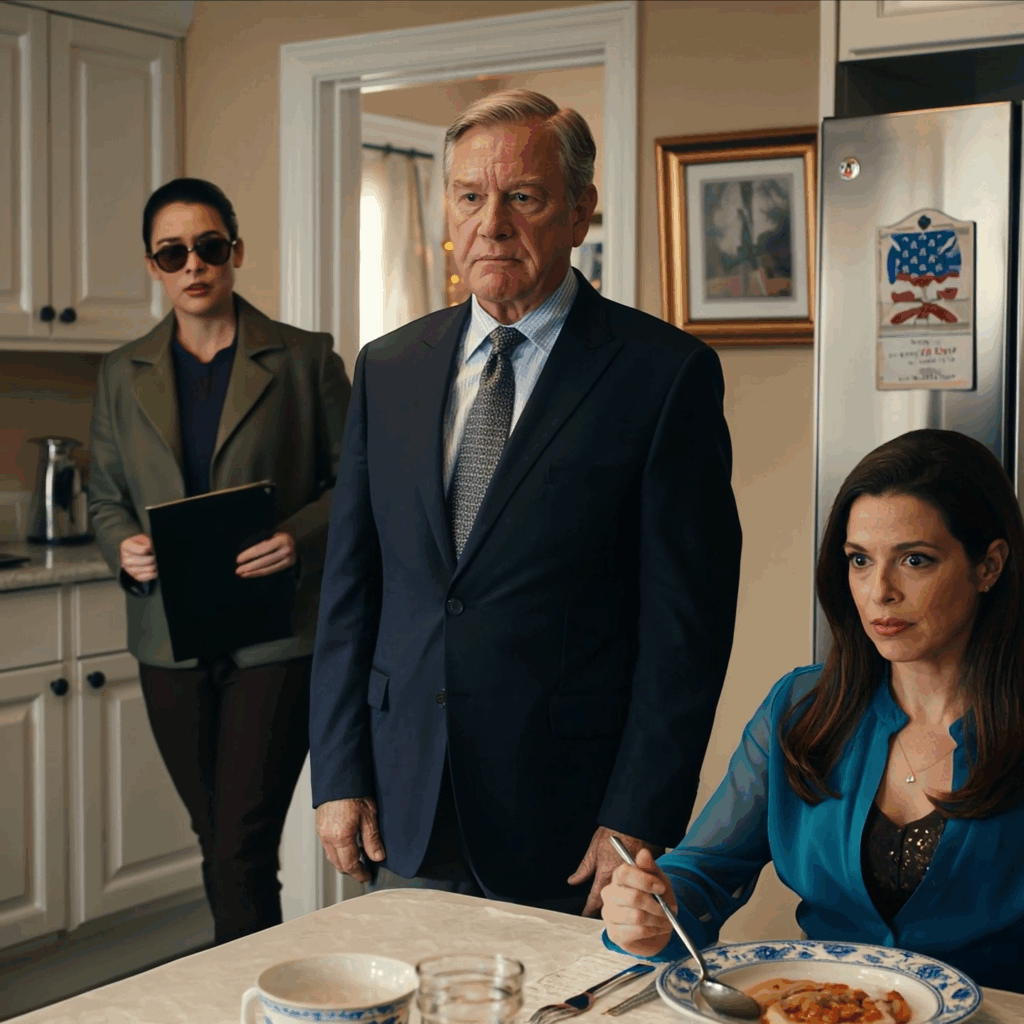
Grandpa Hail sat at the head of the table like he always had, a weathered hand resting on his cane, the other cupping a glass he never actually drank. Even in his eighties, he had the kind of posture that made you sit straighter. His eyes were that improbable glacial blue you only see in old fishing photos and high mountain lakes—a color that could warm when he told a story and frost over when someone lied.
The conversation was thin, as if everyone were saving oxygen for something unseen. My mother passed the potatoes and an opinion about how adulthood should work. My father cleared his throat in that way he does when he wants credit for keeping the peace. My aunt and uncle traded glances like they were playing tennis with a secret. My older brother, Daniel, smirked at his phone, then at his plate, then at me, as if any of those things were worth more of his attention than the people who raised him.
When the plates were mostly empty and the candle wax sagged into the frosting like a tired flag, Grandpa set his glass down. The sound was light—just a polite tap—but the room felt it. His chin lifted an inch, and the hum of the overhead light suddenly seemed loud enough to hear.
“Did the account transfer go through?” he asked.
It was the tone more than the words—curious but precise, like he’d called a number he knew by heart and was waiting for the ring. I froze mid-breath, a fork suspended above my plate, a piece of carrot clinging to the tine like it was trying not to fall.
“What transfer?” I said. I could hear my own voice, steady enough to carry to every corner of the room, steady enough to betray the panic rushing through me like I’d swallowed a live wire.
The air changed. My mother’s wine glass slipped in her hand and made a bright, traitor’s chime against the plate. My father cleared his throat and looked anywhere but at me. My aunt’s mouth tightened. My uncle’s eyes did that downward flick people reserve for bad news. And Daniel—my brother, my first bully, my longest lesson in swallowing hurt—sat a little straighter, as if a string had been pulled between his shoulder blades and the ceiling.
Grandpa’s knuckles whitened on his cane. Then his other hand came down flat on the table. The plates rattled, the candle flame shuddered, and something frighteningly old and stern entered the room with him.
“Don’t play dumb with me,” he snapped, the kindness in his voice burning off like fog. “I wired a large sum. Enough to cover your future, to make sure you were safe and never dependent on anyone. Where is it? Who took it?”
My heart slammed against my ribs. “Grandpa, I…I don’t know what you’re talking about,” I stammered. Humiliation burned hot across my face. “I never received anything.”
For one breath, silence swallowed the room. Then came the whispers.
“She’s lying,” my aunt hissed, her words knife-thin.
“Or she already spent it,” my uncle muttered, his lip curling like the thought entertained him.
Daniel leaned back slowly, folding his arms as though settling into a show he’d seen before and liked. The corner of his mouth twitched, the kind of almost-smile he wore when something unfair was about to benefit him. I looked at him and saw it—the satisfaction, the petty triumph. A realization slid through me, cold as an open freezer. My chest tightened with a betrayal I didn’t want to name.
“You knew?” I breathed, half a question, half a warning to myself.
Grandpa’s head snapped toward Daniel like a hawk locking on a rabbit. “Did you touch that account?” he demanded, his voice booming enough to make the candle flame stutter again.
Daniel laughed once, short and unconvincing. “Why would I? I’ve got my own savings.” His fingers drummed on the table. The rhythm was all wrong—too fast, too loud—and the tight muscle in his jaw jumped each time like it was answering a question nobody had asked out loud.
I straightened in my chair. “I swear,” I said, my voice cutting cleanly through the noise. “I never received anything. If Grandpa sent money, someone else intercepted it. And I think I know who.”
The room erupted into heat and noise—accusations, defenses, voices climbing over each other like wild animals fighting for the same scrap of meat. Grandpa rose slowly, his hand heavy on the cane, his voice colder than I had ever heard it.
“Tomorrow morning,” he said, each word an iron bar. “We will find out exactly where that money went. And God help the one who dared to take it.”
I didn’t sleep that night. The dark felt too loud. Every time I closed my eyes I saw Daniel’s almost-smile, my mother’s trembling glass, my grandfather’s blue stare cutting the room into before and after.
The texts began before dawn like a storm arriving while you’re still zipping your coat. My mother: Pick up the phone. My aunt: You’re embarrassing us. A cousin who loves a front-row seat to disaster: What did you do? Even Daniel tried: three missed calls in a row, then a fourth, then a fifth, each one piling up on my lock screen like a dare. I turned the phone face-down and let it vibrate the table.
Grandpa had said nine o’clock sharp at the estate. And when Grandpa gave an order, it wasn’t a suggestion.
I left early. The tires of my old Toyota crunched over gravel as white as bone. The Hail estate rose out of the morning like a memory in a fogged-up mirror—white pillars, long shadows, glass that reflected the sky with enough confidence to make you think it had invented blue. Through the high windows I could see silhouettes already pacing, arguing, arranging excuses like place cards.
Inside, the living room had been arranged into something that looked suspiciously like a courtroom. No dais, no seal, no judge in black, but the furniture understood its assignment. Grandpa sat at the head of a leather couch as if it were a bench. His cane was posted at his knee like a sentry. Beside him stood a man I’d met three times, each on a day that felt like a storm warning: Mr. Otto Wittmann, the family attorney, with silver hair that always seemed recently combed and glasses that turned his gaze into a cutting instrument. He held a thick folder the color of a bruise.
“You’re late,” my mother said the instant I crossed the threshold, her voice dipped in judgment.
“I’m on time,” I answered, lifting my chin and leaving my coat on. The room was warm but felt colder than my car had been.
Grandpa’s eyes cut to me. For a second, something softened there—something that looked like relief—but it hardened again when he looked past me at the cluster of family filling the room. He nodded once at Mr. Wittmann.
“Show them,” Grandpa said, the words gravelly, the order unmistakable.
The lawyer cleared his throat, slid papers from the folder, and placed a stack on the coffee table. The smack of paper against wood was small and final, like a door clicking shut.
“On March 12,” he began, adjusting his glasses with two fingers, “Mr. Hail authorized a wire transfer of two hundred and fifty thousand dollars to an account under the name of his granddaughter, Emily.”
A gasp rippled around the room, followed by a murmur that felt like insects crawling over skin. My hands went cold. I had not dreamed this.
“This account,” Wittmann continued, voice even as a metronome, “was not created by Miss Hail. It was set up fraudulently. The funds were transferred to a secondary account within hours. That secondary account belongs to”—he paused, his eyes a level blue behind those sharpened lenses—“Daniel Hail.”
The room detonated. Chairs scraped, someone swore, someone else said no over and over like the word could undo time. I looked at Daniel. He shot to his feet, pale beneath his tan, his arrogance struggling to keep its footing.
“That’s ridiculous.” He tried to smile and failed. “I don’t know what kind of trick this is, but I didn’t steal anything.”
Wittmann slid a page across the table and tapped a line with his pen. “Your signature, Mr. Hail, as clear as any on file. We traced the routing. We traced the card. We traced the withdrawals. The account is yours.”
Grandpa’s cane cracked against the floor. The sound went up through the walls like thunder.
“You lying, thieving boy,” he roared, and if rage has a temperature, the room dropped ten degrees. “I entrusted you with our name, with our honor, and you robbed your own sister.”
Daniel’s mask cracked. His jaw clenched. His eyes began to dart, quick and sharp, the way an animal looks for exits. “She doesn’t deserve it,” he shouted suddenly, pointing at me with a hand that shook. “Everything goes to her. Everything. You’ve spoiled her, Grandpa. What about me? I work just as hard. I’m just as worthy.”
My stomach turned. The rage that flooded me had edges I didn’t know how to hold. “You stole my future,” I said, my voice breaking once and then finding its balance. “You didn’t just take money. You took my chance to breathe without debt, to have a life that didn’t start with a ledger full of zeroes I couldn’t change. You betrayed me.”
“Stop it,” my mother said sharply, as if volume could make morality kneel. Her cheeks were high with color. “Daniel is your brother, Emily. You can’t tear this family apart over wires and numbers. He was desperate. He made a mistake.”
I turned to her. “He had a choice. And he chose to stab me in the back.”
The room held its breath. Grandpa stood, every inch of him a verdict. “No,” he said, his voice going cold enough to frost glass. “It wasn’t just betrayal. It was theft. It was fraud. And I won’t cover for him.” He didn’t look away from Daniel. “File the charges,” he told Wittmann.
The room stopped moving. My mother made a sound like someone had cut the oxygen. Daniel swayed, then caught himself. “You’d send me to jail,” he said, his voice cracking on the second word. “Your own grandson.”
“I would send anyone to jail who betrays his own blood,” Grandpa said, and I believed him so completely that the floor felt steadier under my shoes.
My father finally spoke, his voice low, as if shame had its own weight. “Dad, please don’t do this. It’ll destroy us.”
Grandpa’s hand trembled once on the cane and then stilled. “You destroyed yourselves,” he said, “the minute you let greed rot your hearts.”
Daniel lurched forward, the plea snapping out of him almost involuntarily. “Grandpa, please. I just—I thought I deserved it more than she did. She’s weak. She doesn’t know how to handle money.” His gaze slashed toward me, all venom again. “She would have wasted it.”
There are words that hit like sticks and words that sink like stones. Those sank. But floating above the hurt was a clarity I had not known I possessed. “You don’t get to decide what I deserve,” I said, calm now, as if the center of me had stopped shaking. “You took what wasn’t yours. And you proved to me that family can be the sharpest blade.”
Silence took the room again, heavier this time. Grandpa exhaled, and when he looked at me, something changed in his eyes.
“From this moment,” he said, voice steady, “you are the only one in this family I trust.”
It was a gavel strike. My aunt gasped; my uncle’s mouth did an odd opening-and-closing thing; a cousin made a sound that was half shock, half gossip inhalation. My hands shook. My breath came uneven. But for the first time in years, I felt seen.
The meeting staggered to its end. People dispersed with the kind of stiff limbs you get after a car ride that was too long and too quiet. I stepped out onto the porch because the air inside had begun to feel like it belonged to someone else.
Morning had burned into late morning. The light had sharpened. The gravel looked whiter. The lawn looked like it had been combed by a giant hand. I sat on the top step and tried to figure out how to breathe with the truth sitting on my chest.
It didn’t take long for the phone to begin again—buzzes that felt like bee stings. You made a scene. You don’t know what you’re doing. He’s family. Apologize to your mother. I silenced the phone and left it facedown beside me like a rock paperweight on a thin page.
That night I didn’t cook. I didn’t talk. I didn’t turn on the TV for noise. I brushed my teeth with the bathroom fan roaring and still heard my grandfather say File the charges. I got into bed and stared at the ceiling and negotiated with the dark: an hour of sleep for a minute of quiet, a minute of quiet for a second when I did not see Daniel’s shaking hand.
Two nights later, the trouble I was waiting for found my driveway.
Headlights slid across the blinds like searchlights. Tires stopped hard against the curb. The engine cut out too fast. I stood in the hall with my phone in my hand and the numbers 9-1 dialed in case the last one needed pressing. When the banging started—meaty, impatient blows on a hollow-core door that suddenly felt unfit for purpose—I nearly pressed it.
“Open up, Emily,” Daniel shouted. The whole neighborhood could have heard. “You think you’re better than me?”
Fear does a strange thing when it’s been simmering for years. It doesn’t boil; it condenses. I put the chain on, cracked the door two inches, and let the porch light do what it could to scrape the darkness off my brother’s face.
“Go home, Daniel,” I said, my voice steady enough that it surprised me.
“Home?” He laughed, a bitter bark. He shoved at the door and the chain caught with a sharp, metallic warning. “I don’t have a home anymore. Thanks to you. You ruined everything.”
“No,” I said, pulse thudding in my throat. “You did that to yourself.”
For one thin instant, a flicker—memory of a boy ten and taller than me, a boy who once stood in front of another boy on a playground and told him to pick on someone his own size. I looked and looked for that boy and could not find him in the man on my porch.
“Grandpa won’t live forever,” he spat suddenly, eyes narrowing like he’d just remembered a weapon he’d left in his back pocket. “When he’s gone, everything will fall back to me. You’ll see. You’re nothing without his protection.”
I unlatched the chain and stepped into the doorway. His eyes widened half a fraction as I did it. I kept my phone visible in my right hand and the last 1 on the keypad.
“You’re wrong,” I said. “I don’t need protection. I already survived you. That’s more powerful than any inheritance.”
For once he had no reply. His jaw tightened. His eyes went hard and flat. He turned, walked down my steps, slammed his car door, and tore away so fast the tires screamed at the asphalt. I stood in the doorway until the red taillights disappeared and the night remembered how to be quiet.
The next morning, my doorbell rang once—one of those quick, efficient rings people use when they know they’re expected anywhere they go. I opened the door to my grandfather.
He didn’t speak at first. He walked past me with the slow care of someone who has learned to pace himself and set a plain envelope on my kitchen table. His hand stayed on it a second too long, as if he were transferring more than paper.
Inside were copies of deeds, account authorizations, paperwork with lines for signatures and initials and dates. Names had been moved. Titles retitled. Things that had never been mine now were.
“Emily,” he said, resting his hand on mine where it lay on the table, “I don’t know how much longer I have, but I refuse to leave this legacy in the hands of liars. From this day forward, you are the heir. Not because of blood. Not because of favoritism. Because you earned it. Because you told the truth when it mattered.”
Tears blurred the black print until it looked like a small storm on paper. “Grandpa, I don’t want this to be about revenge.”
“Then don’t make it about revenge,” he said, his voice gentler than it had been in months. “Make it about change. Do better than we did. Set a new table.”
The words sank into a place inside me I had only recently discovered—somewhere between backbone and breath. Outside, a delivery truck rattled past. Somewhere, a dog barked. Life did what it always does, and still the kitchen felt strange, as if the air had been pressed through a filter and come out changed.
By afternoon, the backlash had found its way to my phone with full force. You’re manipulating him, from an aunt who’d never returned a call in under a week. He’s being cruel, from my mother, who had not asked me if I was okay in years. This is a disgrace, from my father, who preferred dignity to honesty when the two were not on speaking terms. I read the messages. I put the phone down. I let the room be silent.
I wish I could tell you that felt like victory. It didn’t. It felt like standing after a wave that should have knocked you down. It felt like the ache you get when you start using a muscle you didn’t know you had.
On my birthday, my life had been ripped open. Secrets slid across the table like shards of glass. But in the mess, I found something no one had ever given me—and no one could take.
Strength.
That night I locked my door and stood for a long time looking out at the quiet street. The porch light painted the steps a milky yellow. A moth shouldered the glass. Somewhere, a neighbor’s TV laughed at a joke I couldn’t hear.
“I am not your victim,” I whispered to the dark, to the house, to myself. “I am my own.”
The house held the words like a secret and did not give them back.
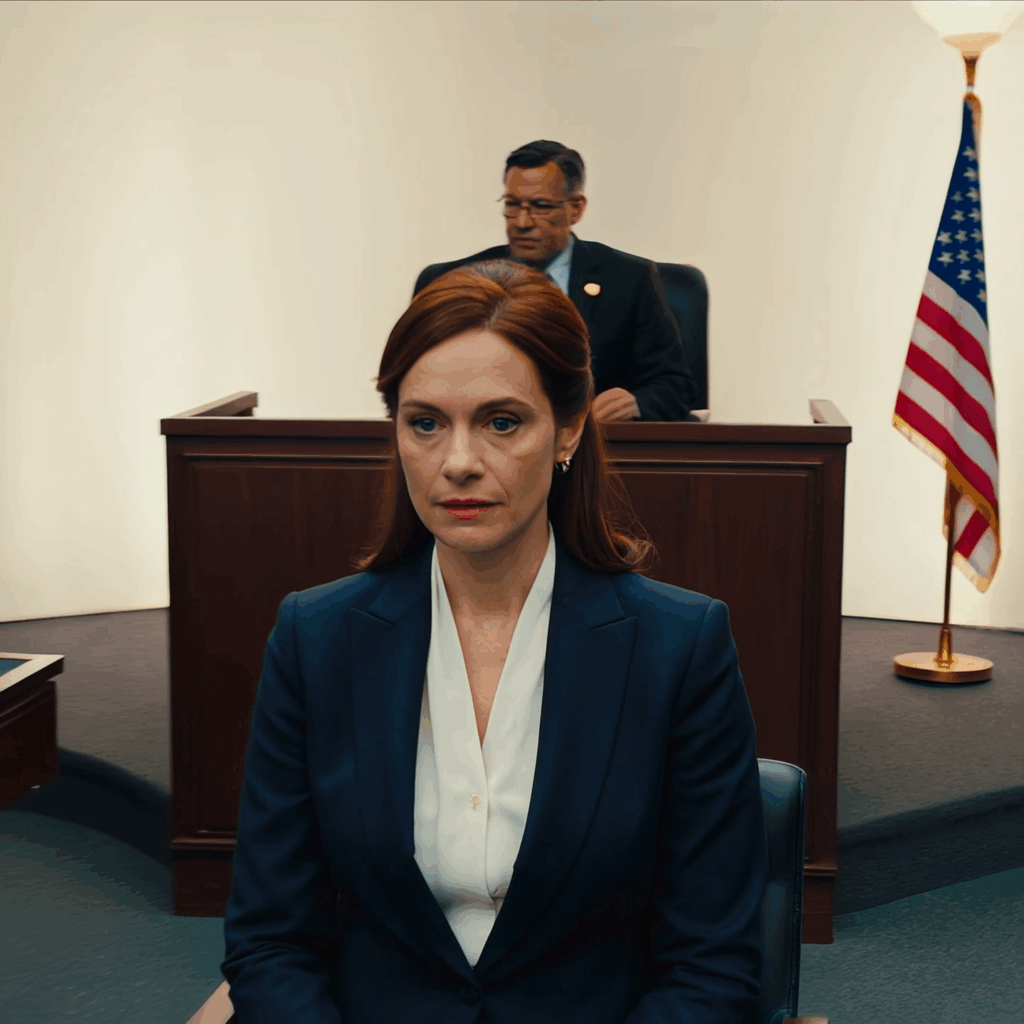
The days that followed had a rhythm but no map. There were practical things—calls with banks; appointments that had to be moved because my hands shook too hard to sign a straight line; a meeting with Mr. Wittmann where he explained, in the careful calm of a person who has seen many families pretend their way into ruin, what would happen next. Paper trails, police reports, prosecutors who would ask careful questions and require exact answers. A judge at some point, a courtroom eventually, the possibility of a plea if Daniel’s counsel counted correctly and advised him to stop playing with the fire he had lit.
“We’ll handle the criminal side,” Wittmann said, sliding a checklist across his desk. “Your job is to keep living your life. Don’t engage with him. If he shows up, call 911. Document everything. And Emily?” He waited until I met his eyes. “Don’t apologize for surviving the truth.”
I nodded until it felt like agreement rather than motion. Outside his window, the late-afternoon light made every parked car look briefly expensive. On the drive home, I didn’t turn on the radio. I listened to the car, to the click of the turn signal, to the way my breath measured itself and then measured again.
Family has a way of convincing you that the edges of what you’re allowed to want are much closer than they actually are. I had internalized those edges so well that even at thirty, I still sometimes asked permission before deciding what to eat. Sitting at a stoplight, I realized something simple and enormous: the distance between what I wanted and what I would allow myself had shortened by a mile in a single week.
News traveled the way news always travels in families—via the relative with the lowest threshold for boredom. A cousin texted a screenshot from a group chat I had not been invited to join. He says you set him up. He says Grandpa has lost it. He says you’re after everything. The screenshot bloomed with little bubbles of agreement, each one a small betrayal, each one predictable enough to be boring.
I put my phone face-down again and watched the light change on my living room wall.
There are stories we tell about money in America because we need to believe them to keep going: that merit rises, that work and worth are twins, that families are sturdy ships. What happened in my grandfather’s living room ripped those stories down to the studs. I could see the wiring beneath them, the way it had been patched and spliced poorly, the places where someone had wrapped the wrong tape around the wrong line and called it secure.
In the first quiet weekend after the estate meeting, I drove to the grocery store and bought the basics—eggs, milk, coffee, a loaf of bread I would toast every morning because rituals are scaffolding when your house has been shaken. At the register, the total blinked up at me and for once it did not feel like a math problem with claws. I tapped my card and nearly cried, not because of the number, but because of the absence of a familiar dread.
At home, I cleaned the fridge the way you do when something is over and you need things to be bright again. I pulled everything off the shelves, wiped them until my arm ached, tossed the expired, kept the still-good, lined up the jars with their labels facing forward like soldiers. When I finished, I stood with the door open and let the cold air hit my face until I could name what I was feeling.
Relief, yes. Grief, too. It’s possible to grieve a version of your family that never existed in the first place. It’s possible to be relieved that a lie has broken while also mourning that you ever needed it.
I didn’t hear from Daniel again that week. I heard about him. That he had moved out of his apartment because the lease had his name alone on it and leases are less forgiving than people. That he’d tried to return a watch for cash at a boutique that remembered him as a big spender last month and an unremarkable liar today. That our mother had taken to calling him by his childhood nickname like it could rewind him.
When she finally called me, her voice was thick with a righteous sadness reserved for people who believe they’re losing something they had already lost. “He’s your brother,” she said. “Blood matters.”
“So does truth,” I said. “So does accountability.”
“You’ve turned your grandfather against his own family,” she said. “He isn’t thinking straight.”
“Mom,” I said, and when I said it, I heard the smallness I was trying to outgrow. “Grandpa is the only one who is thinking straight.”
She didn’t reply. The line went quiet in the way people go quiet when they’ve reached the edge of their story and can’t, or won’t, write the next page. We hung up. I stared at the phone and didn’t cry.
I wish I could say there was a single moment when everything changed, a clean cut in the film that spliced Before to After. There wasn’t. There was only a thousand small, ordinary moments that added up to a new life: taking out the trash; paying a bill without flinching; walking past a mirror and seeing someone who had stopped apologizing for taking up space.
On a Sunday, I drove to my grandfather’s house with a bag of groceries he didn’t need because I needed to do something besides think. He was sitting in his den reading a newspaper like it was still the most reliable way to know what mattered. He looked up and smiled in a way that made me want to sit on the floor like I did when I was five and listen to him tell stories about the old factory, the fishing trips, the time a tornado peeled the roof off a warehouse and he had to lead a crew up there to tarp it in the rain.
“You look taller,” he said, eyeing me the way he eyes a tree he planted years ago that has suddenly grown.
“I’m not,” I said, but part of me knew I was, in the only way that counts.
We didn’t talk about the case. He didn’t ask me if I’d heard from my mother. He didn’t bring up Daniel’s name like it was a stain. We talked about coffee and whether the new roast tasted burnt, about the Cardinals and whether they had any pitching left in them, about a neighbor’s new dog that barked in a way that suggested deep personal problems. When I left, he slipped a folded note into my hand in a way that would have been corny from anyone else. Proud of you, it said in the lean, all-capitals handwriting that had signed checks and contracts and birthday cards for seventy years. Keep going.
I put the note on my fridge door with a magnet shaped like a peach from a roadside stand we’d stopped at once on a long drive home from a wedding where we’d both felt like ghosts. Every morning after that, while the coffee brewed, I read it and felt my shoulders drop a fraction of an inch.
A week later, an officer called to tell me charges had been filed. The words were dry—case number, statute, hearing date—but they carried a weight I felt in my knees. I thanked him. I sat down on the floor of my living room and pressed my palm flat against the carpet because sometimes you have to touch something solid to keep from floating off.
I don’t know how our story will end. I know only the shape of the next few chapters: lawyers and court dates, witnesses and statements, a brother who will have to decide whether the truth is a place he can stand or a wave he will try to outrun until he can’t. I know my mother will find new ways to explain why a cut feels like a hug if you think about it long enough. I know my father will put his head in his hands and whisper to the floor and hope someone else will clean it up.
But I also know this: when the gavel falls in whatever courtroom we end up in, it won’t be the first time I’ve heard the sound. I heard it already when my grandfather said file the charges. I heard it when I told my brother I had survived him. I hear it now, quietly, each time I choose the next right thing in a long string of right things that will lead me out of a house built on secrets into a place where the floor holds.
On my birthday, my grandfather asked a question that split the room. Did the account transfer go through? He could have asked it gently. He could have saved it for another day. He didn’t. He pounded the table and forced the lie into daylight where it could not keep living.
I looked up at him then and felt shock and shame and a fear that I would never stop feeling small. Today, when I look up, I see the man who taught me to measure myself against the truth instead of the people who need me to be quiet. Today, I run my finger over the ink of my name on documents that say I am trusted. Today, I answer my phone when it’s a number I recognize and let the rest go to voicemail. Today, I sleep.
What transfer? The one that was meant for me. The one that never reached my account because someone else believed he deserved my breath more than I did.
Then who took it? He did. He took it, and he will answer for it. And I—finally—will not.
I didn’t know you could feel both anchored and untethered at once—like someone had finally pressed your feet to the ground while the rest of you leaned out over a ledge and looked down. That’s how the week after my birthday felt. I moved through the apartment as if it were a new place wearing my old furniture. The couch had the same sag, the kitchen the same stubborn drawer that stuck halfway and then gave with a little twist, the hallway the same squeak in the floorboard that announced me to no one. And still, when I set a mug on the counter, when I turned the deadbolt, when I folded a towel, everything sounded different, as if the air itself had been edited.
I kept thinking about the weight of a hand. In the living room at the estate, Grandpa’s hand on the cane. At my kitchen table, his hand on the envelope. The way his fingers had trembled for a second before going still, as if force had to pass through fragility first and become itself on the way. There was a tenderness in that—something like love’s own physics—that I hadn’t noticed when I was busy flinching.
Sleep came in thin sheets. I would doze and surface, doze and surface, like a swimmer practicing not to drown. Each time I woke, the same thought arrived already formed: two hundred and fifty thousand dollars, March 12, 2025. The number had a taste. The date had a temperature. I would see the print on Wittmann’s papers and then I would see Daniel’s face, pale where his tan failed him, the little shock that moved across his features when denial broke its ankle on the curb of evidence.
On the second morning, I made coffee too strong on purpose. I wanted something to brace against. I stood at the sink with my hands around the mug and watched the wash of early light move across the counter. It made a strip of brightness that climbed from the toaster to the backsplash tile by tile, as if the day were climbing a ladder to reach me. When my phone buzzed, I let it. Three pulses, a pause, three pulses—the cadence that had announced bad news since high school.
I set the mug down and picked up the phone. We need to talk, from my mother. Dad says you’re being dramatic. Daniel is struggling. You’re going to make this worse. And then, from Daniel, the first words from his number since the pounding on my door: Answer. One conversation and this ends.
I typed and erased three different replies. There is a particular kind of anger that looks exactly like restraint from the outside. I chose it. All communication goes through the attorney now, I wrote. I added the line Mr. Wittmann had given me almost like a script: Do not contact me again. I hit send and stared at the little gray “delivered” like it was a finish line.
I expected a torrent. I got nothing. A silence long enough to prove itself. When it finally broke, it came from an unexpected quarter—a cousin who had perfected the art of pretending neutrality in rooms where neutrality is a luxury. Just checking on you, the text said. That was intense. It wasn’t nothing. I sent back a small truth: I’m okay enough.
At noon, the phone rang from a number I recognized. Mr. Wittmann’s assistant—efficient voice, clipped syllables, the cadence of someone whose calm had been ironed and hung up properly—asked if I was available for a call. A beat later, Wittmann himself: “Good afternoon, Emily.”
“Hi.” My voice did that thing voices do when they are surprised they still work.
“I won’t take much of your time,” he said. “The bank has confirmed the internal timeline on their end. We’ll be forwarding the packet to the detective assigned, and the DA’s office will review. Meanwhile, a couple of reminders. Document any contact from your brother or anyone acting on his behalf. Screenshot, save, do not respond—that sort of thing. If he comes to your residence again or you feel threatened, call 911. We can discuss a restraining order if needed.”
It should have been terrifying to hear it put so plainly. Instead it felt like furniture being moved into place. I could see where the couch went, where the lamp would make sense, where not to bump my knee anymore.
“Okay,” I said. “I can do that.”
“One more thing,” he added, and his voice gentled in a way that made me picture him taking off the glasses he always wore at the estate. “Guilt is going to try to rent a room. Don’t give it a key. You didn’t cause this. You told the truth.”
After we hung up, I sat on the kitchen floor with my back against the cabinet and let the cool reach through my shirt. I tried out the words he’d said, one by one, like shapes you hold to the light. You told the truth. If there is a simpler compliment in the world, I don’t know it. If there is a harder one to accept from yourself, I haven’t learned how to yet.
That afternoon, I did something so ordinary it felt radical: I organized a drawer. The junk one, the one with birthday candles in a Ziploc, rubber bands that had lost their elasticity, the screwdriver with the bit I always meant to replace, a paperclip chain that began life as boredom and became a snake. I emptied it onto the counter and made four piles: keep, trash, maybe, and what even is this. I threw away the dead batteries and found the key to a lock I no longer had and put the candles in a place where I could reach them when I needed light.
There’s a particular peace that comes from lining up small things when the big things refuse to be lined. I stood back and looked at the drawer and felt a ridiculous surge of competence. I texted my grandfather to ask if he needed anything from the store. No, he wrote back. But come over if you like. Coffee at three.
I left early so I could drive the long way through the older part of town where the oaks meet over the street like old friends, where porches still have chairs on them, where you can tell which houses have children by the chalk half-washed from the sidewalk. The estate, when it rose up out of its hedges, looked both exactly as imposing as it had and slightly less so, as if last week’s storm had knocked an inch off its height and nobody had bothered measuring.
Grandpa was in the den with the window cracked an inch, a habit he had even in winter because he liked the way real air felt. He had a newspaper folded to the crossword, a pen uncapped and waiting. I kissed his cheek and poured coffee and took the chair near him that had become mine by simple repetition.
“How’s your head?” he asked, which was his way of inquiring after my heart.
“Loud,” I said, smiling. “But clearer.”
He nodded at that. “Clarity makes a racket at first. Like a truth moving furniture.”
I laughed softly. “I cleaned a drawer today. The junk one.”
“A victory,” he said, and we both let the word sit between us and do what it knows how to do.
We didn’t talk about Daniel. Not directly. We talked about coffee and whether anyone knows how to roast it anymore so that it tastes like something other than a dare. We talked about the Cardinals again and whether their bullpen would ever learn the difference between a fastball and an apology. He told me a story I’d heard twice before about a day in the old factory when a forklift broke and the only thing to do was to remember that people are stronger than machines when they’re allowed to be.
When I left, he stopped me at the door, his hand light on my forearm. “Emily,” he said, and I looked up. “Don’t let them turn this into a question about whether you deserve to breathe.”
“I won’t,” I said. “Not anymore.”
On the drive home, I let the radio find me a station that played songs from ten years ago and sang along to choruses I hadn’t thought I remembered. Memory is funny that way: it hoards the map to a place, then lets you stumble on it as if it were new. At a red light, I caught my reflection in the dark window of a closed hardware store—the line of my jaw, the set of my mouth—and I recognized myself with a jolt that made me laugh.
My mother called again that night. I didn’t pick up. She left a message in the voice she used at the end of arguments when she wanted me to choose peace over integrity and pretend I didn’t know the difference. “This is a family matter,” she said. “We don’t need police involved. Your grandfather is being vindictive, and you’re encouraging him. Think about what this will do to your brother.”
I listened twice, not because I needed to hear it again but because the second time, the words sounded like a script she had been handed. The line about family. The line about police. The warning about consequences for someone who had already chosen his own. I saved the voicemail and slid the phone into the drawer I had organized and closed it gently as if that made any difference to silence.
The next day, I took stock of my paperwork. W-2s and W-9s, leases and insurance policies, bank statements in their thin envelopes with windows like one-way glass, copies of my lease, copies of the advance directive Grandpa had made me fill out two years ago because he believed in order the way some people believe in seasons. I made a binder. I tabbed it. I labeled the tabs like a person in a commercial for a product I don’t own but might want now. There’s a power in seeing the shape of your own life on paper instead of as a blur of obligations you keep tripping over.
A neighbor waved as I carried a bag of trash out and I waved back and tried to place his name and couldn’t. The ordinariness of that exchange felt like proof of something I had always known but forgotten: the world does not organize itself around your private catastrophes. It keeps on, stubbornly, mercifully.
By evening, a rhythm had found me. Cook an egg. Wash a plate. Answer one text I wanted to and none that I didn’t. Read three pages of a book without rereading the same sentence twice. Fall asleep with the window cracked just enough to let in the smell of pine mulch from the landscaping crew that had been two buildings over that afternoon.
On Thursday, the detective called. A spare voice, no-nonsense without being unkind. He asked three questions he already knew the answers to from the file and one I hadn’t expected: “How are you doing?”
“I’m okay,” I said, and then, because the question deserved the truth, “I’m a little scared.”
“That makes sense,” he said. “Fear is not a bad instrument as long as you don’t hand it the wheel.” He outlined next steps in phrases that made the bureaucracy sound like a river you could understand if you watched it long enough. Review, referral, charging decision. He told me not to worry about the hearing dates yet. “We’ll let you know. You won’t be surprised.”
After we hung up, I stood very still in the middle of the living room and let the quiet touch me. I thought about the word surprised. How much of my life had been a series of small ambushes? You learn to walk soft in houses where moods are maps and you don’t get a copy. You learn to quiet yourself before you even speak. You learn to anticipate someone else’s hunger before you remember your own.
The truth is an interruption. It kicks the door. It turns on the light. It says we’re not doing that anymore.
That evening, I wrote a letter I didn’t intend to send. “Dear Daniel,” I began, and then crossed out Dear because the word stuck in my throat. “Daniel.” I wrote for ten minutes without stopping, the way a physical therapist might ask you to move a muscle past comfort and into capacity. I wrote about the boy he had been, about the way he had learned to make attention from trouble and mistake it for love. I wrote about my own complicity in letting him define the size of my life by his need. I wrote about a fork suspended over a plate and a sentence that sounded like a gavel and the way a candle flame can flinch. I wrote until my hand cramped and then I kept going. When I finished, I put the pages in a folder and labeled it with the date. A private archive. Proof for myself that I had said what needed saying even if no one ever read it.
Friday brought a small mercy: a morning with no calls. I drove to the grocery store early and walked the aisles as if they were corridors in a museum. Apples lined up like a color wheel, cereal boxes in their bright rectangles, the cold blue light of the dairy case. I put coffee in the cart, the brand Grandpa liked, and butter and eggs and a loaf of sourdough that made the paper bag smell like a bakery from five blocks away. At the checkout, the cashier asked if I wanted the receipt and I said yes and tucked it into my wallet with a care that would have made no sense a month ago.
At home, I made toast and scrambled an egg and sat at the table with the plate and the coffee and the morning sun and felt—for a brief, ordinary minute—like a person with a manageable life. I ate slowly. I read the local paper online and clicked away from stories that would have made me spiral. I texted my grandfather a photo of the coffee bag with the note: For the bullpen’s sake. He responded with three words: We’ll need it.
In the afternoon, my mother came to my door unannounced. She had never learned to love a boundary. I saw her through the peephole—lipstick too bright for daytime, hair set as if for a banquet, a posture that said she believed in the concierge service of motherhood even when the child is an adult.
I took a breath. I counted to five, not because I was afraid but because fear and anger wear the same shoes and I didn’t want either tracking through my house.
When I opened the door, I kept the chain on. “Hi, Mom.”
She fumbled for something like a smile and landed on a pout. “Are you really going to do this?”
“Do what?” I asked.
“Treat me like a stranger.” She gestured at the chain as if the small length of metal were a fence around a field she once owned.
“I’m treating you like a person I love who doesn’t currently respect my safety,” I said. “If you’d like to talk, we can. The chain stays.”
Her shoulders lifted and fell, a sigh with choreography. “Your grandfather is out of control. He’s punishing your brother. You’re letting him.”
“I’m letting the truth stand,” I said. “That’s all.”
“He made a mistake,” she said, and there it was again—that word that wanted to shrink felony into faux pas, theft into error, the severing of trust into an oops.
“He committed a crime,” I said quietly. “Several.”
She winced as if the word itself had teeth. “You’ve always been so dramatic, Emily. Always taking things personally.”
“It is personal,” I said, and my voice softened because the truth often asks you to lower it, not raise it. “He stole something meant for me. He lied to my face. You asked me to lie with you. I’m done.”
She looked past me into the apartment as if she could rearrange it with her eyes. “You don’t understand how hard it’s been for him.”
“I do,” I said. “And I am no longer volunteering to be the stopgap for his choices.”
She pressed her lips together and then let them go. “Your father thinks—”
“I know what Dad thinks.”
A flash of anger lit her gaze then, sharpened by a fear I recognized from the mirror on bad years. “You think you’ve won,” she said. “You think being the favorite will save you.”
I shook my head. “I think telling the truth saved me. That’s different.”
We stood in that standoff for three long beats that felt like the last scene of a play where everyone has already said their lines and the lights haven’t dimmed yet. Then she straightened. “When this family breaks,” she said, “I hope you’re happy.”
“I’ll be honest,” I said. “Happiness is not what I’m aiming for. Integrity is. Safety is.”
She flinched at the word safety, as if I had accused her of something she didn’t have a name for. “Goodbye, Emily,” she said, and the way she said my name made me think of teachers taking attendance and never looking up.
“Goodbye, Mom.”
I closed the door. I slid the chain out of its track and set my forehead against the wood for a second and breathed. The apartment smelled like toast and coffee and the faint lemon of the cleaner I had used on the counter. Ordinary. Kind. The air of a place that had survived a weather event and was making itself habitable again.
I texted Grandpa—not a blow-by-blow, just a line: She came by. I’m okay. He sent back a thumbs-up emoji that landed like a hand squeeze. A minute later, a second text: Proud.
There are words that ricochet in your chest and bruise from the inside. There are others that fit like a key and turn something you didn’t know was locked. Proud did both. I let myself feel it. I let myself miss the version of my mother who might have chosen me over denial. Then I opened the window an inch and let the air come in and do what air does.
Saturday, I drove nowhere in particular and ended up in the parking lot of the ballpark, empty now, the flags stirred by a lazy wind, the faint smell of old popcorn a ghost under the sun. I sat in the car and thought about scarcity. How we’d been taught it at home as if it were arithmetic: if one person gets, the other loses. As if love is a pie and not a river. Daniel had believed that story so hard he’d become it. Maybe we all had, in our own ways.
I wrote in my notebook until my hand cramped again. Not a letter this time. A list titled What I Believe When I’m Not Afraid. I wrote: Truth is not a weapon in the right hands. Boundaries are an expression of love. Money is a tool, not a mirror. Family is a verb. I didn’t know if any of it would hold on a worse day, but it felt like building a small bridge back to myself in case I needed to cross quickly.
On Sunday, the detective called again to say the packet had moved to the DA’s office. He said the word felony without drama. I said thank you the way you say amen when someone else has prayed a prayer you needed and didn’t know how to form.
That evening, I went to Grandpa’s for dinner. He had insisted on simple: grilled chicken, a salad, a loaf of bread with a crust that could cut your gums if you weren’t careful. We ate at the kitchen table instead of the formal dining room because the kitchen table is where you put your elbows down and tell the truth without an audience. He asked me to pass the salt and I did and he shook it once and said, “Do you know what I’m most ashamed of?”
I set the salt down. “What?”
“That I saw it in him,” he said. “Years ago. The hunger. The entitlement. I thought I could teach it out of him. I thought I could pay it quiet.”
“You tried,” I said.
He nodded. “I paid the wrong debt.”
We were quiet then, the kind of quiet that respects pain without feeding it. After dinner, he poured coffee and we stood by the sink and looked out the window at the dark yard, at the reflection of our faces in the glass. “You know,” he said, “there’s something I never told you about March 12.”
I turned toward him but he didn’t look back; he was watching our reflection.
“I almost didn’t do it,” he said. “I sat with my hand over the keyboard and asked myself if it was love or fear. I decided it was love. It still was, even if it landed somewhere else first.”
“It landed,” I said, and he nodded once and that was enough.
When I got home, my father had left a message. He sounded tired, the way men sound when the thing they have been balancing on their shoulders for years finally shifts and their muscles threaten to give. “Em,” he said, and the nickname reached for me and missed. “I don’t know what to say. I don’t know how to fix this.”
“You don’t have to,” I said into the empty room, as if the words could travel backward through the wire and change him. “You just have to tell the truth.” I didn’t call back. Some calls need to sit like bread on the counter and go stale before you can handle them.
Monday dawned bright, the kind of light that makes everything look like it belongs to you if you’re in the mood to claim it. I cleaned the bathroom, the even more mundane twin of the junk drawer victory, and felt a similar, ridiculous satisfaction. I called the insurance company to update a beneficiary form and answered security questions about the street I grew up on and the make of the first car I drove, the trivia of a life cataloged in ways you cannot imagine until someone reads from the list.
I took a walk. Two blocks up, three over, back through the little park that had one bench always in shadow. I sat there and watched a father teach a small boy to throw a baseball the right way—the hand on the seams, the turn of the shoulder, the follow-through—and felt my throat go tight at the simplicity of it. I wanted that kind of instruction when I was small—not about baseball, but about how to be a human without shrinking to fit someone else’s weather.
Back home, I opened the binder I had made and added a new tab labeled Case. I slid in the copy of the police report the detective had sent for my records, the printouts of the texts I had screenshotted, the photo of the envelope on my table with Grandpa’s note in my own scrawl across the top: The day the air changed. I am not a sentimental archivist by nature, but this felt necessary—like building a lighthouse out of paper. When the water gets rough, you need a fixed point.
By midweek, the noise had quieted. I don’t mean the case; that moved on its own timeline with the slow, deliberate dignity of institutions. I mean the family. The flurry relented. The group chat I wasn’t in went on saying whatever it said without me. I didn’t check. I learned to look at my phone and ask a question I should have been asking for years: Will reading this help me love my life? If the answer was no, I didn’t tap.
On Thursday night, I stood at the sink and washed the dinner dishes and thought of a sentence I had heard once and not understood until now: Dignity is a practice. I dried my hands, wrote it on an index card, and taped it to the inside of the cabinet where I keep the glasses. Every morning after that, when I reached for water, I saw it there, simple as a grocery list, harder than any recipe I know.
Grandpa and I fell into a new habit. Coffee on Mondays and Fridays, dinner on Sundays, a phone call whenever a memory ambushed one of us and we needed the other to hold it still for a minute. He told me about the first time he saw my grandmother at a county fair and how the tilt-a-whirl operator called him sir even when he was twenty because he carried himself that way and it made him laugh. I told him about the first apartment I ever had on my own and how I slept with the light on for a week because silence is louder when it’s new. We were building a bridge backward and forward at once—story by story, plank by plank—until even the oldest parts felt sturdy.
The detective called again. “Your mother left me a voicemail,” he said, and I braced and then let the brace go. “She wanted to make sure I knew Daniel is a good man who made a mistake.” He didn’t say it with contempt; he said it with the tired compassion of someone who has heard every permutation of that sentence and still wishes he hadn’t.
“I’m sorry,” I said, because there are things you apologize for not because you caused them but because you know what they cost.
He cleared his throat, business again. “I’ll be in touch soon with next steps.”
After that call, I took my notebook to the park and wrote down the timeline as cleanly as I could see it. My birthday. The question. The table. The slam of a cane. March 12, 2025. The wire. The fraud. The secondary account. The name on the signature line that matched the one on half my childhood photos. The night at my door. The envelope on my kitchen table. I wrote it all in one unbroken line like I was threading beads. When I finished, I read it out loud under my breath and felt something settle in my chest with an audible click.
I am not naïve. I know storms circle. I could feel it even in the quiet—how Daniel’s silence was not surrender but strategy, how my mother’s righteousness was a leash she kept tugging on as if I would heel. But quiet is not the same as waiting. Quiet is choosing to be ready without building your whole house around the emergency.
On Friday night, I invited myself to sleep. I turned off my phone. I made the bed as if someone else were going to judge it. I stacked the pillows, smoothed the sheet, set the book square on the nightstand, the glass of water full, the lamp within reach. I lay down and told my body a story about safety. The door is locked. The chain is set. The neighbor across the hall leaves at 6 a.m. for work and says hello. The world is not a knife tonight. When I woke just before dawn, I didn’t know what had woken me because nothing had. It took me a minute to recognize the feeling. Rest.
Saturday, I drove to the estate with a bag of groceries and a pie I’d bought because I had not learned how to make pie crusts and was not planning to. I found Grandpa in the garden in an old ball cap, stooping to scold a rosebush. He looked up and grinned like he’d been waiting his whole life for me to show up with a pie I hadn’t baked.
“Stay for lunch,” he said, which meant he didn’t want to eat alone and also meant he wanted to watch me eat in case I was still forgetting how. We made sandwiches and he told me that he’d talked to Wittmann and the phrase motion to compel had come up, and I told him that phrase sounded like something shouted by an actor in a courtroom drama and he laughed and said real life is less dramatic until it isn’t.
“Do you know what I keep thinking about?” he asked then, the bread knife paused midair.
“What?”
“The look on your face when you said, ‘I already survived you.’” He set the knife down and looked at me with that glacial blue, melting at the edges. “I have never been more proud of a sentence.”
It is a rare thing to be seen not just for what you endured, but for the words you built out of it. I carried the compliment carefully like a glass I didn’t want to chip.
We ate. We did the dishes. He asked me to twist the lid off a jar he couldn’t manage and I did it without a joke because there is a holiness in small help. Before I left, he pressed a folded piece of paper into my palm again. Mortgage—zero balance, the top line read in his hand, as if he needed to write it to make it more true. Beneath that, another line: Use the money you earn to build a life, not a shield.
In the car, I cried for the first time in days. Not the messy, hiccuping sobs of a person who has lost their footing, but the clean, grateful tears of someone who has been handed a tool when all they had was a weapon.
It would be easy to end the story here, with the pie and the jar and the sentence that changed the way my heart beat. But life is less courteous than narrative. On Monday, a blocked number left a voicemail I didn’t recognize until the third word.
“Emily,” Daniel said, and my name came out of him like a verdict he was trying to appeal. “You think you won. You think this makes you strong. It makes you small. Grandpa will die. When he does, you’ll wish you had been kinder.”
I didn’t save it. I didn’t need to. I called the detective, then forwarded the audio to Wittmann, then took a walk to the mailbox and mailed a birthday card to a friend I had been neglecting because crises are jealous and possessive. On the way back, a dog I didn’t know wagged in a yard and I scratched his head through the fence and told him he was a good boy and believed myself for once.
That evening, I sat at the kitchen table and did something I hadn’t done since before the account, before the table, before the cane. I made a plan that stretched more than a week into the future. Nothing fancy. A list of meals I would cook. A note to set up a savings transfer into an account with a name that felt like a promise: Future-Emily. A reminder to buy new running shoes when these gave up the ghost. The ordinary architecture of a life you expect to keep living.
In bed, I thought about the question that started all this. Did the account transfer go through? How a sentence can seem simple until you turn it and it shows you all its teeth. How a question can also be an answer. My grandfather had not asked me to choose; he had asked me to tell. I had told. And telling had lifted the room off its foundations and set it somewhere safer.
Morning. Coffee. The inside of the cabinet door with its index card. Dignity is a practice. I poured, I read, I opened the window an inch. A moth bumped the screen and found its way out. I texted Grandpa a photo of the card and he texted back a photo of his crossword with one clue circled: Integrity (7). He had written in the letters in that blocky hand I loved: HONESTY. It fit and it didn’t; truth is eight, integrity seven. Between us, we had them both.
By the end of that second week, I realized something that had been happening without my permission: I had stopped waiting for Daniel. Not for his apology—that fantasy had been repossessed—but for the next intrusion, the next threat, the next attempt to drag me back into the logic of a house I no longer lived in. I had not forgotten him. I had not forgiven. Forgiveness is a language I am learning slowly, conjugating the verbs wrong, practicing under my breath. But I was not standing at a window watching the driveway anymore.
On Friday, I stood on my porch and looked out at the street and counted three things I loved about it. The maple that turned the color of a ripe peach in October. The old couple who walked hand in hand at dusk as if they had never heard of television. The way the air smelled after the lawn guys left. I had to reach for the third one, which told me I still had work to do. Work I wanted.
I don’t know when we’ll sit in a courtroom. I don’t know what the judge will say or what Daniel will plead or how long it will take for the system to declare what we already know. I don’t know if my mother will ever speak to me in a voice that doesn’t embarrass us both. I don’t know if my father will find his way out from under the thing he has been carrying since he said I do.
Here is what I do know: On my birthday, a man I loved pounded a table because he loved me. He asked a question that dragged a lie into daylight and dared it to keep breathing. He looked at me and said Emily, I trust you. And in the days since, I have been learning how to trust myself with the same ferocity.
When the story ringed back around to quiet, I thought I would feel bored. Instead I felt busy in a new way: making a life that was not an argument. Practicing dignity. Choosing silence where it heals and speech where it saves. Paying bills. Buying coffee. Cleaning the drawer. Building the binder. Laughing at a joke on the radio in traffic and not turning it into a thesis about culture. Calling my grandfather to tell him the bullpen had, against all odds, gotten out of the eighth and him saying, “Well, miracles are empirical,” and me saying, “That’s not what that word means,” and him laughing and not caring.
I didn’t need a finish line. I had a next right step and then another. I had a sentence I could pull out of my pocket when the air went thin: I already survived you. I had an answer for a question I would spend the rest of my life honoring. What transfer? The one that matters now is not money moving from one account to another. It is weight shifting from someone else’s judgment to my own. It is the balance recalibrating.
Then who took it? He did. And he will be known for it long after the paperwork stops shuffling. But the story is no longer about what he took. It is about what I’m building in the space he thought he could occupy forever.
If you had told me on the morning of my birthday that this is what the week would bring—that the candle would flicker and the glass would chime and the cane would crack and the line between Then and Now would be drawn in blue ink—I would have laughed and cut another slice of cake to have something to do with my hands. I would have said, “Not this year. Maybe I’ll make a change next year.”
I am not waiting for next year anymore.
I am my own.
I learned that endings aren’t a single door you walk through. They’re a hallway with lights that come on one by one as you move. Part of me wanted a gavel to fall, a curtain to drop, a line to be drawn so dark even my mother couldn’t smudge it. But life—stubborn, ordinary life—kept insisting I finish in the human way: quietly, deliberately, with dishes in the sink and coffee on the stove and the truth settling like dust after a renovation.
The third week began with rain. Not a storm, just a steady tap on the windows like a neighbor checking in. I left the blinds open and let the gray come in because it made the apartment honest. I brewed coffee and watched the steam climb, and I opened my binder to the tab I’d labeled CASE and read the printouts like a person reading an almanac: not to be surprised by weather, only to be informed.
A note from the detective. A copy of the bank’s internal timeline. Screenshots of Daniel’s messages and my mother’s voicemail. The police report. A list in my own handwriting of dates and times and the words I had said, the words I had refused to say. I slid a new page in behind the others and wrote a title along the top I never thought I’d write: Statement for Myself. Not for a judge or a jury. Not for a prosecutor or an attorney. Not for vindication. For the part of me that still tried to shrink around other people’s comfort.
On my birthday, a question split my life into then and now.
I wrote the rest in a neat hand, slower than a grocery list, faster than regret. I wrote about the candle bending, the glass chiming, the cane slamming. I wrote about March 12, 2025, the number in black ink that turned my brother from a problem into a fact. I wrote about my mother’s voice and my father’s quiet and my grandfather’s blue eyes sharpening the room. I wrote the sentence I had carried out of that house like a lantern: You don’t get to decide what I deserve. When I finished, I signed my name like a promise.
I made toast. I buttered it to the edges. I ate it standing at the sink the way I had done a hundred times when money was tight and the dishes were a chore I couldn’t afford to leave for later. The toast tasted like ordinary victory. When I rinsed the plate, I said out loud to the empty kitchen, “This is what an ending feels like,” and the faucet kept running, unconcerned, which is to say the world agreed.
Grandpa called in the afternoon. He didn’t ask how I was; he asked if I’d tasted the new roast. “They swear it’s a medium,” he said, with the skepticism of a man who has watched labels lie for decades. “Tastes like it wants to be a dare.”
“I’ll bring a bag,” I said. “We can conduct a controlled experiment.”
“Bring your binder,” he added. “Let me see what you’ve built.”
I drove over with the rain still courteous. The estate always looked less like a fortress in weather; it seemed almost sorry for its size. Grandpa met me in the kitchen. He handled my binder with the same care he used for photographs that had been moved through four houses and still kept their corners. “You did this,” he said, and the emphasis was a benediction.
He flipped through the tabs. “Order,” he murmured. “Order is mercy.” Then he set the binder down and turned to the stove to fuss with the kettle like a scientist. We drank coffee that did, in fact, taste like a dare trying to pass as reasonable. We made faces and agreed to keep the old roast.
“Wittmann called,” he said, still looking into his cup. “He says the paperwork’s set for the accounts. The deeds are final. The…other thing is moving.” The pause around other thing was his version of gentleness.
“I know,” I said. “The detective sent me a note.”
He nodded once, and that was enough.
We didn’t revisit the living room trial in words, but we did in a different way. After coffee, he said, “Come with me,” and we walked down the hall to the dining room where the long oak table had waited like a lesson. The room smelled like lemon oil and quiet. The crooked candle from my birthday had been thrown away; a small vase with two sprigs of rosemary stood in its place. The chair he always sat in was pushed in; mine was pulled out an inch, as if someone had wanted to save my seat.
He gripped the back of his chair. “Stand where you stood,” he said.
I moved to my spot. My hands found the edge of the table the way hands find a railing in the dark. He lifted his chin and the blue of his eyes cooled. In a voice that was gentler than the one he’d used that night but truer, he asked, “Did the account transfer go through?”
I smiled then. It came without force. “Yes,” I said, and I felt the answer land in my body where fear used to live. “It did. The one that matters.”
He let out a breath I didn’t know he was holding. He knocked the table, not a slam—a knock like a neighbor who brings soup. “Then we’re done with this room,” he said.
We walked back to the kitchen. He slid a cookie tin toward me and pretended not to see me take two. “Do me a favor,” he said, almost offhand. “Rewrite the story.”
“I thought that’s what we were doing,” I said.
“For yourself,” he clarified. “Write it once for the record, and once the way you’ll tell it when you don’t need to explain anymore.”
That night, I did. Two pages for the record—dates, amounts, names, the clean bones of the thing. One page for the future: Once, on my birthday, the truth knocked. I slept with the window cracked and woke once to the sound of rain relieved of its responsibility.
The next morning, my father’s truck pulled into my lot. I watched from the window and didn’t move. He sat in the cab for a full minute like a man rehearsing, then got out and stood by his door with his hands in his pockets. He didn’t approach. He didn’t call. After another minute, he got back in and drove away.
It would have been easier if he had been cruel. It is easier to armor yourself against a knife than a sigh. I put the kettle on and told myself the truth I now kept on a card inside the cabinet: Dignity is a practice. Practicing sometimes looks like letting a truck leave without chasing it.
Around noon, a message came from the detective: Just a heads-up—your brother’s counsel reached out. No contact is best. Let us know if that changes. The facts stayed facts. The process moved like a river constrained by banks. I replied with a simple Thank you, saved the message to the folder, and made lunch.
When the afternoon stretched, I did something I’d been putting off for reasons that had nothing to do with fear and everything to do with habit: I went through old boxes in the hall closet. Inside were the remnants of a decade—apartment moves, jobs that had been bad fits, friendships that had been lifeboats and then drifted. I found a stack of birthday cards from years when wishes had felt like obligations. I found a letter Daniel had written me on the day I left for college, two paragraphs of the brother he had been when we were small. Don’t let them make you small, it said in handwriting that leaned like it had somewhere to be. I sat on the floor and cried for that boy until the crying felt like gratitude.
I kept the letter. I put it in the binder under the tab I had not planned to make but now did: Context. Not as an excuse. As a truth. People are not single acts. They are sequences. You can love an early chapter and still refuse to live inside a late one.
Sunday dinner at Grandpa’s was simple again. Bread that fought back. Chicken that didn’t. Salad that tasted like it had been invented for a better table than ours and settled happily for ours anyway. We ate in the kitchen and let the formal room keep its quiet. He told me a story about a summer job hauling ice when he was seventeen and how cold can bruise you if you don’t respect it. I told him about the letter I found and he said, “Keep it,” without hesitation. “We are not bound to the lie just because we name the truth.”
After dinner, we stood at the sink, and he said without looking at me, “When the time comes to sit in an official room, I’ll be there. I’ll say what I know. I won’t be loud unless loud is required.”
“I know,” I said.
He set the mug down. “It is a strange grace to outlive your illusions.”
The week moved. The calls quieted. I learned the names of the early-morning dog walkers on my street by the rhythm of their leashes. I learned the exact hour the sun hit the fern on my windowsill. I learned I could open my email without bracing. I set an automatic transfer to a savings account with a name that was not a dare, not a fortress: FUTURE, nothing more clever than that, which is exactly how I wanted it.
My mother left a bag at my door—a sweater I had forgotten I owned, a photograph of me at five with cake on my nose, a note that said Call me and nothing else. I left the bag where it was until the sun shifted and the shadow changed; then I brought the photo in and left the sweater and the note in the hall to let the elements have their say. The photo made me laugh. The girl in it had taken a handful of frosting and not apologized. I put the photo on the fridge with the peach magnet beside Grandpa’s Proud of you note and told the two of them they made a nice pair.
When the detective called midweek, I was ready to hear the words I had been waiting for and not wanting: the formal date set for the first official step. He told me the time, the place, the expectation. He asked if I had questions. I had one: “What should I wear?” He laughed the kind laugh of a man who knows how dignity dresses. “Whatever makes you steady,” he said. “Shoes you can stand in.”
I told Grandpa over coffee. He didn’t blink. “We’ll eat breakfast first,” he said. “We don’t go somewhere important hungry.”
On the morning itself, the light was crisp, the way days sometimes honor you without your asking. We ate toast and eggs at his table and didn’t talk about what came next. We didn’t need to. He wore a suit he had owned for ten years that still fit like a promise and the tie my grandmother had once told him made him look like a senator she’d actually vote for. I wore shoes I could stand in.
We didn’t drive to the courthouse in the story. You already know what buildings look like when they hold other people’s decisions. You already know the smell of hallways that never quite get enough air. You already know the quiet of benches where strangers sit on the edge of their own names. The facts of that day will live in official files. What matters for this ending is what I carried in: my binder; a sentence I could lean on; a memory of a candle that had flinched and gone steady again.
After, back at the estate, the dining room was still, as if it had learned its lesson. We didn’t go in. We sat on the back porch where the afternoon gathered itself in the trees and the air smelled like cut grass gone sweet. Grandpa poured iced tea, the summer version of our coffee ritual, and we clinked the sweating glasses like a rehearsal for a celebration we hadn’t earned yet but would not be ashamed to want.
“I thought endings would feel like leaving,” I said.
“They feel like staying,” he answered. “Staying with yourself.”
I told him about a sentence I had written in my Statement for Myself and he nodded like he’d already read it somehow. “Truth,” he said, and the way he said the word made it a place you could live.
The calls from my mother dwindled to a silence thick enough to be a choice. My father sent a text that said Proud of you. Don’t know how to say it out loud, and I let the words be what they were: an offering from a man with a pocketknife and a paper tiger and a long history of choosing the latter.
One evening, alone in my apartment, I pulled the shoe box from the hall closet that held the smallest artifacts of a life—ticket stubs, a postcard, a key that didn’t belong to any door I still owned, a pressed leaf from a tree I couldn’t name. I added one more thing: the matchbook from the diner where Grandpa and I had stopped for pie on the way back from the first meeting at the bank—the day that hadn’t made it into any statement because it didn’t need to. The day we ate dessert first because sometimes that is what survival tastes like. I wrote the date inside the flap and closed the box and put it back and felt a click again, the sound of meaning seating itself.
A letter arrived from the DA’s office addressed to me. It was formal and kind and said what official letters say. I put it in the binder. I didn’t read it twice. I didn’t read it out loud to make it heavier or lighter. I opened my window instead and listened to a neighbor’s radio, a ballgame drifting between innings, the announcer filling the air with facts about the wind and the count and the way the batter tapped the plate like a ritual.
Some nights I still woke around two and went into the kitchen and read the index card. I would run a finger over the ink like a person tracing a map. Dignity is a practice. On one of those nights, I added another card beside it: Mercy is a choice. Not for him—at least not yet. For me. For the part of me that wanted to calcify where soft would do. I didn’t tell anyone about that card. It did its work in the dark where it belonged.
Daniel did not come back to my door. He didn’t call again from a number I could block. He existed somewhere else in a story that had decided to tell itself with or without my cooperation. I imagined him sometimes in a small apartment with a big TV, the kind of place you rent when you still believe square footage equals dignity. I let the picture be and then I let it go. Hope is not the same as hospitality. You can wish for someone without handing them your keys.
On a soft Saturday, I drove to the park with a paperback and a pen and sat under a maple and wrote a list of things I had learned this season that I wouldn’t have learned any other way. That I can stand up without an apology. That love is not a receipt you hand someone to get what you’re owed. That money is a tool, not a verdict. That the truth can be a table where only the hungry come to eat. I numbered them and then didn’t number them because numbering turned them into assignments and I wanted them to be food.
When I got home, Grandpa had left a message: “Call me when you can. I’ve been thinking about the question.” I called and he said, “Which question?” and we both laughed because there had been so many.
“The one that started it,” he said finally. “Did the account transfer go through?” He paused long enough for the air to ask with him. “I keep wondering if I asked the wrong thing.”
“You asked exactly the right thing,” I said. “You asked the truth to identify itself.”
He sighed, not tired—relieved. “Then I can live with that.”
We talked about baseball and coffee and the tomato plant he insisted on coaxing along even though the soil preferred ornamentals. “Everything worth eating takes a little work,” he said, and I pretended to write it down.
As summer leaned into itself, the case kept its pace. Papers moved. Dates settled. The detective’s voice became a familiar instrument, the kind you recognize after only three notes. Mr. Wittmann’s calm never broke. My mother’s silence stayed a wall. My father found small ways to send me kindness like contraband: a bag of oranges on my porch, a five-word text, a joke bad enough to make me groan and keep it anyway.
On a Tuesday with the sky too blue to take seriously, I drove to the estate with a pie from the store we both liked and found Grandpa on the back steps tying a rope onto something that didn’t need tying because he liked to show the world who was in charge. He looked up and smiled in a way that rearranged the lines on his face into a map I knew by heart.
“Come here,” he said, and I did. He put a hand on my shoulder and squeezed once. “We’re almost through the hallway.”
I knew what he meant. Not that a verdict was coming or a sentence or some official conclusion that would make the family tidy. He meant the hallway of an ending, the lights clicking on, one by one, until you could see where you were without trying.
We sat and ate pie with forks straight from the tin because dignity and joy belong in the same sentence when you let them. “You remember the candle?” he asked suddenly.
“I do.”
“It flinched,” he said, smiling. “Didn’t go out.”
We let that sit between us like a trophy nobody else would understand.
Back home, I opened my binder to the first page and then to the last, and I saw what had changed in the distance between them. The facts were the same. The names were the same. The dates had not moved. But my handwriting had steadied. The margins had widened. I had left room for breath.
I took the index card down from the cabinet and wrote one more line beneath the other two, then taped it back up: Truth is a place you can live. I said it out loud because some sentences like to hear themselves and this one had earned the right.
That night, I stood at the kitchen window and watched the streetlight throw its small circle on the sidewalk. A moth battered the glass once and then decided not to. Somewhere down the block, a dog barked twice and then lay down. I thought of the oak table and the candle that flinched, of the cane that cracked, of the envelope on my kitchen table, of the words From this day forward, you are the heir. I thought of the girl with frosting on her nose. I thought of the boy who told me not to let them make me small and the man who forgot his own advice. I thought of my mother’s bag at my door and my father’s oranges and my grandfather’s blue eyes, sharp as winter, warm as summer, both at once.
On my birthday, my grandfather asked a question.
“Did the account transfer go through?”
I looked at him in shock. “What transfer?”
The candle flinched. The room held its breath. The table learned the sound of a hand that refuses to tremble even when it is old. A lie tried to live and couldn’t.
If you ask me now, I will tell you the truth plainly: Yes. The transfer went through. The money the bank could count ended up where it needed to go—back to the place where it will be accounted for. The other transfer—the one I will spend the rest of my life honoring—moved something heavier. The balance shifted from someone else’s permission to my own authority. The ledger changed from What do I owe for peace? to What is the price of my dignity? and the math came out clean.
Then who took it?
He did. And he will answer. But that is not my question anymore. My question is How will I live? and I have an answer I can carry into any room: With the truth. With the door locked and the window cracked. With coffee on the stove and a binder on the shelf and a sentence in my pocket that keeps time with my pulse: I already survived you.
The hallway lights are on. The door ahead is not a finish line. It is just a door. I am not waiting for the gavel; I heard it already in the living room, in the kitchen, in my own chest. It sounded like a cane on wood and a voice saying File the charges. It sounded like my own voice learning to take up the room it needs.
I turned off the kitchen light. I left the window open an inch. I set my shoes by the door, the ones I can stand in. I put the binder back in its place and the matchbook in the box and the index card inside the cabinet and my hand on the counter to feel the steadiness of ordinary wood.
Then, quietly, the way a person ends a story without finishing themselves, I said goodnight to the room.
And the room—finally—said it back.