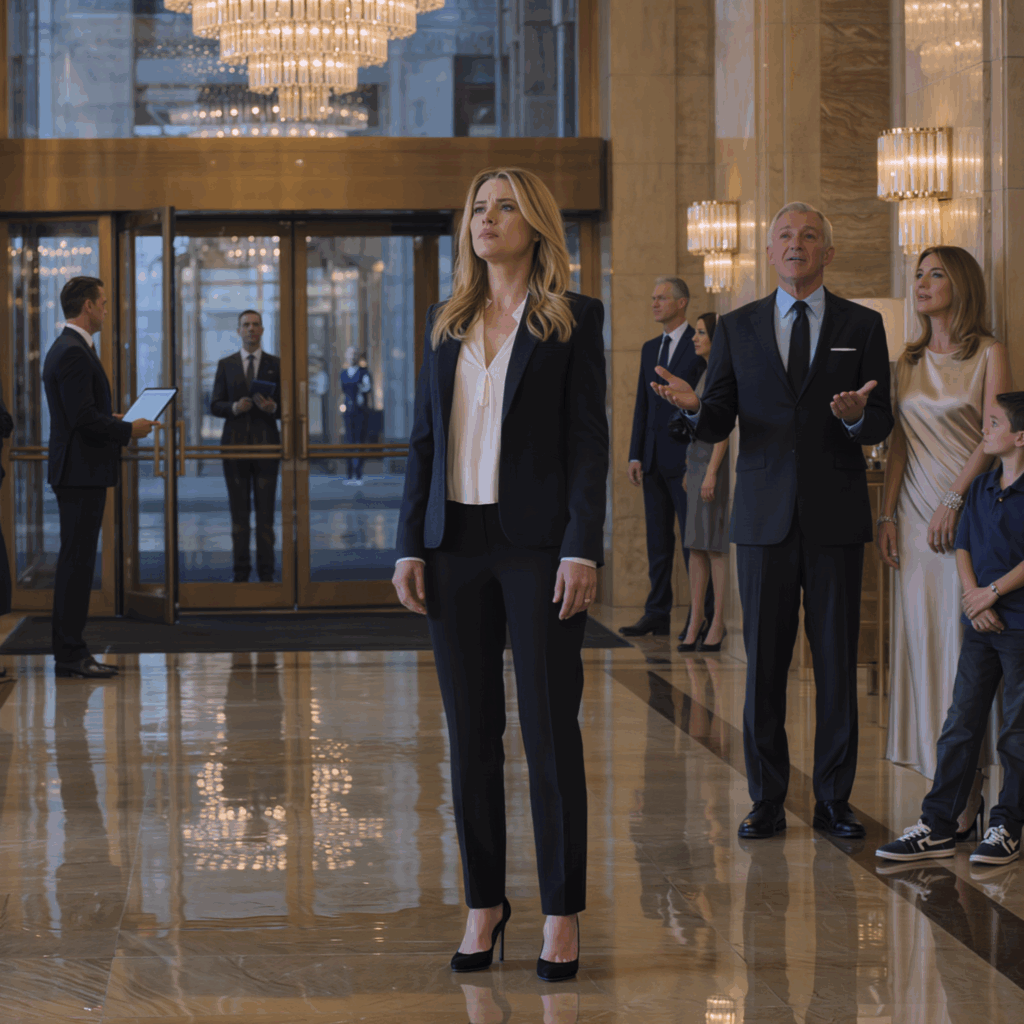
My dad’s laugh bounced off the marble and glass like it owned the place. The lobby smelled like polished stone and money—real or borrowed, it didn’t matter. A muted TV over the concierge desk played a baseball game beneath a tiny American flag, the kind stapled into a plastic stand. Next to it, a bowl of red-white-and-blue mints sweated under the lights. I shifted my tote higher on my shoulder; the cheap metal of my keychain—a little enamel U.S. flag I’d bought for three dollars at a Times Square souvenir shop when I first moved to the city—clicked against the zipper. It was the only thing on me that looked like it belonged anywhere else but here.
He didn’t say my name. He didn’t have to. Harold Carter had always believed volume was proof that he was right.
Valerie, his wife, stood a step behind him, wrapped in silk and superiority: cream blouse, pencil skirt, heels that probably had a French name. Her manicure glittered like she’d dipped her hands in champagne. She gave a laugh that sounded like ice cubes clinking in an empty glass.
“Oh, Harold, stop,” she drawled. “She’s just trying to look important. Let her have her little fantasy.”
Their son, Mason, leaned against a marble pillar, scrolling his phone with that bored, weaponized indifference he’d perfected by age sixteen. He didn’t bother to look up as he added, “Guess they’re letting T-shirts in now.”
It wasn’t a T-shirt. It was a black blouse I’d worn to a closing that morning, tucked into tailored pants I’d bought off a clearance rack two years ago. But to them, if it didn’t come with a designer label big enough to stunt in photos, it didn’t count.
The last time my father had looked at me this way, I was nineteen and standing in our kitchen in Pennsylvania, holding a stack of community college enrollment forms he refused to sign. Back then, the fridge had been covered in magnet souvenirs from his work trips—Miami, Chicago, a Stars-and-Stripes bottle opener from Vegas. He’d tapped the Vegas magnet and told me, “You don’t hit the big time by playing small, Clare. Aim higher or don’t aim at all.”
Now here we were, twenty years later, and he was still confusing cruelty with mentorship.
I could have walked away. I should have walked away. That had always been my role in the Carter family: the daughter who swallowed the joke, the one who left a room before she cried, the one who learned to be silent so she wouldn’t be mocked for trying.
But something inside me—the part that had spent years being underestimated, dismissed, and humiliated, the part that had stared at a computer screen at 2:17 a.m. with nothing in her checking account but seventy-four dollars and a dream—rose like fire.
I stepped forward, heels clicking on the marble, and met my father’s eyes.
“You’ve made a career out of mocking me,” I said quietly. “It must be exhausting carrying that much insecurity around.”
His face darkened so fast it was almost impressive. “Watch your tone, young lady.”
There it was again—young lady, like I hadn’t signed eight-figure contracts, like I was still the girl who borrowed his car and brought it back with the gas tank half full.
Before I could reply, the glass doors slid open behind me with a soft hiss. Cool air swept across my shoulders, scented faintly with coffee and new carpet. A tall man in a navy suit approached, his leather shoes whispering over the floor. He carried a sleek tablet cradled in one hand, his tie knotted with the kind of precision that said he ironed his own shirts because he cared enough to get it right.
“Ms. Carter,” he said, voice smooth as Sinatra on a Sunday playlist. “I’m glad you’re here. We’ve just finished the interior updates on your penthouses. Would you like to review both, or shall we start with the one overlooking Central Park?”
For a heartbeat, the lobby forgot how to breathe.
The valet stopped pretending to not listen. The concierge’s fingers froze over his keyboard. Valerie’s smile cracked like cheap porcelain.
My father blinked. Once. Twice. “Your what?”
The realtor smiled politely, professionalism wrapped over amusement like gift wrap. “Her two penthouses, sir. She owns both units on the top floor.”
Valerie’s hand froze midair, her diamond bracelet catching the light so sharply it threw little stars across the marble floor. Mason’s smirk evaporated. His phone dropped a fraction, enough for me to see the reflection of my own face on the black screen—calm, almost bored.
Dad stammered, “You must be mistaken. This is my daughter. She couldn’t possibly—”
The realtor interrupted gently. “Ms. Clare Carter, owner and managing partner of Skyline Developments. We closed the purchase last month.”
I turned fully toward my father, feeling my heartbeat slow instead of race. For the first time in years, I watched his expression, really watched it—the disbelief, the anger, the panic clawing up behind his eyes.
“Would you like to come up, Dad?” I asked softly. “Or is it too expensive to breathe the same air?”
He didn’t answer. None of them did.
The keychain at my hip clinked again when I shifted my tote. A tiny U.S. flag, chipped in one corner, catching lobby light like it had been waiting its whole life for this moment.
“Right this way, Ms. Carter,” the realtor said.
As I followed him toward the elevator, I could feel the weight of their silence pressing at my back. For once, it wasn’t me shrinking beneath it. It was them.
The elevator doors slid shut with a quiet chime.
For the first time in my life, I smiled at the sound of an ending.
The elevator hummed as it rose, each floor passing by like a heartbeat in slow motion. I stared at my reflection in the mirrored panels: dark hair pulled into a neat low ponytail, blazer still crisp from the morning meeting, eyes clear and steady. I looked unrecognizable from the girl who once cried herself to sleep over my father’s words, my phone face-down on the pillow to hide the thirty-two missed calls from collection agencies.
The city lights spread below us, glittering through the narrow slice of glass at the back of the cab, a grid of possibility my father had always insisted was too big for me.
The realtor cleared his throat lightly. “Your father seemed… surprised,” he said, tactful but amused.
I smiled faintly. “He’s been surprised my whole life. Just never for the right reasons.”
He chuckled under his breath, polite enough not to add more.
When the elevator doors opened, the view did what my father’s words had never managed to do.
It nearly stole my breath.
Sunlight poured in through the floor-to-ceiling windows, washing over Italian marble floors and glass railings that framed an open balcony. The skyline shimmered beyond, the green of Central Park spreading like a promise in the distance. The city didn’t look like something I was chasing anymore. It looked like something I owned a piece of.
“This,” the realtor—Ethan Shaw, according to the nameplate I’d seen on his email signature—said with a grin, “is the south unit. The redesign turned out even better than we expected. Your taste is impeccable.”
I set my tote on the kitchen island and ran my hand along the smooth quartz counter. It was cool under my fingertips, solid. Real.
Every inch of this penthouse whispered the same word.
Proof.
Proof that all those nights working two jobs and sleeping four hours weren’t for nothing. Proof that the girl who’d once been called a failure now owned the view people like my father only bragged about renting for the weekend.
As I walked through the space, memories cut through me like glass, sharp and glittering.
“You’ll never make it in real estate,” Dad had said the day I told him I was leaving Pennsylvania for New York with nine hundred and twelve dollars in my bank account and a Craigslist roommate I’d never met. He’d been standing by the grill in our backyard, an American flag flapping lazily from the porch, beer in hand. “You’re too emotional to lead. No one takes girls who cry seriously in this business.”
I’d swallowed the tears then, using his advice against him in the only way I knew how.
I’d been swallowing them ever since.
“I built an empire out of the pieces he tried to break,” I murmured, almost without meaning to.
Ethan glanced at me from where he was reviewing the tablet. “You did all this yourself, didn’t you?”
“Every cent,” I said.
I thought about the first check I’d ever received as an agent—three thousand four hundred and twenty dollars. I’d stared at it on the kitchen counter of my shoebox rental while my roommate’s TV blared some reality dating show. I remembered how my hands had shaken as I opened a separate savings account and moved exactly nineteen hundred and fifty dollars into it. A stupid, oddly precise number that had become my thing.
Nineteen hundred and fifty dollars.
Every time I closed a deal, I’d move that amount first. Non-negotiable. My future tax. My escape fund. My proof.
“No investors, no inheritance,” I added. “Just mistakes, lessons, and one very expensive kind of silence.”
He smiled softly. “The kind that comes when you finally stop explaining yourself.”
“Exactly.”
A knock echoed from the private elevator entrance—three quick taps that didn’t sound like maintenance or housekeeping.
Ethan walked over and opened the door.
I froze.
My father stood there, hands in his pockets, jaw tight like he’d chewed glass. He looked past Ethan without acknowledging him and let his gaze sweep the room, slow and appraising, the way he used to walk through open houses when I was a kid.
Behind him, Valerie hovered like the ghost of old money, her perfume arriving a second before she did. Mason trailed in last, his usual smugness dissolved into something like awe.
“Well,” Dad said slowly, his voice echoing off the high ceilings. “I’ll give you credit. You’ve done well for yourself.”
“Well,” I replied, turning to face him fully, “that’s what you call two penthouses and a business you said would fail.”
His lips tightened. “You’ve clearly learned something from me after all.”
I laughed, short and sharp. “No, Dad. I learned what not to become.”
Valerie shifted uncomfortably, clutching the strap of her designer bag. “We just wanted to see how you were doing, dear. It’s been so long—”
I cut her off with a look. “You wanted to see if the rumor was true. If the daughter you called embarrassing somehow outran your expectations.”
Mason muttered, “You didn’t need to show off like this. It’s just money.”
I turned to him slowly. “Then why are you here, Mason? Because you and Dad lost the last family property to foreclosure? Or because you realized the ‘embarrassing’ sister now owns more than both of you combined?”
He looked away, his jaw flexing.
Valerie pressed her lips together, her hands twisting around her clutch. “You don’t have to rub it in. We’ve had a rough year.”
“A rough year?” I repeated, heat flaring in my chest. “You emptied my college fund to pay for your wedding dress, Valerie. That was a rough year. For me.”
Ethan’s eyes flicked briefly to mine, then back to his tablet, like he’d decided to become invisible.
My father stepped closer, lowering his voice as if we were still in some suburban kitchen and not my living room with a view of Central Park.
“Listen to me, Clare,” he said. “You don’t talk to me like that. No matter how much you own, I’m still your father.”
I met his eyes and saw, for a flicker of a second, the man he’d been when I was eight—lifting me to hang a plastic flag on the porch for the Fourth of July, telling me we were Carters and Carters always won.
“And I’m still the daughter you abandoned when she couldn’t pay her college rent,” I said, my voice steady. “The one you told to ‘figure it out’ because you were tired of bailing me out of my ‘bad decisions.’”
The silence that followed was thick enough to choke on.
Ethan, ever the professional, broke it gently. “Mr. Carter, if you’d like to tour the second penthouse, I can arrange—”
“No,” I said firmly, without looking away from my father. “This one’s for people who know their place.”
Dad’s face hardened. “You think this makes you better than us? Money doesn’t buy respect.”
I stepped closer, the space between us compressing into twenty-eight years of unsaid things.
“Respect isn’t bought, Dad,” I said. “It’s remembered when you’re gone. And when people think of you, they won’t remember kindness or loyalty. They’ll remember the man who mocked his own daughter in front of strangers.”
His jaw twitched—the first crack in years of arrogance.
“You’ve become cold,” he said, like it was an insult.
“I’ve become free,” I answered.
He opened his mouth again, some new lecture coiling behind his teeth, but I turned away before he could let it loose.
“You should go,” I said. “I have a meeting.”
For once, he didn’t argue.
He turned on his heel and walked toward the elevator, Valerie clutching his arm, Mason trailing behind like a shadow that had lost its light source.
The elevator doors closed with a soft chime.
The sound didn’t feel like an ending this time.
It felt like a beginning.
Ethan glanced at me, measuring the storm he’d just witnessed. “You okay?”
I exhaled slowly, realizing my hands were trembling. “I’m fine,” I said. “Just tired of ghosts.”
He gave a half smile. “Then maybe it’s time to start living for the living.”
Later, after they were gone, I walked back toward the window. The city stretched endlessly below, each light a tiny reminder of how far I’d come and how far I’d fallen to get here. Somewhere out there, the girl I used to be was walking home from a double shift, counting tips and praying her MetroCard still had enough fare left for the week.
The night breeze slipped through the balcony doors, carrying the smell of car exhaust and hot pretzels from the street. I could almost hear the hum of the subway, the wail of distant sirens, somebody’s music spilling from an open car window.
For years, my father’s voice had been the one in my head, telling me I’d never make it, that I was too soft, too dramatic, too much. Now his silence was louder.
And for the first time, I liked the sound of it.
A week later, I walked back into the same lobby, under the same chandeliers, over the same marble floor. The little flag on the concierge desk had been replaced with a seasonal pumpkin arrangement, but the bowl of red-white-and-blue mints was still there, stubborn and slightly sticky.
This time, I wasn’t walking in as the humiliated daughter.
I was walking in as the woman who owned the building my father used to brag about managing.
Ethan walked beside me, holding a leather folder stuffed with contracts and printouts. “You sure you want to buy it under your own name?” he asked quietly as we crossed the lobby. “Carter and Hall is the same company that pushed you out years ago.”
“That’s exactly why,” I said. “I’m not buying the building, Ethan. I’m buying closure.”
He nodded like he understood there were some numbers you couldn’t fit on a spreadsheet.
When the boardroom doors opened on the tenth floor, I saw him seated at the head of the long mahogany table, like he still ruled something.
My father.
Valerie sat to his right, spine stiff, lips pressed together so tightly they were almost invisible. Mason lounged in a leather chair a few seats down, fiddling with a pen, pretending he wasn’t rattled.
The air in the room smelled like old coffee and older ego.
Dad looked up, his voice coated in disbelief. “What are you doing here?”
I set the leather folder on the table and slid it toward him. “I’m here to finalize the acquisition. Your company’s been bankrupt for six months. I’m the buyer.”
The room froze.
Valerie’s forked tongue failed her for once. “You’re joking.”
I met her eyes coolly. “Do I look like I’m joking?”
Dad let out a laugh, sharp and desperate. “You think I’d sell my name to you?”
Ethan stepped forward, placing another set of documents beside the first. “Legally, Mr. Carter, the sale was completed this morning. Ms. Carter is now the majority shareholder and acting CEO.”
The papers didn’t lie.
His hands trembled as he scanned the signature page. My name, bold and clean, sat right beneath the old company seal—CARTER & HALL DEVELOPMENTS, EST. 1987.
Mason muttered, “You can’t just take everything, Clare.”
I turned to him, calm but lethal. “You took everything first. You took my home when you kicked me out. You took my chance when you refused to co-sign loans but signed for Mason’s new truck. You took my dignity every time you laughed at my job. I just took back what was mine all along.”
Dad slammed his palm on the table, making the water glasses jump. “You’ve got no idea what it takes to run this business.”
“Oh, I do,” I said, leaning in. “Because while you were drinking at country clubs and posting photos from golf tournaments, I was learning how to close multi-million-dollar deals from scratch. You taught me failure, Dad. And I built an empire out of it.”
Valerie stood abruptly, her chair scraping the floor. “This is ridiculous. You’re punishing us for being successful.”
“Successful?” I echoed, almost laughing. “You spent my college fund on your wedding dress. Mason sold my car to pay off his gambling debt and you called it ‘family helping family.’ Don’t talk to me about success. You built your comfort on my humiliation.”
The silence sharpened until even the clock on the wall seemed afraid to tick.
My father rose slowly, his face red with fury, veins standing out at his temples. “You may have money, Clare, but you’ll never have respect.”
I met his glare with a steadiness I’d earned one unpaid invoice at a time. “Respect doesn’t come from fear. It comes from how you treat people when they have nothing left to give. You failed that test a long time ago.”
He opened his mouth, but I continued, my voice low but firm.
“I used to want your approval so badly,” I said. “I thought if I worked hard enough, if I earned enough, if I could show you my bank account balance, you’d finally be proud. But your approval means nothing if it costs me my peace.”
Ethan placed a hand on the back of my chair. “It’s done,” he said softly. “The deal’s closed.”
I was still locked on my father. “Then let’s make it official.”
I picked up the pen.
The nib slid across the paper with a sound like a blade cutting through years of silence. When I set it down, I looked up at them: three faces frozen in disbelief.
“From this day forward,” I said clearly, “Carter and Hall is under new management. You’re all welcome to stay as employees. But if you can’t handle that, there’s the door.”
Valerie gasped. “You can’t mean that.”
“Oh,” I said, allowing myself the smallest smile, “I do.”
Dad’s voice cracked, the first sign of his armor finally rusting. “You think this is revenge?”
I shook my head. “No, Dad. This is peace. You wanted me to crawl. I learned to fly instead.”
For a long moment, no one spoke.
The weight of what I’d said hung in the air like a storm cloud that refused to break. Then slowly, my father’s shoulders slumped. For the first time, he looked… human. Not the tyrant who used to tower over me in doorways, not the booming voice at the head of the table.
Just a man who’d finally run out of control.
“You’ve changed,” he muttered.
“I had to,” I said quietly. “You made sure of it.”
He stared at the papers again, at my signature, at the corporate logo that no longer belonged to him. Reality settled over his face like ash.
Then, wordlessly, he gathered his coat, looked at me one last time, and walked out of the office he’d once ruled like a kingdom.
Valerie followed, whispering curses under her breath. Mason lingered a moment longer, fingers drumming against the chair.
“Guess you won,” he muttered.
I looked at him. “No, Mason. I survived. There’s a difference.”
When they were gone, I stood there for a while, alone in the boardroom that had never been mine and was now entirely mine. The walls still smelled like old money and arrogance. But beneath it, there was something new.
Freedom.
Ethan broke the silence. “You did it.”
I smiled faintly. “No,” I said. “She did.”
He frowned slightly. “Who?”
“The girl who walked out of this lobby three years ago with a duffel bag and a credit score in the four hundreds,” I said. “She’s the one who deserves the credit.”
He nodded, smiling quietly.
Later that night, back in my penthouse, I stood on the rooftop terrace and watched the city pulse below like a living thing. The skyline glittered against the dark, each light a reminder of some apartment full of strangers, all of us trying to prove something to someone.
I wasn’t the same woman who had once trembled under my father’s shadow. The noise of his judgment no longer echoed in my head. It had been replaced by something stronger.
Peace, earned the hard way.
Ethan walked up beside me, holding two mugs of coffee. “You’ve been out here a while,” he said, setting one beside me.
“Big day,” I said, wrapping my hands around the warm ceramic.
“You could say that,” he replied. “The final merger went through this morning. Three new developments under your company’s name. Your company.”
He said it with a quiet pride that landed somewhere deep in my chest.
“You’ve built something even your father couldn’t dream of,” he added.
I nodded, tracing the outline of the city with my eyes, from the neon in Times Square to the dark ribbon of the Hudson. “He tried to break me,” I said. “Without that, I wouldn’t have learned how to rebuild.”
The sound of the elevator interrupted us, soft but distinct. My heart tensed as the doors slid open.
My father stepped out.
No entourage this time. No polished smirk. Just an older man holding a small envelope in both hands like it might break if he squeezed too hard.
Ethan stepped back quietly, sensing the weight of the moment.
Dad walked toward me slowly, the night wind tugging at the sleeves of his coat. The city lights carved lines into his face I’d never noticed before. Or maybe they’d been there all along and I’d been too busy trying to read approval where there was none.
“You’ve made quite the empire, Clare,” he said, his voice softer than I’d ever heard it. “I saw the news this morning. You’ve become everything I said you couldn’t.”
I didn’t move. “And you’ve become the man you promised you’d never be.”
He nodded once, like he’d rehearsed that acceptance in the mirror.
“You’re right,” he said quietly.
He held out the envelope. “It’s the deed to the old Carter house,” he said. “The one you grew up in. I sold everything else, but I kept that. It’s yours now.”
I stared at it, but didn’t reach for it.
“Why give it to me now?” I asked.
“Because it’s the only thing I have left to give,” he said. “You don’t owe me forgiveness. I just needed you to know I was proud of you. I just… didn’t know how to say it without losing the little power I had left.”
For the first time, I saw it—the guilt in his eyes, raw and heavy, like a man finally staring down the wreckage of his own choices.
The same man who once mocked me for dreaming now looked smaller than the world he’d tried to control.
I finally reached out and took the envelope. The weight of it surprised me. Paper and ink and history.
“You hurt me, Dad,” I said. “In ways that still burn.”
“I know,” he whispered. “And I’ll live with that.”
The silence between us wasn’t angry anymore. It was honest.
And that was something new.
He turned to leave, then paused at the edge of the terrace, the city wind tugging at his thinning hair.
“I hope you find happiness, Clare,” he said. “Not revenge. Real happiness.”
I nodded once. “I already did.”
He left quietly.
The sound of the elevator closing behind him didn’t feel like a door slamming this time. It felt like a lock clicking on a room I never had to enter again.
Ethan came closer. “You okay?”
I let out a breath I felt like I’d been holding since I was nineteen. “Yeah,” I said. “For the first time, I think I am.”
We stood there together, looking out over the glowing city. The wind carried the faint hum of traffic, the far-off wail of a siren, someone shouting about hot dogs two streets over. Life moved on.
It hit me then.
Revenge hadn’t been the victory.
Survival had.
Growth had.
The ability to look my past in the face and not crumble under it—that was everything.
I glanced down at the envelope in my hand. Tucked into the corner of its flap was my old keychain, the tiny enamel U.S. flag I’d left on the hook by the Carter house front door the night I walked out. Somewhere along the way, he’d taken it down and kept it.
The little flag was chipped in the same corner.
Same scar.
Different story.
I smiled and slid the keychain into my pocket.
“Let’s go,” I said, turning back toward the penthouse. “There’s work to do. The future won’t wait.”
As we walked inside, the city lights reflected off the glass walls, catching the faintest hint of my reflection—stronger, wiser, completely free.
Because in the end, the best revenge was never destruction.
It was building a life so solid that no one who tried to break you could even afford to step inside.
In the days that followed, the story of my little lobby scene spread the way stories always do in this town—sideways. Not a headline, not a scandal, just a whisper that traveled through brokers’ offices, private group chats, and Friday happy hours: the daughter who bought her father’s firm, the woman who owned the sky over Central Park and the company that once told her she was “not a culture fit.”
I started getting texts from people I hadn’t heard from in years.
“Hey girl, long time! Drinks soon? So proud of you!”
“Crazy about Carter and Hall! I always knew you’d make it!”
A cousin I hadn’t seen since a Fourth of July barbecue—he’d spilled beer on my sneakers and laughed when I flinched—sent a screenshot of an online article with my headshot. The headline called me “The Turnaround Queen of Midtown.” Beneath it was a quote I vaguely remembered giving on a panel last year about resilience.
I stared at the screen, thumb hovering over the reply button.
Then I locked my phone and slid it face-down on the counter.
When you finally stop needing applause from the people who used to boo, their sudden cheering feels more like noise than support.
On Monday morning, I went to work like it was any other day. I still took the subway downtown, even though I could’ve afforded a driver now. Old habits die hard, especially the ones that remind you where you started.
A kid in a Yankees cap barely looked up from his phone as the train rattled into Columbus Circle. An older woman beside me clutched a grocery bag with a tiny Stars-and-Stripes logo printed on it from some discount store, its red and blue faded from a hundred trips. The train smelled like coffee, old paper, and determination.
This, I thought, is who I work for.
Not for boardrooms or headlines.
For the people counting every dollar and still stepping onto this train anyway.
At the new Skyline Developments offices—our logo now sharing space with the Carter & Hall name in the lobby directory, like a before-and-after photo—I stepped into the conference room to meet with the leadership team I’d inherited.
Some faces were familiar from industry events. Some weren’t. All of them watched me like I was either their biggest opportunity or their worst nightmare.
“Good morning,” I said, setting my notebook on the table. “I’m Clare Carter. I know the last few months have been… uncertain.”
A murmur went around the table. One man in his fifties adjusted his tie like it was strangling him.
“I’m not here to burn this place down,” I continued. “If you’re waiting for that, you can relax.” A few people laughed, just enough to cut the tension. “But I am here to rebuild it. And that means things are going to change.”
The woman closest to me—dark curls, sharp eyes, name tag reading J. Lopez – Finance—raised a cautious hand. “Change how?”
“For starters,” I said, “we’re done pretending this company didn’t run on fear. I’ve talked to too many ex-employees who walked out of this building convinced they were worthless because someone in this room treated them like they were disposable.”
I let that sink in.
If you want to change a room, you start by naming what’s poisoned it.
“I know what it feels like to be that person,” I added. “I was that person.”
A hush settled over the table. Eyes shifted, some to the floor, some to me.
“I’m not interested in revenge,” I said. “I’m interested in results. So here’s the deal: if you’re willing to learn, stay. If you think this place belonged to the old guard and you’re just waiting for them to come back, there’s a generous severance package waiting downstairs. No hard feelings. But from today on, we do business differently.”
A man across from me—gray at the temples, expensive watch—cleared his throat. “And what does ‘differently’ mean, specifically?”
“Transparency,” I said. “Fairness. Actual mentorship instead of hazing. We promote people because they’re good, not because they’re related to someone on the golf course.”
I saw a flicker of something on a few faces.
Hope.
“Also,” I added, “we’re setting up a fund—nineteen thousand five hundred dollars a quarter—to invest in training and certifications for junior staff. If you want people to stay, you invest in them.”
“Why that number?” someone asked.
I smiled a little. “Because that’s what I scraped together over three years in a secret savings account while I was working for people who told me I’d never be more than an assistant. It got me through my broker’s exam, my first months of going independent, and my first office lease. It changed everything. I want that head start to have a different ending for the people here.”
The number hung in the air like a quiet vow.
Nineteen thousand five hundred.
Once, it had been my lifeline.
Now, it was my way of dropping a rope behind me.
After the meeting, as people filtered out, Ms. Lopez lingered.
“I worked under your father for twelve years,” she said. “He never used my name once without also using the word ‘assistant,’ even after I was a senior analyst.”
“I’m sorry,” I said.
She shook her head. “Don’t be. You’re not him.” She paused. “If you’re serious about the changes you mentioned, I’ll stay. But I’m not here to be anyone’s token redemption story.”
“Good,” I said. “I’m not interested in those. I’m interested in partners.”
She studied me for a moment, then nodded. “Then let’s get to work.”
That was the first day I realized the empire I’d built wasn’t just glass and steel.
It was people.
It was the way their shoulders lowered half an inch in relief when they realized the new boss wasn’t going to make them bleed to prove their loyalty.
That night, I found myself walking past a bar in Midtown I hadn’t set foot in for years. The last time I’d been there, I’d been twenty-six and wearing a blazer that didn’t quite fit, listening as a senior broker explained that clients wouldn’t respect “a girl who looked like she just got her first credit card.”
He’d put his hand on my lower back and steered me toward a table of investors, introducing me as “our office sweetheart.”
I’d gone home that night and moved another one hundred and fifty dollars into the same quiet savings account. Even humiliation has interest if you know how to convert it.
Now, the bar looked smaller somehow. Less intimidating. I watched people spilling onto the sidewalk with their drinks, laughing, complaining about bosses and closings and landlords.
Ethan called me from the corner.
“You ever going to just walk by without glaring at this place?” he asked.
I hadn’t realized I was glaring.
“Probably not,” I said. “I’ve got history with their happy hour policies.”
He chuckled, falling into step beside me. “How’d the leadership meeting go?”
“Better than I expected,” I said. “Worse than I hoped.”
“So… real, then.”
“Yeah,” I said. “Real.”
We stopped at a crosswalk. The light turned from orange to red, little illuminated person standing stock-still. Cars rolled by, a yellow cab blaring a horn at a delivery truck.
“Can I ask you something?” Ethan said.
“You just did.”
He rolled his eyes. “Why didn’t you tell your dad sooner? About the penthouses. The company. Any of it.”
The question sat between us like a curb you could trip over if you weren’t careful.
“Because for years,” I said, “success was a script I was writing for him. Every deal, every late night, every commission check—I thought it was all leading to one big scene where he’d finally look at me and say, ‘You did it, kid.’”
“And?”
“And then I realized I didn’t want him in the audience.”
Ethan nodded, the kind of nod that hurts.
Sometimes the hardest part of healing isn’t what you lost.
It’s admitting who you don’t want to impress anymore.
A few weeks later, my aunt Beth called.
She lived back in Pennsylvania, in a two-story house with vinyl siding and a swing on the porch. Growing up, she’d been the only adult who ever told me Dad was wrong about me.
“I saw your name on the news,” she said, voice crackling through the line. “You really bought the company? The whole thing?”
“Yeah,” I said, staring out over the city from my office window. “The whole thing.”
“And the place in New York with the park view?” she asked. “Your father says it’s… obscene.”
“He would,” I said.
She was quiet for a moment. I could almost hear the clink of dishes in her sink, the muffled sound of a game show on in the background.
“You know your dad,” she said finally. “He’s always talked a big game. Always needed to be the biggest voice in any room. But he’s not all bad, Clare.”
“I know,” I said. “That’s the problem.”
Because if he’d been a cartoon villain, this would’ve been easier.
He’d also been the man who packed my lunches in grade school, who worked overtime so we could have a pool one summer, who taught me how to check the oil in my first car.
But he’d weaponized that kindness as a past-due bill.
“I’m not asking you to forgive him,” Aunt Beth said. “I’m just asking you not to let him own your story anymore. He’s already taken enough.”
I swallowed. “I’m working on it.”
“Good,” she said. “And Clare?”
“Yeah?”
“I’m proud of you,” she said simply. “For the record. Always have been. Not because of the money. Because you got out.”
When the call ended, I sat with the phone in my hand for a long time.
Sometimes the words you’ve been chasing your whole life don’t come from the mouth you expected.
One Friday afternoon, a notification popped up on my phone: 29 missed calls – Dad.
My stomach dropped.
I stared at the screen, thumb hovering over the voicemail icon. Part of me was twelve again, braced for impact because I’d dented the car or forgotten to unload the dishwasher.
I pressed play.
His voice came through, grainy and tired.
“Clare. It’s your father. Call me back. It’s about the house.”
Second message.
“Clare, this is important. You can’t just leave it sitting in your name like that without—without talking to me. There are… there are taxes, and…”
Third.
“Look, I know you’re angry. You’ve made your point. You bought the company, the apartments. You win. Just call me back.”
By the sixth message, the anger had drained from his voice.
“I drove by the old place,” he said quietly. “Your bedroom window still has the sticker from that summer camp you went to. I never scraped it off. Thought maybe you’d come back and want it to still be there.”
He exhaled, a sound I’d never heard from him before.
“Anyway. Just… call me, kid.”
I sat there, phone warm in my palm, listening to the weight of all the years we’d both spent trying to win a game that didn’t even have a prize.
I didn’t call back. Not then.
Instead, a week later, I got on a train.
The Amtrak from Penn Station to Harrisburg was half-full, a mix of students, business travelers, and families hauling snack bags and pillows. The woman across the aisle was knitting something red-and-blue that looked suspiciously like a holiday sweater. An older man wore a veteran’s cap with a small embroidered flag above the word ARMY.
I wrapped my fingers around the envelope with the deed inside. The paper edges had already grown soft from how often I’d taken it out, stared at it, and put it away again.
When I stepped out of the rideshare an hour later, the Carter house looked both smaller and exactly the same.
White siding. Blue shutters. A front porch with two steps I’d once jumped off in a red-white-and-blue swimsuit, towel billowing like a cape.
The flagpole holder by the front door was empty.
The little bracket that used to hold our Stars-and-Stripes every Memorial Day and Fourth of July now just held rust.
I stood on the sidewalk for a full minute before I could make myself move.
The key still fit the lock.
Inside, the air smelled like dust and old carpet. Someone had taken the magnets off the fridge. Faint rectangular outlines marked where they’d been.
I walked slowly through each room.
The living room where I’d watched fireworks on TV when it rained on the Fourth. The kitchen where Dad had once spilled mustard on his flag T-shirt and made us all swear never to tell anyone. The hallway where he’d stood blocking my way the night I left, arms crossed, saying, “If you walk out with that suitcase, don’t expect to come back when it doesn’t work out.”
In my old bedroom, the sticker on the window was still there.
A faded blue rectangle with white stars and the name of a summer camp where I’d learned how to paddle a canoe and kiss a boy badly behind the rec center.
I sat on the floor and leaned back against the wall.
The silence here wasn’t heavy with tension anymore. It was thick with things that had already happened and couldn’t be changed.
I didn’t cry.
I thought I might. Part of me wanted the cinematic breakdown, the kneeling-on-the-carpet moment.
Instead, I just breathed.
Sometimes closure doesn’t come with fireworks.
Sometimes it comes with dust and sunlight and a house that doesn’t belong to the person who hurt you anymore.
I stayed an hour, then locked up and drove to a small diner off the highway, the kind with a faded American flag in the window and laminated menus.
My father was already there, sitting in a corner booth.
He looked… smaller.
Not shorter. Just less filled with certainty.
The waitress topped off his coffee and glanced at me. “Menu, hon?”
“I’m good, thanks,” I said.
Dad stood up halfway, then sat back down like his knees betrayed him. “You came,” he said.
“I did.”
We stared at each other for a moment.
Up close, I could see the lines around his eyes, the way his hands trembled just slightly when he reached for his mug.
“How’s the empire?” he asked gruffly.
“Growing,” I said. “Steady.”
He nodded. “Good. That’s good.”
He cleared his throat. “Look, I know you think I was always against you. But I was trying to toughen you up. The world’s not kind to girls who break easily.”
“I didn’t break,” I said. “I bent. There’s a difference.”
He shrugged, staring down at the table. “Maybe I didn’t know the difference.”
We sat in awkward silence while the waitress dropped off a plate of fries and two sets of silverware I hadn’t asked for.
“I saw the number in the article,” he said suddenly. “Nineteen thousand five hundred. Your ‘starter fund.’ You always did like your specific numbers.”
“It was the amount of the first three checks I ever got that meant I didn’t have to choose between rent and groceries,” I said. “So I kept it.”
He snorted softly. “Trust you to make math sentimental.”
“Trust you to make feelings sound like weakness,” I shot back.
His mouth twitched. “You get that from me, you know. The stubbornness. The way you walk into a room like you own it even when you don’t.”
I thought about the lobby, the way he’d stood under that chandelier like it belonged to him, even as the building literally belonged to me.
“Some of it I’ll keep,” I said. “Some of it I’ll return to sender.”
He nodded slowly.
“I didn’t know how to be proud without being scared,” he said after a while. “Scared you’d get hurt. Scared you’d fail and people would laugh. So I tried to beat the world to the punch.”
“And you hit me instead,” I said.
He swallowed. “Yeah,” he said hoarsely. “I did.”
The diner’s TV played a baseball game on low volume. A small flag magnet held up a hand-drawn sign behind the counter: Veterans get free coffee on Sundays.
We watched in silence for a minute.
“I’m not here to rewrite our history,” I said quietly. “I’m not going to pretend you were the dad I needed. You weren’t. But I’m also not here to watch you crumble. You have to live with what you did. I don’t.”
He nodded. “Fair enough.”
He reached into his pocket and pulled out something small, sliding it across the table.
My keychain.
The cheap enamel U.S. flag, chipped in the corner.
“I took it off the hook the night you left,” he said. “I kept it in my glove compartment for years. Figured if you ever called and needed a ride, I’d bring it, give it back when I dropped you off wherever you were going.”
“You never came,” I said.
“You never called,” he replied.
We let that hang there.
Then I picked up the keychain and clipped it to my keys.
“Thank you,” I said.
It wasn’t forgiveness.
But it was something.
On the train ride back to the city, I watched fields blur into suburbs, then into brick and steel and glass. A little girl a few rows up played with a miniature flag on a stick, waving it at her reflection in the window.
I opened my notebook and wrote a list.
Things I Owe No One:
– My story.
– My success.
– My pain.
– My forgiveness.
Things I Choose Anyway:
– Boundaries.
– Fairness.
– Building something bigger than my hurt.
By the time the train pulled into Penn Station, I’d filled three pages.
At the office the next morning, Ms. Lopez met me at the elevator.
“We crunched the numbers on the training fund,” she said. “If we do it right, we can sponsor at least seven junior staffers a quarter. Licensing, certification, even night classes.”
“Seven,” I repeated. “Good number.”
She tilted her head. “Why?”
“Seven was how many times I failed the broker’s exam before I passed,” I said. “I don’t plan on making anyone else go through that without backup.”
She raised her eyebrows. “You failed it seven times?”
“I told you,” I said. “Stubborn.”
She laughed. “Well, stubborn built us a training budget, so I’m not complaining.”
As the months went by, the company shifted.
Slowly.
Painfully, sometimes.
We let people go who couldn’t adjust to a world where screaming at interns wasn’t considered “high standards.” We promoted people whose names my father had never bothered to learn. We lost a few big clients who’d only ever wanted to talk to “the man in charge.”
We gained others who said things like, “It’s about time this industry stopped looking like an old boys’ club.”
One day, an email landed in my inbox from a name I hadn’t expected.
Mason.
Subject: Coffee?
I stared at it for a long time before opening it.
Look, he’d written. I know I’ve been an ass. I know I was Dad’s echo for a long time. I’m trying to be something else now. I got a job at a smaller firm in Jersey. I’m actually doing the work, not just coasting on the last name. If you ever want to see that with your own eyes, I’d… like a chance to show you I’m not him. Not completely. – M
I didn’t respond immediately.
Healing is not a group project.
But a week later, I sent back: Bring your portfolio. No promises. – C
We met in a café near the office, one with a little flag sticker on the door that said Proudly Serving above an espresso cup.
He looked older. Less glossy. The circles under his eyes weren’t from partying; they were from work.
He spread out spreadsheets and property photos on the table.
“I’m starting over,” he said. “Feels weird to be the one who doesn’t know anything.”
“Feels honest,” I said.
We went through his numbers. They weren’t terrible. They weren’t genius. They were a start.
“I don’t expect a job,” he said as we wrapped up. “I just… didn’t want to be the guy in your story who never tried to change.”
“You don’t get to edit my story,” I said. “But you can write your own.”
He nodded, looking relieved. “Fair.”
As he left, he paused. “Hey, Clare?”
“Yeah?”
“You remember that time Dad made you stand up at the Memorial Day barbecue and ‘pitch’ your plan to move to New York like you were on some game show?”
My mouth tightened. “Hard to forget.”
“He told everyone you’d be back within a year,” Mason said. “He made bets. Actual money.”
“I know,” I said. “I heard.”
“He lost,” Mason said quietly. “Spectacularly.”
“I know that too,” I replied.
After he left, I sat alone for a minute, watching the barista carefully stick a fresh flag decal on a to-go cup.
You can’t go back and un-humiliate your younger self.
But you can build a life she would point at and say, We did that.
Three years after the day in the lobby, I stood on the rooftop terrace again.
The city below looked different, not because it had changed, but because I had.
Ethan joined me, a file in his hand.
“The Carter & Hall brand just got shortlisted for a national redevelopment project,” he said. “Veteran housing. Mixed-income. Good press. Better impact.”
“Send the proposal,” I said. “And make sure the design team knows we’re not cutting corners. If we’re putting our name on homes for people who’ve served, they’re going to be the kind of places we’d live in ourselves.”
He nodded. “Already told them that.”
I looked out over the skyline.
There were still people out there who thought I’d been too harsh with my father, too soft, too ambitious, too something.
There would always be people with opinions about a life they didn’t have to live.
But they didn’t own a single brick of what I’d built.
Inside, near the front door, my keys hung on a hook.
The tiny enamel flag swung gently when the door opened or closed.
Once, it had been a three-dollar souvenir from a night when I’d stood in Times Square, overwhelmed and broke and stupidly hopeful, telling myself that one day I’d live in this city like I belonged to it.
Now, it was just my keychain.
Same scar.
Different story.
And for the first time in my life, I didn’t need anyone else to narrate it for me.
Leave a Reply