For my birthday, I took my family out to dinner—my treat. A little place in downtown Austin with exposed brick, Sinatra drifting from the speakers, and tiny paper American flags stuck into the lemon wedges at the bar. I’d booked the private room weeks in advance, prepaid a minimum that could’ve covered a used Honda, and made sure the wine list would impress my mom. It was supposed to be simple: one night where I didn’t feel like a guest in my own family, one night where I existed in more than just the group text when they needed my credit card.
My mom loved the place immediately. “Ooh, they have a Malbec from Napa,” she said, like she personally discovered California. My dad joked about the valet price, loosened his belt, and did that thing where he patted his stomach like he’d earned the right to complain.
Garrett RSVP’d the day before, all-caps text: “BRO, I’M SWAMPED BUT I’LL MAKE IT.” Ryan sent, “Mind if I bring someone?” then showed up alone, claiming she’d “had a vibe shift” and bailed.
“Look at you,” my dad said, clapping me on the shoulder as he sat down. “Finally splurging on the family. Big man.”
Like I hadn’t quietly covered Christmas flights, hotel rooms, and Uber rides more times than I could count. Like the bill hadn’t had my name on it for years.
I smiled anyway. That was the unspoken family rule: smile. Laugh at the right spots. Take up as little space as possible.
Dinner went exactly how you’d expect. Ryan retold our childhood stories like they belonged to him now, punching up the parts where he looked clever and trimming any piece of me out of the frame. Garrett gave a ten–minute monologue about a networking event in a downtown hotel ballroom where some guy in a navy vest called him “visionary.” My parents nodded along like they were watching a rerun of their favorite sitcom.
I poured the wine, passed the bread, asked the server for more iced tea. I listened. I nodded. I didn’t talk much. I’d trained myself out of needing to.
Then dessert came. One slice of New York cheesecake, one candle, the whole table mumbling a half-hearted “Happy Birthday” twenty seconds off-key. Someone stuck one of those tiny American flag toothpicks into the crust as a joke. My mom took a blurry photo, flash on, and said, “For the family memories!”
Funny choice of words, considering what happened next.
“Okay,” Ryan said, grinning, “we made you something.”
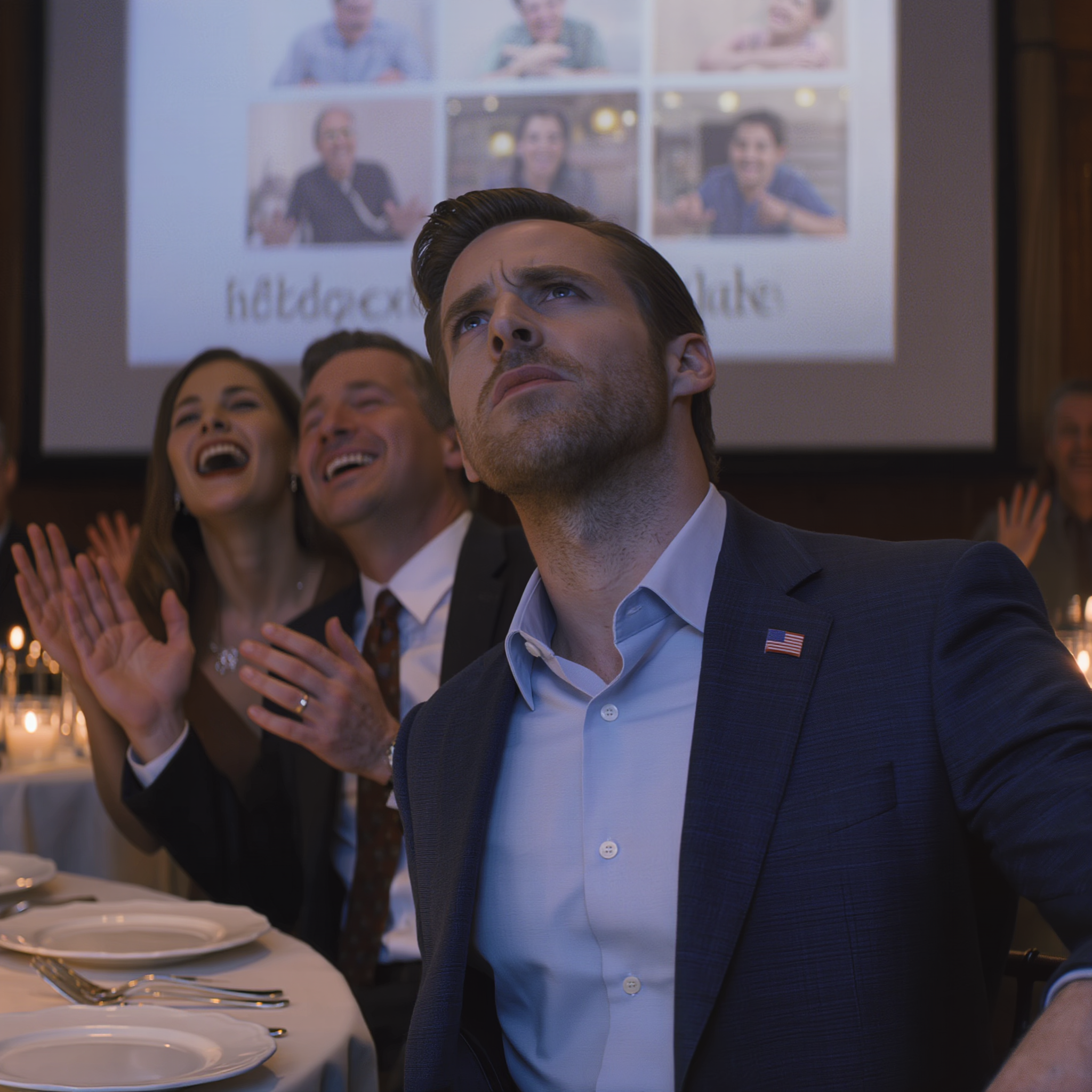
Garrett pulled out his laptop like a magician about to reveal the trick that makes the room gasp. The restaurant staff had already set up a projector and a pull-down screen at the far wall.
“Just a little surprise,” my mom added. “Family memories and stuff. You’ll love it.”
The lights dimmed. Sinatra faded. The screen blinked to life.
It started with grainy footage of our old backyard. Garrett’s eighth birthday. Balloons tied to the deck railing, cheap folding chairs, a dollar-store banner. Ryan knocked over a stack of paper cups and everyone laughed. My mom’s voice floated from behind the camera. My dad turned the camcorder sideways so half the shot was sky.
Then came the photos. Florida beach trips. Disney. Christmas mornings with wrapping paper piled like snowdrifts. Ryan in his Spider-Man costume. Garrett with his first trophy. My parents in matching Fourth of July shirts, grinning in front of a grill with another tiny flag stuck into a burger bun.
Slide after slide, year after year, memory after memory.
I watched. I waited. I kept my face trained neutral because I wasn’t in a single frame.
Not one.
No Halloween costumes. No middle school band concerts. No high school graduation photos. No Thanksgiving group shots where I was shoved to the side. Nothing. It wasn’t that I’d been badly cropped or blinking. I simply wasn’t there.
Just like that, ten minutes of curated history rolled by as if I had never existed at all.
They laughed at a video of Ryan falling face-first into the pool. They cheered when Garrett flexed at a hotel mirror on spring break. They cooed over a dog we’d had for six months before my mom decided fur was “too much work.”
Still, no one noticed the missing person.
The music under the slideshow was Ed Sheeran, obviously. Something sentimental and overused, the musical equivalent of a pre-printed greeting card.
Then the final slide appeared: a beach sunset, stock-photo perfect, pale cursive text drifting across the water.
Family is everything.
They clapped. My mom actually wiped away a tear. My dad sniffed, pretending it was allergies. Ryan leaned back in his chair with that satisfied look people get when they think they’ve nailed the assignment.
“What do you think?” Garrett asked, turning toward me, pleased with himself. “Pretty great, right?”
I smiled. “Yeah,” I said, voice steady. “That was really something.”
And it was. It was proof.
I stood up, smooth, calm. “Excuse me for a second,” I added, adjusting my napkin.
Nobody asked where I was going. Nobody paused the conversation or reached for my arm or said, “Hey, wait.” Garrett was already pivoting into a story about a “game-changing” business lunch. Ryan was refreshing his phone. My mom was trying to AirDrop the slideshow to the server.
I walked out of the private room, past the coat check, past the noise of the main dining room, into the narrow hallway by the restrooms where the sound dropped away and the air smelled faintly of lemon cleaner. I stepped into the single-stall bathroom and locked the door.
Then I took out my phone.
The email draft was already there, waiting. I’d typed it that morning at my kitchen island, a mug of black coffee by my elbow, my fridge humming in the background, a magnet shaped like the American flag slightly crooked on the door. I wasn’t sure I’d send it then. I am sure now that I would’ve gotten here one way or another.
I stared at the words on the screen, not because I was hesitating, but because I knew exactly what pressing send would do. Not tonight. Not tomorrow. But soon.
I could already see it: the crack in Garrett’s voice, the panic in my mom’s eyes, the way my dad would rub his forehead when the numbers stopped making sense. I could picture the moment they finally realized what I’d taken back.
And by then, it would be too late.
All it took was one tap.
I hit send.
I slipped the phone into my pocket, washed my hands, looked at myself in the mirror. Straightened my collar. Fixed my expression into something light and unreadable.
Then I went back to the table and slid into my still-warm seat.
Garrett was midway through another monologue about “scaling operations.” Ryan was trying to show my mom a meme about middle children. My dad was topping off his wine.
No one asked where I’d been.
They had no idea that while they were busy replaying a version of our life where I never existed, I’d just quietly stepped out of theirs.
That was the hinge for me—the moment I stopped begging to be in the picture and started acting like the person who owned the camera.
I used to tell myself it wasn’t on purpose, the forgetting.
The missing seat in the car when they drove off without me. The unsigned permission slip that meant I missed the field trip. The teacher conference no one showed up to. The way my name never made it onto the group chat. The family email with updates that somehow skipped me every time.
I used to think I was just quiet, and quiet people get overlooked. That I took up so little space they just… miscalculated.
But you can only explain away being invisible so many times before you realize it isn’t an accident. It’s a decision.
From the beginning, I was the filler kid. The one between the photo-worthy firstborn and the charming baby.
Garrett got the big reactions, the camcorder flashes, the “He’s just like his dad” comments. Ryan got the warmth, the laughter, the “He lights up a room.”
I got polite nods. “That’s Elliot. He’s good with numbers.”
I had a stutter when I was a kid. Not always—mostly when I was nervous or had to talk in front of people, which in my family was every time more than two of us were in the same room.
“Use your words, Elliot,” my mom would say, smiling, like it was a joke.
“Spit it out already,” my dad would throw in, not even looking up from the TV.
Garrett would mimic me at the dinner table, dragging syllables out until Ryan fell off his chair laughing. My parents would shush them, but softly, the way you might hush a TV commercial. Background noise.
I learned to talk less.
Birthdays blurred together. I remember one where I didn’t blow out my candle because Ryan leaned over and did it for me, then took the first slice. I remember my fifth-grade talent show—me with a cheap guitar, singing an original song. I remember looking up into the crowd and recognizing not a single face.
I walked home alone that night.
One Christmas, Garrett got a brand-new electric guitar. Ryan got the latest iPhone. I got a secondhand sweater that still smelled like another man’s cologne.
My parents took photos of the boys holding their new toys in front of the tree, wrapping paper everywhere. I stood off to the side, holding my sweater by the hanger. I don’t know if anyone even bothered to take my picture.
Looking back, I guess I do know. That slideshow told me everything I needed to hear.
In high school, Garrett was varsity-everything. Ryan was the class clown, the kid teachers loved even when he broke the rules. I was the one who tutored people in algebra and stayed behind after field trips to help the teacher stack chairs.
At parties, I was introduced as, “This is Garrett, our star athlete. This is Ryan, our comedian. And this is Elliot, he’s… responsible.”
So I stopped inviting people over. Stopped sharing what I was working on. Stopped expecting anyone to notice when I did something worth mentioning.
By the time I got to college, the stutter was gone. Not because anyone helped me. No speech coach, no therapy. Just years of quietly knowing that if I didn’t fix myself, no one else was coming.
I built my first business out of my dorm room. Packed orders on the floor with borrowed tape. Took customer service calls at three in the morning because I couldn’t afford to outsource anything yet. Ate microwaved ramen while I balanced shipping spreadsheets.
No one asked how it was going.
Garrett, meanwhile, was launching his own “tech company.” My parents threw him a backyard launch party with banners, sliders, and a cooler full of craft beer. They invited neighbors, cousins, anyone who would clap in the right places.
I found out about it from a picture Ryan posted.
I didn’t bring it up. I just saved the photo to my camera roll like proof.
Garrett’s business started rocky. Bad suppliers. Late shipments. He was all pitch, no process.
Still, everyone talked like greatness was inevitable. “He’s just on the brink,” my dad would say, like a stock analyst.
Around the same time, my company finally started doing real numbers. Nothing flashy yet, but the kind of steady growth you can build a life on.
More importantly, I’d built a supply chain that could absorb more volume.
So I made a decision.
I went to Garrett, sat across from him at a coffee shop with reclaimed wood tables and Edison bulbs, and told him I wanted to route some of our materials through his company. It wasn’t efficient, it wasn’t cheap, but I could justify it as loyalty spend.
He was grateful for about five minutes.
Then the tone changed.
“I’ll keep the price stable for you,” he said one afternoon, leaning back like he was doing me a favor. “You’re lucky I had the bandwidth, honestly.”
I just smiled. “Thanks, man. I appreciate it.”
That was two years ago.
Since then, his company—MoreTech—had become quietly dependent on that contract. My team flagged it early. “We can get better rates elsewhere,” my operations manager told me. “Why are we still with them?”
“It’s a relationship thing,” I said. “Let it ride for now.”
I didn’t tell them the truth: that the contract was the only reason MoreTech was still breathing. That Garrett’s version of success was balanced on an invoice line with my company’s name on it.
He didn’t know. My parents didn’t know. Ryan definitely didn’t know.
And even with me underwriting his stability, I was still the afterthought. The backup plan. The quiet one in the corner they could erase from the slideshow without even noticing.
So when I watched that beach sunset fade in behind the words Family is everything, something in me clicked into place.
If family is everything, I thought, then maybe they should feel what it’s like when the part they never counted finally goes missing.
That email I sent from the bathroom? It was simple. Clean. Professional.
Effective immediately, we are terminating all supply contracts with MoreTech LLC.
No explanation. No drama. No apology.
Just a line in the sand.
The strangest part was how normal everything felt afterward.
The next morning, I woke up at six, laced my running shoes, and jogged past neatly lined suburban lawns, U.S. flags hanging from a few porches even though it wasn’t a holiday. I made myself eggs, scrolled through my inbox, and answered three client emails before eight.
Nothing exploded. No one showed up at my door.
A few days passed.
Then Garrett called.
I watched his name flash across the screen. Let it go to voicemail.
He didn’t leave a message.
Ryan texted next: “Wow, birthday boy ghosts us after turning a year older. Classic middle-child behavior.”
I didn’t answer that either.
My mom left the first voicemail.
“Elliot, sweetheart, I don’t know what’s going on between you and your brother, but it sounds like there’s been a big misunderstanding. He’s really upset. Maybe you could just talk to him?”
There it was again. The word they always used like duct tape over a cracked foundation.
Misunderstanding.
When they drove off from a rest stop and left me there at nine years old, they called it a misunderstanding. Garrett told that story for years at Thanksgiving, laughing about my “solo vacation.” Ryan reenacted me standing alone by the vending machines.
My parents laughed every time.
I remembered sitting on the curb that day, staring at the highway, not crying. Just waiting. Wondering how long it would take them to realize I was gone.
When you grow up as the one they overlook, you learn not to cause trouble. You learn to swallow hurt before anyone notices it exists.
So this time, I stayed quiet. Only now, my silence actually cost them something.
While I kept my side still, the rest of their world started shifting.
I didn’t know the details at first. I didn’t have to. I knew Garrett.
I knew how much of his identity was built on looking successful, not being successful. I knew how badly he needed people to believe MoreTech was “crushing it.” I knew how fragile that illusion really was.
When we pulled the contract, the damage didn’t show up overnight, but it was already spreading through his numbers like a hidden leak.
Ryan called more often. At first it was casual: memes, random updates, a TikTok about middle kids.
Underneath the jokes, I heard something else. Tightness. Nerves.
A week later, Garrett called again and this time he left a message.
“Hey, man, uh… I think there’s been some kind of mistake with the contracts? No big deal, I figured we’d just renew them. Can you give me a call?”
His voice was trying to sound breezy, but the edges were sharp.
I went to the gym instead.
My dad called after that.
“Elliot, I don’t know what’s going on, but Garrett says you’re pulling some kind of move to hurt him. That doesn’t sound like you. Is everything okay?”
He sounded tired. Not angry, not apologetic—just confused that I might have boundaries he hadn’t factored into the script.
I didn’t answer.
A mutual contact forwarded me an email the next week. Garrett had reached out to one of my vendors, trying to swoop in and offer them a “better deal.”
“Is this some kind of coordinated play between your companies?” my contact asked me.
“No,” I replied. “It’s not.”
Garrett was grasping, and every move he made exposed how much he’d depended on me without ever once acknowledging it.
But here’s the part that stung more than anything he’d actually said aloud: he still never asked why.
He didn’t ask what had upset me. He didn’t mention the slideshow. Didn’t ask what was in the email. Didn’t ask how I was feeling.
He just wanted the scaffolding back.
To him, I wasn’t a brother. I was a contingency plan.
And when the plan failed, the family did what they always did—they blamed me.
It started subtle.
My aunt called, voice soft and syrupy. “We’ve been hearing you’re going through a tough time. Just want you to know we’re here.”
My uncle texted: “If you ever want to talk, we’re family.”
A guy I barely knew from one of Garrett’s old accelerator programs messaged me on LinkedIn: “Hey man, heard you’re dealing with a lot. Hope you’re okay.”
They were building a story. One where I was unstable, vindictive, spiraling. One where I’d sabotaged Garrett out of jealousy.
It wasn’t just business. It was personal theater.
And they were trying to cast me as the villain before anyone took a closer look at the script.
I saw a neighbor on my evening walk. Someone who’d lived down the street since we moved into my parents’ subdivision back when I was twelve.
“Hey, Elliot,” she said. “I heard about… everything. Your mom said you’ve been struggling. I hope you’re okay.”
Struggling.
Not wrong, exactly. But twisted just enough to make any of my choices look like symptoms instead of decisions.
I didn’t defend myself. Just smiled, thanked her, and kept walking.
But something shifted in me after that. Because they weren’t just rewriting what I’d done—they were trying to erase me again. The same way they had in that slideshow.
Only this time, I wasn’t going to fade quietly.
I still didn’t go public. I didn’t post threads or stories. I didn’t blast anyone online.
I just stopped being careful with the truth.
When a mutual contact asked why we’d dropped MoreTech, I answered directly.
“We had a contract that wasn’t beneficial anymore,” I said. “We kept it for loyalty, not because it made business sense. Loyalty only works when it’s mutual.”
No extra commentary. No names called.
But the truth has a way of leaking.
One of Garrett’s former employees, someone I’d never met, posted on LinkedIn a week later.
He didn’t mention us by name, but it wasn’t hard to connect the dots if you knew the players. He wrote about a company that had been propped up for years by a single big client. About leadership that confused charisma with competence. About how entitlement is not a business model.
From there, the story started to shift.
Family friends stopped returning Garrett’s calls. A potential investor backed out. One of Ryan’s old college buddies sent him a long email that ended with, “You can’t build your house on someone else’s foundation and then act surprised when it sinks.”
My parents stayed quiet for a while. Then a letter showed up in my mailbox.
Real paper. My dad’s handwriting.
Elliot,
Things have gotten messy. We’d like to meet and clear the air.
We’re still family.
There was a time when that line—We’re still family—would’ve undone me. I would’ve driven over, apologized for making things hard, and tried to patch a boat I didn’t poke holes in.
This time, I read the letter twice, folded it, tore it in half, and dropped it straight into the trash under a takeout container.
Even at their lowest point, it wasn’t an apology. It was damage control.
Being the forgotten child teaches you something they don’t intend: how to live without their validation.
Once you stop needing it, you can finally see who actually cares about you and who just cares about keeping their own story neat.
The fallout kept coming in fragments.
Ryan sold his car—his pride-and-joy Mustang with the loud exhaust. He posted some vague caption about “new chapters” next to a photo of an empty driveway.
Garrett moved back into my parents’ house “temporarily.”
The family “investment pool,” which had always been talked about like a magical safety net, turned out to be a knot of IOUs, half-promised returns, and wishful thinking. A few relatives had put real money in—retirement-level money—banking on Garrett’s company becoming their ticket out.
They were furious.
People started asking questions.
Why didn’t Elliot help?
What did he mean about loyalty?
And eventually, someone thought to look closer at the birthday dinner.
It was my cousin Ashley. She’d been there that night, sitting at the far end of the table, half-distracted by her phone.
Months later, she remembered the slideshow. Remembered something feeling off about it. So she texted Garrett and asked him to send it.
He did, proud as ever.
She watched it at her kitchen table with her laptop propped on a stack of magazines. Backyard parties. Vacations. Christmas mornings. The pool. The dog. The beach sunset.
Family is everything.
She watched it twice before she realized what was wrong.
I wasn’t in it.
Not once. Not in the background. Not on the edge of the frame. Not anywhere.
Ashley called me.
“I just wanted to say I’m sorry,” she said, voice tight. “I didn’t catch it that night. I was on my phone, and it just felt like another family montage. But watching it again…” She exhaled slowly. “You’re not in it at all, Elliot. Not one picture. Not one video.
“And now they’re acting like you’re the one who cut them out?”
That call mattered more than anything else that had happened since I hit send on that email.
Not because I needed her to take my side, but because it proved I wasn’t imagining all of it. Someone else saw the gap where I should’ve been.
Someone else saw the eraser.
“I appreciate you saying that,” I told her. And I meant it.
After that, I didn’t have to say much of anything.
Word moved the way it always does in extended families—group chats, side texts, quiet conversations in church parking lots.
Nobody got a big speech from me. Nobody got a list of their wrongs.
The business collapsed.
The truth spread.
The lies fell apart on their own.
Months later, my phone lit up on a random Tuesday afternoon while I was in a meeting with my team, going over a new distribution deal. When we wrapped, I glanced down and saw the notifications stacked on my lock screen.
Seventeen missed calls.
Nine voicemails.
Three separate texts from my mom: “Please pick up.” “We need to talk.” “We can’t fix this without you.”
Thirty calls in three days. Thirty chances to rewrite their narrative with mine. Thirty tiny digital flags waving for my attention.
I let them all pass.
Because here’s the thing: they’d spent years telling a story where I didn’t matter. A story where I was the extras casting, not the main plot.
Now they were living in a story I’d written without them.
The tiny flag toothpick from my birthday cheesecake is in the top drawer of my desk now, next to a USB drive and an old hotel key card. I don’t know why I took it that night—maybe instinct. Maybe proof.
Sometimes I see it when I’m looking for a pen.
Family is everything, the slideshow said.
Maybe they’re right.
Because the day I realized I was allowed to be my own family, everything else finally made sense.
I don’t know if they ever replay the slideshow and notice the hole where I should have been, if they pause on that sunset and hear the silence differently now.
But I don’t need to know.
I’ve already stepped out of their frame—and this time, I’m not waiting for anyone to notice I’m gone.
The calls didn’t stop right away. They came in waves.
First from my mom. Then from my dad. Then from Garrett on different numbers—his cell, his fiancée’s old line, a random Google Voice account he thought I wouldn’t recognize. Ryan tried FaceTiming me twice, as if seeing his expression would make me more likely to fold.
I silenced everything.
The only sound in my house most nights was the low hum of the AC and the soft crack of ice in the glass when I poured myself a drink. I’d stand at my kitchen window, staring at the cul-de-sac, porch lights glowing in the Texas heat, a couple of houses sporting those same little flag magnets on their mailboxes.
I wondered if my parents ever drove by.
I didn’t wonder enough to check.
My company, Brightline, didn’t slow down. If anything, things moved faster.
Without the drag of the MoreTech contract, our margins sharpened. My operations manager, Serena, came into my office one Tuesday with a spreadsheet and a look that said she’d been waiting for this.
“You know we should’ve dropped them eighteen months ago, right?” she said, half-teasing.
“I know,” I replied.
“So what changed?”
I thought of the slideshow. The empty frames. The beach sunset.
“Nothing,” I said. “I just finally caught up with myself.”
She watched me for a second, then nodded. “Well, whatever you did, it’s working. Our Q2 projection just jumped by twenty-one percent.”
There it was—an actual number to match the feeling I’d had walking out of that bathroom.
Freedom, quantified.
We hired three new people. Signed a distribution deal I’d been chasing for a year. For the first time, I started leaving work at a decent hour because I wanted to, not because I was too exhausted to stay.
On Friday nights, I grabbed tacos with friends who knew me as Elliot, not as somebody’s quiet middle son. I let them ask about my life, my work, my plans. I actually answered.
One night at a rooftop bar, my friend Nate asked, “So, your brothers still doing the big startup thing?”
I took a slow sip of my drink.
“Not so much,” I said.
He raised an eyebrow. “You okay with that?”
I thought about it.
The old version of me would’ve rushed to soften it, to explain, to make it easier on everyone.
“Yeah,” I said finally. “I am.”
“You ever going to tell me the full story there?” Nate asked.
“Maybe,” I said. “Just… not tonight.”
Because the truth was, the story still hurt. Even if I’d stepped out of their frame, the edges of it still cut when I turned them too fast.
On a quiet Sunday afternoon in July, I got an email that made the room tilt for a second.
Subject line: MORETECH, LLC – NOTICE OF DISSOLUTION.
It was a courtesy copy from a law firm I’d worked with before. Legal phrasing, dates, signatures.
Effective as of June 30, MoreTech, LLC had officially ceased operations.
A second attachment listed creditors, outstanding debts, and a summary of the company’s financial state when it folded.
The amount owed was a real number. Heavy and specific.
$719,000.
I stared at it for a long time.
Not with glee. Not with regret.
Just… with clarity.
That was the cost of the story Garrett had insisted on telling—that he was a visionary, that he was destined for greatness, that I was the one riding his coattails when the fabric had actually been mine all along.
I forwarded the email to my company’s general counsel with a single line: For records only. No action required.
Then I went for a run, the air thick and hot, the sky that washed-out Texas blue. A kid on a scooter waved as he passed me. Someone down the block was grilling, the smell of charcoal drifting over the sidewalk.
Life kept moving.
Two weeks later, I ran into Ashley at H-E-B.
She was standing in front of the cereal aisle, weighing the moral implications of sugared loops versus whole grain when she spotted me.
“Elliot,” she said, smiling in a way that didn’t look forced.
“Ash.”
We did the small talk thing for a minute—work, weather, the way Austin traffic had somehow gotten worse.
Then she glanced around, lowered her voice.
“I talked to your mom yesterday,” she said. “She said they’re thinking about selling the house.”
Of course they were. The house had always been the physical version of their self-image. Big, polished, just slightly beyond their actual means.
“Yeah?” I said lightly. “Market’s decent.”
She studied me. “You really aren’t going to… I mean, you’re not going to swoop in, are you?”
There it was—the unspoken expectation that if things got bad enough, I’d step in. Write a check. Save the story.
“I’m not,” I said.
She nodded slowly, as if testing the shape of the answer inside her own head.
“Good,” she said at last. “You shouldn’t have to.”
That took me off guard.
We ended up standing there for half an hour, carts angled awkwardly, blocking three types of cornflakes.
She told me my parents were framing everything as an “unfortunate season,” like the weather would eventually clear and they’d forget who pulled the plug on their umbrella.
“Garrett still tells people you panicked and made a bad business call,” she added. “Ryan… I don’t know. He repeats whatever he heard last.”
“Sounds about right,” I said.
Ashley hesitated, then said, “You know what nobody talks about? The fact that they’d been erasing you long before any of this happened. People pretend the slideshow was just a slipup, but it wasn’t. It was a symptom.”
She put a box of cereal in her cart. “I’ve been in that house since we were kids, Elliot. I’ve watched them brag about Garrett and Ryan for years. When your name came up, it was always like an afterthought. ‘Oh, and Elliot’s doing fine.’ Like a footnote.”
The word landed hard.
Footnote.
“Anyway,” she said, clearing her throat, “I just wanted you to know you’re not crazy. You didn’t imagine it.”
“I know,” I said.
But it still helped to hear.
After we said goodbye, I walked past the freezer section, staring at a row of ice cream pints without really seeing them.
Footnotes don’t get a say in the story, I thought.
I wasn’t a footnote anymore.
Around the same time, Brightline got invited to a regional conference in Dallas. Mid-market founders, operations panels, networking dinners where sparkly name badges did most of the talking.
Normally, I’d have sent Serena or one of our sales leads. This time, I decided to go.
The first night, there was a rooftop reception with string lights and a skyline view. I shook hands, swapped cards, talked about fulfillment models and last-mile logistics like it was casual.
At one point, a guy in a navy blazer and sneakers—exactly the kind of “cool business casual” Garrett used to copy—came up to me.
“You’re Elliot Hayes, right? Brightline?”
“That’s me,” I said.
“I met your brother a while back,” he said. “Garrett? At some tech retreat in Colorado. He used to talk about you like you were his secret weapon.”
I blinked.
“Did he,” I said.
“Yeah. Said you were the numbers guy, the one who kept everything afloat. Honestly, I thought he was exaggerating.” The man shrugged. “Guess not.”
He moved on to ask about our latest expansion, oblivious to the way his words had just rearranged something in my chest.
For all the years Garrett had acted like he was doing me a favor, he’d known the truth, at least on some level.
He’d just never said it where it counted.
That night in my hotel room, I lay awake staring at the ceiling, air conditioner clicking in the corner. I thought about sending a text.
You knew.
Just two words.
I didn’t send anything.
I realized I wasn’t actually interested in what he’d say back.
Another month slipped by.
My parents didn’t sell the house yet. Instead, they refinanced, tightened everything, cut corners.
Ashley mentioned they’d canceled cable and started putting groceries on a rewards card.
Ryan picked up a job bartending at a hotel downtown “for the vibes,” which we both knew meant “for the tips.”
Garrett started posting long, cryptic quotes on social media about resilience and reinvention.
The first time I saw one, a follower had tagged me in the comments with a pair of wide-eyes emojis.
I muted the thread and went back to my day.
One afternoon, I was working from a local coffee shop—brick walls, Edison bulbs, a huge flag mural painted on one side—when my phone buzzed with a number I didn’t recognize.
I almost ignored it.
Instead, I answered.
“Hello?”
There was a beat of silence.
Then: “Elliot?”
My father’s voice, but thinner. Like someone had turned the volume down on his usual certainty.
“Yes.”
“It’s Dad.”
“I know.”
He cleared his throat. “I, uh… I got your new office address from Ashley. I thought about stopping by, but your mother said that might be too much.”
He paused, as if expecting me to fill the gap.
I didn’t.
“You know things have been… difficult,” he said finally.
“I heard,” I replied.
“Well.” He exhaled, long and uneven. “We wanted to see if you’d be willing to sit down. Talk. Maybe… work something out.”
There it was again. Work something out. Not apologize. Not own anything.
“What does ‘work something out’ mean to you?” I asked.
He sounded surprised that I’d asked.
“I don’t know,” he said. “Maybe you and your brother can find a way forward. He feels blindsided. We all do. It’s like you pulled the rug out from under the family.”
I let that hang between us.
“The rug,” I said slowly, “was under my feet, Dad. I paid for it. I put it there. You just never noticed until I rolled it up.”
He went quiet.
The espresso machine hissed behind me. Someone laughed near the register. Life, going on.
“We never wanted you to feel… left out,” he said. “If we made mistakes, that wasn’t—”
“A misunderstanding?” I cut in.
He hesitated. “Yes.”
A younger version of me would’ve swallowed the anger, pressed it down until it dissolved.
I was tired of being my family’s acid wash.
“It wasn’t a misunderstanding when you left me at a rest stop,” I said calmly. “It wasn’t a misunderstanding when you skipped my talent show. Or when you threw Garrett a launch party and forgot to even ask me how my company was doing.”
“That’s not fair—”
“And the slideshow?” I interrupted. “Was that a mixup, too? Ten minutes of ‘our best memories’ without a single picture of me?”
He drew in a breath. “Your mother said she pulled photos from the shared folder. Maybe some files—”
“Dad,” I said. “You can’t accidentally erase someone for thirty years.”
The line went very, very quiet.
I waited.
For once in his life, my father didn’t have a quick answer.
“I don’t know what you want from us,” he said finally, and there was something like genuine confusion there. “We’re trying to reach out. We’re trying to fix this.”
“I don’t want you to fix it,” I said. “I want you to see it. And I don’t think you can.”
“We’re your family,” he said helplessly.
“I know,” I said. “That’s kind of the point.”
We sat on opposite ends of the silence for a few seconds.
Then I said, “I hope you land on your feet.”
“Is that it?” he asked.
“Yeah,” I said. “That’s it.”
I hung up.
My hand shook a little as I set the phone down on the table.
Not because I doubted what I’d said, but because no matter how old you get, there’s still a part of you that wants your parents to finally look up and see you.
I finished my coffee and went back to my spreadsheet.
Two hours later, Serena knocked on my office door back at Brightline.
“You look like you’ve been through something,” she said, dropping into the chair across from my desk.
“Family call,” I said.
“Oof.” She grimaced. “You want to talk about it?”
I thought about the slideshow. The phone calls. The footnote feeling.
“Not in detail,” I said. “But I will tell you this much: I finally said out loud what I should’ve said a decade ago.”
She nodded. “How’d it feel?”
“Like closing a tab that’s been slowing my whole system down,” I said.
We both laughed softly.
A few months later, Brightline sponsored a local charity 5K. Our logo went on the shirts. Our volunteers handed out water at mile two. Kids ran with their parents; dogs trotted along in little bandanas.
At the starting line, someone set up a collage board of community photos—teams, sponsors, volunteers over the years.
Near the bottom, there was a shot from this year’s planning committee. I’d forgotten they’d snapped it.
I was in the middle of the frame.
Not pushed to the side. Not blurred. Not cropped.
Just there.
When the race started, I ran at a steady pace, breath syncing with the sound of sneakers on pavement, sun edging over the tops of the trees. The route looped past a row of houses where people stood on their lawns holding homemade signs and plastic clappers.
A little girl waved a tiny American flag as we passed.
For a flicker of a second, I pictured my family’s slideshow. The backyard. The pool. The holidays.
Then I pictured the empty space where I should’ve been—and the life I’d built in the space outside that frame.
The thing about being edited out is this: once you realize you’ve been cropped, you can either keep fighting to squeeze back into a picture that was never meant to hold you, or you can step fully into your own.
I chose the latter.
When I crossed the finish line, sweaty and winded and grinning, one of my employees snapped a photo on her phone.
“Got you, boss,” she said. “Proof you actually ran.”
Later, she sent it to the group chat.
There I was again—front and center, flushed and laughing, surrounded by people I’d chosen and who had chosen me back.
No one would forget to add that photo to the folder.
If my parents ever call again, maybe I’ll pick up. Maybe I won’t.
I’m not building my life around that question anymore.
They had decades to show me I mattered. I gave them grace until it hollowed me out.
Now, when I open my own camera roll, I see the proof I was always looking for.
I exist.
In my work. In my friendships. In the tiny flag toothpick in my desk drawer. In every choice I make that doesn’t bend itself around their comfort.
Family is everything, the slideshow said.
For the first time in my life, I believe that.
It’s just that the family I’m talking about now is the one I’m carefully, quietly building from the ground up—people who don’t need a slideshow to remember I was there.
People who’d notice immediately if I ever went missing from the frame.
Leave a Reply