By the time the little American flag air freshener stopped swinging from the rearview mirror, my parents had already decided I was worth less than a hospital bill.
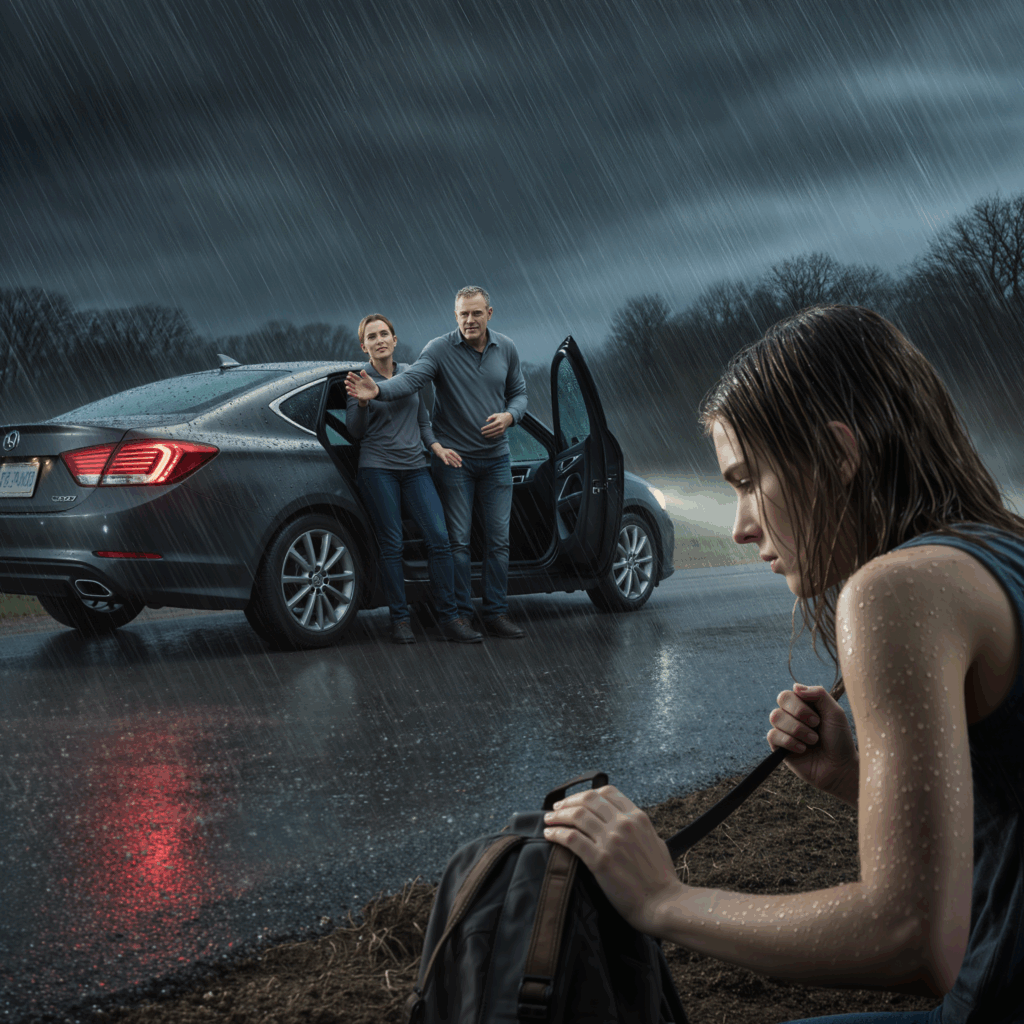
Instead, my father pulled onto a dark shoulder miles from anywhere, put the car in park, and said, “Get out.”
He didn’t turn around when he said it. He just stared straight ahead, at the wipers beating back the storm.
“I… I can’t even stand tonight,” I whispered. My legs were numb, my hands shaking from pain medication wearing off. “Dad, what are you talking about?”
“You’re a burden, Laya,” he said, voice flat. “We’re done.”
They left me on the side of a county road in the rain, with a backpack I hadn’t packed and a body that wouldn’t obey me.
They thought the story ended on that soaked strip of asphalt.
They never saw the second set of headlights waiting in the dark.
My name is Laya Wells. I’m seventeen years old, and the girl my parents tried to leave for dead became the one person who could bring down the company that helped break me in the first place.
Before we get to how a kid with a failing nervous system ended up standing in front of cameras and federal investigators, I need you to understand one thing: the people who called me their greatest burden? I became their worst nightmare.
Rain had been pelting the windshield for an hour by the time everything snapped.
Our family sedan hummed along the interstate, the heater turned too low, the dash throwing off that tired green glow that always made me think of waiting rooms. I sat in the back seat, tracing little hearts and stick figures into the fog my breath made on the window, watching cities disappear and nothingness replace them.
Something was wrong. Even through the haze of pain meds, I could feel it.
“Dad, where are we going?” I asked, raising my voice over the storm and the swish of the wipers.
No answer.
Mom stared straight ahead, face lit by oncoming headlights and the occasional flash of lightning. She hadn’t looked directly at me in weeks, not since my last hospital stay. Not since the latest specialist said “progressive” and “no clear options” and “palliative” while my parents’ faces went gray.
“Mom?” I leaned forward, trying to catch her eyes in the rearview mirror. “It’s pretty late for a doctor’s appointment.”
Dad’s fingers tightened on the steering wheel.
“We’re almost there,” he said finally, and his voice didn’t sound like his at all.
My name is Laya Wells. I’m seventeen, and tonight everything was about to change.
The neurological stuff started when I was twelve. At first, the tremors were little flickers that everyone blamed on nerves or “growing pains.” By fourteen, I needed a cane on bad days. By sixteen, the wheelchair in our trunk wasn’t “just in case” anymore—it was my ticket into school, into grocery stores, into another round of tests at the hospital where the nurses greeted me by first name.
Every MRI, every medication with a name longer than my arm, every specialist at yet another medical center swallowed another chunk of my parents’ savings. I knew that. What I didn’t know was how they had started doing the math.
One chronically ill daughter.
Too many medical bills.
Too much sacrifice.
Too heavy a burden.
We left the interstate and turned onto a narrower state road, then another, each one darker than the last. Tree branches arched over the asphalt, and the streetlights thinned out until they were just lonely dots in the rear window.
My medication was wearing off. Pain started to creep up my spine like cold fingers, followed by the familiar tremors in my legs.
“Mom,” I tried again, throat tight. “I think I need my next dose early. The bumps are making it worse.”
“You’ll be fine,” she cut in, the words sharp enough to slice through the air between us.
The last time she’d used that voice, she’d been fighting with my older brother.
A flash from the past hit me so hard I almost gasped.
My eighth birthday. A sheet cake in our tiny kitchen, chocolate with rainbow sprinkles and crooked blue icing that spelled out HAPPY BIRTHDAY LAYA in my mom’s careful hand. Dad hoisted me up onto his shoulders so I could smack my palm against the ceiling.
“Tallest eight‑year‑old in the county,” he’d boomed while my brother laughed.
Caleb had been seventeen then—lanky, already taller than Dad, with paint on his fingers and sunburn on his nose from too many soccer practices. He’d tied something around my wrist that day: a bracelet woven from thin strands of colored thread.
“One color for every year,” he’d said, knotting it gently so it rested against the little birthmark near my wrist bone. “I’ll add another one next birthday.”
That bracelet was still in my dresser drawer at home. He never got to add the ninth string.
Caleb disappeared the week after their biggest fight, a storm of raised voices and slammed doors that shook the whole house. I’d been eight and standing in the hallway clutching my stuffed bear while Dad shouted, “If you walk out that door, don’t you ever come back!”
He walked out anyway.
Mom’s eyes had been hollow for months after that. When I asked where my brother was, she would just say, “He went to find his own way,” like we were in some after‑school movie. But the way she looked at the front door when she thought no one was watching told me there was more to the story.
The car lurched suddenly, jolting me back into the present.
We were no longer on a paved road. Gravel pinged against the undercarriage as Dad steered us onto a dirt shoulder beside a two‑lane highway. No houses. No gas stations. No glow from a town up ahead. Just trees, rain, and the distant growl of thunder.
Dad killed the engine. The sudden silence inside the car made the rain sound even louder.
“Get out,” he said.
I gave a shaky laugh. “What? Dad, it’s pouring. Did we get a flat or—?”
“Get out.” Each word was clipped, like he was spitting out something sour.
He still wouldn’t turn around.
My heart started to race. “That’s… not funny.” I forced another laugh that died halfway out of my throat. “Seriously. What are we doing out here?”
“Take your backpack,” he said. “We packed your essentials.”
My gaze dropped to the floor. A small backpack rested by my feet. I hadn’t brought it.
“Mom?” My voice cracked. “What’s happening?”
For the first time all night, she turned in her seat to face me.
I didn’t recognize her.
Her eyes were dry, her mouth pressed into a hard line I’d only ever seen when bills arrived in the mail. Lightning flashed outside, illuminating her profile—the same woman who used to braid my hair and tuck me in and chase monsters out of my closet.
“We can’t do this anymore, Laya,” she said. “The bills. The appointments. Watching you… deteriorate. We’ve given everything we have.”
I stared at them, my pulse roaring in my ears. “But I’m your daughter.”
“You’re a burden,” my father said. There was no hesitation, no crack in his voice. “We have nothing left. No savings, no retirement, no life outside hospitals.”
“The community support dried up years ago,” my mother added, almost mechanically. “People moved on. The fundraisers stopped. Insurance won’t cover any more experimental treatments. We can’t watch you suffer anymore.”
“So your solution is to leave me on the side of the road?” The words sounded too calm, like they belonged to someone else.
Neither of them answered.
The trunk popped. A second later, my door yanked open and cold rain slammed into my face.
“Dad, please,” I begged as he reached for me. “Whatever I did, I’m sorry. I’ll try harder, I’ll—”
“It’s not about what you did.” His fingers clamped around my arm, strong and unyielding. “It’s what you are. What you’ve become.”
My legs, already unreliable, chose that moment to completely give out. I collapsed onto the muddy shoulder, pain exploding in my hip as my knees hit gravel.
“The backpack.” He tossed it down beside me. It landed in a puddle, water soaking through the fabric instantly.
I looked up at the two people who had once taped my kindergarten drawings to the fridge and cheered when I took my first steps.
Their faces were blank.
No tears. No guilt. Nothing that looked like love.
“Why?” I managed, teeth chattering.
My mother looked away.
My father turned his back, walked to the driver’s side, and got behind the wheel.
No goodbye. No apology. Not even a last‑second look back.
The doors slammed. The engine roared to life. Red taillights blurred in the rain, then disappeared altogether.
I tried to stand. My legs refused. Tremors rolled through me, stronger now, amplified by cold and fear. I clawed my way to the shallow ditch at the edge of the road, trying to get out of the way of any cars.
Headlights appeared in the distance, slicing through the dark. Hope flared.
I lifted a shaking arm.
The truck slowed for a heartbeat… then sped up and vanished into the night.
Maybe this was a nightmare brought on by medication and fever. Maybe I would wake up in a hospital bed with stale coffee smell and the distant beeping of monitors.
But the rain soaking through my thin sweater and the mud seeping into my jeans said this was real.
I don’t know how long I lay there, slipping in and out of consciousness. Minutes blurred into hours. Memories tangled with the present—birthday candles and MRI machines, my brother’s laughter and my mother’s distant eyes.
At some point, through blurred vision, I noticed headlights far behind me on the road. Not moving. Just… there. Dimmed, like the car was parked a ways back.
Had someone followed us?
A car door opened, its slam barely audible over the storm. Footsteps squelched through the mud, coming closer.
Fear locked my throat. Was this help… or someone ready to finish what my parents had started?
The figure that emerged through the curtain of rain was tall, wearing a dark jacket already plastered to his body.
He crouched beside me, creating the smallest shield against the rain with his own frame. A gentle hand brushed soaked hair away from my eyes.
“It’s okay,” a man’s voice whispered, rough and familiar. “I’ve got you.”
I tried to focus on his face, but darkness crowded my vision.
Strong arms lifted me, careful of my shaking limbs, pulling me against a chest that radiated warmth.
“You’re safe now,” the voice murmured near my ear. “I never forgot you.”
I knew that voice. Knew it from bedtime stories and soccer sidelines and the night he’d shouted with Dad.
A brother’s voice.
“Caleb,” I breathed, or thought I did, as the world finally went black.
Warmth was the first thing that told me I hadn’t died.
Not the clammy, electric warmth of an ER, but the steady, uncomplicated heat of a woodstove.
I opened my eyes to a low ceiling with exposed beams, wooden walls, and a soft orange glow flickering in the corner from a small stove with a glass door. I lay on a bed piled high with handmade quilts. An IV pole stood beside me, clear fluid dripping down a line taped to my arm.
Someone had changed my clothes. I was in a soft flannel nightgown I didn’t recognize. My old jeans and sweater were nowhere in sight.
Rain still pattered against the roof, but now it was a muted, almost comforting sound instead of a threat.
On the wall opposite the bed hung framed photographs—mountains under snow, a forest path in fall, a lake at sunset. Another showed the silhouette of a guy standing on a cliff edge, arms outstretched as dawn broke around him.
My gaze caught on the small table beside the bed.
Resting there, neat and dry, was a bracelet made of colored thread. Faded now, but unmistakable.
One color for every year.
I reached for it with a shaking hand just as a voice came from the doorway.
“You’re awake.”
I jerked my head toward the sound.
A tall man stood there holding a steaming mug in both hands. Late twenties, broad shoulders, the lean build of someone who worked outside more than inside. His brown hair was a little too long, curling at the nape of his neck, and stubble shadowed his jaw.
But it was his eyes that made my heart stutter.
Deep blue. Familiar.
“Caleb,” I whispered, my throat dry and raw.
He set the mug down and crossed the room in three strides.
“Hey, Laya‑Bean,” he said, using the nickname I hadn’t heard in almost a decade.
He adjusted the pillows behind my back with practiced gentleness and eased me up so I could sit.
“How… when…?” I couldn’t seem to land on a complete sentence. Questions crashed over each other in my head.
“Drink this first.” He pressed the warm mug into my hands. “It’s just tea with honey. Your voice sounds like sandpaper.”
The first sip hurt in a good way, like stretching a stiff muscle.
As the fog in my brain cleared, the memory slammed back into place.
“They left me,” I said, the words strangled. “Mom and Dad. They just… drove away.”
His jaw tightened. “I know. I saw.”
“You followed them?”
“For weeks,” he said. “I had a feeling something was off. Figured if I was wrong, I’d waste some gas. If I was right…” He glanced toward the window where rain streaked down the glass. “I wasn’t about to let them make you disappear.”
“But you’ve been gone for years,” I said, hurt I’d buried for so long shoving its way to the surface. “No calls. No letters. Nothing. How did you even find me?”
He exhaled, running a hand through his hair—same old gesture, older version of the brother who used to steal my fries.
“It’s a long story,” he said. “Short version? I never really left you. I left them.”
The words hung in the air between us.
“When Dad told me to get out, I was fifteen seconds away from dialing 911,” I admitted. “I didn’t because… I don’t even know why. Shock, maybe.”
Caleb’s mouth twisted. “When I walked out that door at seventeen, I thought that was rock bottom. I was wrong. That night on the road? That was rock bottom. For you. For them. For what they thought family meant.”
He shifted on the edge of the bed.
“The night I left,” he said, “you’d just been diagnosed. Dad refused to take you to a neurologist in Boston because it was ‘too expensive.’ I’d been saving from summer jobs, so I offered to help pay. He said I was undermining him, that I didn’t understand responsibility.”
I remembered the muffled shouting, the way the walls shook.
“‘If you walk out that door, don’t ever come back,’” I murmured.
He nodded. “So I walked. With fifty bucks in my wallet and a duffel bag.”
“What happened to you?” I asked.
“Some of it, you don’t need the details.” He gave a humorless little laugh. “I was homeless for a while. Slept in shelters when they had space, in my car when I had one. Took whatever work I could get—construction, washing dishes, hauling junk. Got in some trouble I’m not proud of.”
He tapped a small tattoo on his forearm I hadn’t noticed.
“But eventually I got my GED. Found steadier work. Met a guy named Frank on a construction site in Denver who caught me sleeping in my car in the middle of a snowstorm.” A faint smile softened his face. “He dragged me into his cabin, told me I could stay till spring if I made myself useful.”
“How long did you stay?”
“Almost three years,” Caleb said. “He was a Vietnam vet, lived off the land. Taught me how to build, grow food, fix things, live off‑grid.” His eyes flicked around the cabin. “You’re sitting in the final exam.”
I looked again—at the solar‑powered lantern in the corner, the neat shelves of canned food, the clothesline strung near the stove.
“And when he wasn’t teaching me how to survive,” Caleb added quietly, “he taught me about justice. He always said revenge burns you up from the inside, but justice? Justice lights the way for everybody else.”
He let that sit for a second.
“When I finally tracked you down, you were already seventeen,” he said. “Old enough to decide some things for yourself. So I started building a case. Because we’re not just talking about messed‑up parenting.” He reached for something on the nightstand and set it on my lap.
A leather‑bound journal, edges worn soft.
“I found this in a storage unit they were renting under Mom’s maiden name,” he said. “Along with some other things. I think you should read it when you’re ready. There’s more to this than either of us understood.”
I ran my fingers over the cover. The weight of it felt heavier than paper and ink.
“What else did you find?” I asked.
He hesitated.
“While you were out, I made some calls,” he said. “Checked hospital records. Talked to a friend who works in social services. Your parents didn’t just abandon you, Laya. They emptied your medical fund first.”
“The fundraiser money?” My voice came out as a rasp. “The bake sales, the GoFundMe, the checks people mailed?”
He nodded, anger simmering beneath the calm. “Every dollar people donated so you could see specialists? Gone. And then…” He swallowed. “They reported you as a runaway. Told everyone you walked out on them.”
The room tilted.
“So, on paper,” he continued, “you’re a seventeen‑year‑old who bolted in the middle of the night. Not a disabled kid your parents dumped in a ditch.”
It wasn’t enough that they’d left me there. They had rewritten the story so I was the problem.
“I don’t want revenge,” Caleb said, his voice low but steady. “I want justice. For you. For whatever else they’re hiding.”
That night, while the rain drummed on the metal roof, I cracked open the journal.
My mother’s handwriting stared back at me. Loopy letters. Occasional ink blots. The first entries were simple—holiday menus, notes about Caleb’s science fair, my first day of kindergarten.
Then the tone shifted.
The morning sun filtered through handmade curtains three weeks later as I lay on a yoga mat in the cabin’s main room, arms trembling from another set of exercises.
“Arms up,” Anna said. “Good. Hold for ten.”
She was in her mid‑thirties, with close‑cropped dark hair, warm brown eyes, and the kind of no‑nonsense calm that made you believe her when she said, “You can do this.” A faded Army T‑shirt peeked out under her hoodie. The sleeves were pushed up, revealing a patch of rippled scar tissue along her right forearm that looked like melted wax.
“Seven… eight… nine… ten.” Her count was steady. “Okay, down.”
I lowered my arms, sweat beading on my forehead even though the morning air was cool.
“You’ve gained five degrees of mobility in your shoulders since we started,” she said, jotting something in a little notebook.
“Doesn’t feel like much,” I muttered, reaching for my water bottle.
“Healing’s not a straight line,” Anna said. “Especially after what you’ve been through.”
Anna Kim wasn’t just Caleb’s friend. She’d been a combat medic before coming back to run a small clinic about thirty miles away. Now she drove out three times a week to help with my physical therapy and keep an eye on my meds.
She treated me like a patient and a person, not a problem to solve.
After she left that day, promising to be back Friday, Caleb helped me into a chair on the front porch.
If you drove past his land from the road, you’d see nothing but trees. From the porch, the place opened up like a secret world—garden beds lined in neat rows, a small greenhouse, a workshop with its door propped open. Beyond that, woods, a stream glinting through the trees, and not a neighbor in sight.
Inside, the cabin was small but wired like something out of a survivalist forum. Solar panels fed batteries. Rain barrels lined the back wall. A satellite dish tucked under the eaves connected to a secure computer system in an underground room accessed through what looked like a root cellar.
“It’s not paranoia if they’re really after you,” Caleb had joked the first time he showed me the security monitors.
Now, watching him pull carrots and lettuce from the garden, I asked, “You never told me how you learned all this.”
He straightened, brushing soil from his hands.
“Frank,” he said. “The guy I told you about. He lived outside a tiny town in Colorado, way off any grid. Said the only way to stop certain people from controlling you was to stop needing them.”
He walked over and dropped a carrot in my lap.
“Besides, this way I can feed you something that didn’t come from a hospital cafeteria,” he added.
That night, the storm that rolled in was mostly thunder and theatrics. We sat near the woodstove while rain drummed on the roof, the journal open between us.
“Have you read all of it?” I asked.
“Enough,” Caleb said, eyes on the flames. “Enough to know there’s something bigger than bad parenting going on. The entries about ‘the deal’…”
He broke off.
I flipped to one of the pages that had kept me up for two nights.
Robert signed the final paperwork today. $30,000 deposited immediately, quarterly payments to follow. He says this will solve our financial problems, give us the life we deserve. But at what cost? The doctor explained the protocols, said risks were minimal, that L. will be helping other children by participating. But I saw something in his eyes when he mentioned possible side effects. I should have said no. God forgive me. I should have said no.
“They sold me,” I whispered. “When I was a toddler.”
Caleb’s jaw clenched. “I think they enrolled you in some kind of trial,” he said. “I keep seeing the same name on your old medical forms.”
He flipped his laptop around so I could see the logo.
NEUROVANCE RESEARCH.
“A private pharmaceutical company specializing in neurological treatments,” he said. “On paper, they’re innovative. In the stuff my friend pulled from an internal database… not so much.”
“You think my illness isn’t… natural?” The word felt strange.
“I think you were part of an experiment,” he said. “And when the side effects became too dangerous—and the money got tight—they decided to cut their losses.”
Before the rage could fully form in my chest, my phone buzzed across the table.
A text from Anna.
We need to talk. In person.
The next day she showed up at the cabin with her hair still damp from a rushed shower and worry etched into the lines around her mouth.
“You’ve been made,” she said, dropping her bag near the door.
Caleb’s posture shifted instantly. “What happened?”
“Two guys came into the clinic this morning,” she said. “Suits, shiny shoes, definitely not local. They had a printout of Laya’s hospital photo. Said they were relatives looking for a runaway.”
My stomach dropped.
“They asked specifically about a girl with a neurological condition who might be hiding in the area,” Anna went on. “One flashed an ID when he thought I wasn’t looking. It wasn’t police. It looked corporate. Security or private investigations.”
“How detailed was the photo?” Caleb asked.
“Down to the birthmark by her wrist,” Anna said quietly.
She glanced at the bracelet now circling my wrist again—the one Caleb had found in my old room and brought here.
“They’re not just guessing, Caleb,” she added. “They know exactly who they’re looking for.”
Hours after Anna left, a plain white envelope appeared on the cabin’s front stoop.
No knock. No car in the drive.
Just an envelope, already speckled with rain.
Caleb picked it up using a tissue and slit it open carefully.
Inside was a single line typed in a clean, impersonal font.
YOU WERE NEVER MEANT TO SURVIVE.
STOP DIGGING.
We went straight to the underground room. Caleb pulled up the security feed from earlier that afternoon.
On the screen, thirty minutes of quiet forest played out.
Then a dark sedan rolled slowly into view on the far edge of the property. It stopped. A figure in a dark jacket climbed out, walked toward the cabin with quick, efficient steps, slid the envelope under the door, then jogged back to the car and drove away.
“They found the cabin,” I said, throat tight.
“They found this building,” Caleb corrected. His voice was calm, but his eyes were flint. “They don’t know what else is here. Or what we already know.”
Sleep didn’t really happen that night.
When the first light of morning filtered through the trees, I opened Mom’s journal again and flipped forward.
The entry that stopped my breath was dated a little after my third birthday.
Robert says we’re doing the right thing, that the doctors at NeuroVance are the only ones who truly understand what’s happening to our daughter’s brain. $30,000 already in the bank, more coming every quarter. He says we can finally pay off the credit cards, fix the roof, take Caleb on a real vacation. The doctor says the treatment could be life‑changing for her. But when I asked about side effects, he wouldn’t look me in the eye. I dream about her screaming and no one being able to help. I should pull her out. But where would we go? What would we do without the money?
My stomach knotted.
“I was a paycheck,” I said when Caleb came in with coffee. “A research subject and a paycheck.”
He set the mug down, his face hard.
“According to their bank records,” he said, tapping his laptop, “they got regular deposits until you were fourteen. Right around when your symptoms got too big to explain away. That’s when the payments stopped.”
“So when the trial money dried up and my condition got worse…” I finished, “…I went from investment to liability.”
“That’s the math they did.” He nodded once. “But that’s not where this ends.”
Anna came back that afternoon with new intel and a folder under her arm.
“I might have found someone who can fill in the blanks,” she said, spreading out printed pages on the table. “Dr. Rena Voss. She used to lead a research team at NeuroVance. She resigned suddenly three years ago, no explanation. She’s been teaching biology at a community college two hundred miles away under a lot less publicity than she used to have.”
“You think she worked on whatever they did to me?” I asked.
Anna nodded. “When I reached out through a medical contact and mentioned a seventeen‑year‑old with progressive neurological damage that started after early childhood ‘treatments,’ she went quiet. Then she said one sentence: ‘We need to talk, but not over the phone.’”
“What’s the catch?” Caleb asked.
“No electronics at the meeting,” Anna said. “And we go where she chooses. She’s scared.”
“Good,” Caleb said. “Scared means she knows how bad it is.”
Two days later, as we were loading up Anna’s car for the trip, Caleb froze at the window, binoculars halfway to his face.
“Black SUV,” he said. “Parked on the county road. Same shiny shoes.”
“Seriously?” I shuffled closer with my cane.
“Two guys. Same vibe Anna described.” He lowered the binoculars. “Okay. New plan.”
“I don’t like the way you said that,” I muttered.
“I’ll lead them away,” he said. “You and Anna go meet Dr. Voss.”
“Absolutely not.” Fear shot through me. “I’m not losing you again.”
“You’re not,” he said, voice steady. “I’ve got three different routes mapped, a go‑bag in the truck, and more experience disappearing than they do finding people. What we don’t have is another chance to talk to the woman who might be able to prove what they did to you.”
He caught my hand.
“I didn’t drag you out of that ditch just to sit in the dark while they keep winning,” he said. “Trust me on this one.”
Trust used to be easy when I was eight and he was invincible.
It was harder now.
But I nodded.
An hour later, Anna and I watched from the treeline as Caleb’s beat‑up truck rumbled past the SUV. The men inside straightened. A moment later, the SUV pulled out to follow.
“Showtime,” Anna said, helping me into her sedan.
The public meeting spot Dr. Voss chose was a picnic area at a state park. On paper, it was perfect—isolated enough for privacy, public enough that nothing too wild could happen without witnesses.
The woman waiting at the far table wasn’t what I expected.
She was small, early fifties, in jeans and a rain jacket, with salt‑and‑pepper hair pulled into a low ponytail. Her hands twisted around a paper coffee cup, fingertips tapping out an anxious rhythm.
When she saw us, her gaze went straight to the tremor in my left hand and the stiffness in my gait.
“Phase three,” she said quietly as Anna helped me sit. “Tremors, progressive weakness, episodes of collapse. You were in the phase‑three trial, weren’t you?”
I swallowed. “I guess so. I was three when it started. Nobody told me what it was.”
Her mouth trembled, and for a second, I thought she might bolt.
“I need to know how much you already understand,” she said. “Because it’s dangerous for all of us to be talking about this.”
“We know my parents signed a contract with NeuroVance when I was a toddler,” I said. “They got quarterly payments. I started ‘treatments.’ My symptoms got worse. We found internal memos hinting that safety protocols were being… ignored.”
“And we have evidence they were paid out of a trial fund,” Anna added. “Plus bank records, medical files, and a threat delivered to the cabin after we started digging.”
Dr. Voss closed her eyes briefly.
“It was supposed to be revolutionary,” she said. “A treatment for early‑onset neurological disorders. In animal studies, we saw actual reversal of symptoms. Neural regeneration. It was the kind of data that gets you keynote speeches and magazine covers.”
Her voice turned bitter.
“When we moved to human trials, the company was under pressure from investors,” she went on. “Results weren’t coming fast enough. So corners were cut. Safety protocols were… rewritten. Doses increased. Follow‑up shortened.”
“How many kids?” I asked, though part of me already knew.
“Twenty‑seven in phase three,” she said. “Twenty‑four showed severe adverse effects within five years—tremors, cognitive decline, seizures, mobility issues. Three remained on record as ‘stable.’”
My stomach dropped.
“And the other three?” I asked.
“One family relocated overseas,” she said. “We lost contact. One boy died in a car wreck at sixteen, though I’ve always had questions about that. And then there’s you.”
She studied me like she was trying to reconcile a file with a real person.
“You shouldn’t have survived this long,” she said softly. “Not with the level of neurological damage in your charts.”
“So that’s why they want me,” I said. “Because I’m proof of what they did. And I can talk.”
“You’re living evidence,” she said simply. “And worse, you’re old enough to seek justice.”
She reached into her bag and pulled out a small flash drive.
“I made copies before I left,” she said. “Trial protocols, patient data, internal emails where executives acknowledged the risks and decided the potential profits outweighed them.”
She pressed the drive into my hand like it was something hot.
“It won’t give you your health back,” she said, voice shaking. “But it might help you burn down the people who did this.”
Her phone buzzed then. She frowned, checked the screen, and went pale.
“We need to go,” she said, standing abruptly.
She held out her phone so we could see the text preview.
Unknown car asking for you at your apartment. Claimed to be your brother. No brother listed in your file.
“They found my address,” she whispered. “I don’t know if they followed me here, but I’m not taking chances.”
We split up fast—Dr. Voss heading west in her car, Anna and I taking the most indirect route back to the sanctuary.
When we got there, the cabin was empty.
No Caleb.
No truck.
I tried not to panic. I failed.
Hours crawled by, measured in cups of tea I couldn’t taste and the steady beep of the security monitors.
Just after midnight, my prepaid flip phone buzzed.
Unknown number. One text.
ARRESTED. FALSE CHARGES. LAWYER NEEDED.
STORAGE UNIT ON MAIN ST. KEY UNDER THIRD ROCK FROM NORTH CORNER.
DON’T COME. NOT SAFE.
Anna read it over my shoulder.
“He knew they’d move on him,” she said. “That’s why he set this up.”
Her next call was to a lawyer she trusted, one who owed her a favor. While she explained Caleb’s situation, I translated the second half of his message.
The storage unit.
The one where he’d found Mom’s journal.
We went at dawn, when Main Street was still half asleep and the only people out were dog walkers and the guy hosing down the sidewalk in front of the diner with the U.S. flag magnet on its door.
The key was exactly where Caleb said it would be. Inside the unit, a metal filing cabinet waited, drawers labeled in his cramped handwriting.
MEDICAL.
FINANCIAL.
NEUROVANCE.
We hauled everything into Anna’s SUV and locked the unit behind us.
At the bottom of the last drawer was a sealed envelope with my name.
Inside were neatly typed legal papers.
A petition for emancipation.
Evidence of parental abandonment.
Draft affidavits detailing the night on the road, the empty medical fund, the altered records.
And a sticky note in Caleb’s handwriting.
When you’re ready to stop surviving and start fighting, take this to court.
That afternoon, while Anna helped sort documents into something a lawyer could use, another text came through.
COURT DATE THURSDAY. BE READY.
With Caleb in a cell on trumped‑up charges and people in suits circling, it fell to me.
I had been a patient, a problem, a paycheck, and a secret.
I was done adding “victim” to that list.
We filed emergency motions the next day with the help of the lawyer Anna brought in—injunctions to protect Caleb, petitions for my legal emancipation, and a request for a formal investigation into NeuroVance and my parents’ role in the trial.
That night, back at the cabin, I opened Mom’s journal to the last entry.
If she finds this, run. They won’t stop until the girl is gone. I tried to protect her. Failed instead. The money’s gone. Robert’s gambling took it all. They know she shouldn’t have survived this long. They’re watching. God forgive us for what we’ve done.
I closed the journal and set it beside the bracelet on my nightstand.
“Let them come,” I whispered into the dark.
Three days later, the steps up to the county courthouse might as well have been a mountain.
Reporters clustered near the doors, badges swinging from lanyards, cameras already rolling. Someone had taped a laminated American flag to the side of one camera, the edges curling in the summer heat.
Anna walked beside me, close enough to catch me if my cane wasn’t enough.
“You sure about this?” she murmured. “Once you speak, you can’t put it back in the box.”
“I’ve been in someone else’s box my whole life,” I said. “A file, a chart, a diagnosis, a problem. I’m done with quiet.”
The press conference was Caleb’s lawyer’s idea.
“They can’t make you disappear if the whole country knows your name,” he’d said.
Now, standing behind a cluster of microphones, I understood why my heart felt like it was trying to punch a hole through my ribs.
Cameras zoomed in. Microphones sprouted like weeds.
I took a breath.
“My name is Laya Wells,” I said, voice shaking on the first word but steadier on the second. “Three weeks ago, my parents drove me to a deserted road and left me there in a storm because of my chronic illness.”
A murmur rippled through the crowd.
“What they—and a lot of people—didn’t know,” I went on, “is that my condition isn’t natural. It’s the result of experimental treatments I received as a child, without any real consent, in exchange for hundreds of thousands of dollars paid to my parents by a private pharmaceutical company.”
The murmurs got louder.
“In a trial run by NeuroVance Research,” I said, “twenty‑seven children were given a drug that was supposed to change lives. According to an internal scientist, twenty‑four of us developed severe neurological damage. I am one of only three who survived.”
I felt the hinge of the story shift right there. The air changed.
I talked about the contract, the payments, the years of treatments that made me worse instead of better. I described how my parents emptied my medical fund, reported me as a runaway, and then tried to make me disappear for good.
“They called me their greatest burden,” I said. “So they tried to erase me. I’m here to make sure that doesn’t happen—to me or to anyone else those people decide is inconvenient.”
As I spoke, phones buzzed. Reporters tweeted. A hashtag crawled across screens inside the courthouse where the local station had TVs running.
#JusticeForLaya.
By the time I stepped away from the microphones, the story had already started trending.
Other families began to come forward—parents whose kids had been in “promising trials” with disastrous results, guardians who’d signed consent forms they didn’t fully understand.
Public pressure built fast.
Caleb was released on bail two days later.
The charges against him—trespassing, resisting arrest, obstruction—fell apart under even mild scrutiny.
As we walked down the courthouse steps together, cameras flashed.
“You did it,” he whispered, one arm protective at my back. “You blew it wide open.”
“This is just the opening act,” I said.
And it was.
The Justice Department announced a formal investigation into NeuroVance within a week. Lawmakers started asking questions on camera. A federal panel scheduled hearings on clinical trial ethics.
Dr. Voss agreed to testify.
“We might actually get somewhere,” Anna said as we watched the news one evening from the couch, my legs propped up, my bracelet sliding loosely around my wrist.
But when powerful people feel cornered, they don’t usually fold. They double down.
A few days before the hearing, Dr. Voss’s house exploded in the middle of the night.
The local news called it a gas leak. She survived, barely, with severe burns. Her research burned with the rest of the house.
Anonymous sources suddenly appeared in articles questioning her mental health, hinting that she had “an axe to grind” and “a history of unstable behavior.”
“This isn’t over,” I said, anger making my hands shake. “They’re trying to bury her the way they tried to bury me.”
“So we go bigger,” Caleb said. “Find a platform they can’t easily spin.”
The offer came two days later.
A national investigative news program wanted to interview me—live. No editing, no delay.
In the green room, a makeup artist dabbed concealer under my eyes while an intern set a bottle of water on the table next to a tiny American flag stuck into a pot of fake greenery.
“We’re on in five,” the producer said from the doorway.
Caleb squeezed my hand.
“You sure?” he asked softly. “Once this airs, there’s no going back to anonymity.”
“I’ve been invisible my whole life,” I said. “If they’re going to stare, I’d rather it be for the truth.”
The lights on set were hot and unforgiving.
The host—a serious woman with decades of interviews under her belt—started from the beginning. The illness. The trial. The abandonment on the side of the road. Caleb’s rescue. The storage unit. The flash drive from Dr. Voss.
“These are extraordinary allegations,” she said at last. “What evidence do you have to back them up?”
It was the moment we’d prepared for.
I nodded. Caleb handed me a folder.
I pulled out the document that had haunted me since the first time I saw it.
“This is the original contract my parents signed when I was three,” I said, holding it so the camera could zoom in. “In exchange for allowing an unproven neurological drug to be administered to their toddler, they received approximately $400,000 over eleven years.”
The host’s eyebrows rose.
“And you believe this drug caused your condition?” she asked.
“According to internal records,” I said, “all twenty‑seven kids in the phase‑three trial developed similar symptoms. Twenty‑four of us suffered severe damage. Three of us are still alive. I’m not speculating. Their own data shows it.”
I could have stopped there.
But I thought about the ditch. The rain. The way my father had called me a burden like it was a fact instead of a choice.
So I did something we hadn’t rehearsed.
Slowly, every muscle screaming in protest, I pushed myself out of the chair.
“Laya—” Caleb started, half rising.
“I’ve got it,” I said through my teeth.
I stood.
Without my cane.
Without anyone holding me up.
My legs shook. Pain shot up through my spine. The host’s eyes widened. Someone in the control room probably swore.
“For years,” I said, voice steady even as my body trembled, “doctors told me I’d never stand on my own again. That what NeuroVance’s drug did to my nervous system was permanent.”
I looked straight into the lens.
“This is what fighting back looks like,” I said. “This is what they couldn’t take from me—my will to stand up.”
Somewhere, in some living room or break room or dorm lounge, I knew a kid in a wheelchair was watching.
I knew someone who’d been written off as “too broken” sat up a little straighter.
The image of me standing there—braced but unassisted, thin but fierce, bracelet glinting at my wrist—was replayed on news loops for days.
By the next afternoon, NeuroVance’s stock had nose‑dived.
By evening, the Justice Department announced criminal charges against several executives.
My parents’ lawyer released a statement claiming they’d been misled by the company, that they “never would have agreed” if they’d known the true risks.
Funny. Mom’s journal said otherwise.
One year later, I stood at the edge of the property while workers bolted a new sign into the ground.
WELLS FOUNDATION FOR MEDICAL ETHICS AND SURVIVOR SUPPORT.
The sanctuary had grown.
The original cabin was still there, its porch swing now a favorite spot for visitors who needed quiet. Anna’s office occupied what used to be the tiny back bedroom. New buildings dotted the clearing—one for counseling, one for physical therapy, another with rooms for families who needed a place to land when everything fell apart.
The underground room now housed a secure archive of documents and a small team of lawyers and advocates who spent their days making sure no one else’s story got buried under paperwork.
NeuroVance no longer existed. Forced into bankruptcy, its assets seized, its name toxic.
Several executives were serving sentences. Others were still fighting charges. A settlement fund provided compensation for the families of the twenty‑seven children in the trial—those who survived and those who didn’t.
My parents had faced their own reckoning—legal charges, public outrage, financial ruin. Last I heard, they’d sold the house I grew up in to pay for lawyers.
“Ryan’s session went well today,” I said as Caleb came to stand beside me, watching the workers.
“The twelve‑year‑old?” he asked.
I nodded. “He stood on his own for almost a full minute.”
Caleb smiled. “He’s got a good teacher.”
I glanced down at my cane.
I still needed it most days. But I could walk short distances without it now. A victory no one had predicted.
As we headed back toward the main house, Anna called from the porch.
“Mail drop!” she said, waving a stack of envelopes.
She sorted them on the porch table—grant notices, donation receipts, a hand‑drawn card from a kid who’d stayed with us for a month.
“And one for you,” she said, holding up a thin envelope with a return address that made my breath catch.
County Hospice Center.
Inside was a single page.
Laya,
The doctors say I have weeks, maybe days. Lung cancer. Too late for anything but comfort care.
I know you won’t forgive me. I don’t deserve it. I’m not asking.
But before I go, I need you to know you were always the strongest person I’ve ever known. What we did was unforgivable. Your father called it survival, but it was greed. Plain and simple.
The woman you’ve become—standing up, speaking out, helping others—that wasn’t us. That was you. It was always you.
Your mother,
Ellen Wells
No tears came.
Some wounds scab over. Some stay open, even when you build a life around them.
I folded the letter, slipped it back into the envelope, and set it beside the bracelet on my dresser.
That evening, as fireflies blinked in the tall grass and the sky turned watercolor shades of pink and gold, I found Caleb on the porch steps, strumming idly on an old guitar Frank had given him.
“How did you know?” I asked, leaning against the railing.
He glanced up. “Know what?”
“That night,” I said. “On the road. How did you know to be there?”
He looked back out at the trees.
“I’d been tracking them for weeks,” he said. “Their credit‑card charges. The house suddenly going on the market. A new suitcase. A map to a state where they didn’t have any family. And the way they’d been pulling money out of your medical fund in small chunks so the bank wouldn’t flag it.”
He plucked a few more notes.
“I knew they were up to something,” he said. “I just didn’t know what until they got in the car that night without you using your wheelchair ramp and took the back roads instead of the interstate.”
“You could’ve called the police,” I said.
“And said what?” he asked. “That I had a bad feeling? I needed to catch them in the act. So I followed. When I saw them drag you out of the car and drive off…” He broke off, jaw tightening. “I almost ran them off the road.”
“Why didn’t you?”
“Because then I saw you in that ditch,” he said. “And suddenly, nothing mattered except getting you out of there.”
I swallowed.
“After everything they did to you,” I said quietly, “after all those years apart… why risk everything?”
He didn’t hesitate.
“Because you were never a burden to me,” he said.
The next day, the town council held a small ceremony in the community center, honoring the foundation’s work.
The room smelled like bakery sheet cake and coffee. A framed flag hung crooked over the stage. People who’d once dropped coins into donation jars for “that sick girl” now clapped as we walked in.
When they asked me to say a few words, I walked to the mic, my bracelet cool against my skin.
“A year ago,” I said, “I was left on the side of the road like trash by the people who were supposed to protect me. I was a line item on a balance sheet, a box checked on a consent form, a problem too expensive to keep.”
I looked at Caleb and Anna standing in the back, side by side.
“But in losing what I thought was my family,” I went on, “I found my true home. In facing betrayal, I discovered a strength I didn’t know I had. And in helping other survivors heal, I found my own path out of the dark.”
I lifted my wrist slightly, letting the bracelet catch the light.
“I was thrown out to die,” I said, “but instead, I found my reason to live.”
That night, I walked alone to the edge of the property.
The moon hung full and bright above the trees. The campus lights behind me cast long shadows across the grass. My legs trembled with fatigue, but I left the wheelchair on the porch.
I wanted to feel this walk.
I stood under the open sky, small and solid and exactly where I was meant to be.
Footsteps crunched on gravel behind me.
“You okay?” Caleb asked, coming to stand at my side.
“I’m more than okay,” I said, smiling. “I’m home.”
We stood there in silence, two survivors of different storms who had somehow steered each other into safe harbor.
The road ahead wouldn’t be easy. My condition would always be part of my life. The fight for ethical trials and real consent would never truly be finished.
But for the first time, I wasn’t moving through it as someone else’s burden.
I was moving through it as myself.
Have you ever wondered how much strength is hidden in the people the world writes off as too broken to matter? Someone once left me on the side of the road in the rain and decided my story was over.
Now I’m the one changing lives—and bringing down empires built on kids like me.
If my journey from victim to victor hit you in the gut, tap follow, hit like, share it with someone who needs to hear it. Because this isn’t just my story.
It’s a warning—to anyone who thinks a “burden” can’t burn your whole empire to the ground.
Leave a Reply