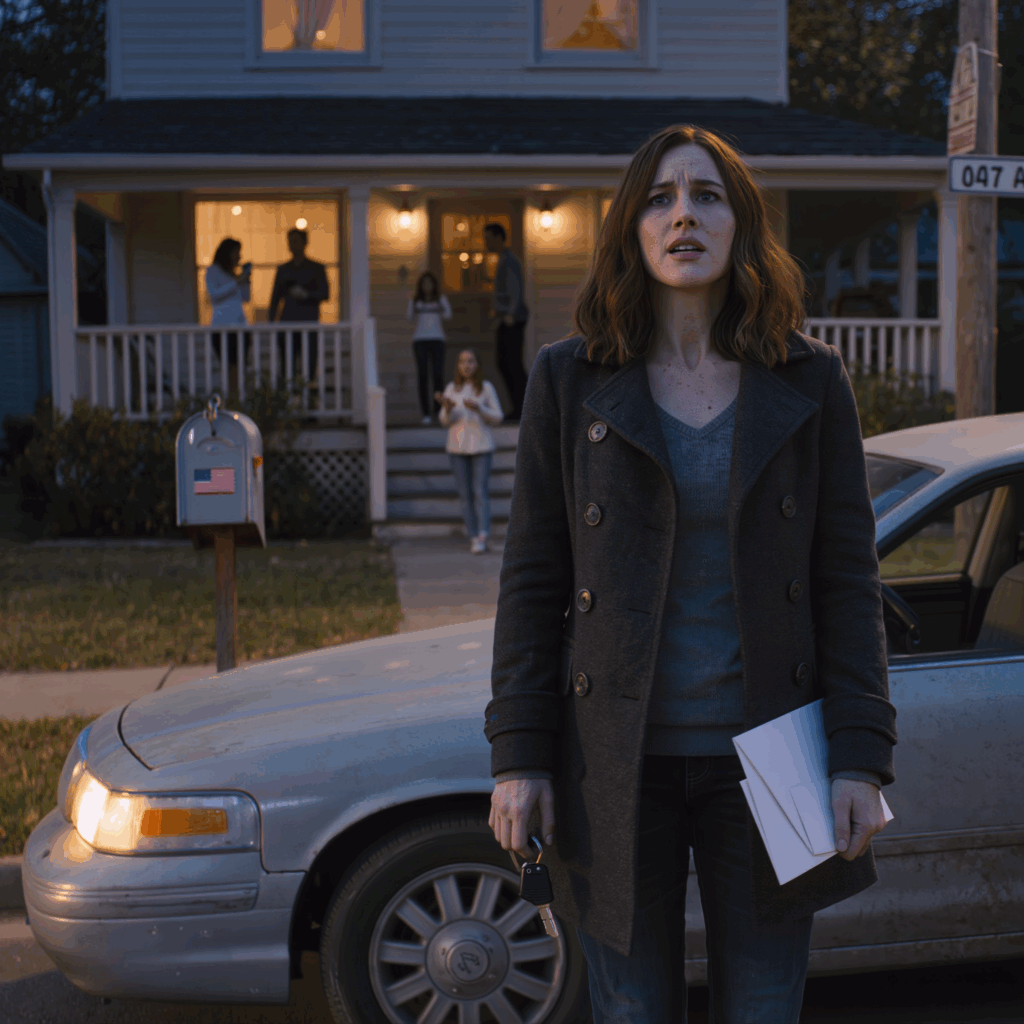
My mom always said our house looked “properly American” at night.
That night, sitting in my car three houses down, I watched that same house like it was a stranger.
At 8:13 p.m., their lights went out.
The porch went dark first, a flicker and then nothing, like a movie that had just run out of film. The living room windows followed, the soft gold glow collapsing into shadow. For a heartbeat, Maple Avenue held its breath.
I knew exactly why their power went out.
Because their new landlord had made a call.
Me.
Three years earlier, my life had been reduced to a single sentence.
“Start packing. We’re turning your room into a home gym for your sister.”
My mom said it without looking at me. She stood at the stove, flipping chicken in a pan, the smell of garlic and lemon filling the kitchen like this was just another Tuesday in suburban New Jersey. The late-afternoon sun slanted through the window over the sink, glinting off the fridge where that same crooked American flag magnet held up Madison’s honor roll certificate.
Mine had been taken down months ago to make room.
I was still in my work uniform, polo shirt and black pants, a name tag that said AVA in blocky, cheerful letters. Grease dots stained the hem from my morning shift at the diner. My feet ached. My brain ached more.
I blinked at her. “I’m sorry, what?”
She finally turned, spatula in hand, ponytail pulled too tight, eyes already impatient. “You heard me. Start packing. Madison needs space for her new equipment. We’re turning your room into a home gym.”
The words didn’t even sound real. “My room,” I repeated slowly. “You’re turning my room into a gym.”
My dad cleared his throat from behind his newspaper at the table like I’d just interrupted a commercial break. “It’s not personal, Ava,” he said, not looking up. “You’re an adult now. It’s time to move out and make your own way.”
That sentence, right there, was the first crack in the foundation.
I stared at him. “I’m barely paying off my loans,” I said, trying to keep my voice steady. “You know that. I work two jobs. I’m hardly ever here because I’m paying for my degree. Remember that?”
My mom shrugged, like I’d mentioned the weather. “You’re barely here anyway,” she said, reaching for the salt. “Madison actually uses the house. She needs space for her treadmill and weights. Don’t be dramatic, sweetheart. You knew you weren’t staying forever.”
“That last part hit harder than the first,” I murmured.
“Don’t start,” she snapped, finally catching my eyes. “You always make everything so heavy.”
Madison, my younger sister, leaned against the fridge, sipping a green smoothie like she was on some lifestyle talk show. Perfect hair blown out, perfect teeth glowing against her tan, her phone on the counter recording a time-lapse of her own reflection.
“Don’t take it so hard,” she said sweetly. “You can stay at a cheap apartment downtown. That’s what independence is, right?”
Her tone was sugar; her eyes were knives.
I looked at her, at the honor roll certificate held up by the crooked flag magnet, at the stack of Amazon boxes labeled RESISTANCE BANDS and YOGA MAT propped against the wall like my eviction notice.
I wanted to scream.
Instead, something colder crawled up my spine.
“Fine,” I said, my voice unfamiliar even to me.
Mom exhaled in relief like I’d finally passed some test. “That’s mature of you,” she said, turning back to the stove. “We’ll give you a couple of weeks to sort yourself out.”
She didn’t ask if I had anywhere to go.
No one did.
That was the moment I realized I wasn’t part of the house anymore. I was clutter to be cleared.
I didn’t slam my chair back. I didn’t make a speech. I didn’t cry.
I just stood up, walked past Madison’s smoothie and my dad’s newspaper, and headed upstairs.
My childhood room smelled faintly of vanilla candles and coffee from all the late nights I’d spent studying at my desk. The bedspread was still the navy comforter I’d picked the summer before freshman year, when I thought college would fix everything. Photos were taped along the mirror—me in a thrifted cap and gown, me with friends on the Jersey Shore, me holding a “CONGRATS, GRAD!” balloon that deflated two weeks later when the first loan payment reminder came.
I opened my closet and pulled out the same black duffel bag I’d brought home from college, the cheap canvas handle worn soft from a hundred moves between dorms and sublets. I started folding clothes into it. T-shirts rolled tight. A pair of dark jeans. Three work polos. The only blazer I owned, bought from a clearance rack for a job interview I never got.
Every item felt like a question.
How much of yourself fits into one bag?
On my desk sat a chipped ceramic mug with a little American flag printed on the side, a tacky gift from a tourist stand near Times Square. I’d bought it on a school trip because it was on sale for $4.99 and I liked how sturdy it felt in my hands. I picked it up, thumb brushing the rim.
The faded flag looked tired, like me.
I wrapped the mug in an old sweatshirt and slid it into the duffel.
By dusk, I was gone.
No tears. No begging.
Just the quiet click of the door behind me.
The air outside was colder than I expected. The sky over Maple Avenue was streaked pink and purple, the kind of sunset my mom used to drag us out to see when we were little. “Look,” she’d say, “free art.” Tonight she didn’t even glance at the windows.
I loaded my duffel into the back seat of my ten-year-old Honda, pushed aside fast-food bags and crumpled pay stubs, and slid behind the wheel. The heater had died last winter. I’d never gotten it fixed.
My phone battery blinked at 6%.
I pulled away from the curb and didn’t look back.
As the houses thinned and the strip malls took over, my chest tightened. I had nowhere lined up. No friend with a spare room. No savings worth mentioning after loan payments and rent for the tiny place I’d given up when I moved back home “just for a while.”
The city didn’t care that I’d just been kicked out. The traffic lights blinked the same bored sequence. Billboards still tried to sell me soda and car insurance. The cold wind slipped through the broken heater vents and bit at my fingers on the steering wheel.
I drove to the edge of town, where the streetlights gave up and the trees took over, and pulled into the cracked parking lot behind a run-down convenience store. The smell of stale beer and gasoline hung in the air.
For a moment, the silence was unbearable.
Then I whispered to myself, “All right, Ava. Let them turn your room into a gym. You’ll turn the whole house into something they can’t touch.”
That was the first promise.
It sounded impossible even to me.
I reclined my seat and stared at the ceiling of my car as the last bit of daylight vanished. Somewhere in the distance, a siren wailed. My phone died at 2% while I scrolled through apartment listings I couldn’t afford.
Sleep didn’t come. Every time I closed my eyes, I saw Madison’s smirk, my mom’s casual shrug, my dad’s eyes fixed firmly on the sports section while they erased me from their world.
Around 5 a.m., when the sky turned the color of old cotton, I gave up.
I dragged myself into the gas station bathroom, splashed my face with cold water that smelled faintly of iron, and tried not to look too closely at my reflection. My hair was a mess. My eyes were puffy. My AVA name tag stared back at me from my wrinkled polo like an accusation.
“You’re fine,” I told the mirror. “You’re not broken. You’re in between.”
The second promise slipped out before I could stop it.
“They’ll remember this day,” I whispered. “Not because you begged. Because you didn’t.”
Across the street, the small corner café where I’d applied months ago sat like a postcard—red door, chalkboard sign, string lights still on from the night before. I’d never gotten a call back.
I walked in anyway.
The bell over the door tinkled weakly. The smell of coffee and baked bread wrapped around me like a blanket I didn’t deserve.
The man behind the counter looked up, glasses sliding down his nose. He was in his sixties, gray hair sticking up, flannel shirt rolled to the elbows. A small radio on the shelf behind him played some Sinatra song about New York.
“You look like you’ve been through a storm,” he said bluntly.
“Is it that obvious?”
He shrugged. “You’re holding your whole life in one bag and you’re here before sunrise. That’s either a storm or a midlife crisis, and you’re too young for the second one.”
I laughed once, the sound thin. “I just need a job,” I said. “Any shift. Any hours. I’ll mop floors. I’ll do dishes. Whatever you need.”
He squinted at me. “Didn’t we get an application from you in March?”
“April,” I corrected before I could stop myself.
He nodded slowly, like that was the answer to a different question. “I’m Keller,” he said. “I own the place. Don’t make me regret this.”
He walked into the back and returned with a black apron. “You start today. Don’t burn the place down.”
Sometimes a life changes quietly, in a room that smells like coffee and bleach.
That morning, I learned how to work the espresso machine, where the extra filters were, and how Mrs. Rodriguez liked her latte with exactly two packets of raw sugar. My feet hurt by noon. My brain hurt by ten.
But I had somewhere to be. I had a small, steady paycheck and a key to the back door.
Keller pointed toward the storage room that afternoon. “There’s a cot in there,” he said gruffly. “For when I used to do overnight inventory. If you need it for a few nights, don’t ask. Just use it.”
I swallowed hard. “Thank you,” I said.
He waved me off, already pretending he hadn’t said it.
The cot was lumpy. The storage room was cold. The shelves were stacked with paper cups and bags of coffee beans, and in the corner, next to a crate of syrup bottles, I set down my duffel and pulled out my chipped mug with the little American flag.
I rinsed it in the sink and filled it with tap water.
It wasn’t much.
But it felt like mine.
Weeks blurred.
I worked open to close most days, the bell over the door ringing in my dreams. I learned the regulars’ names and their orders. I memorized that Mr. Jenkins always left a $1.25 tip and that the girl with the pink headphones cried quietly over her laptop every Thursday afternoon.
After we locked up, I stayed late, sweeping floors, wiping down tables, counting the register with Keller at the corner table while the radio played old standards.
Every paycheck, I sent the same amount to my student loan servicer. Every leftover dollar went into a savings account I opened at the bank down the street. I watched the number climb—$147.50, then $322.10, then $781.90.
Each digit was a weapon I’d use later.
Every four hundred words of my life felt like the same sentence: keep going.
One Tuesday evening, the café was almost empty. Rain streaked the windows, turning the streetlights outside into smeared halos. The rush had died; the only sounds were the soft hiss of the espresso machine and Sinatra crooning about strangers in the night from the back radio.
The bell over the door chimed.
A man in a charcoal suit walked in, shaking raindrops from his hair. Mid-thirties, maybe. Short dark hair, neatly trimmed beard, tie loosened just enough to say he’d had a long day without admitting he was tired. He carried a leather messenger bag and the kind of quiet confidence that said he never waited in line if he didn’t want to.
“Evening,” I said, forcing a smile. “What can I get you?”
“Black coffee,” he said. “No room.”
His voice was smooth, not in a practiced way, but in the way of someone used to being listened to.
I poured his coffee, slid it across the counter, and gave the total. He paid in cash, left the change in the tip jar, and took a seat in the corner by the window. He pulled out a tablet, fingers moving quick across the screen.
I went back to wiping the counter, rearranging the pastry case, pretending I wasn’t wondering what it would be like to sit at a table and work instead of hustling behind the bar.
A few minutes later, I glanced over.
He was staring at the chalkboard menu.
Not just glancing—really looking.
I’d redone it the week before on a slow afternoon, bored of the crooked letters and smudged prices. I’d wiped the whole thing clean and rewritten everything from scratch, grouping items, adding little doodles of cups and beans. I’d adjusted prices by fifty cents here, seventy-five there, pairing drinks with snacks, creating “combos” that made more sense than the old layout.
Keller had grumbled that customers hated change.
But the next day the average ticket shot up by $2.40.
The man in the suit looked from the board to me and back again.
When I brought over a fresh pot of coffee to refill the airpots, he spoke.
“You’re not just a barista,” he said.
I stiffened. “Excuse me?”
He gestured toward the menu with his cup. “You redesigned that, didn’t you?”
Heat crept up my neck. “Why?”
“The pricing, the layout,” he said. “You grouped high-margin items near the eye line, created simple bundles, moved the cheapest drinks to the far right where people are least likely to look. That’s not random. You think like a business owner.”
I blinked, thrown by the accuracy.
“I think like someone who’s tired of struggling,” I said quietly.
He smiled, just a little. “Even better.”
He set his cup down and extended a hand. “Daniel Reed,” he said. “I run a small property investment firm downtown.”
Property.
The word made something in my chest tighten.
“Ava Bennett,” I replied, wiping my hand on my apron before shaking his. “I run the espresso machine.”
He laughed. “For now,” he said. “If you ever want to learn something new, stop by.”
He slid a business card across the table.
The cardstock was thick, the letters raised: REED CAPITAL GROUP. Address on Broad Street. Phone number. Email.
I turned it over in my fingers. “Why?” I asked.
He looked up, gaze steady. “Because most people complain their way through being broke,” he said. “You redesigned a menu to squeeze an extra couple of bucks out of a cappuccino.”
He stood, slipped his bag over his shoulder. “I like people who think ahead, Ava. The door’s open. Whether you walk through it is up to you.”
When he left, the bell chimed again.
I stood there, card in hand, heart pounding, floor still needing to be mopped.
The card felt heavier than it should have.
Like opportunity always does.
I didn’t go the next day.
Or the one after that.
I tucked the card into my wallet behind the only credit card I had, the one I tried not to use unless something was on fire.
But every time I counted the register, every time I crashed on the cot in the storage room staring at the ceiling, I felt the edges of that card pressing against my ribs like a challenge.
A week later, on my only afternoon off, I stood outside the building on Broad Street.
It wasn’t a skyscraper. Just a six-story brick building with clean windows and a lobby that smelled faintly of lemon cleaner instead of despair. The elevator hummed as it carried me to the fourth floor.
REED CAPITAL GROUP was etched into the glass door.
I took a breath, adjusted my thrift-store blazer, and walked in.
The office was smaller than I’d imagined but busier. Phones rang. Printers hummed. A woman in a blazer and sneakers hurried past with a stack of folders, nodding politely.
Daniel looked up from his desk by the window.
“Didn’t think you’d show,” he said, a spark of surprise quickly replaced by something like approval.
“I don’t like wasting chances,” I replied, clutching my purse strap.
He grinned and gestured to the chair across from him. “Then sit down,” he said. “Let’s get started.”
He didn’t hand me a miracle.
He handed me a stack of books and printouts heavy enough to bruise.
Real estate law. Property valuation. Basic accounting. A binder labeled INTRO TO MULTIFAMILY INVESTING in bold black letters.
“Read,” he said. “Ask questions. If you’re still here in a month, we’ll talk about more.”
I flipped through the pages, words blurring together—cap rates, amortization schedules, net operating income. My brain buzzed.
“This is a lot,” I said.
“So was learning to walk,” he replied. “You figured that out.”
For the next year, my life split into three parts: the café, the office, and the storage room cot.
I worked mornings at Keller’s, took the train to Broad Street for afternoons at Reed Capital, and studied at night until my eyes burned. Keller pretended not to care that I sometimes worked on loan documents at the back table during slow hours. Daniel pretended not to notice that I occasionally dozed off on my notes during lunch.
“People think you need money to get into this,” he said one afternoon, tapping a spreadsheet. “What you really need is information and audacity.”
“Good,” I said. “I’m broke but stubborn.”
He laughed. “You’re not broke,” he corrected. “You’re pre-wealth.”
My savings account grew—$1,092.50, then $2,700, then $5,340. The number 7,000 lodged in my brain like a finish line. When my balance finally hit $7,015.32, I stared at the screen for a long time, breath caught.
That was my first down payment.
We found a small duplex in a rough-but-improving neighborhood fifteen minutes from downtown. It was ugly—peeling paint, sagging porch, overgrown yard. The kind of place people drove past without seeing.
I saw it.
“We can get this for $95,000,” Daniel said, flipping through the listing packet. “Owner’s desperate. If you’re willing to put in sweat equity, it’s yours.”
“I don’t know how to renovate a house,” I said.
“You didn’t know how to pull an espresso shot either,” he replied. “Look at you now.”
So I learned.
On weekends, I scraped wallpaper, ripped up stained carpet, watched YouTube videos on how to patch drywall. I learned the difference between a Phillips and a flathead, between gloss and eggshell, between tired and the kind of bone-deep exhaustion that comes from building something that might save you.
I slept on an air mattress in the smaller unit for three months while I painted, sanded, replaced light fixtures, and begged friends from the café to help me haul in a secondhand fridge.
When the first tenants moved into the upstairs unit, I signed my name at the bottom of the lease and tried not to cry.
The first rent check felt like oxygen.
Two properties turned into three.
Three turned into five.
By the end of the second year, I owned a portfolio of ten small units scattered across the city—nothing fancy, nothing glossy, but each one a brick in the wall between me and the night I’d slept in my car.
Every time a deal closed, I thought of my mom saying, “You’re barely here anyway,” like my absence made me disposable.
I was still absent from their lives.
But now it was by choice.
Then, on an ordinary Friday morning, Daniel dropped a file on my desk.
“Here’s a listing you might want to see,” he said casually.
I opened it, scanning the address.
1047 Maple Avenue.
My chest went still.
My old house.
I read it twice, waiting for the numbers to rearrange themselves into something less familiar.
They didn’t.
Owner: Carol and Thomas Bennett.
Behind on their mortgage by $19,500.
The bank was preparing to sell.
The walls that once echoed with my laughter, my arguments, my mother’s sharp sighs were now another distressed asset in a banker’s spreadsheet.
“Deja vu?” Daniel asked quietly.
I looked up, forcing my voice steady. “Something like that,” I said.
He watched me carefully. “We don’t have to touch this,” he said. “There are a dozen other deals we can look at this quarter. This one… it’s personal. Personal can get messy.”
He wasn’t just my mentor anymore. He was my friend.
That made the decision sharper.
“I need to think,” I said.
“Good,” he replied. “Think with all the parts of you. Not just the hurt one.”
That night, I sat by the window of my small apartment, the city stretched below like a circuit board lit up in white and red. The contract for 1047 Maple sat on my kitchen table, a neat stack of papers waiting for one thing.
My name.
My chipped mug with the faded American flag sat beside it, steam curling from the coffee inside. I wrapped my hands around it, feeling the familiar roughness of the chipped rim.
“You wanted me out,” I whispered to the empty room. “Now I’m buying the door you closed.”
Revenge tasted tempting.
But as the hours ticked by, something shifted.
It wasn’t about making them beg.
It was about closure.
Taking back what they’d tried to tell me never belonged to me in the first place—security, stability, the right to exist without apology.
Around midnight, I picked up the pen.
“You wanted me to grow up, Mom,” I murmured. “I did.”
I signed.
When the ink dried, a strange calm settled over me.
The same calm I’d felt the night I left home with nothing.
Only this time, I had quiet, legal, undeniable power.
The next evening, I parked my car a few houses down from 1047 Maple.
The porch swing was still there. The siding needed a fresh coat of paint. The crooked American flag magnet still clung to the mailbox, edges rusted.
In the front window, I could see Madison on a treadmill, ponytail bouncing, a ring light illuminating her like a minor celebrity. My old room, now full of gym equipment and mirrors.
Of course.
My phone buzzed at exactly 8:00 p.m.
Daniel.
Transaction completed. Deed transferred, the text read. You are now the legal owner.
I exhaled slowly.
It was done.
Every signature, every dollar, every sleepless night spent scrubbing floors and studying contracts had led here.
I thought I’d feel rage.
Triumph.
Instead, all I felt was that same eerie calm.
I made one call.
The property management company I used for my units confirmed the details. My “tenants,” my parents, were months behind on payments. The previous landlord had been lenient. I didn’t have to be.
“As the new owner, you have the right to terminate the lease for nonpayment,” the agent said. “Do you want to proceed?”
I watched the light from the living room spill onto the lawn.
“Proceed,” I said.
They handled the paperwork. I handled the next call.
The power company rep sounded bored. “You’re requesting service termination at 1047 Maple Avenue?”
“Yes,” I said. “Effective immediately.”
“Reason?”
“Nonpayment,” I replied.
She typed something on her end. “Done,” she said. “They’ll see the change within the hour.”
From my car, I watched.
The porch light flickered once, then went out.
The living room dimmed, then died.
The treadmill in my old room stuttered to a halt, throwing Madison off balance.
I saw my mother’s silhouette rush to the window, phone in hand, panic in her posture.
A moment later, the SUV headlights flared to life, slicing through the dark as they backed out of the driveway and sped down the street, probably heading to the nearest gas station or neighbor’s house to call the landlord.
They didn’t know they’d be calling me.
I drove home, heart pounding but hands steady.
My apartment felt smaller that night, but the air inside felt bigger, lighter.
For the first time in years, I slept like a child.
The next morning, I was halfway through a meeting at the office when my phone buzzed with an unknown number.
Daniel arched an eyebrow. “You can take it,” he said, leaning back.
I stepped into the hallway and answered. “Hello?”
A shaky female voice came through. “Hi, this is Carol Bennett. We, uh, live at 1047 Maple, and there’s been a mistake. Our power was cut off last night. The landlord, Mr. Clarkson, said the property changed ownership. I was hoping you could put us in touch with the new owner.”
My heart thudded once, hard.
“Yes,” I said, keeping my tone neutral. “It did change hands.”
“Oh, thank God,” she rushed on. “We’ve had some… delays, but we can get the payment sorted this week. We just need a few more days. If you could tell the new owner—”
She stopped.
I could hear it.
The realization creeping into her voice as the silence stretched.
“Ava?” she whispered.
“Hi, Mom,” I said.
The other end went dead quiet.
“You… bought the house?” she finally asked, the words barely there.
“Yes,” I said. “Actually, it’s mine now. And I’m calling about your overdue rent.”
I could hear her breathing, short and trembling.
“Ava, this isn’t funny,” she snapped, trying to rebuild her composure. “You can’t do this to your own family.”
A short laugh escaped me. “You did worse to yours,” I said calmly.
There was a beat of silence, heavy and hot.
Then the line went dead.
That night, I drove back to Maple Avenue.
Rain threatened, the air thick with that clean, electric scent before a storm. Their SUV was back in the driveway. The house was lit, but dimly—battery lamps, probably. No glow from the streetlights outside; the porch was still dark.
I parked across the street and sat for a minute, watching.
Through the kitchen window, I could see the three of them clustered together. My father pacing, hands in his pockets. Madison with her head down, shoulders shaking. My mother still, arms crossed, face tight.
I stepped out of my car.
The gravel crunched under my boots as I walked up the path. The crooked flag magnet on the mailbox caught my eye again, rusted and stubborn.
My mother turned first.
She stepped onto the porch, arms still crossed.
“You’ve made your point,” she said, voice icy. “Now stop this.”
I stopped a few feet away.
“No,” I said quietly. “This is the point. Actions have consequences. You can’t kick someone down and expect them to forget where they fell.”
My dad came to the doorway, looking older than I remembered. “Ava, we were wrong,” he said, guilt etched into the lines around his mouth. “We know that. But taking our home?”
“Our home?” I repeated, something sharp sliding into my tone. “You mean my home? The one you threw me out of so your perfect daughter could have a treadmill?”
Madison appeared behind them, eyes swollen, mascara smudged. “I never wanted this,” she whispered.
“Didn’t you?” I asked. “You smirked when I left. You told me I’d be back in a week, begging. You said I’d never make it on my own.”
She looked away, shame flickering across her face.
I took a slow breath, feeling my anger cool into something heavier, more permanent.
“You have thirty days to vacate,” I said. “After that, the locks change.”
My mother’s eyes filled with tears.
“Ava,” she said, her voice breaking. “We’re your parents.”
“I know,” I said. “That’s what makes this hurt and matter.”
She stared at me like I was a stranger.
“You’re not the daughter I raised,” she whispered.
I paused.
“You’re right,” I said. “You raised the daughter who left. Life raised the one who came back.”
For a moment, no one spoke.
Thunder grumbled somewhere in the distance.
I turned and walked back to my car, each step steady.
When I reached the driver’s side, I looked back once more.
The house stood dark behind them, not ruined—just reclaimed.
For years, I’d fantasized about hearing them say, “We’re proud of you.”
Tonight, their silence was louder than those words could have ever been.
I slid into my seat, started the engine, and watched my headlights slice through the fog as I pulled away.
“They took my room,” I whispered to myself. “I took back everything.”
The story didn’t end there.
Three weeks passed.
By then, the whispers had crawled through the town like ivy.
“Ava bought her parents’ house.”
“She evicted them.”
“How could she do that? To her own family?”
At the café, Mrs. Rodriguez gave me a look over her latte one morning. “People are talking,” she said.
“People always talk,” I replied, refilling the pastry case.
“Some say you went too far,” she added.
“Some said I’d never go anywhere,” I said. “They were wrong then. They might be wrong now.”
On Facebook, someone started a thread in the local neighborhood group. I didn’t have to read it; Keller did and gave me the summary, banging mugs a little louder than usual.
“Half of them think you’re a monster,” he grumbled. “Half of them want to hire you to negotiate their next lease.”
“Sounds about right,” I said.
Daniel watched the whole thing unfold from a distance.
“You okay?” he asked one afternoon, leaning against my office door.
“I didn’t do it for them,” I said, staring at the spreadsheet on my screen.
“But you still hear them,” he replied.
I sighed. “Every sentence.”
He nodded. “Good. It means you’re still human. Just remember what version of you they’re talking about—the one they made up, not the one who survived.”
The morning my parents moved out, I parked at the end of Maple Avenue and watched.
My father loaded boxes into the SUV, his movements slower than I’d ever seen. Madison carried a laundry basket full of shoes, her eyes on the ground. My mother stood on the porch, fingers clenched around the railing, staring at the street.
She didn’t look at me.
When the door finally shut behind them, it didn’t feel like victory.
It felt like the end of something that had already died years ago.
When they were gone, I walked up to the house.
The key felt heavy in my hand.
I opened the door.
The air inside smelled of dust and faint perfume—the ghost of my old life.
The living room furniture was gone, leaving pale rectangles on the hardwood where the couch and rug had been. The wall where my elementary school art projects once hung now held faint nail holes and a shadow of sun-faded paint.
I walked down the hallway to what used to be my room.
The walls were painted a bright, aggressive pink now. A treadmill, stationary bike, and weight bench crowded the space. Mirrors covered one wall. A ring light sat on a tripod in the corner.
“Of course,” I muttered.
I stepped inside, remembering the old posters that used to cover these walls, the glow-in-the-dark stars on the ceiling, the nights I’d cried myself to sleep wondering why love felt like a test I kept failing.
I almost called Daniel.
I almost said, “I changed my mind. Let’s sell it. Let’s flip it, take the profit, and never come back.”
But forgiveness without accountability isn’t healing.
It’s surrender.
I ran my hand along the wall where my childhood height marks were still faintly visible, half-covered by new paint.
“You took everything from me,” I whispered. “But you also taught me exactly what to build.”
That night, I called Daniel.
“I don’t want to sell it,” I said.
“What do you want to do?” he asked.
I looked around the empty living room, imagining different furniture, different voices.
“I want to turn it into something else,” I said slowly. “A place for women who have nowhere to go. For anyone who’s been told they don’t belong in their own home.”
He was quiet for a beat.
“That’s poetic, Ava,” he said at last. “Full circle.”
“Exactly,” I replied. “It’s not revenge anymore. It’s closure.”
The following month, the house transformed.
The pink walls in what used to be my room were repainted a soft cream. We took down the mirrors. We patched the holes. We replaced the treadmill with two twin beds, crisp white sheets, soft blankets in shades of blue.
The kitchen cabinets got a new coat of paint, the hardware replaced with simple brushed nickel pulls. The old fridge left a dent in my budget, but the new one hummed quietly in the corner, a promise instead of a threat.
We replaced broken floorboards, updated the wiring, installed better locks on the doors and a security system.
I kept the porch swing.
One Saturday afternoon, I stood in the doorway holding my chipped mug with the faded American flag, steam rising from the coffee inside, and watched sunlight spill through the clean windows.
A caseworker from a local nonprofit walked the rooms with me, clipboard in hand.
“This will help a lot of people,” she said.
“I hope so,” I replied.
The first woman arrived on a rainy Wednesday.
She was in her early thirties, clutching a duffel bag that looked too familiar, a little boy clinging to her hand. Her eyes were rimmed red, but her jaw was set.
“Hi,” I said softly. “I’m Ava. Welcome.”
Her eyes flicked over my shoulder to the house behind me. “I’m not… I don’t want charity,” she said, defensive.
“This isn’t charity,” I said. “This is a reset button. You get three months here. No rent. Just a chance to breathe while you figure out your next step.”
Her shoulders sagged with relief she didn’t want to show.
“Thank you,” she whispered. “For giving me a home.”
I smiled, and for the first time in years, I felt the word land inside me without splintering.
“You deserve one,” I said.
We named it Maple House.
Word spread quietly—through caseworkers, social workers, whispered conversations at church basements and school parking lots. A spare room here, a safer place there.
Some nights, when the house was full, laughter floated out onto the porch—kids’ voices, women telling stories over takeout containers and mugs of tea.
Real laughter.
Not the brittle kind I grew up with.
A few weeks after the first residents moved in, I found an envelope in my mailbox at the apartment.
No return address.
But the handwriting on the front hit me in the chest.
My mother’s.
I stared at it for a long time before opening it.
Inside was a single sheet of paper.
Ava,
We heard what you did with the house.
I can’t say I understand it.
But I see now that you’ve built something beautiful.
Maybe we didn’t raise you perfectly.
But you grew into someone stronger than we ever imagined.
Mom.
No apology.
No “I’m proud of you.”
Just honesty.
It was more than I’d ever gotten.
I read the letter twice, then folded it carefully and tucked it into my wallet, right behind the credit card and Daniel’s now-worn business card.
Not as a reminder of pain.
As proof of distance.
That evening, I drove to Maple House.
The sun was dipping behind the trees, painting the sky in streaks of orange and pink. The porch swing creaked gently in the breeze. Through the front windows, warm light spilled out onto the lawn.
Kids’ drawings covered the fridge now, held up by the same crooked American flag magnet.
The magnet was still chipped.
But it held.
I stood on the porch, listening to the laughter inside, the murmur of conversation, the clink of dishes.
Peace settled over me like a warm blanket.
I hadn’t gotten revenge.
I’d gotten something better.
Freedom.
I locked the front door behind me, the key turning smoothly in the new lock.
“Thank you for making me leave,” I whispered into the dusk.
Then I walked down the steps, the chipped mug warm in my hands, and smiled, knowing that sometimes the only way to reclaim your home is to build a better one and invite the right people in.
Behind me, Maple House glowed against the falling night.
This time, when the lights burned, they were mine to keep on.
[CONTINUED — PART II]
The night Maple House opened its doors, the sky was a deep indigo, the kind that made the streetlamps glow like warm halos on the pavement. The hum of distant traffic drifted through the windows as Ava moved through the renovated kitchen, checking the labels on the cabinets one last time. The scent of fresh paint mixed with the soft aroma of the candles she’d placed along the counter—lavender and vanilla, familiar anchors in a home that once rejected her.
She paused by the sink, fingertips grazing the cool marble countertop that replaced her mother’s old laminate. It was the first upgrade she’d insisted on, a small rebellion that felt like redemption. The faucet gleamed silver under the light, a symbol of the new life growing inside these walls.
Her phone buzzed with a message from Daniel:
Proud of you. Try to sleep tonight, okay? Big day.
She smiled, a soft curve she barely recognized. Pride had always felt like a foreign language. She typed back:
Trying.
But she didn’t sleep. Not because of nerves—because the house felt alive. Like it was breathing again, stretching after years of holding its breath under her parents’ rules.
Just after midnight, a knock echoed through the quiet.
Ava stiffened.
She wasn’t expecting anyone—not until tomorrow morning.
She walked to the door, hand hovering over the knob. Another knock, softer this time. When she opened the door, a woman stood on the porch, soaked from the light drizzle outside. Dark hair clung to her cheeks. She held nothing except a small purse and a trembling resolve.
“Hi,” she whispered. “Are you Ava?”
Ava nodded. “You’re early.”
The woman let out a breath that seemed too heavy for her frame. “I didn’t know where else to go.”
Something inside Ava cracked—not in pain, but in recognition.
“Come in,” she said gently.
The woman stepped inside, shoulders sagging with relief. “I’m Jenna.” She looked around, eyes filling. “It’s… warm.”
“That’s the goal,” Ava said softly. “Here, let’s get you a towel.”
As Jenna dried her hair, Ava made her tea and listened. Jenna hadn’t meant to arrive early—but her husband had thrown her suitcase out the door during another argument. She didn’t bring the suitcase. Just herself and a decision.
“You’re safe here,” Ava said, the words coming easier than she expected.
Jenna nodded, eyes shimmering. “Thank you. I didn’t think anyone would believe me.”
“I believe you,” Ava said. It wasn’t charity. It was truth.
When Jenna settled into the room meant for move-ins, Ava stepped into the hallway, leaning against the wall. The soft glow from the overhead light cast gentle shadows, her shadow merging into the wall like she belonged here.
She exhaled.
She finally did.
The next weeks multiplied into stories.
A high school senior who’d been kicked out after coming out to her parents.
A nurse who’d left a controlling fiancé.
A grandmother raising two grandkids after her daughter disappeared.
Each person arrived carrying their own cracked pieces of life. And Maple House became a place where those pieces could be gathered—not fixed, not forced—but simply held.
Ava held them, too.
But as Maple House grew, something else crept into Ava’s world: attention.
It started small.
A local reporter emailed, asking to do a feature on the “quiet home changing lives on Maple Avenue.”
Then the nonprofit field office asked Ava to speak at an event.
Then came the city council request: could she advise on transitional housing policy?
Ava blinked at her inbox one morning, heart racing. She wasn’t trying to be a spokesperson. She wasn’t trying to be anything. She just wanted to give people what she never had.
Keller noticed her stress before she did.
“You’re everywhere these days,” he said, sliding her a croissant behind the café counter one morning. “People see what you’re doing.”
Ava broke a piece of pastry, crumbs scattering. “I don’t want this to be about me.”
“It’s not,” he said. “It’s about the thing you built. But people need someone to point at when they say, ‘Look, that’s possible.’”
Ava sighed. “I don’t want to be a symbol.”
“Too late,” Keller said, shrugging. “At least you’re a good one.”
But not everyone agreed.
By the time the first article ran, Ava’s phone buzzed nonstop.
Most messages were kind.
Some weren’t.
You kicked your own parents out for this? Disgusting.
Bet this is just for attention.
What kind of daughter does that?
Ava deleted them, but the words left small thorns.
Later that week, she stood outside Maple House as two kids played on the porch swing, giggling as the chain squeaked with each push. Their laughter warmed the chilly evening.
That’s when a car slowed in front of the house.
Ava turned.
Her stomach dropped.
Her mother.
Carol pulled to the curb and stepped out, arms crossed tightly against the cold. She stared at the house—not with anger, but with something Ava couldn’t name.
“Mom,” Ava said cautiously.
Carol swallowed. “I came to see it,” she said. “What you did with it.”
Ava didn’t invite her inside. She didn’t shut the door, either.
Carol’s eyes traced the porch swing, the kids, the warm light from the windows.
“You always did like this house more than any of us,” she murmured.
Ava stiffened. “I liked what I thought it could be.”
Carol nodded slowly. “I see that now.”
Silence stretched, taut but necessary.
“I read the article,” Carol continued. “They said you turned this into a haven.” She exhaled shakily. “I don’t know how you learned all this. Or why you thought to do it.”
Ava looked at the chipped flag magnet on the mailbox. “Because I know what it feels like to have nowhere to go,” she said simply.
Carol’s eyes softened—not fully, not magically fixed, but softened.
“I’m not asking for forgiveness,” she said. “I’m just… trying to understand the daughter I didn’t see growing up.”
Ava’s throat tightened.
“Maybe you will,” she said quietly. “One day.”
Carol nodded, stepped back, and took one more long look at the house.
“It’s beautiful,” she whispered, voice cracking. “You made it beautiful.”
Then she turned, got into her car, and drove away.
Ava stood on the porch for a long time, the cold biting her cheeks, her heart both heavy and lighter than it had been in years.
That night, Ava sat in the living room with the residents, watching a movie projected on the wall—something light and funny. She listened to the laughter, the soft chatter, the clinking of tea cups.
Every story in the room layered itself inside her.
She realized something then.
She hadn’t built Maple House to erase the past.
She built it because the past taught her exactly what people needed most.
A door that didn’t lock behind them.
A room that didn’t disappear.
A light that didn’t go out when they were struggling.
Ava looked at the chipped American flag mug in her hands—the same mug she’d carried from the gas station bathroom to Keller’s café to her first duplex.
It had cracked in two places.
But it still held warmth.
Like her.
And the story was far from over.
Leave a Reply